Maximize business impact with data analytics in 2026

Despite substantial investments in digital transformation, only 35% of initiatives achieve their objectives. This gap reveals a critical truth: throwing money at technology alone does not guarantee success. The difference lies in how organizations deploy data analytics strategically to drive decision-making and create measurable value. This guide provides evidence-backed insights and practical steps to help you leverage data analytics effectively in 2026, turning confusion into clarity and investment into ROI.
Table of Contents
- Understanding The Transformative Role Of Data Analytics In Business
- Overcoming Challenges And Pitfalls In Data Analytics Implementation
- Leveraging Modern Data Architectures And Technologies For Agile Analytics
- Applying Data Analytics For Measurable Business Value And Digital Transformation Success
- Unlock Your Analytics Potential With YS Lootah Tech
Key takeaways
| Point | Details |
|---|---|
| Actionable insights drive strategy | Data analytics enables evidence-based decisions that improve outcomes across operations, marketing, and customer engagement. |
| Data quality is critical | Poor data quality and inconsistent definitions are the top barriers preventing 64% of organizations from realizing analytics value. |
| Modern architectures enable agility | Serverless data lakes and cloud platforms provide scalable, self-service analytics that accelerate time to insight. |
| Measurable ROI is achievable | Real-world cases show fuel savings of $638,000 annually and operational efficiency gains of 25% through targeted analytics. |
| Success requires holistic alignment | Combining technology, governance, skilled teams, and organizational culture drives sustainable digital transformation. |
Understanding the transformative role of data analytics in business
Data analytics has evolved from a back-office function to a strategic imperative for business leaders. At its core, analytics transforms raw data into actionable intelligence that informs everything from daily operations to multi-year strategic plans. Organizations now apply analytics across diverse domains including customer behavior, supply chain optimization, financial forecasting, and risk management.
Marketing analytics exemplifies this transformation, enabling managers to convert massive data volumes into strategic decisions. Rather than relying on intuition or outdated reports, executives can now test hypotheses, segment audiences, and predict outcomes with statistical rigor. This shift fundamentally changes how businesses compete and adapt.
The benefits extend across your organization:
- Predictive insights that anticipate market shifts and customer needs before competitors react
- Operational efficiencies through real-time monitoring and automated optimization of processes
- Enhanced customer engagement via personalized experiences based on behavioral patterns
- Risk mitigation by identifying anomalies and trends that signal potential problems
Companies applying analytics strategically report tangible improvements. Fuel management analytics has delivered $638,000 in annual savings for high-mileage fleets. Customer retention models enable proactive interventions that reduce churn. Inventory optimization cuts carrying costs while maintaining service levels.
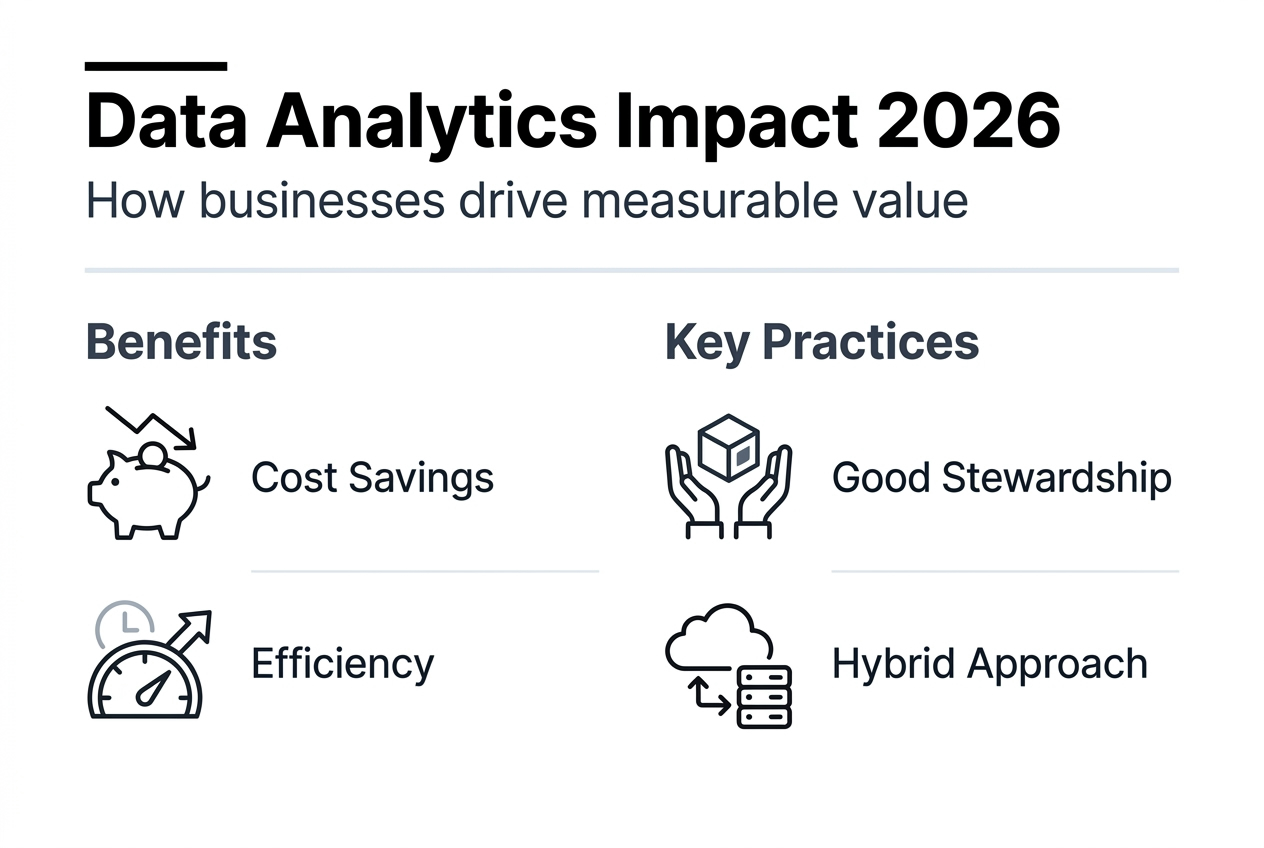
When integrated properly, data analytics becomes the engine of digital transformation impact for CIOs. It provides the feedback loop necessary to test assumptions, measure progress, and adjust course rapidly. Without this analytical foundation, digital transformation initiatives often drift aimlessly, consuming resources without delivering value.
Overcoming challenges and pitfalls in data analytics implementation
Despite its promise, analytics implementation faces significant obstacles that derail even well-funded initiatives. Understanding these challenges helps you proactively address them before they sabotage your investment.
The most critical barriers include:
-
Data quality issues: 64% of organizations cite data quality as their top challenge, with 77% rating their data quality as average or worse. Incomplete records, duplicates, and outdated information poison analytics models.
-
Inconsistent data definitions: When different departments define "customer" or "revenue" differently, analytics produces conflicting results that erode trust and decision-making confidence.
-
Biased or incomplete inputs: Missing offline engagement data or skewed samples lead to flawed conclusions that misguide strategy and waste resources.
-
Data leakage: Including information in models that would not be available at prediction time creates artificially inflated accuracy that fails in production.
-
Integration complexity: Legacy systems, siloed databases, and incompatible formats create technical debt that slows analytics deployment and increases costs.
-
Skills gaps: Shortage of data scientists, analysts, and engineers who can translate business problems into analytical solutions limits scalability.
Poor data stewardship cascades through your organization. Failed predictions damage credibility. Inaccurate forecasts lead to inventory shortages or excess. Biased models create regulatory risk and customer backlash. Resources spent on analytics without proper foundations deliver negative ROI.
Many analytics failures trace back to insufficient attention during digital transformation failure analysis phases. Organizations rush to deploy AI and machine learning without establishing data governance frameworks, quality standards, and change management processes.
Pro Tip: Conduct thorough data audits and establish organization-wide data definitions before launching analytics projects. Investing two weeks in data quality assessment can prevent months of rework and failed deployments.
Addressing these challenges requires commitment beyond technology. You need executive sponsorship, cross-functional alignment, and cultural shifts toward data literacy. A comprehensive digital transformation roadmap should explicitly address data foundations as a prerequisite for advanced analytics.
Leveraging modern data architectures and technologies for agile analytics
Traditional analytics architectures create bottlenecks that slow innovation. Centralized data warehouses require extensive coordination between business users, data engineers, and IT operations. Each new data source demands complex ETL pipelines, schema changes, and lengthy approval processes. This rigid structure cannot keep pace with modern business velocity.
Serverless data lake architectures offer a compelling alternative. These cloud-native platforms enable agile, self-service analytics that dramatically reduce time from question to insight. Key advantages include:
- Petabyte-scale storage that grows elastically with your data volumes without capacity planning
- Interactive query capabilities that let analysts explore data directly without waiting for IT to build reports
- Cost-effectiveness through pay-per-query pricing that eliminates idle infrastructure expenses
- Built-in security and governance that enforces access controls while enabling democratized data access
- Native integration with AI and machine learning services for advanced analytics
The contrast with legacy approaches is striking:
| Feature | Traditional Architecture | Serverless Data Lake |
|---|---|---|
| Setup Time | 3-6 months for infrastructure | Days to configure services |
| Scalability | Manual capacity planning required | Automatic elastic scaling |
| Cost Model | Fixed infrastructure costs | Pay only for usage |
| Data Onboarding | IT-dependent ETL pipelines | Self-service ingestion tools |
| Query Performance | Pre-aggregated views only | Interactive exploration of raw data |
Modern architectures support digital innovation concepts by reducing friction in the analytics lifecycle. Business analysts can prototype models rapidly. Data scientists can experiment with new algorithms without impacting production systems. Executives can access real-time dashboards without burdening IT resources.
Pro Tip: Adopt a hybrid approach that gradually migrates workloads to modern platforms while maintaining legacy systems for critical operations. This phased strategy balances innovation with stability and manages organizational change more effectively.
Serverless architectures particularly benefit organizations with diverse data sources, fluctuating workloads, and distributed teams. Cloud platforms handle infrastructure complexity, allowing your technical staff to focus on delivering business value rather than managing servers.

Applying data analytics for measurable business value and digital transformation success
Theory becomes compelling only when supported by concrete results. Real-world applications demonstrate how strategic analytics deployment delivers substantial ROI and competitive advantage.
Fuel Optimization in High-Mileage Fleets
High-mileage fleets achieved 22% fuel optimization, translating to $638,000 in annual savings through comprehensive data management. By integrating telematics, fuel card transactions, and maintenance records, fleet managers identified patterns invisible in siloed systems. Analytics revealed optimal refueling locations, detected fuel theft, and flagged inefficient driving behaviors.
Operational Efficiency Through Fuel Visibility
Centralized fuel visibility platforms improved operational efficiency by 25% and saved Crossroads Logistics $1.1M annually. Real-time dashboards provided transparency across distributed operations, enabling data-driven decisions about routing, vehicle utilization, and maintenance scheduling. The platform consolidated data from multiple sources into actionable intelligence accessible to managers at all levels.
Customer Retention Through Predictive Analytics
Predictive models for customer churn improved retention strategies by enabling proactive interventions. Rather than reacting to cancellations, companies identify at-risk customers weeks in advance based on engagement patterns, support interactions, and usage trends. Targeted retention campaigns increased lifetime value while reducing acquisition costs.
| Business Outcome | Analytics Technique | Key Benefits |
|---|---|---|
| $638K annual fuel savings | Telematics integration and pattern analysis | 22% optimization, theft detection |
| 25% efficiency gain | Centralized visibility dashboards | Real-time decisions, $1.1M savings |
| Improved retention | Predictive churn modeling | Proactive interventions, higher LTV |
These cases share common success factors that you can replicate:
- Define clear KPIs aligned with business objectives before building analytics capabilities
- Align cross-functional teams around shared metrics and incentives to ensure adoption
- Invest in data governance frameworks that maintain quality and accessibility
- Implement continuous monitoring to track model performance and adjust as conditions change
- Combine technology with process change rather than expecting analytics alone to transform outcomes
Organizations applying these principles consistently report measurable improvements within months. The key is connecting analytics investments directly to strategic priorities rather than pursuing technology for its own sake.
Sectors like healthcare demonstrate similar potential. Analytics in digital healthcare enables predictive diagnostics, population health management, and operational optimization that improve patient outcomes while reducing costs. The same analytical frameworks apply across industries with appropriate customization.
Sustainable digital transformation requires this marriage of technology, strategy, and organizational culture. Analytics provides the insights, but human judgment determines how those insights translate into action and value.
Unlock your analytics potential with YS Lootah Tech
Transforming data into strategic advantage requires more than good intentions. You need robust platforms that scale with your ambitions, intuitive interfaces that empower users, and integrated systems that eliminate friction. YS Lootah Tech delivers comprehensive application development services that build scalable analytics platforms tailored to your industry and objectives.
Our expert UX/UI design services ensure your analytics tools feature intuitive interfaces that drive adoption across technical and non-technical users. We understand that the most powerful insights remain useless if stakeholders cannot access and interpret them easily. Our website development services integrate analytics dashboards seamlessly into your enterprise ecosystem, providing secure, role-based access to the intelligence that drives decisions. Partnering with YS Lootah Tech accelerates your digital transformation journey by combining deep technical expertise with practical business understanding honed across diverse industries.
FAQ
What are the most common challenges in implementing data analytics successfully?
Data quality issues, inconsistent definitions across departments, and lack of skilled personnel represent the primary hurdles. Organizations report that 64% struggle with data quality, while integration complexity and skills gaps prevent scaling. Overcoming these requires strong governance frameworks, executive sponsorship, and ongoing investment in data management capabilities.
How does serverless data lake architecture benefit analytics initiatives?
Serverless data lakes provide scalable, cost-effective analytics pipelines that enable self-service data exploration without extensive IT coordination. They eliminate manual capacity planning, reduce infrastructure costs through pay-per-query pricing, and accelerate time to insight from months to days. This architecture particularly benefits organizations with diverse data sources and fluctuating analytical workloads.
What measurable business outcomes can data analytics deliver?
Companies report fuel savings exceeding $638,000 annually through telematics analytics and operational efficiency improvements of 25% from centralized visibility platforms. Customer retention models reduce churn by enabling proactive interventions weeks before cancellation. These results demonstrate that properly implemented analytics delivers multi-million dollar impact within months of deployment.
How long does it take to see ROI from data analytics investments?
Organizations with clear KPIs and strong data foundations typically see measurable improvements within 3 to 6 months of deployment. Quick wins like operational dashboards can deliver value in weeks, while advanced predictive models may require longer development cycles. The key is starting with high-impact use cases that align directly with strategic priorities rather than pursuing analytics broadly.
What skills are essential for building an effective analytics team?
Successful teams combine data engineers who build pipelines, analysts who translate business questions into analytical approaches, data scientists who develop predictive models, and business stakeholders who interpret results and drive adoption. Equally important are change management skills to foster data literacy and analytical culture across the organization beyond just technical capabilities.