What Is Digital Transformation—Impact for CIOs in 2026

Many CIOs in Dubai face growing pressure to move beyond basic digitization and deliver true transformation that reshapes organizational value. In a city driven by rapid change and global competition, staying ahead means more than just deploying new software or automating tasks. This article breaks down the difference between digitization, digital optimization, and real digital transformation, making it clear why structural change is the path to enhanced efficiency and customer engagement.
Table of Contents
- Digital Transformation Defined and Debunked
- What Digital Transformation Actually Involves
- Debunking Common Myths
- Core Pillars and Technologies for 2026
- Strategic Use Cases and Success Stories
- Risks, Pitfalls, and CIO Priorities
- Future-Ready Strategies for Ongoing Success
Key Takeaways
| Point | Details |
|---|---|
| Differentiating Digital Transformation | Digital transformation involves redesigning business models and internal processes using technology, differing from mere digitization, which only converts analog processes to digital formats. |
| Common Myths | Many misconceptions exist, such as believing complete system replacements are necessary or that transformation occurs quickly; in reality, it often takes years and combines legacy systems with new technologies. |
| Core Pillars for 2026 Success | Organizations must build adaptable infrastructures focused on sustainable intelligent ecosystems, empowered communities, and trust and security for successful digital transformation. |
| Measuring Success | Establish clear metrics tied to business outcomes and frequently assess progress to ensure alignment and drive continuous improvement throughout the transformation journey. |
Digital Transformation Defined and Debunked
Digital transformation means fundamentally restructuring how your organization operates using technology. It's not simply buying software or moving files to the cloud. Real transformation changes your business model, customer relationships, and internal processes at their core.
Many CIOs confuse digital transformation with digitization. Digitization converts analog processes into digital formats—scanning documents or automating a single workflow. Transformation goes deeper: it reimagines entire value chains and organizational structures.
Here's how digital transformation differs from digitization and digital optimization:
| Aspect | Digitization | Digital Optimization | Digital Transformation |
|---|---|---|---|
| Focus | Convert analog to digital | Improve existing processes | Redesign business model |
| Impact | Limited operational efficiency | Incremental gains | Structural competitive edge |
| Tools/Approach | Scanning, workflow automation | Tweaking legacy operations | Reimagining value chain |
| Leadership Requirement | Low | Medium | High, organization-wide |
What Digital Transformation Actually Involves
Digital transformation strategies serve as blueprints that guide organizations through fundamental change. These aren't one-size-fits-all templates. Your transformation roadmap must align with your unique business objectives, industry demands, and competitive position.
The key elements your CIO should address include:
- Process redesign: Eliminating redundant workflows and creating new operational pathways
- Technology enablement: Deploying tools that support new ways of working
- Cultural shift: Building organizational readiness for change
- Customer-centricity: Redesigning experiences around user needs
- Data-driven decision making: Establishing analytics foundations for informed choices
Dubai's competitive marketplace demands that mid to large enterprises move beyond incremental improvement. You need structural change that repositions your organization for the next five years.
Debunking Common Myths
Myth one: Digital transformation requires complete system replacement. Reality: Successful transformation often integrates legacy systems with modern solutions, preserving investments while unlocking new capabilities.
Myth two: Technology alone drives transformation. Reality: Organizational culture and process redesign matter more than any single tool. Your team must embrace new ways of working.
Myth three: Transformation happens quickly. Reality: True transformation typically requires 2-3 years minimum for mid-size enterprises. Expecting results overnight sets you up for failure.
Digital transformation reshapes fundamental business operations and value creation models, not just adding technology to existing processes.
What CIOs actually face: resistance from departments comfortable with legacy processes, budget constraints limiting investment scope, and talent shortages in key technical areas. These challenges are real, but addressable through strategic planning.
Your transformation strategy should develop a clear roadmap that aligns technology investments with measurable business outcomes. Without this alignment, you're spending money without direction.
Pro tip: Start your transformation by mapping current state processes and identifying 2-3 high-impact areas where digital change drives immediate business value—this builds momentum and stakeholder confidence for broader initiatives.
Core Pillars and Technologies for 2026
Three structural pillars will shape digital transformation success in 2026. Your organization must address sustainable intelligent ecosystems, empowered communities, and trust and security simultaneously. These aren't separate initiatives—they work together to create resilient business models.
Sustainable intelligent ecosystems mean building technology infrastructure that operates efficiently while scaling with your business. This includes optimizing energy consumption, reducing carbon footprint from data centers, and designing systems that adapt to changing market demands without constant overhauls.
Empowered communities focus on enabling employees and customers to participate in digital transformation. Your workforce needs the right tools, training, and autonomy to drive innovation. This creates competitive advantage in markets like Dubai where talent retention directly impacts growth.
Trust and security form the foundation for everything else. Without strong governance, encryption, and compliance frameworks, transformation efforts collapse under regulatory pressure or cyber threats.

Technologies Driving 2026 Success
Agentic AI systems operate autonomously to handle routine workflows, freeing your teams for strategic work. Unlike traditional automation, these systems learn and adapt to edge cases without constant human intervention.
Key technologies reshaping transformation include:
- Vertical AI: Industry-specific artificial intelligence tailored to healthcare, finance, retail, or manufacturing workflows
- Digital twins: Virtual replicas of physical systems enabling real-time monitoring and predictive optimization
- API-enabled data collaboration: Secure data sharing across departments and partner organizations
- Digital sovereignty strategies: Localized infrastructure ensuring data residency and compliance with regional regulations
- Quantum computing: Frontier technology solving complex optimization problems previously impossible
For CIOs in Dubai, digital sovereignty matters significantly. Data localization requirements and regional compliance frameworks demand infrastructure strategies that keep sensitive information within UAE borders while maintaining global capabilities.
The convergence of agentic AI, digital twins, and localized IT infrastructure creates faster innovation cycles, higher system resilience, and seamless scaling across your enterprise.
Pro tip: Begin by auditing your current technology stack against these 2026 pillars—identify which gaps create the most business friction, then prioritize pilot programs in those areas to build internal expertise before full-scale rollout.
Strategic Use Cases and Success Stories
Real transformation happens when organizations move beyond planning and execute with clarity. Successful cases share three common elements: transformational leadership, capability development, and measurable ROI tracking from day one.
Companies across industries prove that digital technologies drive innovation and competitive advantage. The difference between success and failure often comes down to how organizations integrate these technologies into their core business model rather than treating them as separate initiatives.
Industries Seeing Tangible Results
Retail organizations transformed customer experiences by combining AI-powered personalization with cloud infrastructure. When customers visit websites or physical stores, they encounter recommendations based on behavioral data—increasing conversion rates by up to 35% in documented cases.
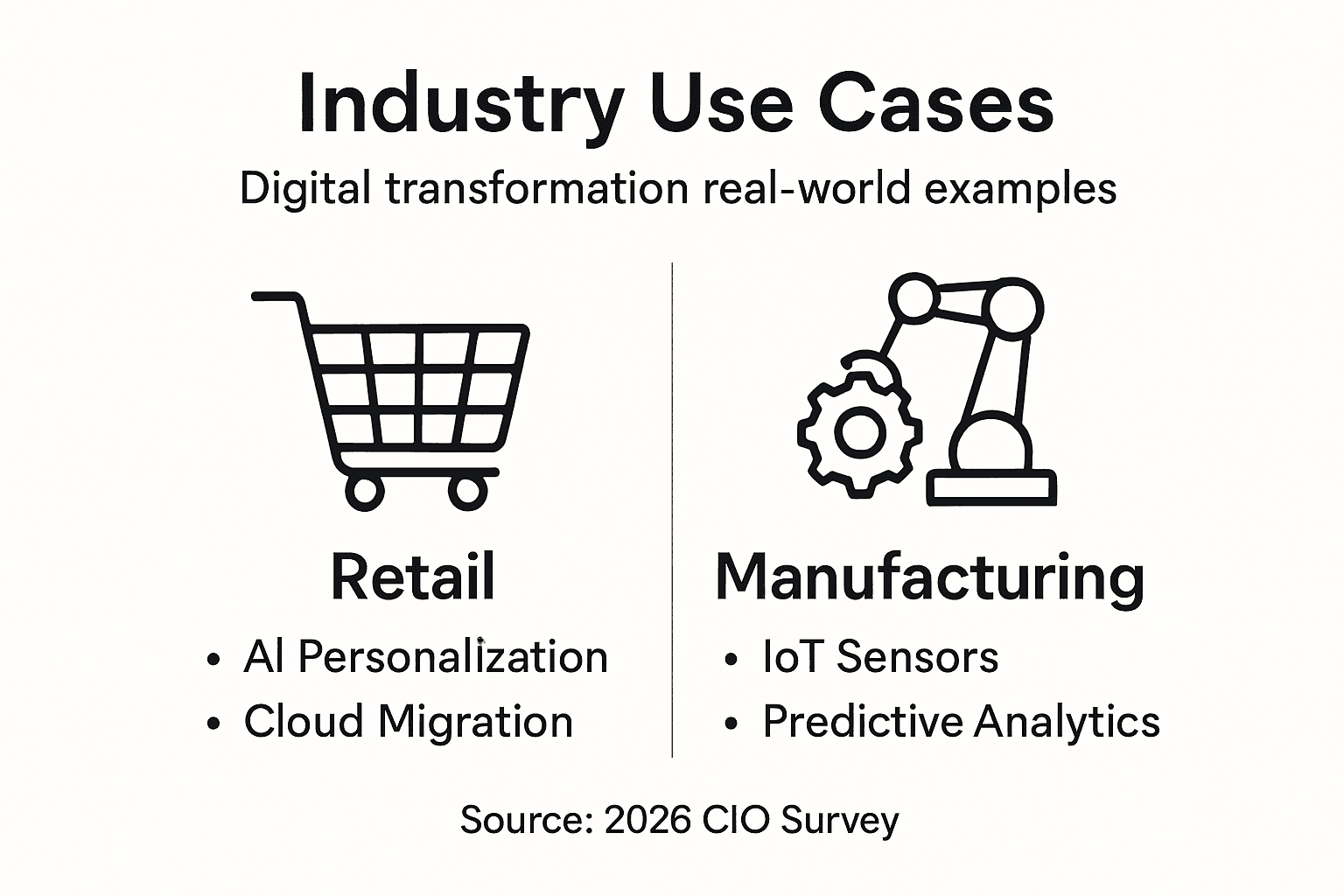
Manufacturing companies deployed IoT sensors and predictive analytics to shift from reactive maintenance to predictive maintenance. This reduces equipment downtime by 40-50% and extends asset lifespan significantly. Your maintenance budget stops funding emergency repairs and starts preventing failures.
Financial services firms leverage Big Data and AI to detect fraud patterns in real-time. These systems learn from millions of transactions, catching suspicious activity faster than human analysts while reducing false positives.
Below is a summary of how selected industries gain value from digital transformation initiatives:
| Industry | Main Solution Deployed | Key Result Achieved | Strategic Business Benefit |
|---|---|---|---|
| Retail | AI-driven personalization | 35% higher conversion rates | Enhanced customer experience |
| Manufacturing | IoT & predictive analytics | 40–50% less downtime | Reduced costs, longer asset life |
| Financial | Big Data & AI fraud detection | Faster risk response | Improved trust, fewer losses |
What Separates Winners From the Rest
Successful transformations share critical success factors:
- Clear ROI targets: Define measurable outcomes before implementation begins
- Executive sponsorship: CIO leadership must align with business strategy, not operate in isolation
- Phased implementation: Start with high-impact use cases, then scale
- Continuous capability building: Invest in team training alongside technology deployment
- Regular adaptation: Markets change; your transformation must evolve accordingly
Strategic integration of digital technologies into core business processes sustains competitiveness and drives innovation-related revenue growth across organizations globally.
Organizations in Dubai's competitive market gain advantage through faster implementation cycles. By adopting digital-first approaches, mid-market enterprises compete with larger competitors without matching their scale.
The Real Cost of Inaction
CIOs who delay transformation face increasing pressure. Companies moving faster capture market share, attract top talent, and build customer loyalty before competitors respond. Standing still accelerates competitive decline.
Pro tip: Select one high-visibility business problem—like customer acquisition cost or operational efficiency—implement a digital solution within 90 days, and measure results transparently to build organizational momentum for broader transformation.
Risks, Pitfalls, and CIO Priorities
Digital transformation carries real risks alongside opportunity. Many CIOs launch AI initiatives without clear ROI targets, burning budgets on experimentation that never delivers business value. This approach wastes resources and erodes stakeholder confidence in future technology investments.
Cybersecurity threats multiply as your organization expands its digital footprint. Every new system, API connection, and cloud service creates potential vulnerabilities. Attackers specifically target enterprises mid-transformation when security controls remain incomplete or fragmented.
Data governance failures plague organizations that deploy AI and analytics without establishing clear data ownership, quality standards, or access controls. Poor data governance cascades into compliance violations, regulatory fines, and eroded customer trust.
Common Pitfalls CIOs Must Avoid
These mistakes derail transformation initiatives repeatedly:
- Technology-first thinking: Deploying solutions before understanding business problems
- Siloed implementation: Building disconnected systems without integration strategy
- Insufficient change management: Ignoring workforce readiness and cultural resistance
- Unclear accountability: No one owns transformation outcomes or ROI metrics
- Underestimating complexity: Assuming rapid transformation without realistic timelines
Dubai's regulatory environment adds another layer. Digital sovereignty compliance requires data localization, strict governance, and infrastructure that keeps sensitive information within UAE borders. Organizations ignoring these requirements face penalties and operational disruption.
Your CIO Priorities for 2026
Focus your transformation efforts on outcomes that matter most. Start by defining what success looks like in measurable terms—revenue growth, cost reduction, customer satisfaction scores, or operational efficiency gains.
Align AI initiatives with business strategy. Every AI project must connect to organizational goals. Pilot programs should prove ROI before scaling to enterprise-wide deployment.
Strengthen your security posture. Embed cybersecurity into transformation planning, not as an afterthought. Build zero-trust architectures, implement comprehensive access controls, and conduct regular security audits.
Reorganize IT for agility. Traditional IT operating models can't keep pace with transformation speed. Restructure teams around business capabilities rather than technology silos.
CIOs must balance rapid innovation with manageable risk, ensuring transformation delivers measurable business value while maintaining security, compliance, and operational resilience.
Pro tip: Establish a transformation governance board with representatives from business, IT, security, and compliance—meet monthly to review ROI metrics, identify risks early, and course-correct before problems escalate into major issues.
Future-Ready Strategies for Ongoing Success
Transformation isn't a destination—it's a continuous journey. Organizations that treat digital change as a one-time project fall behind competitors who embed innovation into their culture. Your strategy must prioritize adaptability, learning, and human-centric design.
Transformational leadership combines technology expertise with business acumen and workforce management. As a CIO, you're not just deploying systems; you're reshaping how your organization thinks and operates. This requires blending strategic vision with operational excellence.
Building Adaptive Infrastructure
Future-ready organizations move beyond rigid systems toward modular, composable architectures. Your technology stack should support rapid reconfiguration as market demands shift. This means investing in cloud-native platforms, microservices, and API-driven integrations that allow quick adaptation.
AI-native architectures enable seamless physical-digital integration and behavior-driven digital redesign. Rather than bolting AI onto existing systems, design new systems around AI capabilities from the ground up.
Key infrastructure priorities include:
- Modular platforms: Build systems you can upgrade without disrupting operations
- API-first design: Enable rapid integration and data flow across departments
- Edge computing: Process data locally for faster response times and compliance
- Scalable databases: Support growth without architectural rewrites
- Security by design: Embed protection at every layer, not as an afterthought
Developing Your People Strategy
Technology investments fail without talented people to operate them. Foster lifelong learning in your IT organization. Offer training programs in AI, cloud technologies, and emerging platforms. Reward curiosity and experimentation.
Cross-department collaboration breaks down silos that slow innovation. When marketing, operations, and IT work together, transformation accelerates. Create forums where teams share learnings and build on each other's successes.
Successful digital transformation requires treating change as continuous, integrating AI into all customer touchpoints, and building organizational culture that embraces learning and experimentation.
Measuring and Adapting
Define clear metrics aligned with business outcomes. Track customer satisfaction, operational efficiency, revenue growth, and market share gains. Review these metrics monthly and adjust strategies based on what the data reveals.
What gets measured gets managed. When teams see how their work connects to business results, engagement and ownership increase dramatically.
Pro tip: Establish quarterly "transformation health checks" where you assess progress against metrics, celebrate wins, identify blockers, and adjust priorities—this keeps stakeholder alignment strong and prevents strategies from drifting off course.
Accelerate Your Digital Transformation Journey with YS Lootah Tech
Digital transformation is more than just adopting new technology. It demands a clear strategy that addresses process redesign, cultural shifts, and trust and security—challenges every CIO in Dubai faces today. If you are ready to overcome resistance, budget constraints, and infrastructure complexity while embracing AI-driven innovation and sustainable intelligent ecosystems, YS Lootah Tech offers tailored solutions perfectly aligned with your transformation goals.
Partner with YS Lootah Tech to harness our deep expertise in custom software development, AI integration, cloud computing, and cybersecurity. Our comprehensive digital transformation services help you build adaptive technologies and empowered teams ready for 2026 and beyond. Don’t let delayed action cost you market position. Explore how our strategic planning and ongoing support ensure measurable business outcomes by visiting YS Lootah Tech solutions. Start your transformation roadmap today to turn disruption into your greatest advantage.
Frequently Asked Questions
What are the key components of digital transformation?
Digital transformation includes process redesign, technology enablement, cultural shift, customer-centric experiences, and data-driven decision-making.
How does digital transformation differ from digitization?
Digitization focuses on converting analog processes to digital formats, while digital transformation reimagines entire business models and value chains, driving fundamental change.
What technologies are shaping digital transformation success through 2026?
Key technologies include vertical AI, digital twins, API-enabled data collaboration, digital sovereignty strategies, and quantum computing, all allowing organizations to innovate and adapt efficiently.
What are common pitfalls to avoid during digital transformation?
Common pitfalls include technology-first thinking, siloed implementation, insufficient change management, unclear accountability, and underestimating the complexity of transformation initiatives.