Driving Sustainability in Tech: UAE Enterprise Guide
TL;DR:
- Over 95% of UAE CTOs actively promote sustainability, but only 38% incorporate it into daily decisions.
- Implementing frameworks like GreenOps, AI-driven cloud management, and lifecycle practices can significantly reduce energy use and e-waste.
- Balancing pragmatic goals with measurable progress and cross-departmental support is key to effective digital sustainability.
Over 95% of CTOs in the UAE actively drive sustainability, yet only 38% factor it into everyday technology decisions. That gap is not a motivation problem. It is an execution problem. UAE enterprises face a unique convergence of regulatory pressure, extreme climate conditions, and rapidly scaling digital infrastructure, all demanding that sustainability move from boardroom ambition to operational reality. This guide is written for CTOs and sustainability officers who are ready to close that gap using data, proven frameworks, and UAE-specific digital strategies that actually work in practice.
Table of Contents
- Understanding sustainability in UAE enterprise tech
- Core strategies: From GreenOps to AI-driven optimization
- Tackling data and e-waste: Closing the operational gap
- Integrating sustainability into enterprise decision-making
- Perspective: Why digital sustainability demands pragmatism, not perfection
- Take your sustainability strategy to the next level
- Frequently asked questions
Key Takeaways
| Point | Details |
|---|---|
| Frameworks enable progress | GreenOps, AI optimization, and UAE-specific guidelines offer practical steps to make technology operations greener. |
| Data and e-waste are priorities | UAE enterprises can make outsized sustainability gains by reducing unused data and improving e-waste recycling. |
| Pragmatism is essential | Sustainability in tech requires balancing ambition with economics, efficiency, and UAE-specific constraints. |
| Leadership drives results | CTOs and sustainability officers who integrate sustainability into daily decisions create the most impact. |
Understanding sustainability in UAE enterprise tech
Sustainability in the context of UAE enterprise technology is not simply about solar panels or carbon offset credits. It means designing, operating, and retiring digital systems in ways that minimize energy consumption, reduce waste, and align with both regulatory expectations and long-term business resilience. For CTOs operating in the Gulf, the stakes are especially high.
The UAE's arid climate creates energy and water demands that far exceed global averages. Data centers require intensive cooling, desalinated water, and grid power heavily influenced by fossil fuels. These are not abstract concerns. They directly affect operating costs, regulatory risk, and reputational standing with international partners.
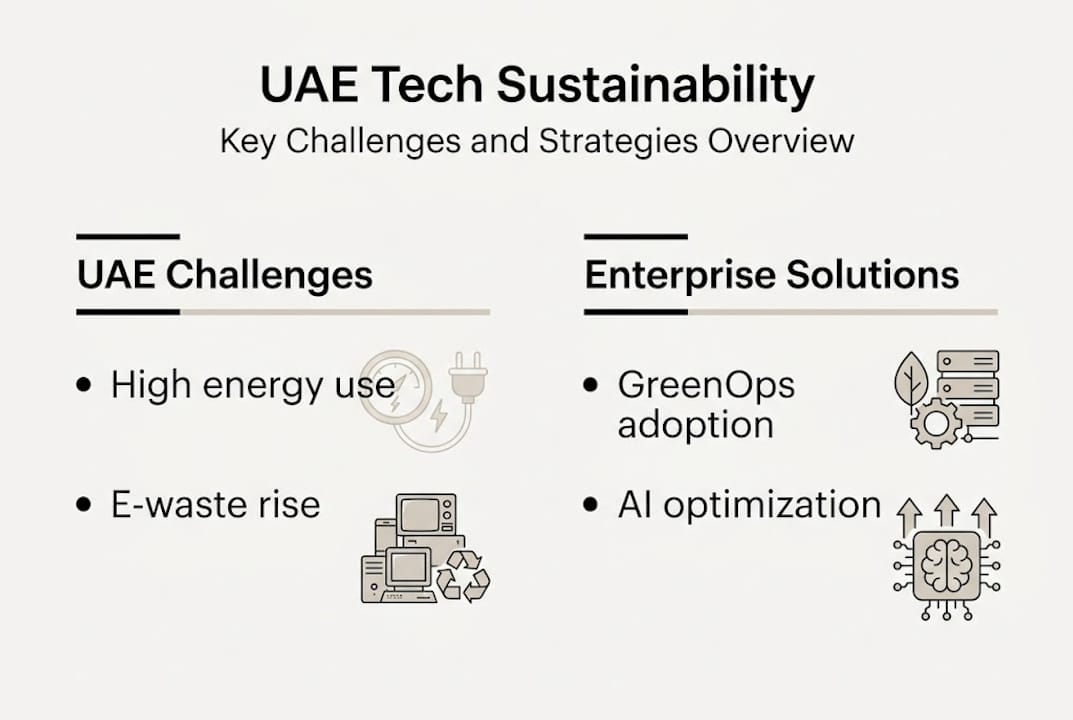
The government has responded with clear direction. The UAE Ministry of Finance's Sustainable Digital Services (IT) Guideline sets specific recommendations covering energy efficiency, renewable adoption, and responsible cloud use across public and aligned private sector entities. Reviewing the full UAE IT sustainability guidelines is a practical starting point for any enterprise building a compliance-ready sustainability strategy.
The numbers below reveal why action is urgent:
| Metric | UAE Figure |
|---|---|
| Annual e-waste generated | 162,000 tonnes |
| E-waste recycling rate | 30% |
| Cloud data that sits unused | 60% |
| CTOs embedding sustainability in R&D | 84% |
| CTOs applying it to daily decisions | 38% |
These figures expose an uncomfortable reality. Enormous waste accumulates at both the hardware and data layer, while decision-making processes remain largely disconnected from sustainability goals.
For enterprise tech leaders, the drivers to act are concrete:
- Regulation: Government guidelines increasingly shape procurement and vendor expectations.
- Cost efficiency: Energy and infrastructure savings directly impact the bottom line.
- Brand positioning: ESG credentials influence investor confidence and partnership opportunities.
- Risk mitigation: Non-compliance and reputational exposure from poor sustainability records carry measurable financial risk.
Building sustainability into your digital transformation strategies from the start is far cheaper than retrofitting it. And modernizing IT in UAE enterprises without a sustainability lens is increasingly a liability, not just a missed opportunity.
Core strategies: From GreenOps to AI-driven optimization
With the context established, the practical question becomes: which frameworks actually move the needle for UAE enterprises?
GreenOps, carbon APIs, AI-driven cloud management, and lifecycle thinking are the four approaches most relevant to enterprise tech leaders in this region. Each addresses a different layer of sustainability risk.
| Strategy | Description | Benefit | Challenge |
|---|---|---|---|
| GreenOps | Applies DevOps principles to energy and resource efficiency | Reduces operational footprint continuously | Requires cultural adoption across IT teams |
| Carbon APIs | Real-time carbon intensity data integrated into workload scheduling | Shifts compute to cleaner grid windows | Data availability varies by region |
| AI-driven cloud optimization | Machine learning manages dynamic resource allocation | Cuts idle capacity and energy waste | Upfront investment and skills gap |
| Lifecycle management | Governs devices from procurement through responsible retirement | Reduces e-waste and total cost of ownership | Complex vendor coordination |
Here is how to implement these at an enterprise level in the UAE:
- Audit your current infrastructure. Map every server, cloud instance, and endpoint device. You cannot optimize what you cannot see.
- Deploy GreenOps workflows. Assign energy efficiency KPIs alongside performance KPIs at the team level.
- Integrate carbon APIs. Tools like Electricity Maps allow workloads to shift to lower-carbon compute windows automatically.
- Apply AI optimization to cloud. Platforms with auto-scaling reduce idle resource consumption without sacrificing uptime.
- Formalize lifecycle management. Define procurement standards that include end-of-life plans before a device is ever purchased.
The UAE guidelines advocate lifecycle management and AI-powered resource optimization as foundational practices, not optional enhancements.
"Economic and strategic motives have overtaken pure ideology as the primary driver of sustainable technology decisions. CTOs who frame sustainability as a business discipline, not an environmental campaign, get faster organizational buy-in."
The data reinforces this. CTOs embed sustainability in R&D 84% of the time, but only 38% apply it to daily decisions, largely because operational data systems are not set up to surface sustainability signals in real time.
Pro Tip: Track carbon using granular metrics tied to specific workloads, applications, or business units, not just total spend. Aggregated numbers hide the specific inefficiencies that cost you the most.
For enterprises pursuing strategic digital efficiency, treating GreenOps for energy savings as an operational standard rather than a project initiative creates compounding returns over time.
Tackling data and e-waste: Closing the operational gap
Two sustainability pain points dwarf most others in UAE enterprises: data hoarding and device waste. Addressing both requires discipline and the right digital tools.
Data hoarding occurs when organizations accumulate data without active use or a defined retention policy. It is not just a storage cost problem. Every terabyte of dormant data still consumes power for storage systems, cooling, and backup processes. Across UAE enterprises, 60% of stored cloud data sits completely unused, driving up power consumption without delivering any business value.
AI and automation tools can analyze data usage patterns and flag redundant, obsolete, or trivial datasets for archiving or deletion. This directly reduces the power draw on storage infrastructure by up to 30%, a meaningful efficiency gain given UAE energy costs and cooling demands.
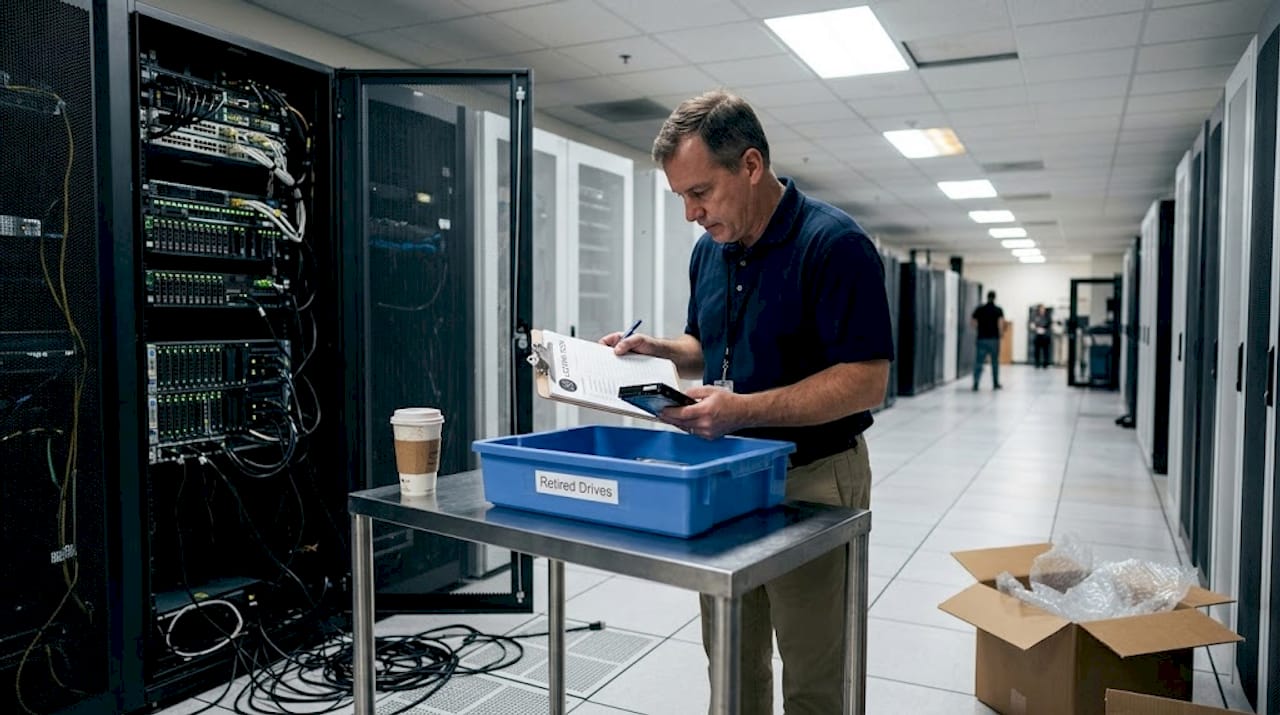
E-waste is the other critical front. The UAE generates 162,000 tonnes annually with only a 30% recycling rate. Barriers include limited certified recycling facilities, complex logistics for bulk hardware disposal, and organizational inertia around device refresh cycles. Policy frameworks are evolving, but enterprises cannot wait for full regulatory clarity to act.
Here is a practical action list for improving performance on both fronts:
- Conduct a cloud asset audit. Identify all active, idle, and orphaned cloud resources across your environment.
- Implement data lifecycle policies. Classify data at ingestion and define automated archiving or deletion timelines.
- Consolidate storage. Migrate fragmented storage environments to fewer, more efficient platforms.
- Partner with certified e-waste processors. Identify and contract UAE-based certified recyclers before your next hardware refresh.
- Track device lifecycles centrally. Maintain a register of all devices with procurement dates, expected end-of-life, and planned disposal routes.
Pro Tip: Map all your cloud assets before any optimization program begins. Organizations that skip this step consistently underestimate idle resource costs by 40% or more.
The cloud computing futures landscape in the UAE is moving toward intelligent, self-optimizing infrastructure. Staying aligned with cloud trends 2026 positions your enterprise to use these tools before competitors do.
Sustainability at this layer is not a technology challenge alone. It is a data discipline challenge. Organizations that treat data hygiene as a sustainability practice, not just an IT housekeeping task, create measurable reductions in both cost and environmental footprint.
Integrating sustainability into enterprise decision-making
Fixing high-impact technical issues is necessary but not sufficient. Lasting sustainability impact in UAE enterprises requires embedding green thinking into culture, process, and governance.
CTOs identify poor data quality as the primary barrier to sustainable AI adoption, even as 84% push for sustainability inclusion in R&D roadmaps. This reveals a structural problem: ambition outpaces the operational infrastructure needed to act on it.
Here is how to close that structural gap:
- Add sustainability criteria to vendor selection. Score suppliers on energy efficiency, e-waste policies, and carbon reporting alongside price and capability.
- Integrate sustainability KPIs into procurement approvals. No hardware or cloud service should be approved without an environmental impact assessment.
- Fix data quality at the source. Invest in data governance so that AI tools can actually surface actionable sustainability insights.
- Replace legacy infrastructure incrementally. Prioritize systems with the highest energy draw for modernization in each budget cycle.
- Appoint cross-functional sustainability leads. Sustainability cannot live only in the IT department. Finance, operations, and procurement must co-own outcomes.
Cross-departmental buy-in requires more than memos. Keys to genuine adoption include:
- Tying sustainability metrics to team performance reviews
- Sharing energy and waste reduction wins visibly across the organization
- Providing training on why sustainability decisions affect business financials directly
- Creating feedback loops so teams can report friction points in green practices
"AI's energy draw is real and growing. The pragmatic approach is not to avoid AI, but to ensure every AI deployment is measured against the efficiency gains it produces. Net positive impact is the standard."
For enterprises still managing complex hybrid environments, managed IT services UAE providers can operationalize sustainability monitoring without overburdening internal teams. IT support for sustainability at the infrastructure level ensures that green practices are maintained during incidents and change cycles, not just at launch. For organizations building new capabilities, sustainable app development practices embed efficiency from the code level up.
Perspective: Why digital sustainability demands pragmatism, not perfection
The most common mistake UAE tech leaders make is treating sustainability as a binary state: either your operations are green or they are not. That framing paralyzes action.
The UAE sits at a genuinely unique intersection. It is a hydrocarbon economy actively investing in renewables, a global logistics hub with massive data infrastructure, and a government pushing digital sustainability standards while pragmatically managing energy transition timelines. Digital leaders here balance hydrocarbons and renewables with a focus on maximum efficiency rather than theoretical zero-impact ideals.
That is exactly the right frame. Perfection is not the goal. Measurable progress is. Every percentage point of idle cloud capacity eliminated, every tonne of e-waste diverted to certified recyclers, and every AI workload shifted to a lower-carbon grid window adds up. The cloud benefits in Dubai context makes this especially clear: efficiency gains are financial gains in a high-cost, high-heat operating environment.
Economics drive sustainability faster than ideology. Frame your sustainability program as a cost reduction and risk management initiative, and you will secure budget and cross-functional support far more reliably than with environmental messaging alone. Take imperfect but measurable steps, track them rigorously, and build from there.
Take your sustainability strategy to the next level
Strategy without execution stays on the whiteboard. UAE enterprise leaders who are ready to operationalize sustainability need a technology partner that understands both the regional context and the digital tools required to deliver real outcomes.
At YS Lootah Tech, we help UAE enterprises integrate AI and machine learning services for intelligent resource optimization, design enterprise app development solutions with sustainability built in from day one, and build cloud strategies that reduce waste while improving performance. From data hygiene programs to GreenOps implementation, our team translates sustainability frameworks into practical digital solutions. Explore our full range of digital sustainability solutions and connect with our team to start turning your sustainability ambitions into measurable results.
Frequently asked questions
What are the main sustainability challenges for UAE tech enterprises?
E-waste management, high volumes of unused cloud data, and the organizational barriers to embedding sustainability in daily operations are the three most significant challenges. The UAE generates 162,000 tonnes of e-waste annually and 60% of stored cloud data sits idle.
How can AI and cloud optimization improve sustainability?
AI-driven cloud management identifies idle and redundant resources in real time, enabling enterprises to cut power consumption on storage and compute infrastructure by up to 30% through smarter allocation and automated scaling.
What is GreenOps and how does it help UAE enterprises?
GreenOps applies the continuous improvement principles of DevOps to energy and resource efficiency, making sustainability a built-in operational standard. UAE guidelines advocate GreenOps and lifecycle management as core IT practices for reducing environmental impact.
Are UAE organizations required to use renewable energy for IT?
The UAE Ministry of Finance's guidelines strongly encourage renewables for IT infrastructure but stop short of imposing universal mandates; specific requirements vary depending on sector, entity type, and applicable regulatory frameworks.