B2B E-Commerce Platform Guide: UAE Firms' 2026 Path

TL;DR:
- UAE B2B buyers prefer self-service and digital workflows over traditional sales calls.
- B2B platforms must support complex pricing, multi-user roles, and compliance with UAE regulations.
- Successful rollout focuses on key workflows, mobile optimization, and iterative adoption measurement.
UAE B2B buyers are no longer willing to call a sales rep just to check inventory or place a bulk order. Across Dubai, Abu Dhabi, and beyond, procurement teams now expect the same digital convenience they get in their personal shopping lives. Yet 75% of buyers prefer self-service over talking to a sales rep, and most B2C-based platforms simply cannot deliver the workflows, pricing structures, and compliance features this demands. This guide walks you through identifying your real needs, pinpointing essential platform features, navigating UAE regulations, and executing a launch strategy that drives measurable adoption from day one.
Table of Contents
- Understanding B2B e-commerce needs vs. B2C: Why the difference matters
- Core capabilities of a successful B2B e-commerce platform
- Local compliance and scalability: Meeting UAE's regulatory and business demands
- How to select and launch your B2B e-commerce platform: A step-by-step UAE playbook
- Why most B2B e-commerce rollouts miss the mark—and how UAE firms can get it right
- Turn your B2B vision into a robust UAE e-commerce platform
- Frequently asked questions
Key Takeaways
| Point | Details |
|---|---|
| B2B ≠ B2C | B2B e-commerce demands specialized workflows, user roles, and pricing — generic B2C platforms rarely suffice in the UAE. |
| Compliance is critical | Your chosen platform must address UAE VAT, PDPL, and contract needs to secure business continuity. |
| Start small, measure impact | A focused launch for key accounts and features delivers faster success than overloading your platform at once. |
| Mobile-first and AI future | UAE buyers expect mobile solutions and will soon demand AI-driven personalization on B2B sites. |
Understanding B2B e-commerce needs vs. B2C: Why the difference matters
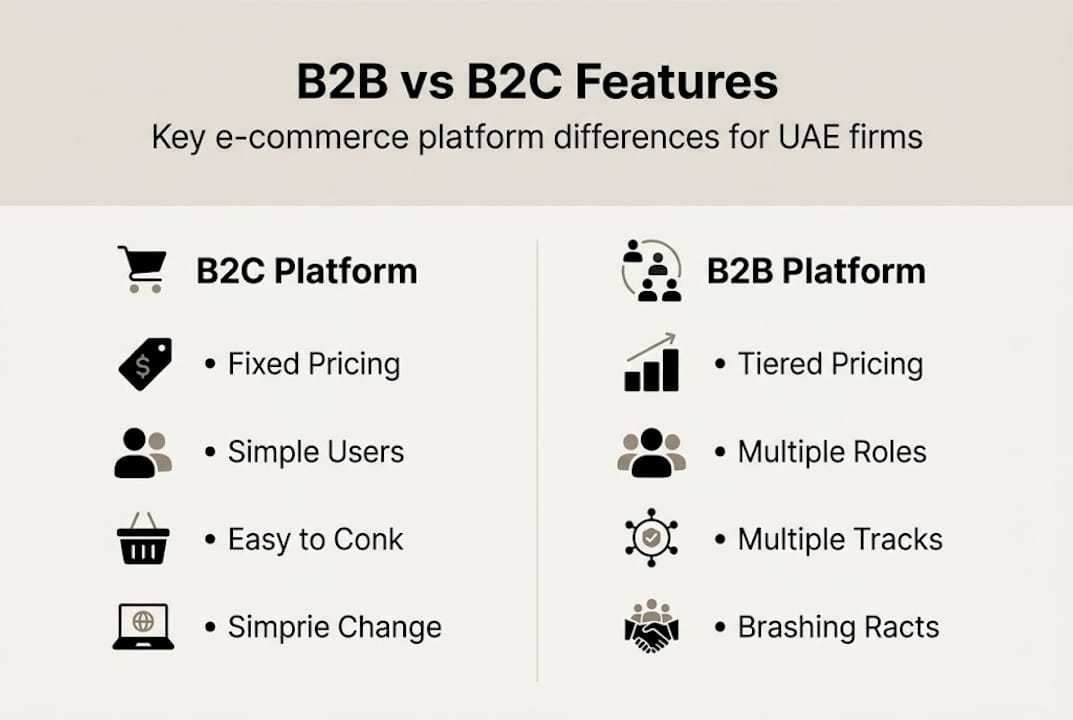
The gap between B2B and B2C e-commerce is wider than most decision-makers expect. A B2C platform is engineered for single buyers, impulse decisions, and standard pricing. A B2B transaction, by contrast, often involves multiple stakeholders, negotiated contracts, tiered pricing, and internal approval chains before a single order ships. Treating these two realities as similar is where most UAE digital projects start to unravel.
Consider the structural differences side by side:
| Feature area | B2C platform | B2B platform |
|---|---|---|
| Pricing | Fixed, public | Account-specific, tiered |
| User roles | Single buyer | Purchasers, approvers, admins |
| Order approval | None | Multi-step workflows |
| Payment terms | Immediate | Net 30/60, purchase orders |
| Catalog visibility | Public | Customer-specific |
B2C platforms fail B2B needs because they lack the role-based access, approval routing, and contract pricing visibility that large UAE buyers require. A procurement manager at a Dubai construction firm, for example, cannot operate effectively on a platform that treats every user the same way and posts one price for everyone.
Here is what is shifting fast in the UAE market right now:
- Self-service is no longer optional. Buyers expect to reorder, check order status, and download invoices without calling anyone.
- Complex catalogs are the norm. High-SKU environments with hundreds or thousands of products require structured navigation and search.
- Approval workflows protect compliance. Finance teams need visibility into who approved what before orders are processed.
- ERP and CRM integration is expected. Order data must sync directly into backend systems to avoid double entry.
The B2B technology trends shaping the UAE market reinforce this shift. Organizations that align their digital platforms with B2B-specific workflows reduce their cost-to-serve significantly, which is a direct impact on margin. The B2B growth frameworks that outperform in this region are built on platforms purpose-designed for business buying, not adapted from retail.
The bottom line: if you are running B2B operations on a B2C-oriented platform, you are fighting your own technology every single day.
Core capabilities of a successful B2B e-commerce platform
Knowing that B2B needs something different is one thing. Knowing exactly what features to look for is another. Core capabilities required for a competitive B2B e-commerce platform include account-based pricing, multiple user roles, real-time inventory visibility, saved carts, quote workflows, and deep ERP/CRM integrations. These are not nice-to-haves. They are baseline requirements for any UAE company expecting real ROI.
Here is how these features play out in practice. Imagine a mid-sized UAE distributor supplying industrial equipment across three Emirates. Their top accounts each have different negotiated prices, three or four internal buyers, and a finance controller who must approve all orders above a certain threshold. Without account-based pricing, every buyer sees the wrong number. Without role management, the controller cannot enforce approvals. Without ERP integration, the warehouse team is reconciling orders manually.
Beyond the baseline, several edge cases matter specifically for UAE businesses:
- EDI and punchout support for large government or enterprise buyers who operate procurement portals.
- Serialized inventory management for regulated goods where individual unit tracking is mandatory.
- High-SKU catalog architecture capable of handling catalogs of one million or more products without performance degradation.
- Multi-buyer approval trees that reflect real organizational hierarchies, not simplified two-step flows.
- Quote and negotiation workflows built into the platform, not bolted on through workarounds.
For businesses focused on resource-efficient distribution, principles similar to those behind energy-efficient B2B logistics apply here too: the right infrastructure reduces operational waste and improves long-term performance. Reviewing technology success factors for UAE businesses gives additional context for how platform capability aligns with business outcomes.

Pro Tip: Do not try to activate every feature at launch. Identify the top 20 to 30 accounts responsible for the majority of your reorder volume and configure the platform specifically around their workflows first. A clean, fast reorder experience for your best customers generates measurable adoption within weeks and builds internal confidence for a broader rollout.
Local compliance and scalability: Meeting UAE's regulatory and business demands
Once you have your feature list, the next filter is non-negotiable: the platform must operate within the UAE's legal and regulatory environment. This is where many internationally developed platforms stumble when deployed in the region without proper customization.
The compliance requirements UAE B2B companies face include VAT calculation and reporting, adherence to the Personal Data Protection Law (PDPL), contract pricing visibility controls, EDI and punchout compatibility for enterprise procurement, and high-SKU catalog management. Ignoring any one of these creates business risk that can surface during an audit or a failed enterprise onboarding.
Here is a breakdown of what each compliance area demands from your platform:
- VAT compliance: Automated VAT calculation on every transaction, correct invoice formatting, and export-ready reporting for Federal Tax Authority submissions.
- PDPL adherence: Data residency controls, user consent management, and access logs that meet the Middle East data security requirements now enforced across the region.
- Contract pricing visibility: Only show account-specific prices to authorized users, never exposing negotiated rates publicly.
- EDI and punchout: Direct integration with buyer procurement systems, which is essential for winning and keeping large accounts.
Failing to build compliance into your platform from day one is not a minor oversight. It is a structural liability that can block enterprise account onboarding, trigger regulatory penalties, and damage the trust you spent years building.
Scalability is the other dimension here. A platform that works for 500 SKUs and 50 accounts today must be able to handle 50,000 SKUs and 500 accounts in two years without a full rebuild. Choosing platforms designed for enterprise scale from the start, rather than patching growth on top of a lightweight solution, is a core principle behind sustainable digital transformation UAE programs. The enterprise app steps UAE companies follow for scalable deployments apply directly here.
Pro Tip: Choose a platform with modular compliance features that can be updated independently as UAE regulations evolve. This prevents a single regulatory change from triggering a full platform rewrite.
Aligning your platform selection with tech sustainability UAE standards also pays dividends, since government and enterprise buyers increasingly evaluate their suppliers on responsible technology practices.
How to select and launch your B2B e-commerce platform: A step-by-step UAE playbook
With requirements and compliance understood, execution comes down to a disciplined process. Here is the exact sequence we recommend for UAE B2B companies moving from evaluation to live platform.
- Needs assessment: Map your current buying journey, identify friction points, and document the specific workflows your top 50 accounts actually use.
- Feature mapping: Translate those workflows into a prioritized feature list. Separate must-haves from enhancements.
- Vendor evaluation: Score shortlisted platforms against your feature list and UAE compliance requirements. Request sandbox access, not just demos.
- Pilot launch: Go live with your top reorder accounts first. Measure adoption rate, error rate, and support ticket volume as your KPIs.
- Iterate and scale: Use pilot feedback to fix friction before expanding to your full account base.
One of the most practical decisions you will make is whether to build in-house, deploy an off-the-shelf solution, or work with a technology partner:
| Approach | Speed to launch | Customization | Compliance readiness | Cost |
|---|---|---|---|---|
| In-house build | Slow | High | Requires internal expertise | High upfront |
| Off-the-shelf | Fast | Low to medium | Variable | Lower upfront |
| Technology partner | Medium | High | Built-in for UAE | Balanced |
The UAE mobile-first reality is critical here: 70% of UAE B2B buyers use mobile devices to browse, reorder, and approve purchases. A platform that is not optimized for mobile will lose adoption before it even starts.
Pro Tip: Prioritize mobile-first features in your vendor scoring matrix. Test every workflow on a smartphone before signing any contract.
AI-driven personalization is also moving from experimental to expected. Platforms that surface relevant products, predict reorder timing, and adapt catalogs based on buyer behavior are already outperforming static experiences. Reviewing innovative tech strategies for 2026 shows how AI is reshaping buyer expectations. Building your digital roadmap around this trajectory now prevents a costly platform migration in two years. For a fuller picture of eCommerce benefits for UAE businesses, the data consistently points toward purpose-built platforms over retrofitted B2C tools.
Why most B2B e-commerce rollouts miss the mark—and how UAE firms can get it right
Here is the uncomfortable reality: most B2B e-commerce projects in the UAE do not fail because of bad technology. They fail because the launch was designed around a feature checklist rather than around user behavior.
Teams spend months configuring every capability the platform offers, then go live expecting adoption to follow automatically. It never does. Buyers return to email and phone calls because the new system feels unfamiliar, even if it is technically superior.
The organizations that succeed start narrow. They pick one high-value workflow, typically reordering, configure it perfectly for their best accounts, and measure everything. That early win builds internal credibility and gives the team real feedback to improve the experience before scaling.
Mobile experience and compliance also never take a back seat, regardless of launch phase. Cutting corners on either to speed up the timeline consistently creates larger problems downstream. The digital transformation pitfalls that derail UAE programs most often trace back to skipping these fundamentals in favor of launching fast.
Our position: measure adoption, not launch dates. A platform live for 90 days with 80% of target accounts actively ordering is worth far more than a feature-complete platform nobody uses.
Turn your B2B vision into a robust UAE e-commerce platform
Ready to put your B2B e-commerce strategy into action? Building a platform that handles UAE compliance, complex pricing, and high-volume catalogs while delivering a seamless buyer experience requires more than off-the-shelf software.
At YS Lootah Tech, we specialize in designing and building scalable, compliant B2B e-commerce platforms tailored to the UAE market. Whether you need a custom application development build or a high-performance website development for B2B operations, our team brings regional expertise and technical depth to every project. Contact us for a platform assessment and let us map the right solution to your specific business requirements.
Frequently asked questions
What are the critical features for a UAE B2B e-commerce platform?
Account-based pricing, multiple user roles, real-time inventory, and ERP/CRM integration are the foundational requirements. Quote workflows and saved cart functionality are also essential for high-volume UAE B2B operations.
How does UAE regulation impact B2B e-commerce platform selection?
UAE platforms must handle VAT and PDPL compliance natively, including contract pricing controls and EDI support. Platforms without these built-in capabilities create legal exposure and block enterprise account onboarding.
What is the most common mistake UAE companies make with B2B e-commerce?
Launching with too many features at once rather than focusing on reorders for top accounts is the most frequent failure point. Adoption, not feature count, is the real measure of success.
Why do B2C e-commerce platforms often fail UAE B2B companies?
B2C platforms lack approval workflows, custom contract pricing, and role-based access that B2B procurement teams rely on daily. These are structural gaps that cannot be patched with plugins or workarounds.