Start Digital Transformation UAE 2026: 65% Failure Cut

UAE businesses face mounting pressure to digitally transform amid rapid market evolution and government initiatives targeting a diversified economy. Yet complexity causes failure rates exceeding 65% when organizations lack structured approaches. This guide delivers a phased, practical roadmap aligned with UAE Vision 2021 and National AI Strategy 2031, enabling executives to confidently initiate transformation and achieve measurable success within 24 months.
Table of Contents
- Introduction To Digital Transformation In The UAE
- Prerequisites And Preparation Before Starting
- Step-By-Step Implementation Roadmap And Timelines
- Technology Stack And Smart Solutions Selection
- Managing Organizational Change: Culture, Talent, And Governance
- Common Mistakes And How To Avoid Them
- Measuring Progress And Expected Results
- Security, Privacy, And Regulatory Compliance
- How YS Lootah Tech Supports Your Digital Transformation Journey
- Frequently Asked Questions
Key Takeaways
| Point | Details |
|---|---|
| Phased Implementation | 24+ month staged approach reduces complexity and improves success rates significantly |
| Preparation First | Leadership mandate, governance model, and customer journey mapping establish foundation |
| UAE-Aligned Tech Stack | Cloud, AI automation, and zero-trust cybersecurity match market demands and regulations |
| Cultural Readiness | Talent development and change management drive adoption as critical as technology |
| Continuous Monitoring | Real-time KPI tracking ensures sustained value and enables agile course corrections |
Introduction to Digital Transformation in the UAE
The UAE government has invested heavily in digital infrastructure through Vision 2021 and National AI Strategy 2031 as key drivers of digital economy growth, targeting $96 billion GDP impact by 2030. These initiatives create both opportunities and competitive pressures for businesses across all sectors.
Businesses operating in the UAE now compete in an environment where government services save 530 million work hours annually through digital channels. Your customers expect the same efficiency from private sector partners. Companies that delay transformation risk losing market share to digitally native competitors and regional entrants leveraging advanced technology stacks.
Successful transformation requires alignment with national priorities while addressing your specific operational challenges. The most effective digital strategy tips for UAE leaders emphasize practical, staged implementation over disruptive wholesale change.
Key drivers pushing UAE businesses toward transformation include:
- Government mandate for digital service delivery across industries
- Customer expectations shaped by consumer technology experiences
- Operational cost pressures requiring automation and efficiency gains
- Competitive threats from digitally mature regional and global players
- Access to cloud infrastructure and AI capabilities previously unavailable
The UAE digital transformation strategies landscape demonstrates that early adopters achieve measurable advantages in customer satisfaction, operational efficiency, and market positioning. Organizations that begin structured transformation now position themselves to capture these benefits through 2030 and beyond.
Prerequisites and Preparation Before Starting
Before launching transformation initiatives, you must establish organizational readiness and governance foundations. Rushing into technology selection without these prerequisites causes project delays, cost overruns, and employee resistance that derail even well-funded efforts.
Start by documenting transformation mandate with timelines and responsible decision-makers to ensure clear accountability. This mandate should specify which business outcomes matter most, typically customer experience improvements, operational cost reductions, or new revenue streams. Assign executive sponsors who will champion initiatives and remove obstacles.
Conduct a comprehensive inventory of existing systems, processes, and technology capabilities:
- List all business-critical applications with vendor details and integration points
- Rate each system's performance and alignment to current business needs
- Identify redundant tools and processes creating inefficiency
- Document technical debt requiring remediation before new implementations
Map complete customer journeys to highlight friction points and opportunities. Walk through each touchpoint from initial awareness through post-purchase support. Measure time spent, error rates, and customer satisfaction at each stage to quantify improvement potential.
Establish governance structures that clarify decision rights and escalation paths. Define steering committee membership, meeting cadence, and approval thresholds. Specify which decisions require board approval versus executive team sign-off. This prevents the ambiguity that stalls projects during implementation.
Pro Tip: Run practice sessions where executives present transformation rationale to skeptical stakeholders. This rehearsal builds confidence and refines messaging before formal communications.
Prepare your organization culturally by assessing change readiness. Survey employees about technology comfort levels, innovation appetite, and training needs. Address fears transparently about automation and job security. The best digital strategy tips for UAE leaders include early engagement with workforce representatives.
Talent planning must address UAE market realities including Emiratisation requirements and IT skills shortages. Identify capability gaps in data analytics, cloud architecture, and cybersecurity. Partner with universities and training providers to build internal expertise before implementation begins. Understanding digital transformation impact for CIOs helps prioritize skill development investments.
Step-by-Step Implementation Roadmap and Timelines
A phased, 24-month roadmap improves success by allowing gradual adoption, piloting, scaling, and optimization stages. This structured approach manages complexity while validating impact before committing full resources. Each phase builds on previous learnings to reduce risk and increase organizational capability.
Phase 1: Discover and Design (Months 0-3) focuses on assessment and strategy definition. Conduct detailed process mapping and technology audits. Define transformation vision aligned with business strategy. Set baseline KPIs for measuring progress. Select initial pilot areas with high impact potential and manageable scope.
Phase 2: Pilot and Prove (Months 3-9) tests selected initiatives in controlled environments. Implement chosen solutions with small user groups. Gather feedback and measure results against KPIs. Adjust approaches based on real-world performance. Document lessons learned and success stories for broader communication.
Phase 3: Scale and Integrate (Months 9-24) expands proven solutions across business units. Roll out technology platforms enterprise-wide with proper change management. Integrate new systems with existing infrastructure. Train employees on new tools and processes. Monitor adoption rates and provide ongoing support.
Phase 4: Optimize and Sustain (Months 24+) focuses on continuous improvement. Review KPIs regularly to identify optimization opportunities. Implement iterative enhancements based on user feedback. Stay current with technology evolution and market trends. Build innovation culture encouraging experimentation.
| Phase | Timeline | Key Activities | Expected Outcomes |
|---|---|---|---|
| Discover & Design | 0-3 months | Assessment, strategy, KPI definition | Clear roadmap and pilot selection |
| Pilot & Prove | 3-9 months | Limited rollout, testing, validation | Proven business case with metrics |
| Scale & Integrate | 9-24 months | Enterprise deployment, integration | Broad adoption and efficiency gains |
| Optimize & Sustain | 24+ months | Continuous improvement, innovation | Sustained competitive advantage |
The staged approach allows you to learn and adapt while maintaining business continuity. Early wins from pilot phases build momentum and justify continued investment. You avoid the common mistake of attempting too much simultaneously.
Pro Tip: Involve cross-functional teams from project inception to accelerate learning and reduce resistance during scaling phases.
Your digital transformation roadmap should include regular checkpoint reviews where steering committees assess progress and authorize next phase investments. This governance ensures alignment with evolving business priorities and market conditions. The phased digital transformation roadmap approach has proven most effective for UAE businesses managing complex legacy environments.
Technology Stack and Smart Solutions Selection
Cloud migration and AI adoption are critical pillars with 60% cloud adoption and $96B GDP impact by 2030 in UAE. Your technology choices must align with these market realities while addressing specific operational requirements and regulatory constraints.

Adopt cloud-first strategy emphasizing public cloud for standard workloads and hybrid models where data sovereignty or compliance requires local hosting. Cloud platforms provide scalability to handle growth without large capital investments. They enable rapid deployment of new capabilities and access to AI/ML services that would be prohibitively expensive to build internally.
AI-powered automation delivers measurable efficiency gains across operations. Robotic process automation (RPA) reduces repetitive task processing time by up to 40% in areas like order fulfillment, invoice processing, and customer onboarding. Machine learning models improve demand forecasting, fraud detection, and predictive maintenance. Natural language processing enhances customer service through intelligent chatbots.
Cybersecurity must incorporate zero-trust architectures combining identity access management and multi-factor authentication. AI-driven threat detection identifies anomalies in real-time, enabling faster response to potential breaches. This approach aligns with UAE regulatory expectations for data protection and operational resilience.
Leverage IoT and edge computing to enhance operational visibility. Connected sensors provide real-time data on equipment performance, inventory levels, and environmental conditions. Edge processing reduces latency for time-sensitive decisions while minimizing cloud data transfer costs.
| Approach | Benefits | UAE Context Considerations |
|---|---|---|
| Cloud-First | Scalability, cost efficiency, rapid deployment | Hybrid options for compliance, local data centers available |
| AI Automation | 40% efficiency gains, improved accuracy | Strong government support, growing talent pool |
| Zero-Trust Security | Enhanced protection, regulatory compliance | Mandated for critical sectors, insurance benefits |
| IoT & Edge | Real-time insights, operational optimization | Smart city initiatives create ecosystem support |
When evaluating vendors, prioritize those with proven UAE market experience and local support capabilities. Assess integration complexity with existing systems before committing. Start with platforms offering modular implementation allowing phased adoption rather than requiring wholesale replacement.
The best custom software solutions in UAE balance international best practices with local market understanding. Consider AI in digital transformation applications specific to your industry. Review UAE digital tech adoption trends to ensure your stack remains competitive through 2030.
Managing Organizational Change: Culture, Talent, and Governance
Leadership commitment and cross-functional governance foster sustained momentum during digital transformation. Technology enables change, but people determine whether transformation succeeds or stalls. Your approach to culture, talent development, and governance separates successful initiatives from expensive failures.
Secure visible leadership commitment beyond initial project approval. Executive sponsors must actively participate in steering committees, remove organizational obstacles, and communicate transformation importance regularly. Their involvement signals priority to the entire organization and accelerates decision-making.
Implement cross-functional governance bringing together business unit leaders, IT, finance, HR, and operations. This structure prevents siloed thinking and ensures solutions address enterprise needs rather than departmental preferences. Regular meetings maintain alignment and enable rapid course corrections.
Address UAE market talent realities through structured training and reskilling programs. Partner with local universities and international training providers to build capabilities in cloud architecture, data analytics, AI/ML, and cybersecurity. Create clear career paths showing how digital skills advance professional development.
Cultivate experimentation culture rewarding innovation and learning from failures. Celebrate teams that test new approaches even when initial results disappoint. Share lessons learned across the organization to accelerate collective capability building. This mindset shift takes time but proves essential for sustained transformation.
Pro Tip: Identify change champions in each business unit early and involve them in design decisions to build grassroots support and reduce resistance.
Address employee concerns transparently about automation impacts on roles. Communicate how transformation creates opportunities for higher-value work while acknowledging transition challenges. Provide support for employees whose roles change significantly, including retraining options and transition assistance.
Integrate Emiratisation policies into talent planning by identifying opportunities for UAE nationals in emerging technology roles. Develop partnerships with government programs supporting digital skills development. This alignment strengthens your transformation business case while meeting national priorities.
The most effective digital strategy tips emphasize that technology and people initiatives must advance together. Review leadership in digital transformation best practices to ensure your governance model supports rather than hinders progress.
Common Mistakes and How to Avoid Them
Underestimating complexity causes a 65% failure rate; cost overruns from legacy data issues and ignoring culture are frequent issues. Learning from common pitfalls helps you avoid expensive delays and disappointing results. Most failures stem from organizational rather than technical factors.
Underestimating organizational complexity leads to unrealistic timelines and budget assumptions. Avoid this by engaging leadership early in honest assessments of change readiness. Map stakeholder concerns and plan specific actions addressing each group's priorities. Allow sufficient time for consensus building before formal project launch.
Scope creep destroys project timelines and budgets when requirements expand without corresponding resource adjustments. Prevent this through detailed system audits and technology inventories completed during preparation phases. Document what's in scope and what's explicitly out of scope. Establish formal change control processes requiring steering committee approval for scope modifications.
Legacy data migration and integration challenges consume more time and resources than anticipated. Plan for data quality issues, missing documentation, and undocumented dependencies. Allocate dedicated resources for data cleansing and validation. Test integration points thoroughly before production cutover.
Cultural resistance emerges when employees perceive transformation as threatening their roles or expertise. Address this proactively through transparent communication about transformation rationale and benefits. Involve employees in design decisions where practical. Provide training and support helping people succeed in evolved roles.
Inadequate progress monitoring allows problems to compound before detection. Implement continuous KPI tracking with weekly or biweekly reviews during active implementation. Establish clear escalation triggers prompting steering committee intervention when metrics deviate from targets.
The most damaging mistake involves treating transformation as purely technology project rather than business change initiative. Technology enables new capabilities, but realizing benefits requires process redesign, role changes, and behavior shifts. Budget and plan for change management activities equal to technology implementation efforts.
Review common digital strategy pitfalls and learn how to avoid digital transformation mistakes through structured governance and realistic planning.
Measuring Progress and Expected Results
Continuous KPI monitoring and defined metrics reduce failure risk; UAE government digital initiatives save 530 million work hours annually. You must establish clear success measures before implementation begins and track them relentlessly throughout transformation.
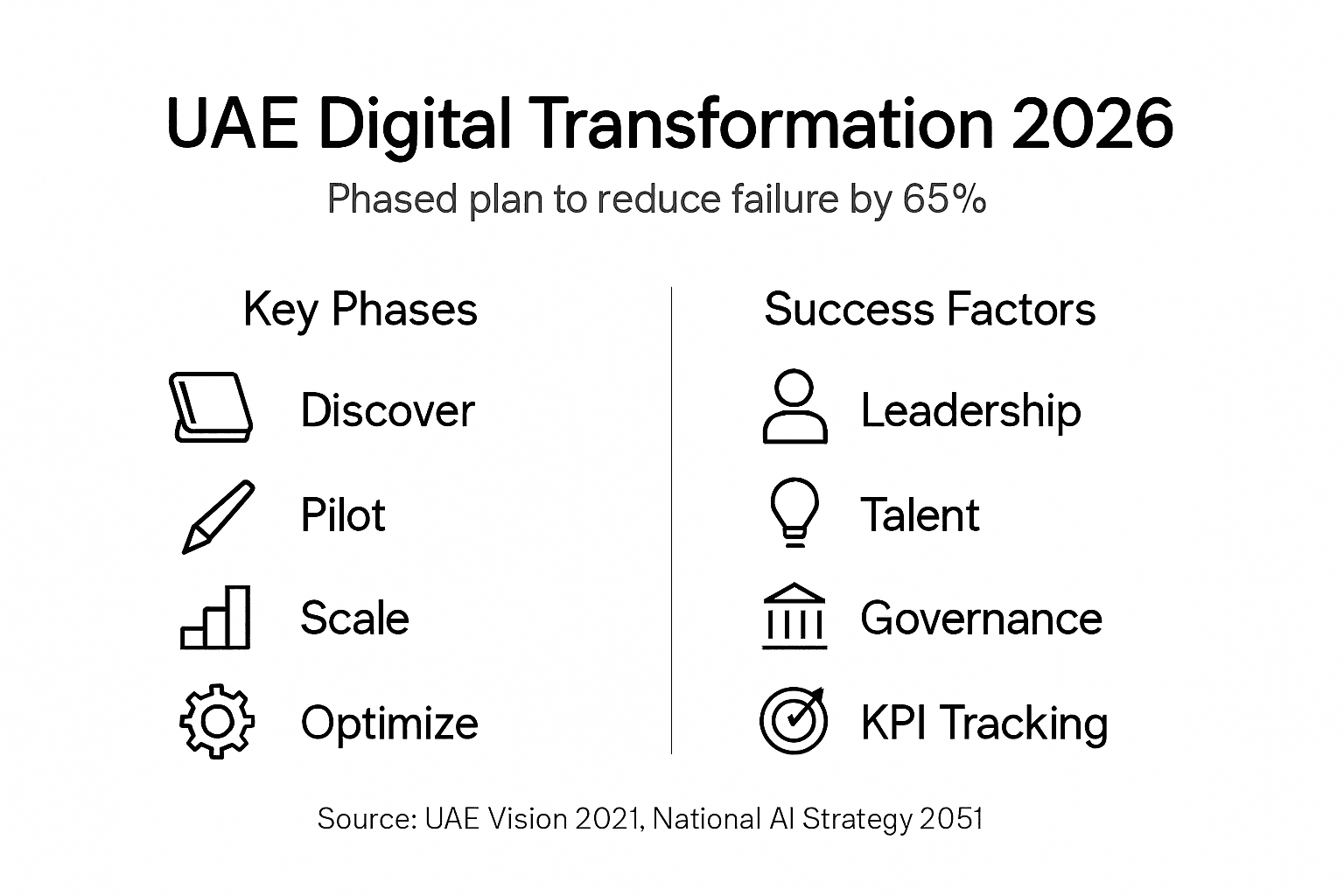
Define KPIs aligned to your stated transformation objectives across operational efficiency, customer satisfaction, and innovation dimensions. Operational metrics include process cycle time reductions, error rate decreases, and cost per transaction improvements. Customer metrics cover satisfaction scores, net promoter scores, and digital channel adoption rates. Innovation indicators track new capability launches and time to market for new offerings.
Track progress continuously using dashboards visible to steering committees and project teams. Weekly reviews during active implementation identify issues requiring immediate attention. Monthly executive reviews assess whether transformation delivers expected business value or requires course corrections.
Realistic improvement expectations based on UAE market experience include:
- 40% reduction in repetitive task processing through AI and RPA implementation
- 25-35% decrease in customer service response times via digital channels
- 15-20% operational cost reductions from process automation
- 20-30% improvement in employee productivity through better tools
| KPI Category | Measurement Method | Expected Improvement | Timeline |
|---|---|---|---|
| Process Efficiency | Cycle time, error rates | 30-40% reduction | 6-12 months |
| Customer Satisfaction | NPS, CSAT scores | 20-25% increase | 9-15 months |
| Operational Costs | Cost per transaction | 15-25% decrease | 12-18 months |
| Innovation Velocity | Time to market | 30-40% faster | 15-24 months |
Customer satisfaction improvements result from journey mapping and targeted friction reduction. Track specific journey stages separately to identify where digital solutions deliver greatest impact. Monitor digital channel adoption as leading indicator of customer acceptance.
Employee feedback provides critical cultural success indicators. Regular pulse surveys measure technology adoption, training effectiveness, and change readiness. Talent retention metrics show whether transformation creates opportunities people value or drives unwanted turnover.
Benchmark your progress against industry peers and regional competitors. Participate in industry forums sharing transformation experiences. This context helps assess whether your results meet market expectations or require acceleration.
Consult comprehensive digital transformation KPIs frameworks and review UAE digital program outcomes to calibrate your measurement approach.
Security, Privacy, and Regulatory Compliance
Zero-trust cybersecurity models with identity access management, multi-factor authentication, and AI threat detection are standard in UAE by 2026. Security and compliance cannot be afterthoughts bolted onto transformation initiatives. They must integrate from project inception to avoid costly rework and regulatory penalties.
Adopt zero-trust architecture assuming no user or system is inherently trustworthy. Implement identity access management (IAM) controlling who accesses which resources under what conditions. Require multi-factor authentication for all privileged access and sensitive data. These measures significantly reduce breach risk from compromised credentials.
Deploy AI-driven security analytics monitoring network traffic, user behavior, and system logs for anomalies indicating potential threats. Machine learning models identify attack patterns faster than manual review, enabling rapid response before damage occurs. Automated threat hunting reduces security team workload while improving detection rates.
Ensure compliance with UAE data protection laws governing personal information collection, storage, and processing. Sector-specific regulations apply additional requirements for healthcare, financial services, and critical infrastructure. Engage legal counsel reviewing transformation plans for regulatory alignment before implementation.
Integrate security considerations throughout solution design and development. Conduct threat modeling identifying potential vulnerabilities in proposed architectures. Perform security testing during pilot phases before scaling to production. This shift-left approach prevents the expensive security retrofits plaguing projects that treat security as final checkpoint.
Educate employees on cybersecurity hygiene as part of broader change management. Phishing and social engineering attacks target human vulnerabilities more than technical weaknesses. Regular training and simulated attacks build awareness and improve defensive behaviors.
Data sovereignty requirements may mandate local hosting for certain information types. Hybrid cloud architectures accommodate these constraints while maximizing cloud benefits for non-restricted workloads. Plan data classification and handling procedures addressing regulatory requirements upfront.
Stay current with evolving Dubai digital transformation cybersecurity trends as threat landscape and regulatory expectations advance through 2030.
How YS Lootah Tech Supports Your Digital Transformation Journey
Starting digital transformation requires expertise spanning strategy, technology, change management, and execution. YS Lootah Tech delivers comprehensive support helping UAE businesses move confidently from planning through successful implementation.
Our custom software solutions UAE address your specific operational challenges rather than forcing processes into generic platforms. We build applications integrating seamlessly with existing systems while providing modern user experiences your teams and customers expect.
Expert IT consulting services help align technology selection with your strategic roadmap. We assess current capabilities, identify gaps, and recommend solutions fitting your budget and timeline. Our consulting approach emphasizes practical implementation over theoretical frameworks.
Proven application development services deliver efficiency improvements up to 74% through custom digital solutions. We handle full lifecycle from requirements through deployment and ongoing support. Our UAE market experience ensures solutions meet local regulatory requirements and business practices.
Frequently Asked Questions
What is the first step to start digital transformation in my UAE business?
Begin by securing executive leadership commitment and defining a clear transformation mandate specifying outcomes, timelines, and accountable owners. Conduct comprehensive system inventory and customer journey mapping to identify highest-impact opportunities. These preparation activities establish the foundation for successful implementation.
How long does a typical digital transformation take to show results?
Phased transformation shows pilot results within 6-9 months demonstrating initial business impact and validating approach. Broader enterprise benefits typically emerge by 18-24 months as solutions scale across business units. Sustained competitive advantage requires ongoing optimization beyond initial implementation.
Which technologies should UAE businesses prioritize for transformation?
Prioritize cloud adoption enabling scalability and access to advanced capabilities, AI-powered automation reducing operational costs 30-40%, and robust cybersecurity implementing zero-trust models. These technologies align with UAE national strategies and deliver measurable ROI within 12-18 months.
How can we measure the success of our digital transformation efforts?
Define KPIs aligned to transformation objectives across efficiency, customer satisfaction, and innovation before implementation begins. Track metrics continuously through dashboards enabling weekly progress reviews and monthly steering committee assessments. Compare results against baseline measurements and industry benchmarks to validate impact.
What role do UAE government programs play in digital transformation?
Government programs significantly accelerate adoption by providing funding, training, and regulatory frameworks supporting transformation. Organizations leveraging these programs report 30% faster implementation timelines and access to talent development resources. Aligning initiatives with national strategies like Vision 2021 enhances stakeholder support and competitive positioning.