Build a Digital Transformation Roadmap for Enterprise Success

Every IT manager knows the pressure to modernize grows stronger as business demands and customer expectations evolve across the United Arab Emirates. Without clear insight into current systems and strategic priorities, digital transformation efforts often stall or miss their mark. This guide offers a practical blueprint built on the crucial concept of digital maturity models to help you assess readiness, set goals, and select solutions that genuinely drive operational efficiency and better customer engagement.
Table of Contents
- Step 1: Assess Current Technology And Business Needs
- Step 2: Define Strategic Goals And Digital Priorities
- Step 3: Select Suitable Technologies And Solutions
- Step 4: Implement Changes And Monitor Progress
- Step 5: Validate Outcomes And Optimize Your Roadmap
Quick Summary
| Key Insight | Explanation |
|---|---|
| 1. Assess current technology | Document your technology stack and identify performance gaps to align with business goals effectively. |
| 2. Define strategic goals clearly | Establish specific, measurable objectives to drive digital transformation and ensure team alignment. |
| 3. Choose technology wisely | Select solutions based on strategic alignment, integration capability, and total cost of ownership. |
| 4. Focus on implementation | Use a phased rollout, assign responsibilities, and monitor key metrics to ensure ongoing progress. |
| 5. Validate and optimize outcomes | Measure actual results against goals and continuously adapt your roadmap based on feedback and performance. |
Step 1: Assess current technology and business needs
Before you can move forward, you need a clear picture of where your organization stands today. This means understanding your existing technology infrastructure, identifying capability gaps, and aligning them with your business goals.
Start by documenting your current technology stack. List all systems, applications, databases, and hardware your teams rely on daily. Include legacy systems that handle critical operations, even if they feel outdated.
Next, evaluate the performance and limitations of each system:
- Uptime and reliability: How often do systems fail or require maintenance?
- Integration capabilities: Can systems communicate with each other, or do teams manually move data between platforms?
- User satisfaction: What frustrations do employees encounter daily?
- Security and compliance: Do current systems meet regulatory requirements for your industry?
- Scalability: Can infrastructure handle growth without major upgrades?
Now assess your team's technical readiness. Digital maturity models help measure your organization's capabilities across dimensions like strategy, governance, and technology. Honest assessment here prevents unrealistic timelines later.
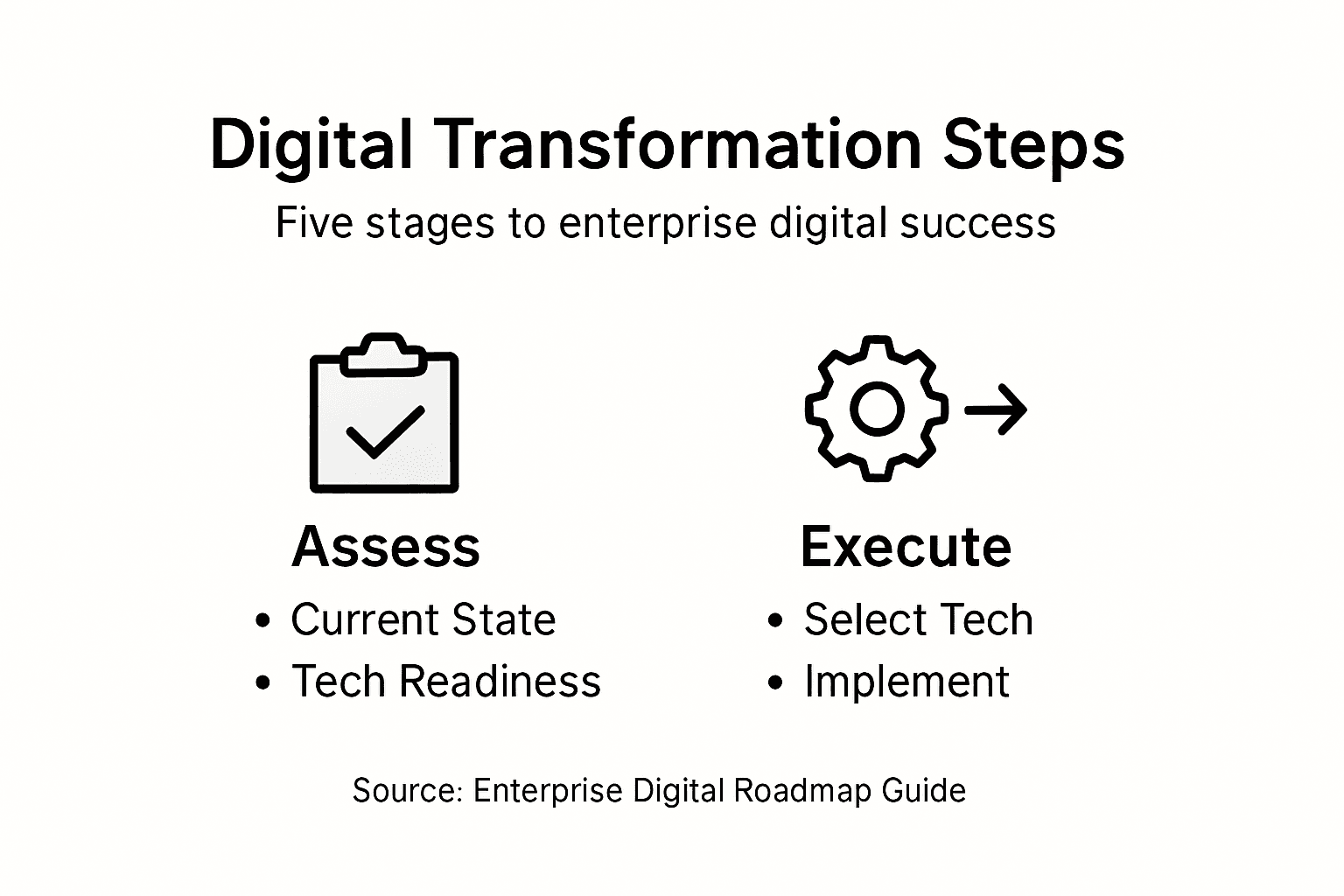
Talk to stakeholders across departments. Sales teams understand customer pain points. Operations knows workflow bottlenecks. Finance sees cost inefficiencies. Each perspective reveals transformation priorities that technology alone cannot uncover.
Document your business objectives clearly. Are you reducing costs, improving customer experience, accelerating time-to-market, or increasing operational efficiency? Different goals require different transformation approaches. A company pursuing cost reduction may prioritize cloud migration, while one focused on customer experience invests in AI and personalization.
Alignment between technology assessment and business goals determines whether your roadmap succeeds or becomes shelved.
Identify gaps between current capabilities and where you need to be in 12, 24, and 36 months. These gaps become your transformation priorities.
Here is a summary of how to assess critical systems and highlight transformation priorities:
| System Component | Current Limitation | Impact on Business | Priority for Upgrade |
|---|---|---|---|
| Order Processing | Manual data entry needed | Delays fulfillment | High, for automation |
| Customer Database | Poor integration | Frustrates support | High, for integration |
| Analytics Platform | Limited scalability | Hinders insights | Medium, for future growth |
| Legacy ERP System | Frequent downtime | Interrupts workflow | High, for reliability |
Pro tip: Create a simple spreadsheet showing each critical system's current state (reliability rating 1-5, integration capability, age, annual costs) and desired future state. This visual comparison makes priorities obvious and gives you concrete data for executive conversations.
Step 2: Define strategic goals and digital priorities
With a clear understanding of where you stand, you can now articulate where you want to go. Defining strategic goals transforms your transformation from a technology project into a business initiative with measurable outcomes.
Start by writing your digital vision statement. This is not a technical statement. Instead, describe the business outcomes you want to achieve in 3 to 5 years. Do you want to become the fastest responder in your market? Reduce operational costs by 40 percent? Create personalized customer experiences at scale? Your vision anchors every decision that follows.
Next, break your vision into specific, measurable goals. Specific strategic goals must be tied to key performance indicators so you can track progress and ensure alignment with overall company strategy. Vague goals like "improve efficiency" lead nowhere. Instead, commit to concrete targets.
Consider these goal categories as you prioritize:
- Customer experience: Reduce response time, increase personalization, improve satisfaction scores
- Operational efficiency: Lower process costs, automate manual tasks, reduce errors
- Revenue growth: Enable new business models, expand market reach, accelerate time-to-market
- Risk and compliance: Meet regulatory requirements, strengthen cybersecurity, improve data governance
- Employee enablement: Equip teams with better tools, reduce friction, improve job satisfaction
Now rank your priorities. You cannot do everything at once, and attempting to will dilute your resources. Evaluate each potential initiative using impact and feasibility. High impact and high feasibility projects go first. These early wins build momentum and organizational confidence.
Align your digital priorities with business outcomes. Too many organizations prioritize technology initiatives that sound impressive but don't drive business results. Ask yourself: Does this directly improve customer experience, reduce costs, or enable growth?
Digital priorities that lack clear business outcomes become vanity projects that drain budgets without delivering value.
Communicate your goals relentlessly. Share them with leadership, department heads, and frontline teams. When people understand the destination, they make better decisions about the path forward.
Pro tip: Use a simple matrix with initiatives across the top and your three to five strategic goals down the left side. Mark how each initiative supports each goal. This visual tool clarifies which projects truly matter and helps you cut initiatives that scatter your focus.
Step 3: Select suitable technologies and solutions
Now that you know your goals and priorities, you need to choose the right technologies to achieve them. Technology selection is not about picking the latest tools or what competitors use. It is about finding solutions that align with your strategic priorities and organizational context.
Start by evaluating your technology options against your specific needs. Create a comparison matrix listing potential solutions across columns and evaluation criteria down the rows. Consider these factors as you assess each option:
- Strategic alignment: Does this directly support your stated business goals?
- Integration capability: Will it work with existing systems or require costly rewrites?
- Scalability: Can it grow with your organization over the next 3 to 5 years?
- Total cost of ownership: Include licensing, implementation, training, and ongoing support.
- Vendor stability: Is the provider financially secure and committed to the market?
- Implementation timeline: How quickly can you deploy and realize value?
- Skill availability: Can you find talent to implement and maintain this solution?
Use technology evaluation methodologies that consider your organizational context, capability requirements, and innovation potential to ensure chosen solutions maximize business value. This structured approach prevents emotional decisions based on marketing hype.
Prioritize best-of-breed solutions over monolithic platforms. Modern enterprises succeed with modular solutions that integrate cleanly rather than forcing everything into one massive system. Cloud-based software-as-a-service options often provide flexibility and lower upfront costs than on-premises alternatives.
Involve your IT team early. The people who will implement and support these technologies must have input on selection. Their frontline insights often reveal deal-breaker issues that executives miss during vendor demonstrations.
Selecting technology without understanding your organizational readiness is like buying a sports car when you have no driver's license.
Request proof of concept demonstrations with your actual data and use cases. Vendor demos look perfect. Real-world testing reveals integration headaches, performance issues, and usability gaps that PowerPoint presentations hide.
Negotiate contracts carefully. Ensure service level agreements match your operational requirements and include penalties for underperformance. Lock in pricing terms and understand the true cost of switching vendors later.
Pro tip: Create a weighted scoring model where you assign importance percentages to each evaluation criterion, then score each technology option. This removes bias and gives you objective data for defending your selection decisions to leadership.
Step 4: Implement changes and monitor progress
Selection and planning mean nothing without execution. Implementation is where your roadmap becomes reality, and monitoring ensures you stay on track toward your goals.

Start with a phased rollout rather than a big bang approach. Deploy to a pilot group first, work through issues, then expand to wider audiences. This reduces risk and builds confidence across your organization as early wins accumulate.
Establish clear milestones and timelines. Break your transformation into manageable chunks with specific completion dates. Each milestone should deliver tangible business value so teams see progress and maintain momentum.
Assign clear ownership and accountability:
- Executive sponsor: Provides air cover and removes organizational barriers
- Project manager: Coordinates day-to-day execution and timeline management
- Technical lead: Oversees system configuration and integration
- Change manager: Prepares staff for new ways of working and manages resistance
- Department owners: Champion adoption within their teams
Regular performance evaluations and iterative adjustments keep your transformation aligned with business needs as circumstances evolve. Establish monthly review cycles where you assess progress against planned milestones, celebrate wins, and identify obstacles requiring leadership attention.
Track metrics that matter. Don't just monitor activity metrics like "systems deployed." Instead, focus on business outcomes. Are customer satisfaction scores improving? Have processing times decreased? Is staff productivity up? These outcomes prove transformation delivers value.
Communicate progress transparently. Share victories with the entire organization. When implementation hits snags, explain the issue and your corrective actions. Silence breeds uncertainty and fuels resistance.
Invest in training and support. New systems fail when people lack skills or confidence to use them. Provide hands-on training, create reference materials, and maintain a support desk during the critical early adoption phase.
Transformation success depends more on people accepting change than on technical perfection.
Stay flexible. Rigid adherence to original plans when circumstances change leads to expensive mistakes. Regularly reassess whether your chosen path still makes sense given market shifts, budget constraints, or technical discoveries.
Pro tip: Create a simple dashboard showing red, yellow, and green status indicators for each major workstream. Update it monthly and present it to leadership. This forces accountability, makes progress visible, and gives you early warning when initiatives drift off course.
Step 5: Validate outcomes and optimize your roadmap
Transformation does not end when systems go live. Real success comes from validating that your initiatives delivered the promised business outcomes and then continuously optimizing based on what you learn.
Measure results against your original objectives. Compare actual outcomes to the goals you set in Step 2. Did you reduce operational costs as planned? Are customer satisfaction scores higher? Is time-to-market faster? Honest assessment reveals which initiatives succeeded and which fell short.
Conduct a comprehensive post-implementation review for each major initiative:
- Business metrics: Compare actual results to planned targets and timelines
- User adoption rates: What percentage of intended users actively use new systems?
- Technical performance: Do systems meet uptime, speed, and reliability requirements?
- Budget performance: Did you spend what was budgeted, or did costs overrun?
- Stakeholder feedback: What do employees and customers say about the changes?
- Unintended consequences: What side effects or problems emerged that you didn't anticipate?
Continuous improvement through roadmap optimization based on performance metrics and stakeholder feedback ensures your transformation remains aligned with evolving business needs. Use this validation data to refine your approach for future initiatives.
The table below compares key post-implementation review metrics and their significance:
| Evaluation Metric | What to Measure | Why It Matters |
|---|---|---|
| Business Outcomes | Goal achievement, cost savings | Confirms value delivered |
| User Adoption | Active user percentage | Reveals acceptance and success |
| Technical Performance | Uptime, speed, reliability | Ensures ongoing stability |
| Budget Adherence | Planned vs. actual spend | Tracks financial control |
| Stakeholder Feedback | Employee and customer input | Surfaces hidden issues |
Identify what worked and what did not. Ask teams what accelerated success and what created friction. Document these lessons so subsequent transformation phases benefit from hard-won experience.
Adapt your roadmap based on results. Market conditions shift, technologies evolve, and organizational priorities change. Your roadmap should reflect this reality, not remain frozen in time. Build quarterly reviews into your governance where you reassess priorities and adjust timelines.
Invest in continuous learning. Digital transformation is not a destination you reach and then stop. It is an ongoing capability that requires your organization to regularly assess emerging technologies, evolving customer expectations, and competitive threats.
Transformation success gets measured in years, not months. Organizations that validate, optimize, and adapt outpace those that declare victory and move on.
Communicate results widely. Share successes to build momentum for future phases. Be transparent about challenges so the organization learns from them.
Pro tip: Build a transformation scorecard showing the original three to five strategic objectives, the metrics you will track, baseline values, targets, and actual results after 6 and 12 months. Update it quarterly and share it at all-hands meetings. This transparency keeps transformation visible and accountability alive.
Drive Your Digital Transformation with Expert Guidance from YS Lootah Tech
Building a clear and actionable digital transformation roadmap requires not only understanding your current technology gaps and strategic goals but also partnering with the right technology experts who can turn your vision into reality. Whether you are facing challenges in system integration, scalability, or aligning technology choices with business outcomes, YS Lootah Tech delivers tailored solutions that empower your organization to optimize operations, enhance customer experience, and accelerate growth.
Ready to overcome common transformation pain points like manual data entry, limited scalability, and lack of user adoption? Discover how our digital transformation services combine cutting-edge AI, cloud computing, and enterprise applications with expert consultation and ongoing support. Visit YS Lootah Tech today and start building a future-proof roadmap that aligns technology selection and implementation with your strategic priorities.
Frequently Asked Questions
What are the first steps to build a digital transformation roadmap?
Start by assessing your current technology and business needs. Document your existing technology stack and evaluate each system's performance and limitations to identify capability gaps.
How do I define strategic goals for digital transformation?
Define specific, measurable goals that align with your business objectives. Consider goals related to customer experience, operational efficiency, revenue growth, risk compliance, and employee enablement to focus your priorities effectively.
What should I consider when selecting technologies for digital transformation?
Evaluate technology options based on strategic alignment, integration capability, scalability, total cost of ownership, and vendor stability. Create a comparison matrix to assess how each potential solution supports your specific needs and goals.
How can I ensure successful implementation of digital transformation changes?
Adopt a phased rollout approach to minimize risk and build confidence. Assign clear ownership and responsibilities within your team, and establish milestones to track progress and ensure accountability.
What metrics should I track to validate the outcomes of digital transformation?
Focus on business outcomes such as customer satisfaction scores, operational costs, and user adoption rates. Measure these metrics against your original objectives to assess if the transformation delivers the expected value.
How can I optimize my digital transformation roadmap over time?
Conduct regular reviews to adapt the roadmap based on performance metrics and stakeholder feedback. Use quarterly assessments to refine priorities and adjust timelines as business needs and market conditions evolve.