What are smart solutions? Boost business efficiency now

TL;DR:
- Smart solutions combine AI IoT cloud data analytics and automation to improve business operations.
- They deliver benefits like increased productivity lower costs and enhanced customer engagement across industries.
- Successful implementation relies on addressing data quality, organizational change, and modular system design.
Productivity rising by 30% and costs falling by 25% sounds like a headline from a futuristic case study, but it describes what Siemens achieved by deploying smart factory solutions at scale. Yet most organizations still struggle to define what "smart solutions" actually means, let alone build a strategy around them. The term gets thrown around in boardrooms and vendor pitches without much precision. This guide cuts through that noise. We will clarify the definition, break down the core technologies, present real evidence of business impact, walk through how adoption works across industries, and address the challenges that trip up even well-funded teams.
Table of Contents
- Defining smart solutions and their core technologies
- Key benefits: Efficiency, cost savings, and customer engagement
- How smart solutions are implemented across industries
- Challenges and expert insights: Edge cases and modular architectures
- Why focusing on people and process beats technology alone
- Take the next step with tailored smart solutions
- Frequently asked questions
Key Takeaways
| Point | Details |
|---|---|
| Smart solutions explained | They combine advanced technologies to automate and optimize business processes. |
| Major benefits | Efficient operations, cost savings, and stronger customer engagement are proven outcomes. |
| Real-world adoption | Manufacturing, healthcare, and hospitality have all seen significant gains from smart solutions. |
| Success factors | Strategic planning and a focus on people and process are key for lasting impact. |
Defining smart solutions and their core technologies
A smart solution is not a single product or platform. It is a purposeful integration of multiple digital technologies working together to automate repetitive tasks, analyze data in real time, and continuously optimize how a business operates. The goal is always measurable improvement, whether that is faster cycle times, lower error rates, or better customer outcomes.
At the foundation of any smart solution, you will find a combination of these core technologies:
- Artificial intelligence (AI): Learns from historical data to predict outcomes, flag anomalies, and recommend actions without human prompting.
- Internet of Things (IoT): Physical devices and sensors that collect live operational data from machines, environments, and supply chains.
- Cloud computing: Scalable infrastructure that stores, processes, and shares data across teams and locations without expensive on-site hardware.
- Data analytics: Tools that transform raw data into patterns, trends, and actionable insights for decision-makers.
- Automation: Software or robotic systems that execute defined tasks consistently and at speed, freeing people for higher-value work.
As modern businesses discover, combining AI, IoT, cloud, automation, and data analytics creates efficiency gains that no single tool can deliver alone. The synergy matters. IoT sensors feed real-time data to analytics platforms, AI interprets that data to predict equipment failures, and automation triggers a maintenance order before a machine breaks down. Each layer amplifies the others.
Understanding these building blocks is also essential for digital solutions for growth planning, because organizations that skip the foundational clarity tend to invest in tools that do not connect. If you want a practical starting point, reviewing digital strategy basics before selecting any technology will save significant time and budget. The principle of digital innovation importance reinforces this: technology is only as valuable as the business problem it solves.
Pro Tip: Before selecting any technology, write down three specific operational problems you want to solve and the metric you will use to measure success. This discipline prevents expensive tool sprawl.
Key benefits: Efficiency, cost savings, and customer engagement
Once you understand what smart solutions are made of, the next question is straightforward: what do organizations actually get in return? The evidence is substantial.
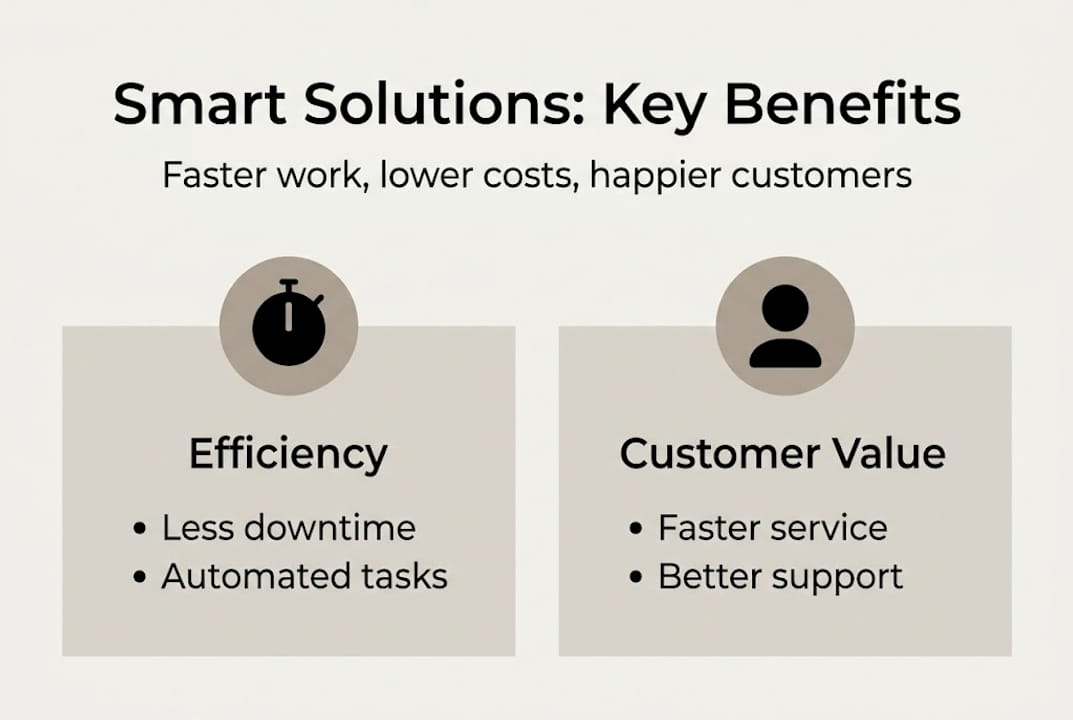
Siemens documented a 30% productivity increase and 25% lower operating costs after deploying smart factory technologies. Eaton achieved a 39% reduction in lead time and a 129% revenue increase using AI and digital twins at their Changzhou facility. These are not outliers. They reflect what happens when technology integration is done with clear goals and proper execution.
Here is how benefits break down across key sectors:
| Industry | Smart technology used | Primary benefit |
|---|---|---|
| Manufacturing | AI, digital twins, IoT | 30% productivity gain, 25% cost reduction |
| Logistics | Route optimization, IoT tracking | Faster delivery, lower fuel costs |
| Healthcare | Predictive analytics, wearables | Earlier diagnosis, reduced readmissions |
| Retail | Personalization engines, inventory AI | Higher conversion, less overstock |
| Hospitality | Digital ordering, CRM integration | Revenue lift, better guest experience |
The biggest benefit areas, summarized:
- Productivity: Automated workflows eliminate manual bottlenecks and reduce processing time.
- Revenue growth: Personalization and faster service directly increase sales and repeat business.
- Cost reduction: Predictive maintenance and optimized resource use cut waste significantly.
- Customer engagement: Real-time data enables personalized interactions that build loyalty.
For organizations developing tech strategies for leaders, these numbers make a compelling case for prioritizing smart solution investment. And if your focus is operational performance, the practical efficiency boost tips from teams already running these systems can accelerate your own results considerably.
How smart solutions are implemented across industries
Knowing the benefits is one thing. Understanding how organizations actually get there is where most planning conversations stall. Implementation is not a single event. It is a structured process that varies by industry but follows a recognizable pattern.
Here is how adoption looks across major sectors:
| Industry | Technology deployed | Key impact metric |
|---|---|---|
| Manufacturing | AI, robotics, digital twins | Lead time, defect rate |
| Healthcare | Predictive analytics, IoT devices | Patient outcomes, cost per case |
| Retail | Recommendation engines, RFID | Conversion rate, inventory turnover |
| Hospitality | Digital ordering, loyalty platforms | Revenue per guest, satisfaction score |
| Logistics | Route AI, real-time tracking | On-time delivery, fuel efficiency |
Restaurants are a useful case study in accessible adoption. Digital ordering tools have delivered 10 to 20% higher revenue for operators who implemented them, largely by reducing order errors and enabling upsell recommendations at the point of decision.
The standard implementation path follows four steps:
- Assess needs: Audit current processes, identify the highest-cost inefficiencies, and define success metrics before touching any technology.
- Select appropriate tech: Match technology capabilities to the specific problems identified. Avoid selecting platforms based on popularity alone.
- Integrate with operations: Connect new tools to existing systems, train staff, and run a controlled pilot before full deployment.
- Monitor and iterate: Use dashboards and KPIs to track results, identify gaps, and refine the solution continuously.
For healthcare organizations, digital healthcare analytics offers a sector-specific lens on how this plays out. Teams working on broader strategy can benefit from understanding big data for strategy and cloud computing trends to make informed infrastructure decisions.
Pro Tip: Study how a neighboring industry solved a similar problem. Manufacturing's approach to predictive maintenance, for example, translates directly to fleet management in logistics and equipment uptime in healthcare.
Challenges and expert insights: Edge cases and modular architectures
Every smart solution project eventually runs into friction. The most common source of failure is not the technology itself. It is the scenarios the technology was not designed to handle.

These are called edge cases: unusual data inputs, rare equipment behaviors, legacy system conflicts, or unexpected user actions that fall outside the training data a model was built on. As documented in a smart factory AI pipeline study, edge cases including unusual sensor readings, hardware failures, and legacy integration issues require robust design and active learning to manage reliably.
Key challenges organizations face during implementation:
- Data quality issues: Dirty, incomplete, or inconsistently formatted data undermines model accuracy from day one.
- Legacy system conflicts: Older infrastructure often lacks the APIs or data standards needed to connect with modern platforms.
- Drift over time: A model trained on last year's data may perform poorly as operational conditions change.
- Organizational resistance: Teams unfamiliar with new workflows slow adoption and generate workarounds that compromise system integrity.
- Scope creep: Expanding requirements mid-project inflate costs and delay delivery.
"Data preparation and cleaning consistently consumes 60 to 80 percent of a project team's time. That is not a problem to eliminate. It is a signal that your data strategy needs to be treated as a first-class deliverable, not an afterthought."
Expert teams address these risks through modular architectures, where each component of the solution operates independently but communicates through defined interfaces. This means a failure in one module does not cascade across the entire system. Simulation environments blended with real operational data help stress-test models against rare scenarios before they appear in production. Drift monitoring tools flag when a model's predictions start diverging from actual outcomes, triggering retraining cycles.
For organizations focused on maximizing business impact through analytics, treating data quality as a strategic asset rather than a technical chore is the single highest-leverage shift a leadership team can make.
Why focusing on people and process beats technology alone
Here is something most technology vendors will not tell you: the organizations that struggle most with smart solution adoption are rarely the ones with the wrong tools. They are the ones that underinvested in people and process readiness.
We have seen well-funded implementations stall because frontline staff did not understand why the new system existed, or because existing workflows were never redesigned to take advantage of automation. Technology sits on top of process. If the process is broken, automation makes broken things happen faster.
The most reliable outcomes come from a blended focus. Employee buy-in, built through transparent communication and genuine training, determines whether a solution gets used as designed or quietly abandoned. Iterative rollouts, starting small and expanding based on real feedback, reduce risk and build organizational confidence. Ongoing training ensures that as the technology evolves, the people operating it evolve with it.
A solid digital transformation roadmap puts people and process milestones alongside technology milestones. Organizations that treat these as equal priorities consistently outperform those that treat adoption as a purely technical exercise.
Take the next step with tailored smart solutions
This guide has covered the definition, the evidence, the implementation path, and the real challenges of deploying smart solutions. The next step is finding a partner who can translate that knowledge into a solution built specifically for your organization's context.
At YS Lootah Tech, we work with businesses across manufacturing, healthcare, retail, logistics, and more to design and build solutions that connect AI, IoT, cloud, and automation in ways that match your actual operational needs. Whether you are starting from scratch or modernizing an existing system, our custom application development and AI and machine learning services teams are equipped to move from strategy to deployment. Reach out to start a conversation about what smart solutions can do for your organization.
Frequently asked questions
What makes a solution 'smart' in a business context?
A solution qualifies as smart when it integrates digital technologies to automate, analyze, and optimize operations for measurable outcomes. Smart solutions combine AI, IoT, automation, and data analytics to produce tangible business gains.
Which industries benefit most from smart solutions?
Manufacturing, healthcare, retail, hospitality, and logistics see the clearest gains. Multiple industries including manufacturing and healthcare have documented significant improvements from smart technology integration.
What is an example of a smart solution in action?
Digital ordering platforms in restaurants have increased revenue by 10 to 20% by streamlining service and enabling personalized upsell recommendations at the point of order.
What is the biggest challenge in implementing smart solutions?
Handling edge cases and maintaining system reliability over time are the toughest hurdles. Edge cases including unusual data inputs and hardware failures require modular design and active learning to manage effectively.