What Is Digital Innovation and Why It Matters

Upgrading your software is only a small part of the digital innovation puzzle. For IT managers in healthcare and fintech, true change comes from rethinking how technology creates real value for patients or clients. With pressures to process claims faster, secure sensitive data, and improve experiences, understanding digital innovation as a holistic, adaptable strategy makes the difference between falling behind and staying ahead. This article defines what digital innovation really means and outlines the guiding principles mid-sized organizations need to succeed.
Table of Contents
- Defining Digital Innovation And Core Principles
- Key Types Of Digital Innovation Approaches
- Essential Technologies Driving Digital Change
- Strategic Applications In Healthcare And Fintech
- Major Risks, Challenges, And Best Practices
Key Takeaways
| Point | Details |
|---|---|
| Embrace Digital Innovation Mindset | Organizations must rethink how they create value through technology, moving from traditional upgrades to continuous adaptability. |
| Core Principles of Digital Transformation | User-centric design, iterative improvement, and cross-functional collaboration are essential for successful digital innovation. |
| Prioritize Technology with Skill Development | Focus on implementing technologies like AI and cloud computing, while simultaneously enhancing team skills necessary for utilizing these tools effectively. |
| Manage Risks Proactively | Address data privacy, skill gaps, and regulatory changes early in the implementation process to avoid costly disruptions later. |
Defining Digital Innovation and Core Principles
Digital innovation goes far beyond buying new software or upgrading hardware. It's about fundamentally reimagining how your organization creates value using technology. Digital innovation refers to the creation of new market offerings, business processes, or models resulting from the use of digital technology—and for IT managers in healthcare and fintech, this distinction matters enormously.
Think of it this way: your current system processes claims in five days. Digital innovation asks, "What if we redesigned the entire workflow using automation and AI to process them in five hours?" That's the mindset shift required.
What Makes Digital Innovation Different
Unlike traditional innovation, digital innovation demands something specific: adaptability. Your team can't treat new technology as a one-time implementation and move on. Healthcare compliance regulations change. Fintech security threats evolve constantly. Your digital solutions must evolve with them.
Core principles that guide successful digital innovation include:
- User-centric design: Start with actual problems your customers and staff face, not what technology vendors tell you to buy
- Iterative improvement: Launch minimum viable solutions, gather feedback, and improve continuously
- Data-driven decisions: Let usage patterns and outcomes guide strategy, not assumptions
- Cross-functional collaboration: Break silos between IT, clinical staff, finance, and compliance teams
- Scalability built in: Solutions must handle growth without complete overhauls later
Your healthcare organization needs digital innovation that respects patient privacy while improving access. Your fintech platform needs innovation that increases transaction speed while strengthening fraud detection. Generic approaches fail here.

The following table highlights how digital innovation distinctively impacts healthcare and fintech organizations:
| Aspect | Healthcare Example | Fintech Example |
|---|---|---|
| Speed Gains | AI reduces claims processing from days to hours | Loans approved nearly instantly by algorithms |
| Compliance Impact | Privacy requirements central to system design | Automated fraud checks built into workflows |
| User Experience | Telemedicine expands reach to rural patients | Mobile-first design for frictionless banking |
| Cost Efficiency | Automation lowers administrative expenses | Real-time settlements reduce overhead costs |
The Transformation Requirement
Here's what separates digital innovation from routine upgrades: it demands new skills and adaptability across your entire organization. Your team members need to think differently. Compliance officers need to understand automation risks. Developers need to grasp healthcare regulations. This skill gap exists in most mid-sized companies, and addressing it determines success or failure.
Digital innovation isn't a project with a completion date. It's an operating philosophy that shapes how your organization responds to market pressure, regulatory changes, and customer expectations year after year.
Digital innovation transforms not just your technology, but how your people work and what they're capable of delivering.
Key Principles to Guide Your Strategy
Four foundational principles anchor successful digital innovation:
- Customer outcomes matter more than technology adoption rates – Does the innovation reduce patient wait times or improve loan approval accuracy? That's what counts.
- Security and compliance are features, not obstacles – Build them into initial design rather than retrofitting later.
- Your team's capability determines what's possible – New technology sitting unused costs money and damages credibility.
- Speed and quality both matter – You can't sacrifice regulatory accuracy for faster deployment in healthcare or fintech.
IT managers who succeed with digital innovation treat it as strategic business capability, not a technical department responsibility. Your role becomes translating business challenges into technology opportunities.
Pro tip: Start your digital innovation journey by auditing current processes where compliance is tight but processes feel outdated—healthcare referrals or fintech onboarding workflows often reveal the highest-impact opportunities with acceptable risk profiles.
Key Types of Digital Innovation Approaches
Digital innovation isn't monolithic. Organizations pursue fundamentally different strategies based on their goals, industry constraints, and competitive position. Understanding these approaches helps you choose the right path for your healthcare system or fintech company.
Key types of digital innovation include new combinations of digital and physical components leading to novel products and services. This layered approach works because modern systems integrate hardware, software, content, and network layers—each requiring different expertise and investment.
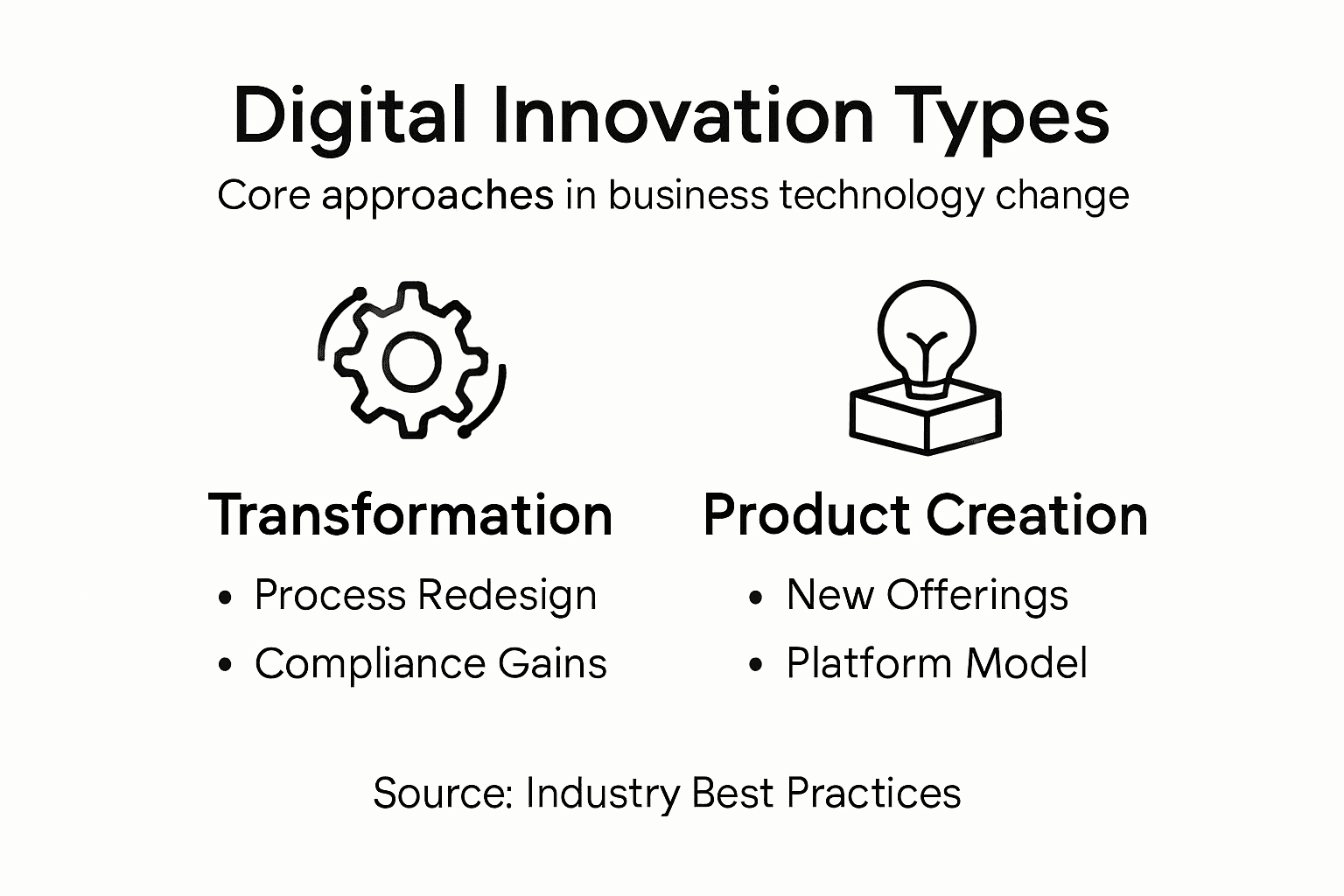
Three Core Approaches to Digital Innovation
Organizations typically follow one of three distinct paths:
-
Digital transformation: Automating existing processes using digital tools. Healthcare example: replacing paper charts with electronic health records. Fintech example: moving loan processing from manual underwriting to algorithmic scoring. The focus stays internal—improving efficiency and reducing costs.
-
Digital platform ecosystems: Creating interconnected digital environments where multiple players create value together. Healthcare example: building interoperable networks where clinics, hospitals, and specialists share patient data securely. Fintech example: open banking APIs that let third-party developers build lending applications on your infrastructure.
-
Foundational digital innovation: Reimagining your core business model through digital capabilities. Healthcare example: shifting from fee-for-service to value-based care supported entirely by digital monitoring and data analytics. Fintech example: moving from traditional banking to decentralized lending networks powered by blockchain.
Each approach demands different skills, technology investments, and organizational changes.
The Power of Recombination
What drives most successful digital innovation? Incessant recombination of existing digital and physical elements. Your healthcare organization doesn't need to invent AI; you recombine existing AI tools with your clinical workflows and patient data in ways competitors haven't.
This matters because digital innovation research distinguishes various approaches based on how they impact innovation activities and strategic capabilities. You're not starting from scratch—you're combining proven technologies in novel ways.
Consider a fintech example: combining mobile authentication, real-time settlement networks, and fraud detection algorithms creates a user experience competitors struggle to match. None of these are new individually. The innovation is the combination.
The most disruptive digital innovations often recombine existing capabilities in unexpected ways, not invent entirely new technologies.
Which Approach Fits Your Organization?
Your choice depends on three factors:
- Your current competitive position: Market leaders can afford platform ecosystems; challengers often start with transformation.
- Regulatory environment: Healthcare faces stricter constraints than fintech, limiting how radically you can innovate initially.
- Resource availability: Small teams succeed with transformation; building platforms requires 50+ people focused on the effort.
Most mid-sized organizations start with digital transformation to build organizational capability, then layer in platform thinking, then eventually pursue foundational innovation. Attempting foundational innovation first burns resources and fails.
Pro tip: Map your current state against these three approaches, identify which one solves your most painful operational problem, and commit fully to that approach for 18 months before evaluating the next phase.
Essential Technologies Driving Digital Change
Digital innovation doesn't happen in a vacuum. Specific technologies create the capabilities that transform how healthcare and fintech organizations operate. Understanding which technologies matter most for your situation separates strategic investments from expensive distractions.
Emerging technologies driving digital change include artificial intelligence, blockchain, IoT, and augmented reality, each solving different organizational challenges. AI handles pattern recognition in massive datasets. Blockchain creates transparent, immutable transaction records. IoT connects physical systems to digital networks. Each technology addresses distinct pain points in healthcare and fintech operations.
The Core Technology Stack
For mid-sized organizations, focus on these proven technologies first:
-
Artificial intelligence and machine learning: Predicts patient readmissions, detects fraudulent transactions, personalizes customer experiences. Healthcare: AI analyzes imaging data faster than radiologists. Fintech: algorithmic trading and credit risk assessment happen instantaneously.
-
Cloud computing: Eliminates infrastructure costs, enables global scalability, supports disaster recovery. Your healthcare network can share patient data securely across multiple facilities. Your fintech platform handles transaction spikes without capacity planning headaches.
-
Internet of Things: Connects medical devices, wearables, and infrastructure sensors. Healthcare: remote patient monitoring tracks vital signs continuously. Fintech: ATM networks, security systems, and payment terminals communicate in real-time.
-
Blockchain and distributed ledgers: Creates immutable records of transactions and ownership. Healthcare: supply chain tracking ensures medication authenticity. Fintech: settlement confirmation is instant and cryptographically verified.
These four technologies form the foundation most organizations build upon.
Here's a summary of how core digital technologies deliver value in healthcare and fintech:
| Technology | Healthcare Benefit | Fintech Benefit |
|---|---|---|
| AI & Machine Learning | Predicts readmissions and personalizes care | Assesses credit risk and detects fraud |
| Cloud Computing | Enables secure data sharing among clinics | Scales transaction handling seamlessly |
| IoT | Remotely monitors patient vitals | Manages real-time ATM and payment security |
| Blockchain | Tracks medication supply chain | Ensures instant, tamper-proof settlements |
Skills Matter as Much as Technology
Here's what most IT managers miss: technology alone changes nothing. Digital transformation skills frameworks highlight critical skillsets required for driving digital change, including digital work capabilities, entrepreneurship thinking, collaboration, and adaptability. Your team needs people who can work differently, not just people who can operate new software.
A healthcare system that implements AI but lacks staff trained to interpret algorithmic recommendations wastes the investment. A fintech platform with blockchain infrastructure but teams uncomfortable with rapid iteration stalls. Technology amplifies capability; it doesn't create it.
Technologies fail when organizations treat them as purchases instead of platforms requiring new skills and mindsets.
Prioritization Strategy
Which technologies should you adopt first? Consider this ranking:
- Cloud infrastructure: Enables everything else, reduces immediate costs, improves security posture
- AI and analytics: Directly solves operational pain points, shows ROI within 6-9 months
- IoT: Improves visibility and real-time decision-making in operations
- Blockchain: Valuable when you need cryptographic certainty or multi-party verification
Avoid the trap of chasing every new technology. Organizations that excel at digital innovation build depth with core technologies before expanding breadth.
Pro tip: Before selecting any technology, audit your team's current capabilities—picking technologies beyond your staff's ability to support guarantees expensive failure.
Strategic Applications in Healthcare and Fintech
Digital innovation creates measurable value only when applied strategically to solve real problems. Healthcare and fintech face distinct challenges, yet both sectors are discovering that similar digital approaches deliver competitive advantage and operational transformation.
Healthcare Digital Innovation
Digital innovation in healthcare leverages digital technologies and organizational frameworks to enhance managerial and administrative processes. This isn't about replacing doctors with algorithms. It's about freeing clinicians from administrative burden so they spend more time with patients.
Healthcare organizations apply digital innovation in these specific ways:
- Patient data systems: Electronic health records integrated across departments eliminate duplicate testing and improve care coordination
- Predictive analytics: AI identifies high-risk patients before crises occur, enabling preventive interventions
- Telemedicine platforms: Remote consultations expand care access to rural areas and reduce no-show rates
- Supply chain optimization: Real-time tracking prevents medication shortages and reduces waste
- Billing automation: Automated claim processing reduces revenue cycle time from weeks to days
The result? Patient outcomes improve while operational costs decline. Healthcare systems that invest in digital transformation frameworks see reduced readmission rates, improved staff retention, and stronger financial positions.
Fintech Digital Innovation
Fintech organizations face a different but equally pressing challenge: speed and accessibility. Fintech advances sustainable financial models by integrating innovation and technology, enabling enhanced affordability and access while reducing environmental impact through reduced physical infrastructure.
Fintech digital applications include:
- Mobile-first banking: Customers approve loans in minutes from smartphones instead of visiting branches
- Real-time settlement: Blockchain-based systems eliminate clearing delays, making cash available instantly
- AI-powered credit assessment: Alternative data sources assess creditworthiness for unbanked populations
- Automated compliance: Regulatory technology flags suspicious patterns before they become violations
- Personalized financial services: Machine learning creates customized investment recommendations and budgeting tools
The convergence? Both healthcare and fintech use similar technologies to solve different problems. Healthcare uses AI to predict patient needs. Fintech uses AI to predict customer behavior. Both leverage cloud infrastructure for scalability.
Digital innovation succeeds when it solves industry-specific problems, not when it chases technology for its own sake.
The Convergence Opportunity
Healthcare and fintech are increasingly intersecting. Health insurance companies use fintech strategies to approve claims faster. Fintech platforms develop healthcare lending products. Organizations excelling in one sector recognize digital patterns that apply to the other.
Your strategic advantage comes from applying proven digital approaches from parallel industries to your unique context. A healthcare system can learn from fintech's mobile-first architecture. A fintech company can learn from healthcare's patient-centric design thinking.
Pro tip: Before implementing any technology solution, identify which specific operational problem it solves and establish baseline metrics—this transforms expensive experiments into measurable investments with clear success criteria.
Major Risks, Challenges, and Best Practices
Digital innovation isn't risk-free. Organizations that underestimate challenges waste resources and damage credibility. Understanding the real obstacles lets you plan strategically instead of discovering problems mid-implementation.
The primary obstacles fall into four categories. Major challenges in adopting digital innovation involve privacy concerns, digital illiteracy, economic accessibility barriers, and insufficient supportive regulations. For healthcare IT managers, patient privacy violations trigger regulatory fines and reputation damage. For fintech leaders, security breaches mean customer funds disappear and trust evaporates. Both sectors face staff resistance when employees lack digital skills.
Critical Risks to Manage
These risks require specific attention:
-
Data privacy and security: Patient records and financial data attract cybercriminals. A single breach exposes thousands of people and costs millions to remediate. Healthcare faces HIPAA violations; fintech faces fraud liability and regulatory penalties.
-
Skill gaps in your organization: New technology demands new capabilities. Your operations team can't manage cloud infrastructure using on-premises mindsets. Your compliance officers need to understand algorithmic decision-making risks.
-
Legacy system integration: Older systems don't connect easily with modern platforms. Your healthcare system's 15-year-old billing software won't integrate with new patient engagement tools without custom development.
-
Regulatory uncertainty: Compliance rules change. AI governance frameworks barely exist in most jurisdictions. Healthcare regulators scrutinize algorithmic diagnosis support differently than fintech regulators scrutinize algorithmic trading.
Ignoring these risks guarantees expensive failures.
Proven Best Practices
Organizations that succeed implement these practices consistently:
-
Strengthen data security measures: Implement encryption, access controls, and audit trails before launching any system. Security isn't optional; it's foundational.
-
Enhance digital literacy systematically: Train staff before, during, and after implementation. One-time training doesn't stick. Ongoing support changes behavior.
-
Foster equitable access to resources: Ensure all departments benefit from digital innovation, not just revenue-generating units. Healthcare benefits when administrative staff get efficiency tools. Fintech benefits when back-office teams adopt automation.
-
Plan for regulatory changes: Build flexibility into systems so compliance requirements can be updated without complete overhauls.
-
Start small and scale: Pilot programs reveal problems before they're expensive. A healthcare clinic testing telemedicine with 100 patients discovers integration issues before rolling out to 10,000 patients.
The organizations that excel at digital innovation treat risks as planning requirements, not obstacles to work around.
Your Implementation Strategy
Apply these practices in sequence. First, identify specific risks affecting your organization. Second, strengthen controls targeting those risks. Third, invest in skill development. Fourth, pilot new solutions. Finally, scale with confidence.
Organizations that rush to deployment before managing risks consistently regret the decision.
Pro tip: Establish a digital innovation risk review board combining IT security, compliance, operations, and clinical/business leadership—this prevents silos where IT implements solutions compliance later rejects.
Unlock the Power of Digital Innovation with YS Lootah Tech
Understanding that digital innovation requires more than just technology adoption but a strategic, adaptable approach is critical for healthcare and fintech leaders alike. If your organization is struggling with challenges like integrating AI securely, enhancing regulatory compliance, or transforming legacy systems, YS Lootah Tech offers the comprehensive digital transformation services you need. Our expertise in AI, cloud computing, cybersecurity, and tailored enterprise applications ensures your digital solutions are not only innovative but compliant and scalable.
Ready to move beyond isolated technology projects and build lasting digital capabilities that solve real problems and improve outcomes. Visit YS Lootah Tech to explore how our custom software development and digital transformation services can empower your team with the skills and tools to thrive in a fast-changing digital world. Take the next step in your innovation journey today and secure your organization’s competitive advantage now.
Frequently Asked Questions
What is digital innovation?
Digital innovation refers to the creation of new market offerings, business processes, or models that arise from the use of digital technology. It involves fundamentally reimagining how organizations create value, rather than just upgrading existing systems.
How does digital innovation differ from traditional innovation?
Unlike traditional innovation, which typically focuses on incremental changes, digital innovation requires adaptability and a mindset shift. It emphasizes continuous learning, user-centric design, and iterative improvements rather than one-time implementations.
Why is user-centric design important in digital innovation?
User-centric design is vital because it addresses the actual problems faced by customers and staff rather than simply following vendor technology suggestions. This approach ensures that innovations improve user experience and meet real needs effectively.
What are the core principles guiding successful digital innovation?
The core principles of successful digital innovation include user-centric design, iterative improvement, data-driven decision-making, cross-functional collaboration, and scalability built into solutions.