Analytics in Digital Healthcare: Transforming UAE Patient Outcomes

Every UAE hospital executive understands the urgency of transforming volumes of patient and operational data into meaningful results. In the complex healthcare environment across Abu Dhabi, Dubai, and beyond, mastering analytics fundamentals in digital healthcare unlocks smarter decisions and more effective patient engagement. This article shows how advanced analytics approaches, from predictive modeling to real-time analysis, empower your team to tackle inefficiencies, elevate care quality, and build lasting patient relationships.
Table of Contents
- Analytics Fundamentals In Digital Healthcare
- Types Of Analytics Used In Healthcare
- How Analytics Enhances Patient Engagement
- Predictive Analytics For Operational Efficiency
- Risks, Compliance, And Best Practices In Uae
Key Takeaways
| Point | Details |
|---|---|
| Core Data Types | Healthcare analytics in the UAE involves Clinical, Operational, and Patient Engagement data to enhance care and efficiency. |
| Predictive Modeling Importance | Implement predictive analytics to anticipate patient risks, optimize resources, and improve clinical outcomes. |
| Compliance Necessity | Adhere to Federal Decree-Law No. 45 regarding patient data protection and ensure continuous staff training on security practices. |
| Incremental Implementation | Start with manageable analytics projects in specific departments to build expertise before broadening efforts organization-wide. |
Analytics Fundamentals in Digital Healthcare
Analytics in digital healthcare means extracting actionable insights from patient data to improve care delivery and operational efficiency. For UAE healthcare leaders, understanding these fundamentals is the foundation for successful digital transformation initiatives.
You're working with three core types of healthcare data:
- Clinical data: Patient records, diagnoses, treatment histories, and lab results
- Operational data: Resource utilization, staffing patterns, scheduling efficiency, and facility performance
- Patient engagement data: Appointment adherence, communication preferences, and health outcomes tracking
Big data analytics in healthcare enables systems to process vast volumes of information at scale. In the UAE context, this means analyzing patient populations across multiple emirates to identify regional health trends and resource allocation opportunities.
The analytics process follows a logical sequence. Data collection happens first, where structured and unstructured information flows from electronic health records, medical devices, and patient interactions. Next comes data integration, combining sources into unified datasets. Then analytical techniques reveal patterns.
Predictive modeling stands out as particularly valuable for patient outcomes. These algorithms identify high-risk patients before complications develop, allowing preventive interventions. Diagnostic analytics examines why certain outcomes occurred, supporting clinical decision-making and operational improvements.
Analytics transforms raw data into strategic decisions that directly improve patient care and reduce operational costs.
Healthcare data analytics techniques include descriptive analytics (what happened), diagnostic analytics (why it happened), predictive analytics (what will happen), and prescriptive analytics (what action to take). UAE healthcare organizations benefit from combining all four approaches.
Your team faces real challenges implementing these fundamentals. Data quality issues arise when information comes from multiple legacy systems. Privacy regulations require careful handling of sensitive patient information. Technical expertise gaps exist when staff lack analytics training.
The payoff justifies the effort. Organizations leveraging analytics see:
- Reduced patient readmission rates by optimizing discharge planning
- Decreased operational costs through resource forecasting
- Improved clinical outcomes via evidence-based treatment protocols
- Better patient satisfaction through personalized care pathways
Starting small proves more effective than attempting comprehensive implementation immediately. Begin with one clinical department or operational metric, build expertise, then expand across your organization.
Pro tip: Start by identifying your most pressing operational pain point—whether that's patient wait times, resource utilization, or readmission rates—and apply basic descriptive analytics to understand current performance before moving to predictive modeling.
Types of Analytics Used in Healthcare
Healthcare organizations use five distinct analytics approaches, each serving different strategic purposes. Understanding which type solves which problem helps you allocate resources effectively and build a coherent analytics strategy.
Descriptive analytics answers what happened. This retrospective analysis examines historical data to identify patterns in patient populations, treatment outcomes, and operational performance. In UAE hospitals, descriptive analytics reveals admission trends across seasons, department resource utilization, and common patient demographics.
Diagnostic analytics goes deeper by asking why something happened. Root cause analysis here pinpoints why certain patients have higher readmission rates or why emergency department wait times spike during specific periods. This type supports clinical investigations and operational troubleshooting.
Predictive analytics forecasts future outcomes. Machine learning models identify high-risk patients before adverse events occur, predict hospital bed demand weeks ahead, and anticipate disease progression. These capabilities enable proactive interventions rather than reactive responses.
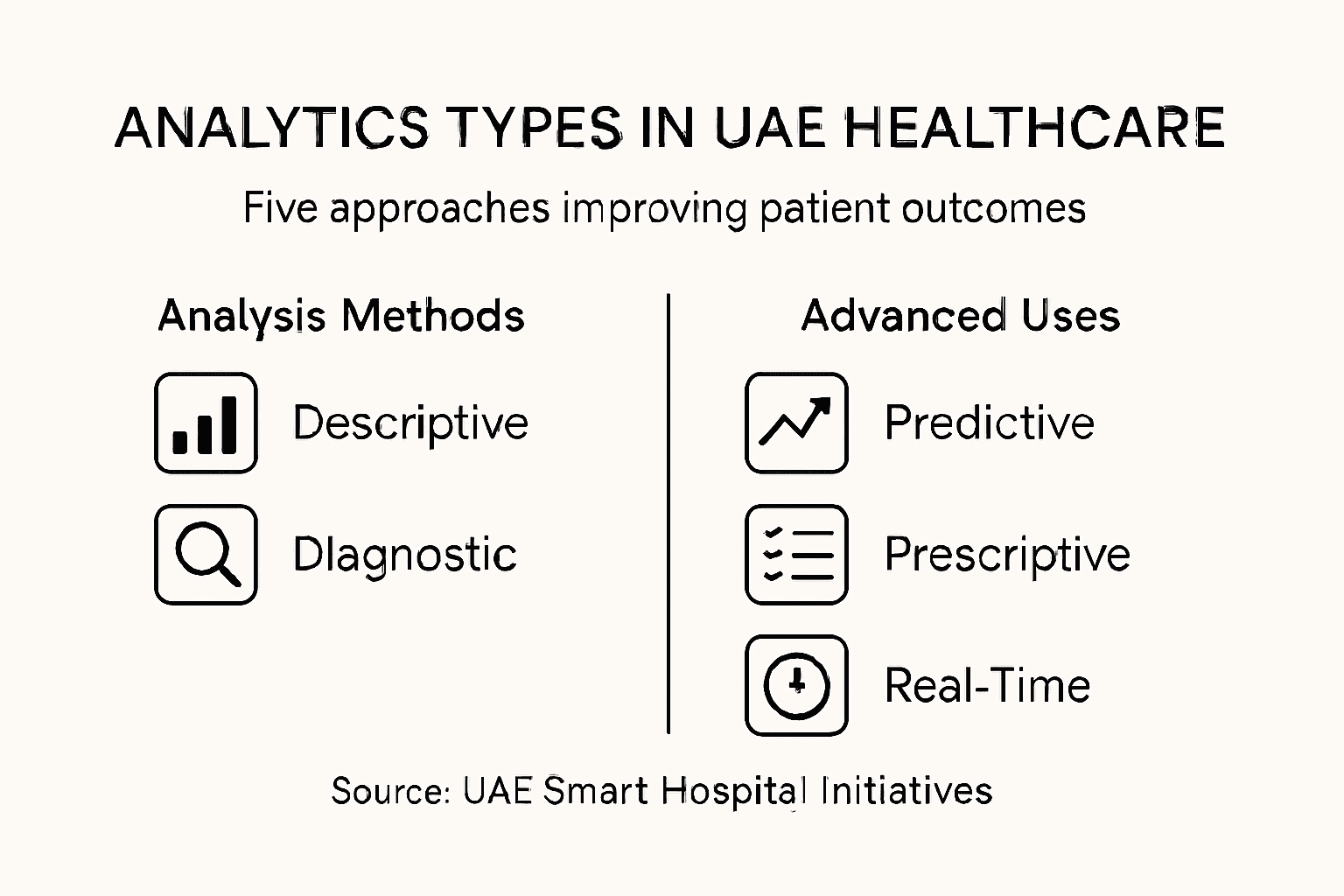
Prescriptive analytics recommends specific actions. Beyond predicting what will happen, it suggests optimal treatment plans, ideal staffing schedules, and resource allocation strategies. This type directly influences operational decisions.
Real-time analytics enables immediate decision-making. Continuous monitoring of vital signs, equipment performance, and patient flow allows staff to respond instantly to emerging situations without waiting for end-of-day reports.
Main healthcare analytics types build upon each other in sophistication and value. Most organizations start with descriptive analytics, progress to diagnostic insights, then add predictive capabilities as skills and data infrastructure mature.
Here's a comparison of the five main healthcare analytics types and their strategic advantages:
| Analytics Type | Key Question Answered | Example Use in UAE | Strategic Benefit |
|---|---|---|---|
| Descriptive | What happened? | Admission trend reports | Establishes baseline metrics |
| Diagnostic | Why did it happen? | Root cause of readmission | Identifies improvement areas |
| Predictive | What will happen next? | High-risk patient modeling | Enables proactive interventions |
| Prescriptive | What action should we take? | Optimal staff scheduling | Directs efficient resource use |
| Real-Time | What's happening now? | Vital sign monitoring | Supports instant decisions |
Consider how these types address your actual operational challenges:
- Use descriptive analytics to establish baseline performance metrics
- Apply diagnostic analytics when unexpected variations occur
- Implement predictive analytics for high-impact patient populations
- Deploy prescriptive analytics for resource-intensive decisions
- Integrate real-time analytics where immediate action prevents harm
Real-time analytics and prescriptive approaches offer the greatest competitive advantage but require more advanced technical infrastructure. UAE healthcare leaders often find success sequencing implementations strategically.
The most effective analytics strategies combine multiple types, using descriptive data to identify priorities, diagnostic insights to understand root causes, and predictive models to prevent problems before they impact patients.
Your organization probably performs some analytics already. Electronic health records generate descriptive reports. Clinical teams conduct diagnostic reviews. The opportunity lies in systematizing these approaches and adding predictive and prescriptive capabilities.
Pro tip: Map your current analytics activities to these five types, identify which type addresses your biggest operational pain point, then invest in capabilities for that type first before expanding to others.
How Analytics Enhances Patient Engagement
Analytics transforms patient engagement from a passive experience into an active partnership between healthcare providers and patients. In the UAE context, this shift directly impacts treatment adherence, health outcomes, and patient satisfaction scores.
Personalized health insights drive engagement. Analytics identifies which patients are most likely to miss appointments, skip medications, or develop complications. With this knowledge, healthcare teams can send targeted reminders, adjust communication styles, and offer proactive support before problems escalate.
Patient-centered care becomes possible when you understand individual preferences and needs. Analytics reveals which communication channels each patient prefers (SMS, email, in-app notifications), optimal appointment times based on their history, and health education topics most relevant to their conditions.
AI-driven applications in UAE healthcare improve patient awareness and acceptance when implemented thoughtfully. Patient training and clear communication about how their data supports their care builds trust rather than concerns.
Chronic disease management improves significantly through analytics-enabled engagement. Patients with diabetes, hypertension, or heart disease benefit from continuous monitoring, personalized recommendations, and regular check-ins triggered by analytics insights rather than fixed schedules.
Engagement strategies powered by analytics include:
- Predictive alerts for high-risk patients before complications develop
- Personalized health recommendations based on individual risk factors
- Appointment reminders timed to patient preferences and patterns
- Educational content matched to patient literacy levels and interests
- Telehealth suggestions for patients showing clinic avoidance patterns
Analytics-driven tools supporting patient involvement require strong infrastructure, staff training, and patient acceptance. UAE healthcare organizations find success when they address all three factors simultaneously rather than deploying technology without proper preparation.
Real engagement means patients understand why they're receiving specific care recommendations. Analytics enables personalized health education by identifying knowledge gaps, preferred learning styles, and optimal timing for information delivery.
Engaged patients follow treatment plans more consistently, report higher satisfaction, and achieve better health outcomes than those receiving one-size-fits-all care.
Your team faces practical implementation challenges. Legacy systems may not capture the granular data analytics requires. Staff need training to interpret insights and act on them. Patients may hesitate sharing health information despite its benefits.
Start by selecting one high-impact patient segment—such as frequent emergency department visitors or patients with multiple chronic conditions—and design targeted engagement strategies using analytics insights for that group.
Pro tip: Combine analytics insights with direct patient communication about how their data will improve their care; transparency about data use builds trust and increases patient willingness to engage with analytics-driven programs.
Predictive Analytics for Operational Efficiency
Predictive analytics shifts hospitals from reactive management to proactive planning. Instead of responding to problems after they occur, UAE healthcare organizations use data models to anticipate demand, optimize resources, and prevent bottlenecks before they impact patient care.
Patient flow prediction represents one of the highest-impact applications. Analytics models forecast how many patients will arrive at emergency departments, which specialties they'll need, and when bed capacity will reach critical levels. Staff can adjust schedules and allocate resources accordingly.

Predictive analytics in UAE smart hospitals optimize bed management by predicting length of stay for different patient types and conditions. This precision reduces unnecessary admissions, accelerates discharge planning, and maximizes bed utilization without compromising care quality.
Staffing optimization prevents both understaffing and overstaffing. Analytics models historical patterns, seasonal variations, and scheduled procedures to recommend ideal staffing levels. One Dubai hospital reduced patient wait times by 45% while lowering labor costs through predictive staffing adjustments.
Supply chain forecasting prevents critical shortages and reduces wasteful overstock. Predictive models anticipate demand for medications, surgical supplies, and diagnostic reagents based on patient volumes, seasonal patterns, and case complexity trends.
Key operational improvements from predictive analytics include:
- Reduced patient wait times through better appointment scheduling
- Increased bed occupancy by optimizing admissions and discharges
- Lowered operational costs via resource forecasting and staffing precision
- Decreased medication and supply waste through accurate demand prediction
- Fewer emergency readmissions by identifying high-risk discharge cases
AI-integrated hospital management systems demonstrate concrete results across the region. Beyond the 45% wait time reduction and 10% occupancy increase, hospitals report 15% cost savings and significantly improved staff satisfaction due to better workload distribution.
Equipment maintenance becomes predictive rather than reactive. Analytics identifies which machines are likely to fail based on usage patterns and performance metrics, allowing preventive maintenance that minimizes equipment downtime.
Hospitals using predictive analytics make decisions based on data-driven forecasts rather than assumptions, resulting in measurable improvements in efficiency, cost control, and patient outcomes.
Implementation requires clean, integrated data from multiple sources. Legacy systems often store information in silos, making comprehensive analysis difficult. Start by consolidating data from your electronic health records, billing systems, and operational databases.
Your team needs training to understand predictions and act on them confidently. A forecast showing increased emergency demand next week is only valuable if staff understand how to interpret it and what actions to take.
Pro tip: Begin with one high-impact operational metric—such as emergency department wait times or bed utilization rates—and build a predictive model for that single metric before expanding to more complex multi-system forecasting.
Risks, Compliance, and Best Practices in UAE
Analytics in UAE healthcare operates within a strict regulatory environment designed to protect patient privacy and ensure data security. Understanding these requirements is non-negotiable for any organization implementing analytics systems.
The Federal Decree-Law No. 45 of 2021 forms the foundation of UAE healthcare data protection. This law mandates how patient information is collected, stored, processed, and shared. Healthcare data management compliance requires robust governance frameworks that address patient privacy, data protection, and secure handling of electronic health records.
Key regulatory obligations include:
- Patient consent before collecting and processing personal health data
- Secure storage of electronic health records with encryption standards
- Access controls limiting who can view sensitive information
- Data breach notification procedures within specified timeframes
- Regular audits verifying compliance with UAE and international standards
Cybersecurity threats in healthcare demand constant vigilance. Ransomware attacks target hospitals, social engineering compromises staff credentials, and insider threats expose sensitive data. Health industry cybersecurity best practices address these evolving threats through email protection, endpoint security, access management, and network monitoring aligned with international standards.
Data governance establishes clear ownership and accountability for information. Define who manages patient data, who can access it, under what circumstances, and how long it's retained. Documentation matters when regulators audit your systems.
Staff training prevents most security incidents. Employees who understand phishing attempts, password security, and proper data handling practices become your strongest defense against breaches. Make training mandatory and ongoing.
Compliance is not a one-time checklist but continuous management of data practices, security controls, and staff awareness throughout your organization.
Third-party vendor management adds complexity. Healthcare organizations often work with analytics vendors, cloud providers, and software companies. Ensure contracts specify their data protection obligations and audit rights.
Below is a summary of compliance and risk management priorities for healthcare analytics in the UAE:
| Compliance Area | UAE Requirement | Implementation Tip |
|---|---|---|
| Patient Consent | Explicit consent for data use | Use digital signing tools |
| Data Security | Encrypted records and controls | Implement multi-factor access |
| Breach Notification | Timely regulator reporting | Automate incident alerts |
| Staff Training | Ongoing security education | Schedule quarterly refresher |
| Vendor Management | Contractual protection | Audit vendor compliance |
Implementation steps for your organization:
- Conduct a data audit identifying what information you collect and where it's stored
- Map current practices against Federal Decree-Law No. 45 requirements
- Implement missing controls (encryption, access restrictions, audit logging)
- Establish clear data governance policies and assign ownership
- Train staff on compliance obligations and security protocols
- Schedule regular compliance audits and update procedures as regulations evolve
International standards like ISO 27001 (information security) and HIPAA principles provide additional frameworks. Many UAE organizations align with these to exceed minimum legal requirements and demonstrate commitment to security.
Pro tip: Create a compliance checklist mapped to Federal Decree-Law No. 45 requirements and review it quarterly with your IT and legal teams; document all reviews to demonstrate ongoing compliance efforts during regulatory audits.
Unlock the Power of Healthcare Analytics with YS Lootah Tech
The challenge of transforming raw patient data into actionable insights is real in UAE healthcare organizations. Whether you face issues with data quality, predictive modeling, or ensuring regulatory compliance, mastering analytics fundamentals like descriptive, predictive, and prescriptive approaches is essential. YS Lootah Tech understands these pain points and offers cutting-edge digital transformation solutions to help you harness AI, cloud computing, and secure data integration for improved patient outcomes and operational efficiency.
Empower your healthcare initiatives today with YS Lootah Tech’s expertise in custom software development and AI-driven enterprise applications. Don’t wait to reduce patient readmissions, optimize staffing, and enhance patient engagement using advanced analytics. Visit YS Lootah Tech to learn how we partner with UAE healthcare leaders for sustainable digital transformation and seamless analytics adoption. Start your journey toward smarter, data-driven healthcare now.
Frequently Asked Questions
What types of data are used in healthcare analytics?
Healthcare analytics primarily uses three types of data: clinical data (including patient records and lab results), operational data (covering resource utilization and staffing patterns), and patient engagement data (like appointment adherence and health outcomes).
How does predictive analytics improve patient outcomes in healthcare?
Predictive analytics forecasts future patient risks and outcomes. It helps identify high-risk patients early, enabling healthcare providers to implement preventive interventions before complications arise, thus improving overall patient care.
What are the key benefits of implementing analytics in a healthcare organization?
Implementing analytics can lead to reduced patient readmission rates, decreased operational costs, improved clinical outcomes through evidence-based practices, and enhanced patient satisfaction with personalized care strategies.
What challenges do healthcare organizations face when implementing analytics?
Organizations often encounter challenges such as data quality issues from multiple legacy systems, maintaining compliance with privacy regulations, and gaps in technical expertise or training among staff.