Digital strategy explained: boost efficiency in 2026

Only 35% of digital transformation initiatives achieve their objectives. That staggering failure rate stems largely from misunderstanding what digital strategy truly entails. Business leaders often confuse technology adoption with strategic transformation, leading to fragmented implementations and wasted resources. This guide clarifies the essential concepts of digital strategy, revealing how a structured approach dramatically improves success rates. You will learn the core components of effective digital strategies, common pitfalls to avoid, and practical steps to implement frameworks that deliver measurable improvements in operational efficiency and customer engagement. Understanding these fundamentals transforms confusion into clarity, enabling you to lead digital initiatives that actually work.
Table of Contents
- What Is Digital Strategy And Why It Matters
- Common Pitfalls And Success Factors In Digital Strategy
- Core Components Of An Effective Digital Strategy Framework
- Implementing Your Digital Strategy For Measurable Success
- Explore Expert Digital Transformation Services
- Frequently Asked Questions
Key takeaways
| Point | Details |
|---|---|
| Digital strategy is your transformation blueprint | It aligns technology, processes, and culture with business goals to guide resource allocation and measurable outcomes. |
| Structured approaches raise success rates by 30%+ | Organizations using frameworks report significantly higher achievement of transformation objectives compared to ad hoc efforts. |
| Common barriers include data quality and skills gaps | Poor integration, unclear metrics, and treating transformation as a project instead of continuous evolution cause most failures. |
| Four pillars drive effective strategies | People and culture, processes, technology, and data must work together to multiply ROI and customer satisfaction gains. |
| Continuous monitoring ensures alignment | Regular evaluation and adjustment based on KPIs keep digital strategy responsive to evolving business contexts and market demands. |
What is digital strategy and why it matters
Digital strategy is a coordinated plan that leverages digital technologies to achieve specific business objectives. Organizations develop digital transformation strategies that serve as blueprints for accomplishing significant changes through technology. This differs fundamentally from digital transformation itself. Strategy is the roadmap. Transformation is the journey of executing that plan and adapting organizational culture, processes, and systems along the way.
Many leaders mistakenly view digital transformation as primarily a technology implementation exercise. They invest in new software, cloud platforms, or automation tools without rethinking underlying business processes. Digital transformation is about rethinking business processes and aligning them with strategic goals, not just deploying new tech. Without this alignment, you end up automating inefficient workflows or digitizing broken processes, which wastes money and frustrates teams.
An effective digital strategy guides resource allocation by prioritizing initiatives that deliver the highest impact. It establishes clear metrics for success, ensuring everyone understands what outcomes matter. For instance, a retail company might define success as reducing checkout time by 40% and increasing mobile conversion rates by 25%. These measurable targets shape technology choices, process redesigns, and training programs. Without such clarity, teams pursue conflicting priorities and struggle to demonstrate value.
Digital strategy also addresses the human and cultural dimensions of transformation. Technology alone cannot drive change. You need buy-in from employees, alignment across departments, and a culture that embraces experimentation and continuous improvement. Leaders who recognize why digital strategy matters invest time in change management, communication, and skills development alongside technology deployment.
Key distinctions to remember:
- Digital strategy sets the vision, objectives, and roadmap for leveraging technology to achieve business goals.
- Digital transformation executes that strategy through organizational change, process reengineering, and technology adoption.
- Strategy focuses on alignment and prioritization, while transformation focuses on implementation and adaptation.
- Both require continuous iteration as markets, technologies, and customer expectations evolve.
Common pitfalls and success factors in digital strategy
About 70% of digital transformation initiatives fail due to lack of measurable success definitions and wrong approaches. This high failure rate reflects common mistakes that undermine even well-intentioned efforts. One major pitfall is vague success metrics. When organizations cannot clearly define what success looks like, teams work toward different goals, resources get misallocated, and leadership cannot evaluate progress objectively.

Another critical error is treating transformation as a one-off project instead of embedding it in the operating model. Companies launch transformation initiatives with fixed timelines and budgets, expecting to flip a switch and become digital. In reality, digital maturity requires ongoing investment, continuous learning, and iterative improvement. When the project ends, momentum dies, and organizations revert to old habits.
Fragmented implementations also sabotage digital strategies. Marketing optimizes its channels in isolation, operations automates its workflows independently, and customer service deploys its own tools without coordination. This siloed approach creates friction for customers who experience inconsistent interactions across touchpoints. It also prevents the organization from capturing synergies and compound benefits that come from integrated systems and unified data.
Culture and communication failures amplify these problems. Leaders announce transformation initiatives without explaining the why or involving employees in shaping solutions. Frontline workers resist changes they do not understand or trust. Middle managers feel threatened by new roles and responsibilities. Without addressing these human factors, even the best technology strategies stall. Understanding digital transformation failure causes helps you anticipate and mitigate these risks.
Success factors that counteract these pitfalls include:
- Defining clear, shared metrics for success that align with strategic business outcomes.
- Embedding transformation into the operating model as a continuous capability, not a temporary project.
- Integrating initiatives across functions to create seamless customer experiences and operational synergies.
- Investing in change management, communication, and employee involvement to build ownership and capability.
- Focusing on culture as much as technology, recognizing that mindset shifts enable sustainable change.
Pro Tip: Start small with pilot programs that demonstrate quick wins and build momentum. Use these early successes to secure broader buy-in and refine your approach before scaling across the organization.
Core components of an effective digital strategy framework
Successful digital strategies integrate four key pillars: people and culture, processes, technology, and data. Companies focusing on these pillars see 25% operational efficiency and 20% customer satisfaction improvements. Each pillar contributes distinct value, but their real power emerges when they work together as a cohesive system.
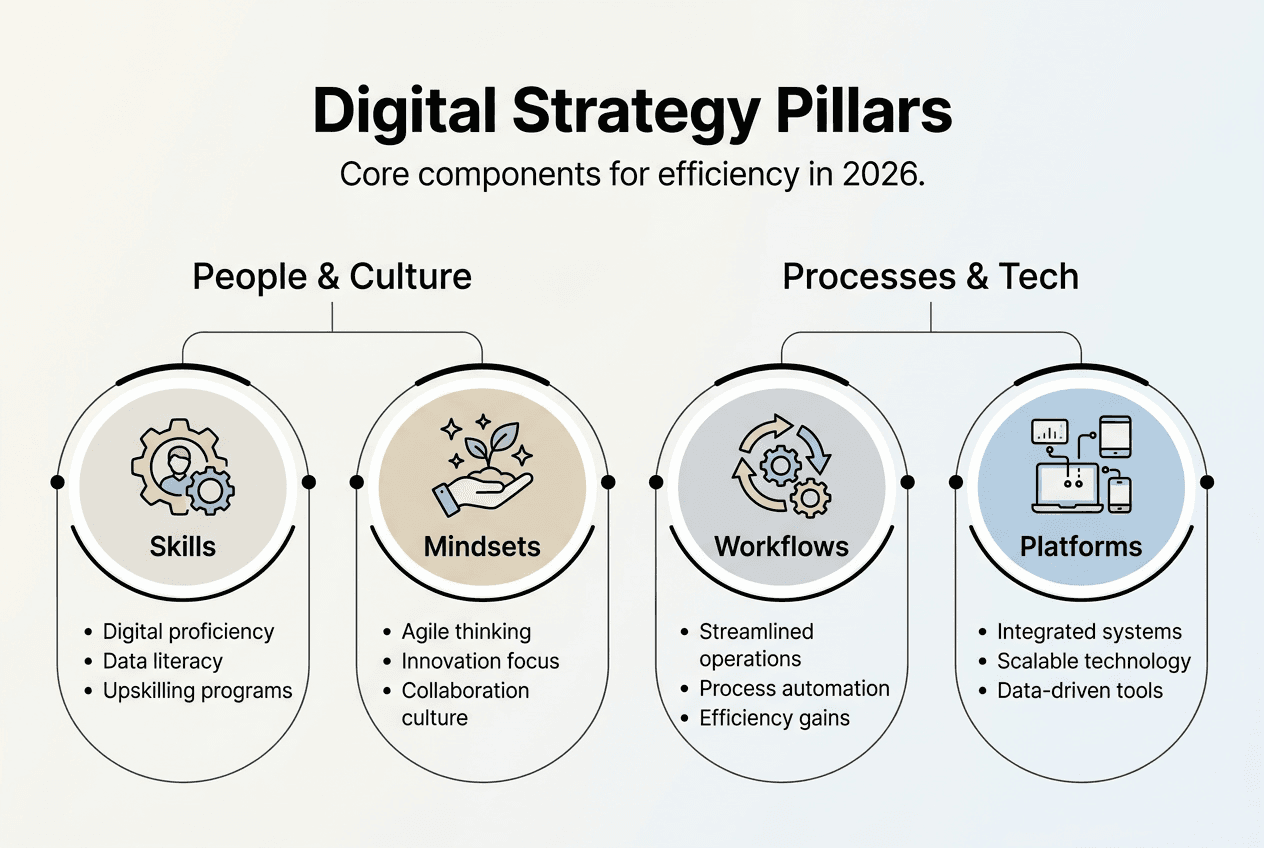
People and culture form the foundation. Digital transformation demands new skills, mindsets, and behaviors. Organizations must invest in training, create psychological safety for experimentation, and align incentives with transformation goals. Leaders model the behaviors they want to see, celebrating learning from failures and rewarding collaboration across silos. Without this cultural shift, employees resist change, undermining even the most sophisticated technology deployments.
Processes determine how work gets done. Digital strategy requires rethinking workflows to eliminate waste, reduce handoffs, and empower frontline decision making. Process reengineering leverages technology to automate routine tasks, freeing people for higher value activities. For example, automating invoice processing allows finance teams to focus on strategic analysis instead of data entry. Well-designed processes also improve customer experiences by reducing friction and response times.
Technology enables new capabilities and efficiencies. Cloud platforms provide scalability and flexibility. AI and machine learning generate insights from massive datasets. Automation handles repetitive tasks with speed and accuracy. However, technology only delivers value when aligned with clear business objectives and supported by capable people and optimized processes. Choosing the right tools requires understanding your strategic priorities and existing constraints.
Data fuels informed decision making and continuous improvement. High-quality, integrated data allows organizations to measure performance, identify opportunities, and personalize customer interactions. Organizations with strong integration achieve 10.3x ROI versus 3.7x for poor integration. Data quality and accessibility remain major challenges, requiring investment in governance, infrastructure, and analytics capabilities.
| Pillar | Focus Areas | Common Challenges | Key Benefits | | --- | --- | --- | | People & Culture | Skills development, change management, leadership alignment | Resistance to change, skills gaps, siloed mindsets | Employee engagement, innovation capability, adaptability | | Processes | Workflow optimization, automation opportunities, customer journey mapping | Legacy complexity, cross-functional coordination, unclear ownership | Operational efficiency, reduced cycle times, improved experiences | | Technology | Platform selection, integration architecture, security and scalability | Technical debt, vendor lock-in, rapid obsolescence | New capabilities, cost reduction, competitive advantage | | Data | Quality and governance, analytics infrastructure, insight generation | Fragmented systems, poor data quality, limited analytics skills | Informed decisions, personalization, continuous improvement |
Pro Tip: Assess your organization's maturity across all four pillars before launching major initiatives. Strengthening weak areas first prevents bottlenecks and multiplies the impact of your investments. For guidance on building robust frameworks, explore digital strategy framework tips and learn how to address data challenges in digital strategy.
Implementing your digital strategy for measurable success
Turning strategy into results requires a structured implementation approach. Organizations with a structured framework report 30% higher success rates in achieving transformation goals. Follow these steps to translate your digital strategy into measurable outcomes:
- Define clear, measurable objectives aligned with business priorities. Specify what success looks like using quantitative targets such as revenue growth percentages, cost reduction amounts, or customer satisfaction score improvements.
- Assess current state capabilities across people, processes, technology, and data. Identify gaps between where you are and where you need to be to achieve your objectives.
- Prioritize initiatives based on impact potential and implementation feasibility. Focus on quick wins that build momentum while laying groundwork for longer-term transformations.
- Develop detailed roadmaps with milestones, resource requirements, and accountability assignments. Break large initiatives into manageable phases with clear deliverables.
- Establish governance structures that enable decision making and resolve conflicts. Ensure cross-functional representation to prevent siloed execution.
- Implement pilot programs to test approaches, gather feedback, and refine solutions before scaling. Use pilots to demonstrate value and build organizational confidence.
- Monitor progress using KPIs tied to your strategic objectives. Track both leading indicators that predict future performance and lagging indicators that measure actual results.
- Adjust course based on data insights and changing business contexts. Digital strategy is not static; it evolves as you learn and as market conditions shift.
Change management and employee engagement are critical throughout implementation. Communicate the vision and rationale repeatedly using multiple channels. Involve employees in designing solutions to build ownership and capture frontline insights. Provide training and support to develop necessary skills. Celebrate wins publicly to reinforce desired behaviors and maintain momentum.
Maintaining alignment between strategy and evolving business context requires continuous monitoring. Schedule regular strategy reviews to assess whether your priorities still match market realities and organizational capabilities. Be willing to pivot when evidence suggests a different approach would deliver better results. Flexibility combined with disciplined execution creates resilience.
Practical tips for sustaining success:
- Create feedback loops that surface problems and opportunities quickly, enabling rapid response.
- Build analytics capabilities that turn data into actionable insights for frontline teams and executives.
- Foster a culture of experimentation where teams test new ideas, learn from failures, and scale successes.
- Invest in platforms and architectures that support integration and adaptation as needs change.
- Partner with experienced advisors who bring external perspectives and specialized expertise.
For comprehensive guidance on execution, review a digital transformation roadmap and explore relevant digital transformation KPIs to track your progress effectively.
Explore expert digital transformation services
Understanding digital strategy fundamentals is the first step. Executing them successfully often requires specialized expertise and tailored solutions. YS Lootah Tech offers comprehensive digital services designed to support your transformation journey from strategy through implementation. Our application development services create custom software solutions that align precisely with your strategic objectives, whether you need enterprise platforms, mobile apps, or integrated systems.
Our IT consulting services help clarify your digital strategy and roadmap, ensuring alignment between technology investments and business goals. We assess your current capabilities, identify gaps, and recommend practical approaches that fit your context and constraints. Additionally, our UX/UI design services enhance customer engagement by creating intuitive, compelling digital experiences that drive satisfaction and loyalty. Partnering with experts who understand both technology and business strategy accelerates your transformation and increases the probability of achieving measurable success.
Frequently asked questions
What is the difference between digital strategy and digital transformation?
Digital strategy is the comprehensive plan that defines objectives, priorities, and approaches for leveraging technology to achieve business goals. Digital transformation is the execution process that implements the strategy through organizational change, process reengineering, and technology adoption. Strategy provides the blueprint and direction, while transformation involves the actual work of changing how the organization operates and delivers value. Both require continuous iteration as markets and technologies evolve. Learn more about digital transformation definition to understand this distinction deeply.
Why do so many digital strategies fail?
Most failures stem from lack of clear, measurable success definitions that align stakeholders around common goals. Organizations also fail when they treat transformation as a one-time project with a fixed endpoint rather than embedding it as a continuous operating model. Poor integration across technology, processes, and culture creates friction and prevents compound benefits. Additionally, insufficient investment in change management and employee engagement undermines adoption, causing even well-designed strategies to stall. Understanding digital transformation failure reasons helps you anticipate and avoid these pitfalls.
How can businesses measure success in digital strategy execution?
Define measurable objectives aligned with strategic business priorities, such as revenue growth percentages, cost reduction targets, or customer satisfaction improvements. Use quantitative KPIs that track both leading indicators predicting future performance and lagging indicators measuring actual results. Continuously monitor these metrics using dashboards and analytics tools that provide real-time visibility into progress. Adjust your approach based on data insights and changing business contexts to maintain alignment and optimize outcomes. Explore relevant digital transformation KPIs to identify metrics appropriate for your industry and objectives.
What role does organizational culture play in digital strategy success?
Culture determines whether employees embrace or resist change, making it a critical success factor. Organizations with cultures that value experimentation, learning, and collaboration adapt more quickly to new technologies and processes. Leaders must model desired behaviors, create psychological safety for risk taking, and align incentives with transformation goals. Without cultural alignment, even the best technology investments fail to deliver value because people continue working in old patterns. Investing in change management, communication, and skills development builds the cultural foundation necessary for sustained digital transformation success.