Why Digital Strategy Matters for Healthcare Leaders

Every hospital executive in Dubai knows that buying new technology rarely solves deep operational challenges. The real value comes from a bold digital strategy that links patient care, staff efficiency, and organizational goals. With digital health tools like mobile platforms, health IT, and wearable devices empowering both clinicians and patients, leaders must craft strategies that integrate these innovations for measurable improvements. Explore how to build a plan that addresses compliance, patient experience, and clinical effectiveness while positioning your enterprise at the forefront of Dubai’s healthcare sector.
Table of Contents
- Defining Digital Strategy in Modern Healthcare
- Key Digital Technologies Transforming Care
- Critical Benefits for Operations and Patients
- Risks of Poor or Absent Digital Strategy
- Building a Sustainable Digital Transformation Roadmap
Key Takeaways
| Point | Details |
|---|---|
| Digital Strategy is Comprehensive | It's a coordinated plan that aligns technology with patient care goals, not just technology adoption. |
| Focus on Measurable Outcomes | Prioritize tools that directly solve clinical and operational challenges to improve patient outcomes. |
| Governance is Crucial | Clear ownership and accountability are essential for successful digital transformation and progress measurement. |
| Tailor to Local Needs | Adapt your strategy to reflect regional priorities and patient expectations in the local healthcare environment. |
Defining Digital Strategy in Modern Healthcare
A digital strategy in healthcare goes far beyond buying technology and installing software. It's a coordinated plan that connects your organization's patient care goals with the tools and processes that make them achievable. Think of it as a roadmap that tells you which technologies to adopt, when to adopt them, and how they'll improve care delivery.
For Dubai's healthcare leaders, this means understanding that digital strategy addresses three core dimensions:
- Clinical effectiveness: How technology improves diagnosis, treatment, and patient outcomes
- Operational efficiency: Streamlining workflows, reducing costs, and automating repetitive tasks
- Patient experience: Making healthcare more accessible and putting patients in control of their data
The foundation of modern healthcare digital strategy involves integrating multiple technology components that work together seamlessly. Digital health includes mobile health, health IT, and wearable devices that enable clinicians to make better-informed decisions and help patients manage their health outside traditional settings. Your strategy must address how these fit into your current operations.
Unlike generic tech implementation plans, healthcare digital strategy focuses on creating measurable value. You're not implementing technology for technology's sake. You're solving real problems: reducing patient wait times, improving diagnostic accuracy, lowering readmission rates, or enabling remote consultations.
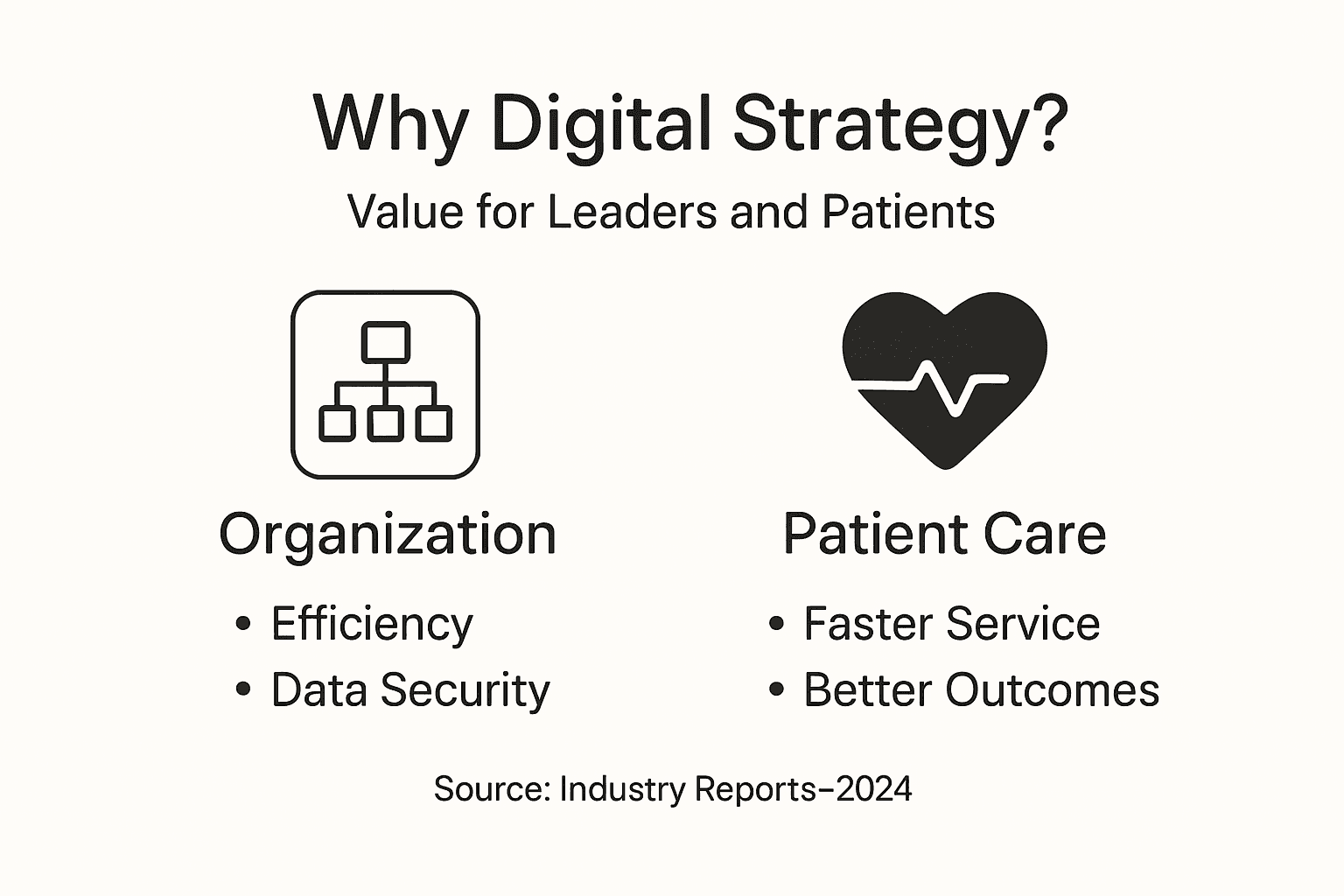
In Dubai's competitive healthcare environment, your digital strategy should reflect regional priorities:
To clarify the core strategic considerations, here is a summary comparing digital strategy priorities for healthcare organizations in Dubai versus global trends:
| Consideration | Dubai Healthcare Focus | Global Healthcare Focus |
|---|---|---|
| Regulatory Compliance | Local UAE laws and data protection | Varies by country/region |
| Integration Requirements | UAE health info systems, national IDs | Diverse legacy system challenges |
| Patient Expectations | Advanced digital touchpoints | Growing demand for convenience |
| Staff Digital Training | Region-specific upskilling needs | Standard e-health training |
| Technology Adoption Speed | Fast adoption, government-led pilots | Varies, often slower |
- Compliance with local healthcare regulations and data protection requirements
- Integration with UAE health information systems and national initiatives
- Patient expectations shaped by advanced digital services across other industries
- Staff capabilities and training needs specific to your organization
A strong digital strategy aligns technology investments with your healthcare organization's mission and patient outcomes, not the other way around.
Your strategy also needs clear governance and accountability. Someone owns the digital transformation journey. Someone measures progress. Someone adjusts course when results don't match projections. In mid to large enterprises, this typically means a Chief Digital Officer or transformation leader who reports directly to senior leadership.
The difference between organizations that succeed with digital transformation and those that struggle often comes down to strategy clarity. When your team understands why you're adopting a specific technology, how it connects to organizational goals, and what success looks like, adoption rates increase significantly. Confusion about strategic direction leads to wasted investments and frustrated staff.
Pro tip: Start by mapping your current pain points (slow patient intake, manual record handling, communication gaps) and align technology solutions to address those specific problems rather than adopting popular tools that "everyone else" uses.
Key Digital Technologies Transforming Care
Your healthcare organization doesn't need to adopt every new technology available. But understanding which ones actually move the needle on patient outcomes helps you make smarter investment decisions. Six main categories of digital technologies are reshaping how care gets delivered across the industry.
Artificial intelligence and machine learning now power diagnostic tools that catch diseases earlier and predict patient deterioration before it happens. AI algorithms analyze medical images, identify patterns in patient data, and suggest personalized treatment options. In Dubai's healthcare sector, this means reducing diagnostic errors and accelerating time-to-treatment.
Here's what's transforming care delivery right now:
- Artificial Intelligence: Diagnostic support, predictive analytics, and clinical decision assistance
- Internet of Things (IoT): Remote patient monitoring, wearable sensors, and real-time health tracking
- Cloud computing: Secure data storage, system scalability, and access from anywhere
- Electronic health records: Integrated patient data across all care settings
- Telemedicine: Remote consultations, reducing travel time and expanding access to specialists
- Big data analytics: Identifying trends, improving population health, and optimizing operations
Telemedicine deserves special attention for Dubai's healthcare leaders. Digital health technologies enable real-time access to personal health data and remote patient monitoring, making specialist care available without requiring patients to visit physical locations. This proves especially valuable for chronic disease management and follow-up consultations.
IoT devices and wearables connect directly to your health systems, collecting continuous data on vital signs, activity levels, and medication adherence. Instead of snapshots from quarterly checkups, you get a complete picture of patient health between visits.
Cloud infrastructure removes the burden of managing massive servers on-site. Your teams access patient records, scheduling systems, and clinical tools from any authorized device. Scaling up doesn't require massive capital investments.
The most successful healthcare organizations don't chase every new technology—they choose tools that directly address their biggest clinical and operational challenges.
Blockchain technology adds another layer, creating secure, tamper-proof records for sensitive health data and pharmaceutical supply chain verification. While still emerging in healthcare applications, it's worth monitoring for future implementation.
The real power emerges when these technologies work together. AI analyzes data from IoT devices. Cloud systems store and manage the information. Electronic records integrate everything into one view. Telemedicine platforms connect patients to clinicians instantly.
Here is an at-a-glance view of how key digital health technologies interact and support care transformation:
| Technology | Primary Role | Enables Collaboration With | Measures of Success |
|---|---|---|---|
| Artificial Intelligence | Data analysis and prediction | IoT devices, EHRs | Faster diagnoses, lower errors |
| Internet of Things | Real-time patient monitoring | Cloud, AI tools | More timely interventions |
| Cloud Computing | Secure, scalable access | EHR, telemedicine, analytics | Lower IT costs, improved uptime |
| Electronic Health Records | Unified patient info | All digital systems | Seamless data flow, less paperwork |
| Telemedicine | Remote consultations | EHR, scheduling systems | Greater access, reduced travel |
| Big Data Analytics | Trend and risk identification | AI, EHR data | Improved outcomes, resource use |
Pro tip: Before investing in new technology, map which clinical problems it solves and what measurable improvement you expect within 6-12 months—adoption rates increase when staff see direct benefits to their daily work.
Critical Benefits for Operations and Patients
Digital strategy delivers tangible results that your board cares about and your patients notice immediately. When implemented well, it addresses the three biggest pressures facing Dubai's healthcare leaders: rising costs, staffing constraints, and patient expectations.

On the operational side, the impact shows up fast. Digital transformation reduces operational costs, increases efficiency, and improves patient outcomes by streamlining workflows and eliminating manual processes. A scheduling system that automates appointment booking cuts administrative time by 40 percent. Electronic health records eliminate paper storage costs and speed up information retrieval. Predictive analytics identify patients at high risk of readmission before discharge, preventing expensive emergency visits.
Your operational benefits break down like this:
- Reduced costs: Fewer manual processes, less paperwork, lower energy bills from optimized facilities
- Better resource allocation: Staff spends time on patient care, not data entry
- Faster decision-making: Leaders access real-time performance data instead of waiting for monthly reports
- Improved staff retention: Clinicians report higher satisfaction when technology removes frustrating administrative tasks
- Scalability without proportional cost increases: Add patient capacity without adding equivalent staff numbers
For patients, the benefits feel completely different but equally important. Digital strategy makes healthcare less stressful and more personalized. Patients book appointments from their phone, access test results online, and receive reminders before visits. Remote monitoring means chronic disease patients check in without traveling to the hospital. Personalized treatment recommendations based on their specific health data replace one-size-fits-all approaches.
Data-driven digital innovation enhances service delivery, resource management, and performance measurement, creating better-connected healthcare systems that coordinate care seamlessly. When a patient moves from one department to another, their information moves with them instantly.
Patient benefits include:
- Better access: Specialist care becomes available without geographic barriers
- More control: Patients manage their own health data and treatment preferences
- Faster care: Reduced wait times from automated processes and better scheduling
- Higher safety: AI tools catch potential drug interactions and medication errors
Digital transformation isn't about technology—it's about giving your team better tools to deliver care and giving patients easier ways to receive it.
Chronically ill patients see the most dramatic improvements. Remote monitoring catches deterioration early. Data analytics predict which patients need intervention before symptoms worsen. Medication adherence improves when automated reminders reduce confusion.
For your organization's bottom line, consider this: One prevented readmission saves $15,000 to $20,000. One avoided emergency visit saves similar amounts. When your digital strategy reduces preventable readmissions by even 10 percent across a mid-size hospital, the savings exceed many technology implementation costs in year one.
Pro tip: Measure and communicate specific wins early—reduced wait times, faster discharge processing, patient satisfaction scores—to build momentum and justify ongoing digital investments to skeptical stakeholders.
Risks of Poor or Absent Digital Strategy
Not having a digital strategy isn't neutral. It's a risk that compounds over time. Healthcare organizations without clear digital direction face mounting pressures that eventually catch up to them—sometimes in ways that directly impact patient safety.
The absence of coordinated strategy creates fragmented systems that don't talk to each other. Your emergency department uses one patient record system. Your outpatient clinic uses another. Surgeons can't see lab results from radiology. This fragmentation leads to duplicate tests, missed diagnoses, and frustrated clinicians who waste time hunting for information instead of treating patients.
Here's what happens when digital strategy is missing or poorly executed:
- Security vulnerabilities: Uncoordinated systems lack proper protections, inviting ransomware attacks and data breaches
- Inefficiency multiplies: Staff works around broken systems instead of within them
- Compliance failures: You can't meet regulatory requirements without organized digital governance
- Burnout accelerates: Clinicians abandon poorly designed technology, returning to manual workarounds
- Wasted budget: Technology investments deliver no return because they don't align with organizational goals
- Lost competitive position: Better-coordinated competitors attract patients and talent
Unequal implementation creates another serious problem. Poor digital strategies exacerbate health inequalities by creating unequal access to technology benefits, leaving vulnerable populations behind. If your digital rollout focuses only on wealthy neighborhoods or high-profit departments, you're widening the equity gap.
Without strategy, you also invite cultural resistance. Staff adopts new tools reluctantly because no one explained why the change matters or how it helps their work. Training becomes sporadic. Adoption stalls. You spent millions on systems that 40 percent of your team actively avoids.
Poor strategy leads to fragmented initiatives, security risks, inefficiencies, and inability to scale solutions, ultimately risking patient safety and sustainability. When you have no master plan, different departments purchase incompatible tools. Scaling becomes impossible. You're stuck managing dozens of separate systems that drain resources.
Organizations that skip strategic planning typically spend 30 to 40 percent more on technology than those with clear roadmaps—and get less value from it.
Patient safety suffers most when digital strategy is absent. Manual workarounds increase error rates. Outdated systems can't integrate safety alerts. Clinical decision support never gets implemented because no one prioritized it. Over time, preventable adverse events climb.
Your reputation takes hits too. Word spreads in Dubai's healthcare community when patients experience poor coordination or long waits. Staff leave for organizations with better technology environments. Recruiting talent becomes harder.
The financial impact accelerates. You maintain aging systems longer than necessary. You pay emergency consulting fees to fix crises that planning would have prevented. Operational inefficiencies compound year after year.
Pro tip: Document your organization's current digital state in writing—which systems exist, where they fail, and what staff complain about most—before committing to any new technology purchases or upgrades.
Building a Sustainable Digital Transformation Roadmap
A roadmap separates organizations that get results from those that waste years and millions. Without one, digital transformation becomes a series of disconnected projects that drain resources and frustrate staff. Your roadmap is the bridge between strategy and execution.
Start by assessing your current state honestly. What systems do you have? Which ones work? Which ones fail your teams regularly? What data do you collect but never use? This baseline matters because it shows you where to begin, not where competitors are.
Your roadmap needs these foundational elements:
- Clear timeline: Specific phases across 18 to 36 months with realistic milestones
- Prioritized initiatives: Which problems to solve first based on impact and feasibility
- Budget allocation: How much you'll spend per phase and where the money goes
- Team assignments: Who owns each workstream and reports progress
- Success metrics: How you'll measure whether each phase delivered results
- Risk management: What could go wrong and how you'll respond
Successful digital transformation requires stepwise guidance for developing scalable and sustainable digital health architectures aligned with health system needs. Your roadmap must address governance structures, integration points between old and new systems, and investment timelines that don't bankrupt the organization.
During phase one, focus on quick wins and foundational systems. Implement scheduling automation that patients immediately notice. Deploy electronic health records across high-volume departments. Build momentum so staff sees change working. Quick wins also generate budget approval for later phases.
Phase two tackles integration and scaling. Now your systems talk to each other. Data flows seamlessly. Clinicians access complete patient information across departments. This phase requires more technical complexity but delivers exponential value.
Phase three focuses on optimization and innovation. You've built the foundation. Now you add AI-driven insights, predictive analytics, and personalized medicine capabilities. By phase three, your organization competes differently than it did at the start.
Clear milestones and priorities help governments and partners coordinate to maximize impact on digital health transformation. This applies equally to individual health systems. Your board needs to see specific milestones, not vague aspirations. "Implement AI" isn't a milestone. "Deploy AI-powered imaging analysis in radiology by Q2 2025 to reduce diagnostic turnaround time by 40 percent" is.
Involve your frontline staff in roadmap creation. Clinicians know where the real pain points are. Administrative staff understand workflow bottlenecks better than consultants do. When people help build the roadmap, they own its success.
A roadmap without stakeholder buy-in is just a document. A roadmap created with your team becomes a commitment they drive forward.
Budget realistically and include contingency funds. Technology implementations overrun budgets 60 to 70 percent of the time when leaders underestimate complexity. Build in 20 to 30 percent contingency funding for unexpected challenges.
Review and adjust your roadmap quarterly. Markets change. New technologies emerge. Staff feedback reveals better approaches. A roadmap should guide your direction, not lock you into decisions made months ago under different circumstances.
Pro tip: Create a visual timeline that everyone in your organization can see—a physical chart showing phases, major milestones, and current progress—and update it monthly so staff stays aligned and motivated.
Take Control of Your Healthcare Digital Strategy Today
Healthcare leaders in Dubai face unique challenges such as integrating complex systems, meeting stringent regulatory requirements, and meeting rising patient expectations. The key to overcoming these lies in a clear and measurable digital strategy that reduces inefficiencies, enhances patient outcomes, and empowers your staff. Without a focused roadmap you risk fragmented technologies and wasted investments that hurt both operations and patient safety.
YS Lootah Tech offers tailored digital transformation services designed to align perfectly with your healthcare organization's mission and goals. From custom software development integrating AI and cloud computing to secure data management and seamless interoperability, our solutions tackle your pain points head-on. Learn how we can help you build a sustainable digital roadmap, accelerate technology adoption, and realize quick wins that improve care delivery and operational efficiency. Don’t let digitization challenges hold you back. Visit YS Lootah Tech to explore how our expertise in digital transformation and custom software development empowers healthcare leaders to deliver measurable value now.
Frequently Asked Questions
What is a digital strategy in healthcare?
A digital strategy in healthcare is a coordinated plan that connects patient care goals with technology and processes to improve care delivery. It involves identifying which technologies to adopt, when to implement them, and how they can enhance patient outcomes.
Why is having a clear digital strategy important for healthcare organizations?
A clear digital strategy is crucial as it aligns technology investments with organizational goals, reduces confusion among staff, and enhances technology adoption. It helps prevent wasted resources and ensures that digital initiatives effectively improve patient care.
What are the core dimensions of a digital strategy in healthcare?
The core dimensions include clinical effectiveness, operational efficiency, and patient experience. These dimensions focus on how technology improves diagnosis, streamlines workflows, and enhances patient interactions with healthcare providers.
How can digital transformation benefit patient outcomes in healthcare?
Digital transformation can lead to improved patient outcomes by reducing wait times, enhancing diagnostic accuracy, enabling remote consultations, and providing patients with better access to their health data. This shift allows for more personalized and timely care.
Recommended
- Digital Marketing That Delivers: YS Lootah’s Proven Strategies for Growth
- Boost Your Online Visibility: YS Lootah’s SEO Strategies That Work
- YSLootah Tech | Digital Transformation & Technology Solutions
- IT Consulting | YS Lootah Tech
- Santé mentale et stratégie DEI : Le guide pour agir
- Digitale Anlagendokumentation: Ihr Schlüssel zur Risikominimierung -