What is enterprise application: 2026 guide for leaders

Many executives confuse enterprise applications with ERP systems alone, missing the broader ecosystem that drives digital transformation. Enterprise applications encompass diverse integrated software solutions, from customer relationship management to supply chain optimization, each serving distinct strategic functions. This guide clarifies what enterprise applications truly are, their impact on operational efficiency, and how to select the right solutions for your organization's digital transformation goals.
Table of Contents
- Definition And Purpose Of Enterprise Applications
- Enterprise Applications And Digital Transformation
- Types Of Enterprise Applications And Their Roles
- Impact On Operational Efficiency
- Common Misconceptions About Enterprise Applications
- Framework For Enterprise Application Selection
- Implementation Challenges And Risks
- Case Studies And Real-World Examples
- Leverage Expert Enterprise Application Services To Drive Your Digital Transformation
Key takeaways
| Point | Details |
|---|---|
| Enterprise applications are large-scale integrated systems supporting complex distributed operations across multiple business units | They enable data consistency, cross-functional workflows, and leverage AI and cloud technologies for intelligent automation |
| These applications underpin digital transformation by enabling real-time data access, process innovation, and organizational agility | By 2026, over 70% of enterprises have deployed comprehensive application suites to accelerate innovation |
| Major categories include ERP for core processes, CRM for customer engagement, and SCM for supply chain optimization | Each serves distinct but complementary roles that enhance overall business operations when integrated |
| Common myths about enterprise applications being ERP-only or cloud solutions being more expensive can hinder informed decisions | Understanding the diversity and true cost models helps evaluate options objectively |
| A structured selection framework assessing business needs, IT compatibility, and vendor support ensures successful implementation | Addressing integration challenges and change management risks improves deployment outcomes and ROI |
Definition and purpose of enterprise applications
Enterprise applications are large-scale, integrated software systems designed to manage and automate complex business operations across entire organizations. Unlike departmental tools, these systems span multiple business units, geographies, and functions, ensuring data consistency and enabling cross-functional workflows. They serve as the technological backbone for companies managing distributed operations, high transaction volumes, and intricate process dependencies.
Modern enterprise applications increasingly leverage AI and cloud computing to deliver scalable, intelligent automation and predictive analytics. This evolution transforms how organizations process information, make decisions, and respond to market changes. Cloud-native architectures enable rapid deployment, seamless updates, and elastic scaling that traditional on-premise systems struggle to match.
These applications address several critical organizational needs:
- Centralized data management ensuring single sources of truth across departments
- Automated workflows reducing manual intervention and human error
- Real-time visibility into operations enabling faster, data-driven decisions
- Standardized processes ensuring compliance and operational consistency
- Integration capabilities connecting disparate systems and data sources
For businesses pursuing application development strategies, understanding enterprise applications as integrated ecosystems rather than standalone tools is essential. The right architecture enables organizations to adapt quickly to changing business requirements while maintaining operational stability and data integrity across all functions.
Enterprise applications and digital transformation
Enterprise applications serve as the foundational infrastructure for successful digital transformation initiatives. They enable organizations to shift from siloed, manual processes to integrated, automated workflows that drive competitive advantage. Real-time data access across functions empowers leadership to make informed strategic decisions based on current operational realities rather than outdated reports.
These systems contribute directly to process innovation by providing the technological foundation for reimagining how work gets done. When integrated effectively, enterprise applications eliminate redundant data entry, reduce cycle times, and enable seamless collaboration across departments and geographies. Organizations gain the agility to respond quickly to market shifts, customer demands, and competitive pressures.
The strategic impact of enterprise applications is reflected in adoption trends. By 2026, over 70% of enterprises have deployed comprehensive application suites as core components of their digital transformation strategies. This widespread adoption demonstrates how essential these systems have become for maintaining operational competitiveness and enabling innovation at scale.
Key transformation enablers include:
- Unified data platforms breaking down information silos
- Process automation freeing staff for higher-value strategic work
- Advanced analytics providing predictive insights for proactive decision-making
- Mobile accessibility enabling workforce productivity anywhere
- API-driven integration connecting internal systems with external partners
For organizations developing their digital transformation roadmap, enterprise applications provide the technical foundation that makes transformation possible. Leaders looking to start digital transformation initiatives should understand that selecting the right application architecture directly impacts transformation success. CIOs specifically need to grasp what digital transformation means in the context of enterprise application strategy.
Types of enterprise applications and their roles
Enterprise applications span several major categories, each serving distinct business functions while complementing the others when integrated effectively. Understanding these categories helps organizations build comprehensive technology ecosystems aligned with strategic priorities.
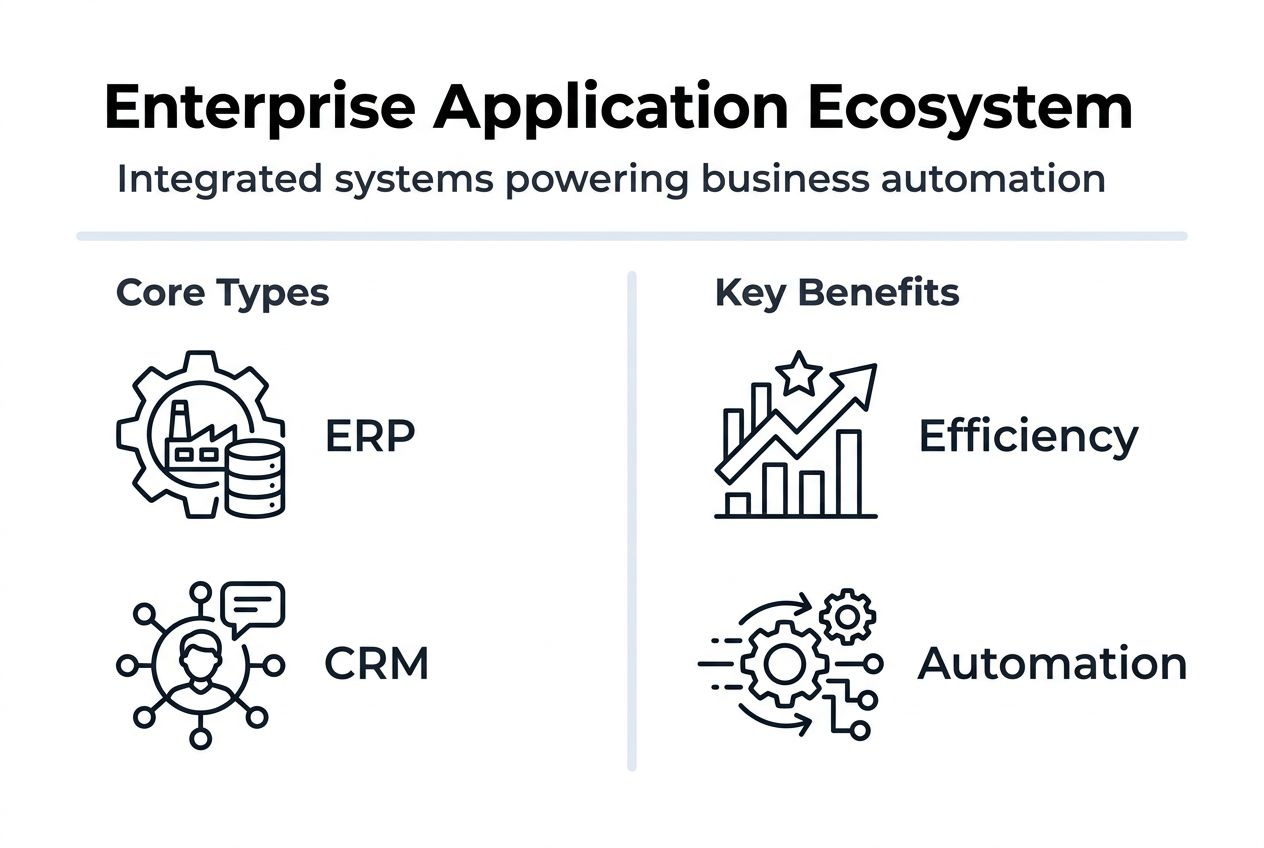
Enterprise Resource Planning (ERP) systems integrate core business processes including finance, human resources, manufacturing, and procurement. ERP solutions handle the most complex operational workflows, managing everything from general ledger accounting to production scheduling. These systems typically represent the largest implementation investment due to their broad scope and deep functional requirements. ERP platforms hold approximately 35% market share among enterprise applications.
Customer Relationship Management (CRM) applications focus on customer-facing processes including sales, marketing, and service operations. CRM systems track customer interactions, automate marketing campaigns, manage sales pipelines, and coordinate service delivery. They provide the single customer view that enables personalized engagement and consistent experiences across touchpoints. CRM solutions account for roughly 28% of the enterprise application market.
Supply Chain Management (SCM) platforms optimize the flow of goods, information, and finances across the supply network. SCM applications provide visibility into inventory levels, logistics operations, supplier performance, and demand forecasting. They enable organizations to balance cost efficiency with service levels while managing complexity across global supply networks. SCM systems represent about 22% of enterprise application deployments.
| Application Type | Primary Focus | Key Functions | Typical Users |
|---|---|---|---|
| ERP | Internal operations | Finance, HR, manufacturing, procurement | Finance teams, operations managers, executives |
| CRM | Customer engagement | Sales automation, marketing campaigns, service management | Sales reps, marketers, customer service |
| SCM | Supply network | Inventory control, logistics, supplier management, demand planning | Supply chain managers, procurement, logistics |
Other enterprise applications include human capital management (HCM) for workforce planning, business intelligence (BI) for analytics, and industry-specific solutions for sectors like healthcare or financial services. The key to maximizing value lies in integration across these systems, ensuring data flows seamlessly and processes connect end to end. Organizations rarely succeed with isolated applications; the real power emerges when ERP, CRM, SCM, and other systems work as a unified ecosystem.
Impact on operational efficiency
Enterprise applications deliver measurable efficiency improvements that directly impact bottom-line performance. Organizations typically achieve operational cost reductions of approximately 25% within 18 to 24 months following successful implementation. These gains result from eliminating redundant processes, reducing manual errors, and accelerating cycle times across critical workflows.
Process automation represents the primary efficiency driver. Enterprise applications eliminate repetitive manual tasks such as data entry, report generation, and approval routing. This automation frees employees to focus on strategic activities requiring human judgment and creativity. The consistency that automation provides also reduces quality issues and compliance risks inherent in manual processes.

Improved data consistency across departments eliminates the reconciliation efforts that consume significant time in organizations with fragmented systems. When finance, operations, sales, and other functions work from the same real-time data, decisions accelerate and accuracy improves. Single sources of truth prevent the conflicting information that slows decision-making and erodes confidence.
Enhanced collaboration capabilities enable cross-functional teams to work more effectively. Enterprise applications provide shared visibility into projects, customer situations, and operational status. This transparency reduces communication overhead and ensures everyone operates with current information. Geographic distribution becomes less of a barrier when teams access the same systems regardless of location.
Key efficiency metrics to track include:
- Order-to-cash cycle time reductions of 30 to 40%
- Invoice processing cost decreases of 50 to 60%
- Inventory carrying cost reductions of 20 to 25%
- Customer service response time improvements of 35 to 45%
- Report generation time savings of 70 to 80%
Pro Tip: Establish baseline metrics before implementation to accurately measure efficiency gains. Track both quantitative measures like cycle times and qualitative factors like employee satisfaction with processes.
For organizations seeking to maximize efficiency, understanding digital transformation KPIs helps set appropriate targets. Leaders developing their digital strategy for efficiency should align application selection with measurable operational improvements that support broader business objectives.
Common misconceptions about enterprise applications
Several persistent myths about enterprise applications lead organizations to make suboptimal technology decisions. Clearing up these misconceptions enables more informed evaluation and selection processes.
Myth: Enterprise applications only mean ERP systems. While ERP represents a major category, enterprise applications encompass CRM, SCM, HCM, BI, and numerous other system types. Each serves distinct functions, and comprehensive digital transformation requires multiple application categories working together. Organizations limiting their view to ERP miss critical capabilities needed for customer engagement, supply chain optimization, and workforce management.
Myth: Cloud solutions always cost more than on-premise deployments. Total cost of ownership analysis often reveals cloud applications delivering lower costs over three to five year periods. While subscription fees may appear higher than on-premise licensing, cloud models eliminate infrastructure costs, reduce IT staffing needs, and provide automatic updates. On-premise systems require significant upfront capital, ongoing maintenance, upgrade projects, and dedicated technical staff. Many enterprises find hybrid approaches balancing control with cloud economics most effective.
Myth: All enterprise applications are essentially the same. Significant functional and architectural differences exist across vendors and product categories. Applications optimized for specific industries, company sizes, or business models deliver better fit than generic solutions. Evaluation criteria should include functional depth, integration capabilities, user experience, and alignment with specific business processes rather than assuming all options provide equivalent value.
Myth: Small and mid-size companies don't need enterprise applications. While originally designed for large corporations, modern cloud-based enterprise applications scale effectively for organizations of all sizes. Modular pricing and phased implementation approaches make these systems accessible to growing companies. Mid-size enterprises often gain competitive advantage by adopting enterprise-class capabilities earlier than competitors.
Pro Tip: Challenge vendor claims by requesting customer references in your industry and company size range. Speak directly with users about their real-world experiences, not just IT leadership.
Understanding these realities helps decision-makers evaluate options objectively rather than through the lens of outdated assumptions or vendor marketing messages.
Framework for enterprise application selection
Selecting the right enterprise applications requires a structured approach balancing business requirements, technical constraints, and strategic priorities. This framework guides organizations through evaluation and decision-making.
-
Assess current business needs and strategic goals. Document pain points in existing processes, growth objectives, and competitive pressures driving change. Prioritize requirements based on business impact rather than technical preferences. Involve stakeholders across functions to ensure comprehensive needs identification.
-
Evaluate your IT environment and legacy system compatibility. Inventory existing systems, data sources, and integration points. Assess technical debt and infrastructure readiness for new applications. Determine which legacy systems require integration versus replacement to avoid creating new silos.
-
Define evaluation criteria across key dimensions. Establish weighted scoring for functional fit, scalability, integration capabilities, user experience, vendor viability, and total cost of ownership. Include both quantitative measures and qualitative factors in assessment.
-
Match application categories and vendors to requirements. Research vendors specializing in your industry or business model. Request demonstrations focused on your specific use cases rather than generic capabilities. Validate claims through reference checks and proof-of-concept projects.
-
Plan phased implementation with change management focus. Break large deployments into manageable phases delivering incremental value. Allocate sufficient resources for training, process redesign, and organizational change. Establish governance structures ensuring business ownership beyond IT.
-
Calculate total cost of ownership including hidden expenses. Factor in licensing, infrastructure, implementation services, training, customization, ongoing support, and internal resource costs. Compare options over three to five year periods for realistic cost comparison.
| Evaluation Criteria | Weight | Key Considerations |
|---|---|---|
| Functional fit | 30% | Coverage of required processes, industry-specific features, depth of capabilities |
| Integration capabilities | 20% | API availability, pre-built connectors, data migration tools |
| Scalability | 15% | Performance under load, geographic expansion support, user volume capacity |
| User experience | 15% | Interface intuitiveness, mobile accessibility, personalization options |
| Vendor viability | 10% | Financial stability, product roadmap, customer base size |
| Total cost of ownership | 10% | All costs over 3-5 years including hidden expenses |
For detailed implementation guidance, review enterprise app development steps that outline best practices for deployment success. This structured approach reduces selection risks and increases the likelihood of achieving targeted business outcomes.
Implementation challenges and risks
Even well-planned enterprise application deployments face significant obstacles that can derail success or diminish return on investment. Understanding common challenges enables proactive risk management.
Legacy system integration difficulties represent the most frequent technical challenge. Older systems often lack modern APIs, use proprietary data formats, or run on outdated technology stacks. Custom integration code becomes expensive to build and maintain. Data migration from legacy systems introduces quality issues when source data lacks consistency or completeness. Organizations must decide whether to integrate, replace, or maintain parallel systems during transition periods.
Timeline delays due to technical incompatibilities occur when discovered issues force rework or redesign. Underestimating integration complexity leads to extended testing cycles and delayed go-live dates. Vendor dependencies for fixes or enhancements create bottlenecks outside your control. Scope creep from stakeholders requesting additional features during implementation extends timelines and budgets.
User resistance stemming from insufficient change management undermines even technically successful deployments. Employees comfortable with existing processes resist new workflows requiring different skills or approaches. Inadequate training leaves users frustrated and unable to realize system benefits. Poor communication about why changes are happening and what benefits they bring reduces buy-in and adoption.
Risk mitigation strategies include:
- Conducting thorough technical assessments before vendor selection
- Building integration prototypes early to validate feasibility
- Allocating contingency time and budget for unexpected issues
- Investing heavily in change management and user training
- Establishing executive sponsorship ensuring organizational commitment
- Planning data cleanup and migration as distinct project phases
- Creating super-user networks supporting peers during adoption
Successful implementations balance technical excellence with organizational change capabilities. Technology challenges often prove easier to solve than human and process obstacles. For additional implementation guidance, consult enterprise app development steps covering both technical and organizational success factors.
Case studies and real-world examples
Real-world implementations demonstrate the tangible benefits and lessons learned from enterprise application deployments across industries.
A multinational manufacturing company with operations in 12 countries implemented an integrated ERP and SCM system to replace fragmented regional solutions. The deployment required 18 months and faced significant challenges integrating with factory floor systems and legacy equipment. However, results within the first two years included 28% reduction in inventory carrying costs, 35% improvement in order fulfillment accuracy, and 22% decrease in supply chain operating expenses. The company achieved ROI in 26 months despite implementation challenges.
Key success factors included executive commitment through leadership changes, dedicated change management resources in each region, and phased rollout allowing early sites to mentor later implementations. The integration between ERP financial modules and SCM logistics capabilities provided end-to-end visibility from purchase orders through customer delivery that was previously impossible.
A global professional services firm deployed CRM and project management applications to standardize client engagement processes across 45 offices. Initial resistance from partners accustomed to autonomy nearly derailed adoption. The firm addressed this by demonstrating how centralized client data enabled cross-selling opportunities and prevented duplicate outreach. Results included 40% increase in cross-service-line sales, 30% improvement in project profitability through better resource allocation, and 25% reduction in proposal development time.
Lessons learned emphasized the importance of:
- Tailoring training to different user roles and skill levels
- Celebrating early wins to build momentum and demonstrate value
- Maintaining flexibility in system configuration for legitimate local requirements
- Measuring and communicating benefits in business terms rather than technical metrics
- Allocating sufficient time for users to adapt to new workflows before expecting full productivity
These examples illustrate that while enterprise application implementations face real obstacles, organizations achieving success realize substantial operational and financial benefits. The key lies in balancing technical execution with organizational change management and maintaining focus on business outcomes throughout the journey.
Leverage expert enterprise application services to drive your digital transformation
Transforming your understanding of enterprise applications into operational reality requires experienced partners who combine technical expertise with business insight. Successfully implementing systems that deliver the efficiency gains and competitive advantages discussed throughout this guide demands specialized skills in both technology and organizational change.
YS Lootah Tech brings deep expertise in application development tailored to enterprise-scale requirements. Our team works with organizations to design, implement, and optimize enterprise applications aligned with strategic business objectives. We understand that technology success depends on solving business problems, not just deploying software.
Our IT consulting services help you navigate the complex landscape of enterprise application selection and implementation. We assess your current environment, clarify requirements, evaluate vendor options, and guide deployment to maximize return on investment while minimizing risk. Beyond implementation, our AI and machine learning services enhance your enterprise applications with intelligent automation and predictive analytics that drive continuous improvement. Ready to transform your enterprise operations through strategic application deployment? Contact YS Lootah Tech to discuss how we can support your digital transformation journey.
FAQ
What is the difference between ERP and CRM systems?
ERP systems manage internal core business processes such as finance, manufacturing, procurement, and human resources, focusing on operational efficiency and resource optimization. CRM applications concentrate on customer-facing activities including sales automation, marketing campaign management, and customer service coordination. While both are enterprise applications, ERP looks inward at organizational operations while CRM looks outward at customer relationships. Most organizations need both systems working together, with integration ensuring customer orders in CRM flow seamlessly into fulfillment processes managed by ERP.
How do cloud-based enterprise applications compare to on-premise solutions?
Cloud applications offer lower upfront costs, faster deployment, automatic updates, and elastic scalability that adjusts to changing business needs. On-premise solutions provide greater control over data, customization options, and performance optimization for specific use cases but require significant capital investment and dedicated IT resources for maintenance. Many enterprises adopt hybrid models that balance these factors, keeping sensitive data on-premise while leveraging cloud applications for less critical functions. The best choice depends on your specific security requirements, IT capabilities, budget constraints, and business priorities.
What are the biggest challenges in implementing enterprise applications?
Legacy system integration represents the most common technical obstacle, requiring custom code to connect old and new systems while ensuring data quality during migration. User resistance stemming from insufficient change management undermines adoption even when technology works correctly. Technical delays and budget overruns occur when organizations underestimate complexity or discover incompatibilities late in implementation. Successful deployments address these challenges through thorough planning, adequate change management investment, executive sponsorship, and realistic timelines that account for organizational learning curves.
How can I measure the success of an enterprise application deployment?
Track operational metrics including cost reductions, cycle time improvements, error rate decreases, and productivity gains directly attributable to the new system. Monitor user adoption rates, system utilization, and employee satisfaction to assess whether people are actually using capabilities as intended. Measure data quality improvements and decision-making speed to evaluate whether the system delivers the visibility and insights expected. Regularly review these metrics against the business case used to justify the investment, adjusting targets as you learn what realistic improvements look like in your specific context.