Master enterprise app development steps for UAE in 2026

Enterprise app development projects in the UAE often face delays and budget overruns that frustrate IT managers and digital transformation leaders. Many organizations struggle to align technology investments with business goals while managing scope creep and legacy system integration. This comprehensive guide walks you through every critical step of enterprise app development, from initial planning and Agile execution to testing, security, and common pitfalls. You'll discover practical strategies to deliver scalable, secure applications on time and within budget.
Table of Contents
- Pre-development Prerequisites And Planning
- Core Development Steps: Agile Execution And Integration
- Testing And Quality Assurance Best Practices
- Security And Compliance Considerations For UAE Enterprise Apps
- Common Failure Points And Fixes In Enterprise App Projects
- Expected Timelines And Success Metrics For UAE Enterprise Apps
- Streamline Your Enterprise App Development With YS Lootah Tech
- Frequently Asked Questions About Enterprise App Development Steps
Key takeaways
| Point | Details |
|---|---|
| Foundation planning prevents overruns | Comprehensive needs analysis and clear scope definition are essential to avoid the 27% average budget overrun caused by poor planning. |
| Agile iteration improves outcomes | Continuous prototyping and sprint retrospectives boost team productivity and stakeholder engagement throughout development. |
| Early testing reduces risks | Continuous integration testing can improve defect detection rates by up to 50%, cutting rework costs significantly. |
| Security must be built in | Integrated security from the start reduces vulnerabilities by over 70% and ensures compliance with UAE regulations. |
| Typical timelines span 4-9 months | Most enterprise app projects complete within this range when properly scoped with realistic budget controls. |
Pre-development prerequisites and planning
Successful enterprise app development starts long before the first line of code. Rushing into development without proper groundwork leads to expensive mid-project pivots and missed business objectives.
Begin with a thorough business needs analysis that connects your app initiative to strategic goals. Document exactly how the application will improve operations, boost revenue, or enhance customer experience. This clarity prevents building features nobody needs.
Next, define clear project scope boundaries to contain costs and timelines. Specify what's included and explicitly state what's excluded. Vague requirements invite scope creep that derails budgets and schedules.
Identify all key stakeholders early in planning:
- IT teams who will build and maintain the system
- Business users who will operate the application daily
- Compliance officers who ensure regulatory adherence
- Executive sponsors who control budgets and strategic direction
- External vendors or integration partners
Assess your infrastructure readiness by auditing existing legacy systems, evaluating cloud requirements, and identifying integration points. Many UAE enterprises underestimate the complexity of connecting new apps to established systems, causing costly delays later.
Establish compliance requirements specific to UAE operations. Review data protection laws, industry regulations, and security standards that govern your sector. For organizations with international operations, consider GDPR and other cross-border data rules. Building compliance into your foundation costs far less than retrofitting it later.
Pro Tip: Create a stakeholder communication matrix early that defines who needs what information and how often. This simple tool prevents miscommunication that causes 70% of project failures.
Businesses exploring broader transformation should review a comprehensive digital transformation guide before diving into specific app projects.
Core development steps: agile execution and integration
With planning complete, shift focus to the actual build process. Traditional waterfall methods fail enterprise apps because requirements evolve as stakeholders see working prototypes.
Adopt Agile iterative development that delivers working software in short sprints. Start with rapid prototyping to visualize core features before committing to full architecture. These early prototypes reveal usability issues and alignment gaps while changes remain inexpensive.
Sequence your development in this proven order:
- Create interactive prototypes for critical user workflows
- Select and validate technical architecture based on prototype learnings
- Build core features in priority order through iterative sprints
- Integrate with legacy systems and external APIs progressively
- Refine based on continuous stakeholder feedback
Prioritize legacy system integration early in your development cycle. Waiting until late stages to tackle integration creates bottlenecks that delay launches. Map data flows, identify API requirements, and build integration layers during your first sprints.
Incorporate AI analytics to guide development decisions with real data rather than assumptions. Modern tools analyze user behavior patterns, predict feature adoption, and highlight technical debt risks before they compound.

Conduct regular sprint retrospectives where your team identifies what worked, what didn't, and how to improve. Research shows retrospectives boost team productivity by 25% by surfacing and resolving communication gaps and process bottlenecks.
Pro Tip: Keep sprint duration consistent at two weeks maximum. Longer sprints reduce feedback frequency and allow teams to drift from priorities.
Maintain a visible product backlog that all stakeholders can review. Transparency about upcoming features and priorities reduces surprise requests and helps manage expectations about delivery timelines.
Explore professional application development services if your internal team lacks enterprise app experience or bandwidth.
Testing and quality assurance best practices
Quality assurance cannot wait until development completes. Catching defects early saves exponentially more time and money than fixing bugs discovered post-launch.
Implement continuous integration testing pipelines from your first sprint. Automated tests run with every code commit, catching regressions immediately before they cascade into larger problems. Studies demonstrate continuous integration improves defect detection by 50% compared to delayed testing approaches.
Balance automated and manual testing strategies:
- Automated tests handle repetitive scenarios, regression checks, and performance benchmarks efficiently
- Manual testing evaluates user experience, explores edge cases, and validates business logic that's hard to script
- Usability testing with actual business users reveals workflow gaps that technical teams miss
Conduct security and penetration testing throughout development, not just before launch. Security specialists should review architecture decisions, audit authentication mechanisms, and probe for vulnerabilities during each sprint.
Early defect detection directly impacts your bottom line. Fixing a bug during development costs 10 times less than addressing it after deployment. For mission-critical enterprise apps, post-launch failures damage user trust and can halt business operations.
Create a dedicated staging environment that mirrors production infrastructure. Test data migrations, performance under load, and disaster recovery procedures in this safe space before risking live systems.
Document test cases and maintain a defect tracking system that links bugs to specific features and sprints. This traceability helps teams learn from mistakes and improves estimation accuracy for future projects.
Businesses seeking efficiency gains through technology should explore how custom software solutions can streamline operations beyond generic platforms.
Security and compliance considerations for UAE enterprise apps
Security failures expose your business to financial losses, legal penalties, and reputation damage that can take years to recover from. Enterprise apps handle sensitive business data and customer information that require robust protection.
Integrate security by design from your project's inception rather than bolting it on later. Security architects should review technical decisions, data flows, and access controls before implementation begins.
Apply these security fundamentals:
- Strong encryption for data at rest and in transit using current standards
- Multi-factor authentication for all user access, especially administrative accounts
- Role-based access controls that limit users to only the data and functions they need
- Regular security patches and dependency updates to address known vulnerabilities
- Comprehensive audit logging that tracks all data access and system changes
Comply with UAE data protection laws that govern how you collect, store, and process personal information. The UAE's regulatory framework continues evolving, so engage legal counsel familiar with current requirements. Organizations with European customers must also address GDPR obligations around data residency and user rights.
"Security is not a one-time implementation but an ongoing commitment that requires vigilance, testing, and adaptation as threats evolve."
Plan ongoing security audits and incident response procedures that activate immediately when breaches occur. Document escalation paths, notification requirements, and recovery processes before you need them under pressure.
Educate users on security protocols through regular training. Human error causes the majority of security incidents, from phishing attacks to accidental data exposure. Well-trained users become your first line of defense.
Consider engaging professional IT consulting services to audit your security posture and validate compliance before launch.
Common failure points and fixes in enterprise app projects
Learning from typical project failures helps you avoid repeating expensive mistakes that derail timelines and budgets.
Neglecting detailed requirements analysis at the start leads to scope creep that causes projects to exceed budget by 27% on average. Combat this by investing time upfront in workshops, user interviews, and process mapping that surface hidden requirements early.
Skipping user training reduces adoption rates and ROI dramatically. Users resist new systems they don't understand, falling back on manual workarounds that undermine your efficiency gains. Build comprehensive training programs that include documentation, workshops, and ongoing support.
Underestimating legacy system integration complexity causes timeline delays in 60% of enterprise projects. Legacy systems often lack documentation, use outdated protocols, and contain business logic that's poorly understood. Budget extra time for integration discovery and testing.
Additional common pitfalls:
- Inadequate stakeholder communication creates misaligned expectations and surprise requirements late in development
- Weak change management processes allow scope additions without adjusting timelines or budgets
- Insufficient testing resources lead to quality issues that damage user confidence at launch
- Poor technical architecture choices create performance bottlenecks that require expensive rework
- Unrealistic timelines set by executives who don't understand technical complexity
Fix these issues through better planning and communication. Hold regular steering committee meetings where stakeholders review progress, approve scope changes formally, and address risks proactively. Establish a change control board that evaluates every new request against impact on timeline and budget.
Pro Tip: Create a risk register during planning that identifies potential failure points and defines mitigation strategies. Review this register weekly and update it as your project evolves.
Compare different development service providers to find partners with proven enterprise app experience and strong references.
Expected timelines and success metrics for UAE enterprise apps
Realistic expectations about timelines and performance metrics help you gauge project health and demonstrate value to stakeholders.
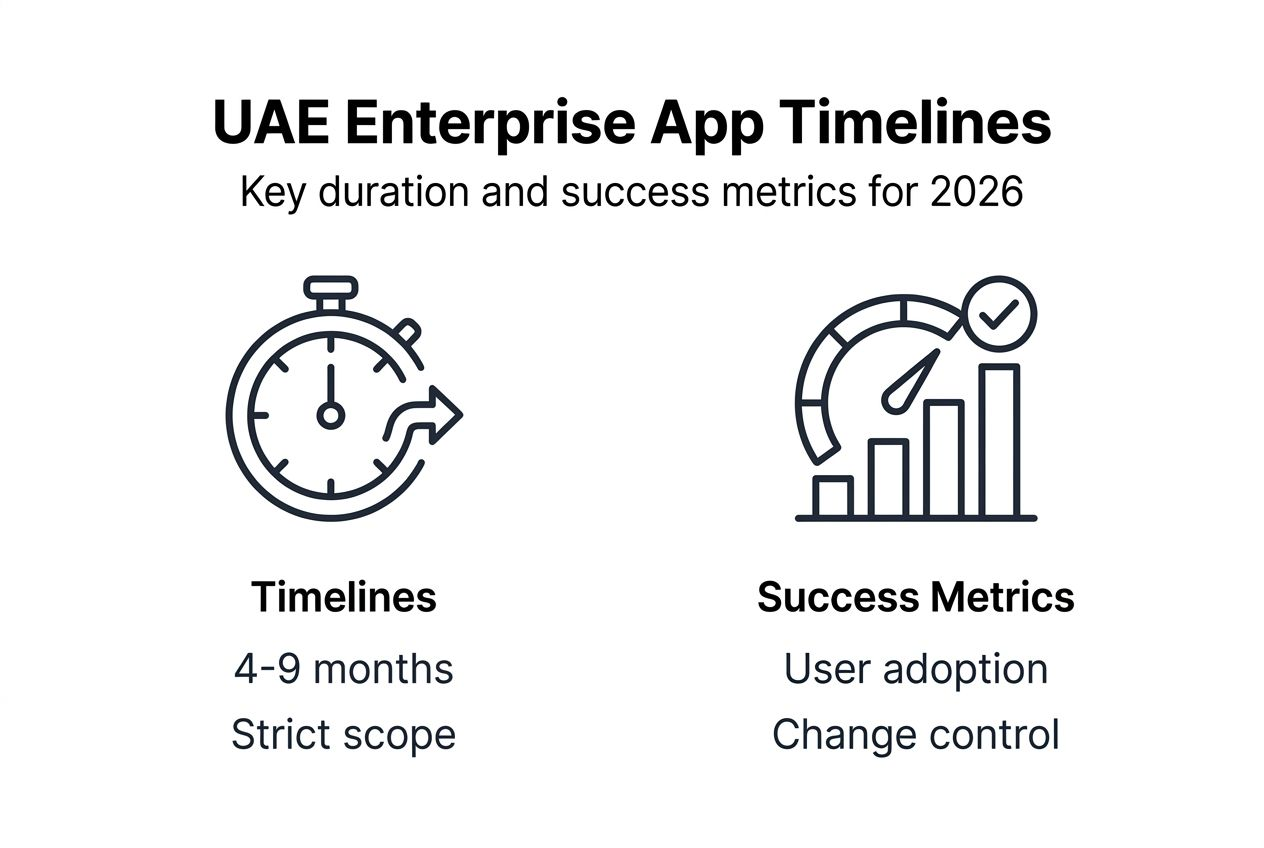
Research indicates 75% of enterprise app projects complete within 4 to 9 months depending on complexity. Simple departmental apps take 3 to 4 months while complex integrated systems require 8 to 12 months. Projects extending beyond one year often suffer from poor scoping or changing requirements.
| Project Type | Typical Duration | Key Complexity Factors |
|---|---|---|
| Departmental app | 3-4 months | Single user group, limited integration |
| Cross-functional system | 5-7 months | Multiple stakeholders, moderate integration |
| Enterprise-wide platform | 8-12 months | Complex workflows, extensive legacy integration |
Budget overruns average 27% for projects without strict scope control. Prevent this by implementing formal change management, conducting weekly budget reviews, and maintaining a contingency reserve for genuine surprises.
User adoption metrics matter more than technical metrics for measuring success. Effective training programs boost adoption rates by over 40%, turning your investment into actual business value. Track weekly active users, feature utilization rates, and user satisfaction scores.
Security metrics validate your protection efforts. Integrated security testing reduces vulnerabilities by more than 70% compared to apps where security is addressed late. Monitor attempted breaches, patch deployment speed, and security audit findings.
Define success metrics before development begins:
- Timeline adherence measured by sprint completion rates and milestone achievements
- Budget control tracked through actual versus planned spending with variance analysis
- Quality measured by defect rates, system uptime, and performance benchmarks
- User adoption tracked through login frequency, feature usage, and support ticket volume
- Business impact quantified through efficiency gains, cost savings, or revenue increases
Review the YJOZ project outcomes to see real-world examples of successful enterprise app implementations and their measured results.
Streamline your enterprise app development with YS Lootah Tech
Executing enterprise app projects successfully requires specialized expertise that many UAE businesses lack in-house. YS Lootah Tech delivers end-to-end application development tailored specifically for enterprises operating in the UAE market.
Our IT consulting services align your digital strategy with business objectives, ensuring technology investments deliver measurable returns. We help you avoid common pitfalls through proven methodologies refined across hundreds of enterprise projects.
Our UX/UI design expertise ensures your applications achieve high user adoption by focusing on intuitive workflows that match how your teams actually work. Partner with YS Lootah Tech to reduce project risk, control budgets, and accelerate your time to market with enterprise apps that drive real business value.
Frequently asked questions about enterprise app development steps
What is the main advantage of Agile in enterprise app development?
Agile methodologies deliver working software incrementally, allowing stakeholders to see progress and provide feedback throughout development rather than waiting months for a final product. This reduces the risk of building the wrong solution and enables teams to adapt to changing requirements efficiently.
How do UAE data laws affect app development projects?
UAE data protection regulations require specific consent mechanisms, data residency considerations, and security controls for personal information processing. Apps must implement appropriate safeguards and may need legal review to ensure compliance with both local laws and international standards like GDPR for cross-border operations.
What steps improve user adoption of new enterprise apps?
Successful adoption requires comprehensive training programs, clear communication about benefits, early involvement of power users as champions, and responsive support during the transition period. Organizations that invest in change management see adoption rates over 40% higher than those that simply deploy new systems without preparation.
How can legacy systems best be integrated?
Start legacy integration early in development after mapping existing data structures and business logic. Use modern API layers to abstract legacy complexity, conduct thorough testing of data flows, and maintain fallback procedures. Budget extra time for discovery since legacy systems often lack current documentation. Review proven digital transformation roadmap approaches for managing complex integrations.
What typical challenges cause timeline delays?
The most common delay causes include unclear requirements that lead to rework, underestimated legacy integration complexity, insufficient testing resources, scope creep from poor change control, and key stakeholder unavailability for decision-making. Addressing these through better planning and governance prevents most timeline overruns.