Future of cloud computing in 2026: enterprise IT guide
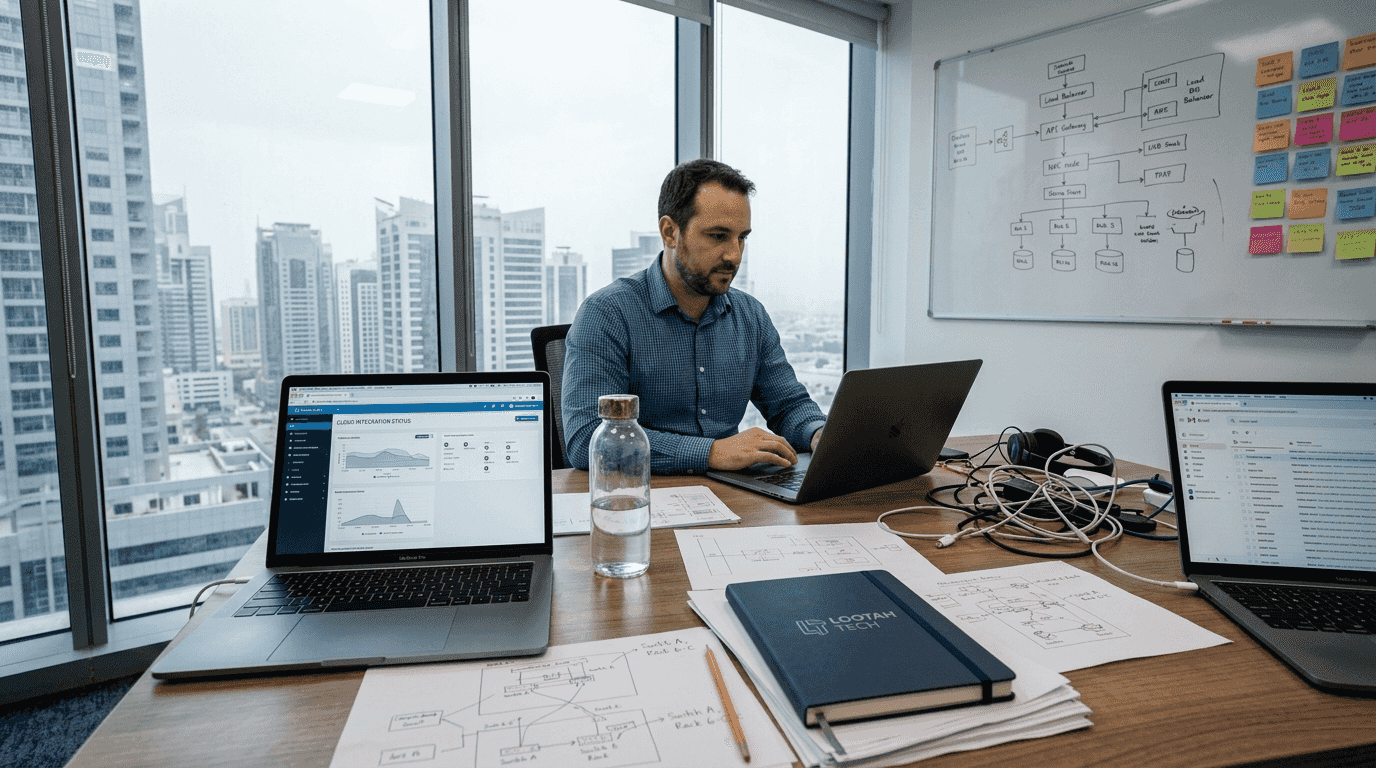
The cloud landscape has evolved far beyond simple migration decisions. Many IT leaders still view cloud computing as choosing between AWS, Azure, or Google Cloud, but 2026 demands a more sophisticated approach. Hybrid architecture is the default for enterprise computing, balancing on-premise datacenters, edge devices, and multiple cloud providers. This guide clarifies how hybrid models, multi-cloud strategies, AI workloads, and edge computing reshape decisions for mid-sized enterprises pursuing digital transformation. Understanding these trends helps you build resilient, cost-efficient infrastructure that drives operational excellence and competitive advantage.
Table of Contents
- The Evolving Cloud Landscape: Beyond Cloud-First To Hybrid And Multi-Cloud
- Operational Maturity Challenges In Multi-Cloud Environments
- AI Workloads And Edge Computing: Driving Cloud Evolution In 2026
- Leveraging Hybrid And Multi-Cloud For Digital Transformation Success
- Explore YS Lootah Tech's Cloud And IT Solutions
Key takeaways
| Point | Details |
|---|---|
| Hybrid cloud integration | Blends on-premise, edge, and multiple clouds for flexible workload orchestration and operational balance. |
| Multi-cloud maturity gap | 76% of enterprises use multiple clouds, but operational maturity lags behind adoption. |
| AI workload dominance | AI applications are the primary growth driver for cloud consumption in 2026. |
| Edge computing value | Solves latency and offline reliability challenges for critical IoT and smart city applications. |
| Strategic workload placement | Choosing the right environment for each workload enhances resilience and reduces costs. |
The evolving cloud landscape: beyond cloud-first to hybrid and multi-cloud
The traditional cloud-first approach has given way to sophisticated hybrid architectures that integrate on-premise infrastructure, edge devices, and multiple cloud providers. This shift reflects the reality that no single deployment model suits every workload. Enterprises need flexibility to orchestrate applications across environments based on latency requirements, compliance mandates, data gravity, and cost optimization.
Multi-cloud adoption has become widespread, with 76% of enterprises using more than one public cloud provider. Organizations pursue multi-cloud strategies to avoid vendor lock-in, access best-of-breed services, and improve resilience through geographic distribution. However, adoption often outpaces operational readiness, creating new challenges.
The gap between multi-cloud adoption and operational maturity creates significant inefficiencies. Many enterprises operationalize each cloud as a standalone silo because that path requires less coordination. This fragmented approach leads to duplicate provisioning systems, inconsistent access controls, and conflicting policy enforcement across AWS, Azure, and Google Cloud environments.
Common symptoms of operational immaturity include:
- Separate infrastructure provisioning workflows for each cloud provider
- Inconsistent identity and access management across environments
- Fragmented cost tracking and optimization efforts
- Disconnected incident response and monitoring systems
Successful hybrid multi-cloud strategies require unified operational models that treat diverse environments as a cohesive platform. This means standardizing governance frameworks, automating provisioning through common tools, and implementing centralized observability. Without this integration, enterprises miss the agility and efficiency benefits that justified multi-cloud adoption in the first place. Exploring trends in cloud computing innovation helps leaders understand how to bridge this maturity gap.
Enterprises keep operationalizing each cloud as a standalone silo because that is the path of least resistance, but this approach undermines the strategic value of multi-cloud architectures.
Addressing operational fragmentation requires treating multi-cloud as an architectural design decision rather than a vendor selection exercise. IT leaders must invest in platforms and processes that unify management across environments while preserving the flexibility to leverage provider-specific capabilities. This balance enables enterprises to capture multi-cloud benefits without drowning in complexity. Learning from innovative tech strategies business leaders 2026 provides practical frameworks for this transformation.
Operational maturity challenges in multi-cloud environments
Many enterprises run separate cloud programs without integrated operations, treating each provider relationship as an independent initiative. This fragmentation creates inefficiencies that compound as cloud usage grows. If you have three different answers for how you provision infrastructure, you don't have a multicloud operating model, you have three cloud programs competing for resources and attention.
The operational complexity manifests across critical functions:
- Infrastructure provisioning requires different tools and workflows for each cloud, slowing deployment velocity
- Access control policies vary by provider, creating security gaps and compliance risks
- Policy enforcement lacks consistency, making it difficult to maintain standards across environments
- Cost tracking becomes fragmented, obscuring total cloud spending and optimization opportunities
- Incident response depends on provider-specific monitoring, delaying problem resolution
- Compliance auditing multiplies effort as teams navigate different control frameworks
Treating multicloud as a procurement choice instead of an operating design leads directly to these challenges. Organizations focus on negotiating favorable contracts and selecting providers with strong feature sets, but neglect the operational architecture needed to manage them cohesively. This oversight transforms multi-cloud from a strategic advantage into a source of technical debt.
The financial impact extends beyond obvious waste. Fragmented operations increase labor costs as teams context-switch between environments and duplicate effort across silos. Security risks multiply when access controls and monitoring lack consistency. Innovation slows when developers must navigate multiple provisioning systems and policy frameworks to deploy applications.
Pro Tip: Establish a single multicloud operating model with unified governance, automation, and observability before expanding to additional cloud providers. This foundation prevents operational fragmentation and maximizes the strategic value of your cloud investments.
Operational maturity requires rethinking how you organize teams, design processes, and select tools. Cross-functional platform teams should own the multicloud operating model, providing standardized services that abstract provider-specific details. Automation through infrastructure as code and policy as code enables consistent provisioning and governance. Centralized observability platforms aggregate telemetry from all environments, providing unified visibility into performance, costs, and security posture. Implementing innovative tech strategies business leaders 2026 accelerates this maturity journey.
AI workloads and edge computing: driving cloud evolution in 2026
AI workloads are becoming the primary driver of cloud consumption, as enterprises shift from asking whether to deploy AI to determining how fast they can operationalize it. This urgency reflects AI's transformative potential across business functions, from customer service automation to predictive maintenance and supply chain optimization. The computational demands of training large models and serving inference at scale make cloud infrastructure essential for most AI initiatives.

However, on-premise systems thrive due to latency-sensitive applications, data gravity, compliance needs, and AI training workloads. Organizations retain on-premise infrastructure when data residency regulations prohibit cloud storage, when training datasets are too large to transfer economically, or when model serving requires single-digit millisecond latency. The cost of egress fees for moving massive datasets to the cloud often exceeds the expense of maintaining local GPU clusters.
Edge computing complements cloud by enabling capabilities that centralized architectures cannot deliver. Edge computing solves problems cloud never could, such as improved reliability in offline scenarios and ultra-low latency for real-time processing. Smart city applications, autonomous vehicles, and industrial IoT deployments require local processing to function when network connectivity fails or when millisecond response times are non-negotiable.
The interplay between cloud, on-premise, and edge creates architectural decisions that significantly impact costs and performance:
| Environment | Latency | Cost Structure | Compliance | AI Suitability |
|---|---|---|---|---|
| On-premise | Ultra-low for local apps | High upfront, lower ongoing | Full control | Ideal for training with large datasets |
| Cloud | Variable based on region | Pay-per-use, egress fees | Provider-dependent | Excellent for inference and elastic training |
| Edge | Minimal for local processing | Moderate device costs | Local data retention | Best for real-time inference |
Pro Tip: Assess workload requirements carefully before deciding where to deploy AI applications. Training large models often benefits from on-premise GPU clusters when datasets are massive, while inference workloads typically perform well in the cloud or at the edge depending on latency needs.
Successful AI strategies in 2026 combine these environments strategically. Training might occur on-premise or in the cloud depending on dataset size and compliance requirements. Model serving could happen at the edge for latency-critical applications, in the cloud for elastic scaling, or on-premise for data residency compliance. This hybrid approach optimizes costs while meeting performance and regulatory requirements. Exploring AI and machine learning services helps enterprises design these architectures effectively.
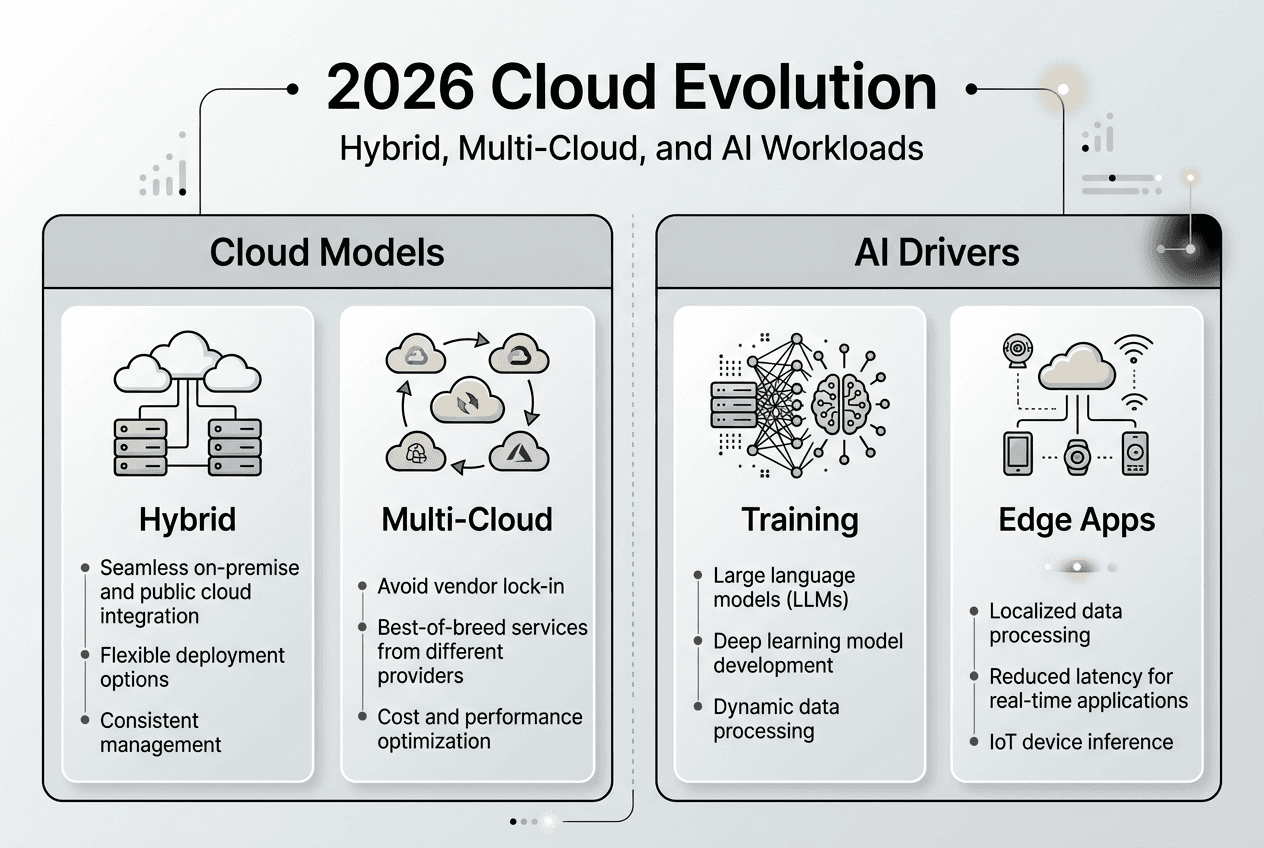
The rise of AI workloads also drives innovation in cloud services. Providers now offer specialized AI chips, managed machine learning platforms, and vector databases optimized for embedding search. These services reduce the operational burden of running AI infrastructure, but require careful cost management as usage scales. Understanding enterprise app examples 2026 demonstrates how organizations successfully deploy AI across hybrid environments.
Leveraging hybrid and multi-cloud for digital transformation success
Technology leaders face a pivotal year in 2026, where disruption, innovation, and risk are expanding at unprecedented speed. IT decision-makers must adopt agile hybrid and multi-cloud strategies that balance rapid innovation with risk management and operational efficiency. The organizations that succeed will be those that treat cloud architecture as a strategic enabler of business transformation rather than a cost center to be minimized.
These trends represent more than technology shifts, they are catalysts for business transformation. Hybrid and multi-cloud architectures enable agility by allowing workloads to move between environments as requirements change. They improve resilience by distributing applications across providers and geographic regions. They optimize costs by matching workload characteristics to the most economical deployment model.
Practical steps for IT leaders to operationalize these strategies include:
- Establish unified governance frameworks that apply consistent policies across all cloud and on-premise environments
- Optimize workload placement based on latency requirements, compliance mandates, data gravity, and cost considerations
- Implement cost transparency through centralized tracking and chargeback mechanisms that reveal total cloud spending
- Build continuous improvement capabilities through regular architecture reviews and optimization cycles
- Invest in automation platforms that abstract provider-specific details and enable standardized provisioning
| Strategy | Agility Benefits | Control Advantages | Cost Considerations | Complexity Challenges |
|---|---|---|---|---|
| Hybrid Cloud | Flexible workload placement | Full on-premise control | Optimized for specific workloads | Requires unified operations |
| Multi-Cloud | Best-of-breed services | Reduced vendor lock-in | Potential for cost optimization | Multiple provider relationships |
Pro Tip: Embed digital transformation goals into your cloud strategy from the start and create cross-functional teams that include business stakeholders, architects, and operations staff. This alignment ensures cloud investments directly support business outcomes rather than becoming technology projects disconnected from strategic priorities.
Successful digital transformation through cloud requires more than technical excellence. It demands organizational change, new skills, and cultural shifts toward automation and continuous improvement. IT leaders should invest in training programs that build cloud-native development skills, DevOps practices, and security expertise. Partnering with experienced consultants accelerates this journey by bringing proven frameworks and avoiding common pitfalls. Understanding digital transformation impact for CIOs provides strategic context for these investments.
The competitive advantage comes from speed of execution. Organizations that can rapidly provision infrastructure, deploy applications, and iterate based on feedback will outpace competitors stuck in traditional IT models. This agility requires automated pipelines, self-service platforms, and governance frameworks that enable innovation while managing risk. Following a comprehensive digital transformation roadmap enterprise success ensures these capabilities develop systematically rather than haphazardly.
Explore YS Lootah Tech's cloud and IT solutions
Navigating the complexities of hybrid and multi-cloud environments requires expert guidance and proven methodologies. YS Lootah Tech offers specialized IT consulting services tailored for enterprises managing sophisticated cloud architectures. Their consultants help you design unified operating models, optimize workload placement, and build the governance frameworks needed to capture multi-cloud benefits without operational fragmentation.
Beyond strategy, successful cloud initiatives require building modern applications that leverage cloud-native capabilities. YS Lootah Tech's application development services help enterprises create scalable, resilient solutions designed for hybrid environments. Their teams bring expertise in microservices architectures, containerization, and serverless computing that maximize cloud agility.
As AI workloads drive cloud consumption, specialized expertise becomes essential. YS Lootah Tech's AI and machine learning services accelerate your ability to operationalize AI across cloud and on-premise infrastructures. Their solutions help you navigate the architectural decisions around training versus inference, data gravity, and latency requirements that determine optimal deployment models. Partner with YS Lootah Tech to transform these cloud trends into competitive advantages that drive operational efficiency and innovation throughout 2026 and beyond.
Frequently asked questions
What is the future of cloud computing for enterprises?
The future centers on hybrid architectures that integrate on-premise, edge, and multiple cloud providers into cohesive platforms. AI workloads will drive the majority of cloud consumption growth, requiring flexible infrastructure that balances cost, performance, and compliance. Successful enterprises will treat cloud as an operating model rather than a destination, continuously optimizing workload placement across environments. Following a structured digital transformation roadmap ensures cloud investments align with business goals.
Why is hybrid cloud becoming the default operating model?
Hybrid cloud balances on-premise, edge, and multiple clouds to meet diverse requirements for latency, compliance, and operational control. No single environment optimally serves all workloads, so enterprises need flexibility to place applications where they perform best and cost least. Data gravity, regulatory mandates, and legacy system integration often require on-premise infrastructure, while cloud provides elastic scaling and rapid provisioning. Edge computing adds ultra-low latency and offline reliability for critical applications.
What are the main challenges in managing multi-cloud environments?
Fragmented infrastructure provisioning and governance lead to operational silos that undermine multi-cloud benefits. Organizations struggle with inconsistent access controls, duplicate monitoring systems, and conflicting policy frameworks across providers. Cost tracking becomes opaque when spending is fragmented across multiple billing systems and organizational silos. Unified operational models with centralized governance, automation, and observability are needed to maximize multi-cloud value while controlling complexity.
How is AI impacting cloud computing strategies in 2026?
AI workloads are the fastest growing driver of cloud consumption, requiring infrastructure that supports both training and inference at scale. Enterprises combine cloud, on-premise, and edge deployments to optimize AI costs and performance based on workload characteristics. Training large models often occurs on-premise when datasets are massive or compliance prohibits cloud storage, while inference workloads leverage cloud elasticity or edge latency. This hybrid approach balances computational demands with budget constraints and regulatory requirements.
How can mid-sized enterprises start their cloud digital transformation journey effectively?
Begin with a clear roadmap that links cloud strategy to specific business goals and operational maturity milestones. Assess current workloads to identify quick wins that demonstrate value while building organizational capabilities. Invest in unified governance frameworks and automation platforms before expanding to multiple cloud providers to avoid operational fragmentation. Leverage expert consulting to access proven methodologies and avoid common pitfalls that delay transformation. Following this start digital transformation guide provides a structured approach to reduce risks and accelerate success.