Trends in Cloud Computing: Driving Business Innovation

Every IT manager knows that outdated servers and rising demands put pressure on both budgets and teams. As mid-sized enterprises across the UAE look to excel in a fast-changing digital environment, understanding the basics of cloud computing and dispelling persistent myths becomes central to success. This guide brings clarity to core cloud principles and reveals practical strategies that empower your organization to make smarter, more flexible technology decisions for lasting operational efficiency.
Table of Contents
- Cloud Computing Basics And Key Misconceptions
- Major Types Of Cloud Services Explained
- Emerging Trends Shaping Cloud Solutions
- Security, Compliance, And Cost Strategies
- Real-World Use Cases Across Industries
Key Takeaways
| Point | Details |
|---|---|
| Cloud Computing Transforms IT | Mid-sized enterprises can reduce capital expenditure and improve operational flexibility by shifting to cloud computing models. |
| Debunking Common Myths | Many hesitations regarding cloud adoption stem from misconceptions about security, control, and suitability for businesses of all sizes. |
| Understanding Service Models | IaaS, PaaS, and SaaS provide varied levels of control and responsibility; organizations should choose based on their specific needs. |
| Emerging Trends Impacting Cloud | AI, multi-cloud strategies, and serverless computing are shaping the future of cloud services, offering greater efficiency and innovation. |
Cloud Computing Basics and Key Misconceptions
Cloud computing shifts how mid-sized enterprises store, process, and access data. Instead of maintaining expensive on-site servers, your organization rents computing resources from specialized providers. This fundamental change has reshaped business operations across the UAE and globally.
Think of cloud computing like switching from owning a backup generator to subscribing to a utility company. You pay for what you use, scale up during peak demand, and eliminate the burden of maintenance.
Understanding Core Cloud Principles
Cloud computing operates on several foundational pillars that make it different from traditional IT infrastructure:
- On-demand access - Request resources instantly without long procurement cycles
- Scalability - Increase or decrease capacity based on real-time business needs
- Pay-as-you-go pricing - Pay only for consumed resources, not unused capacity
- Remote accessibility - Access applications and data from anywhere with internet connection
- Automatic updates - Providers handle software patches and maintenance automatically
According to foundational cloud computing principles, these characteristics enable organizations to reduce capital expenditure while improving operational flexibility.
Your IT team no longer manages physical servers in your data center. Instead, cloud providers handle infrastructure maintenance, security patching, and system upgrades. This frees your team to focus on strategic initiatives rather than routine maintenance.
Common Misconceptions That Hold Businesses Back
Mid-sized enterprises in the UAE often hesitate with cloud adoption due to myths rather than real barriers. Let me address the ones I hear most frequently:
"Cloud is less secure than our on-site servers."
Cloud providers invest billions in security infrastructure. Their security teams work around the clock. Your on-site servers? Likely managed by one or two IT staff. Cloud providers employ certified security experts, run continuous vulnerability testing, and maintain compliance with international standards that most mid-sized companies cannot achieve alone.

"We lose control of our data."
You maintain complete control through access permissions and encryption keys. Cloud providers cannot access your encrypted data. You decide who views what, set access restrictions, and can audit all activities.
"Cloud is only for large enterprises."
Cloud services scale from startups to Fortune 500 companies. Pricing models accommodate smaller budgets. Mid-sized enterprises benefit most because they avoid massive upfront infrastructure costs while accessing enterprise-grade capabilities.
"Migration requires shutting down operations."
Phased migration approaches keep systems running. Most providers offer tools and managed services to move data gradually without operational disruption. Your business continues serving customers throughout the transition.
Cloud adoption fails when organizations expect immediate results without planning. Success requires clear objectives, phased implementation, and staff training.
Pro tip: Start with non-critical workloads to build internal expertise and confidence before migrating mission-critical applications to the cloud.
Major Types of Cloud Services Explained
Cloud services fall into three distinct categories, each serving different business needs. Understanding these models helps you choose the right solution for your enterprise. Your choice affects cost, control, and operational flexibility.
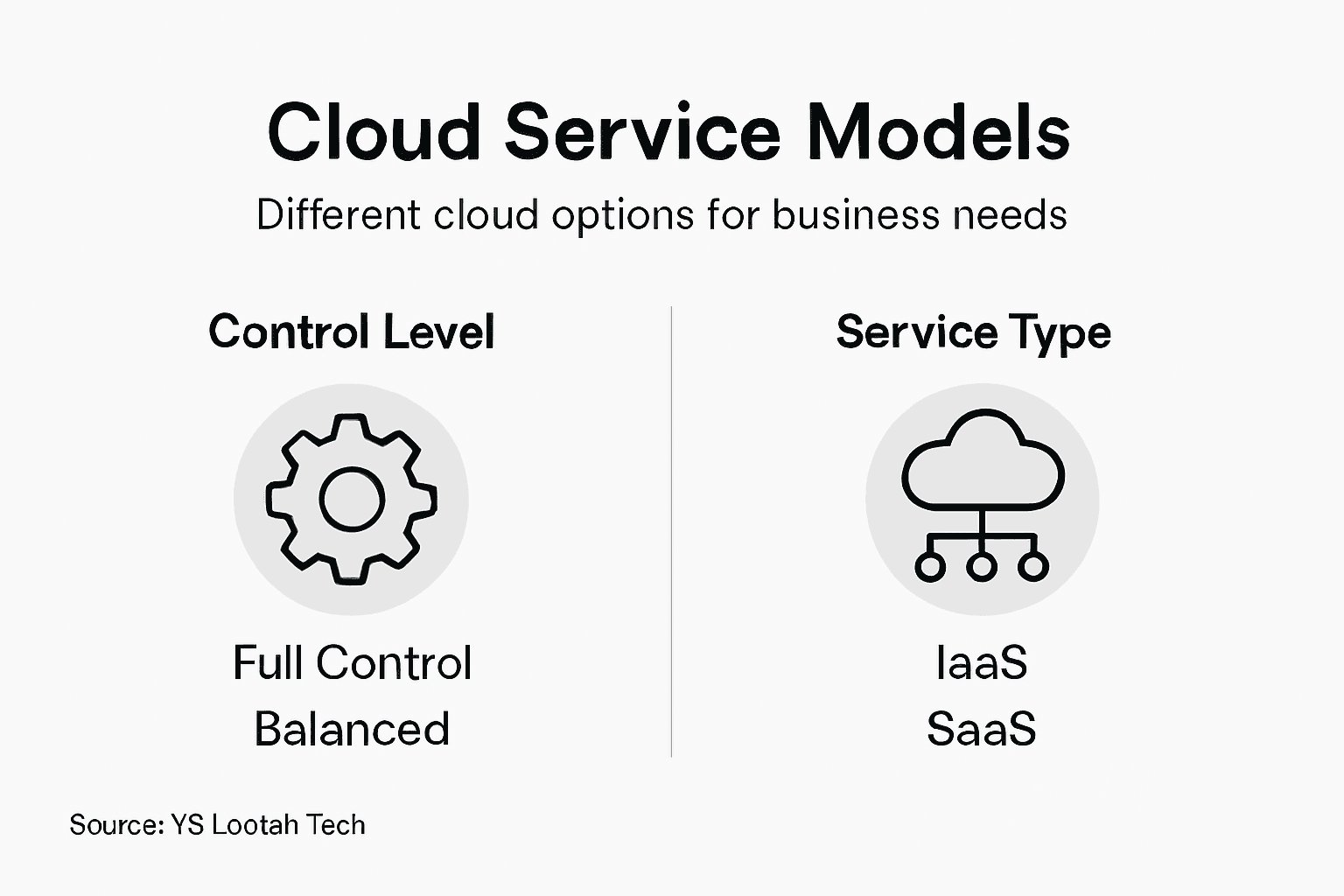
Think of it like dining options: a restaurant (SaaS) handles everything, a kitchen rental (PaaS) provides the space and tools, and raw ingredients (IaaS) leave everything to you.
Infrastructure as a Service (IaaS)
IaaS gives you virtual computing resources over the internet. You rent servers, storage, and networking instead of buying physical hardware. Your organization maintains maximum control and responsibility.
With IaaS, you:
- Provision and configure servers instantly
- Scale infrastructure up or down based on demand
- Pay only for consumed resources
- Manage operating systems and applications yourself
- Handle security patches for your software layer
IaaS works best for organizations needing custom infrastructure. Your development team builds applications on this foundation. You control everything above the hardware layer.
Platform as a Service (PaaS)
PaaS provides development and deployment environments in the cloud. Developers build applications without managing underlying infrastructure. The provider handles servers, storage, databases, and middleware.
Your team focuses on coding while the provider manages:
- Server maintenance and patching
- Database administration
- Security updates
- Scaling and availability
PaaS accelerates development cycles. Developers deploy code directly without infrastructure configuration. Mid-sized enterprises use PaaS to reduce development costs and time-to-market.
Software as a Service (SaaS)
SaaS delivers applications through web browsers. You access software without installation or maintenance. The provider handles everything—hosting, updates, security, backups.
SaaS requires minimal IT involvement:
- Access via internet browser or mobile app
- Automatic updates and patches
- Minimal data center infrastructure needed
- Predictable subscription pricing
According to cloud service models and their applications, SaaS represents the largest cloud market segment due to ease of adoption and low technical barriers.
Comparing Control and Responsibility
Each model shifts responsibility differently:
| Aspect | IaaS | PaaS | SaaS |
|---|---|---|---|
| Infrastructure | You manage | Provider manages | Provider manages |
| Applications | You manage | You manage | Provider manages |
| Control level | High | Medium | Low |
| Technical expertise | Required | Moderate | Minimal |
IaaS gives maximum control but requires more expertise. SaaS offers simplicity but less customization. PaaS balances both.
To better understand how cloud models support different business needs and skills, review the summary below:
| Cloud Model | Ideal Users | Primary Benefits | Common Challenges |
|---|---|---|---|
| IaaS | IT teams, developers | Full customization, flexible scaling | Requires advanced expertise |
| PaaS | App developers, startups | Rapid deployment, simplified management | Limited infrastructure control |
| SaaS | General staff, business units | Fast adoption, low IT overhead | Less customization, vendor reliance |
Your choice depends on control needs, technical capability, and cost tolerance. Most enterprises use all three models simultaneously.
Pro tip: Audit your existing applications first—some fit SaaS immediately while others require PaaS or IaaS for specific performance or customization needs.
Emerging Trends Shaping Cloud Solutions
Cloud computing is evolving rapidly. New technologies reshape how enterprises build, deploy, and manage applications. Staying informed about these trends keeps your organization competitive in the UAE market.
The cloud landscape shifts from infrastructure-focused decisions to business-driven innovation. Your IT strategy must adapt to these changes.
Artificial Intelligence and Machine Learning Integration
AI workloads now dominate cloud adoption across enterprises. Machine learning models require massive computing power that cloud providers deliver efficiently. Your organization can train and deploy AI applications without building expensive on-site infrastructure.
AI in the cloud enables:
- Predictive analytics for demand forecasting
- Automated customer service through chatbots
- Real-time data analysis across operations
- Intelligent resource optimization
According to emerging cloud computing trends, AI-driven workloads represent one of the six major cloud trends reshaping enterprise strategy. Machine learning integration reduces operational costs while improving decision-making speed.
Multi-Cloud and Hybrid Architecture
Multi-cloud strategies reduce vendor lock-in. Organizations distribute workloads across multiple providers based on cost, performance, and compliance requirements. This approach provides flexibility and bargaining power.
Hybrid cloud combines on-premise systems with cloud resources. Your critical legacy applications stay in-house while new projects move to the cloud. This gradual transition manages risk and preserves existing investments.
Challenges with multi-cloud:
- Managing disparate platforms requires specialized skills
- Data consistency across providers demands attention
- Security policies must cover all environments
- Cost tracking becomes more complex
Serverless Computing Growth
Serverless architecture removes infrastructure management entirely. You write code; the provider handles scaling, availability, and maintenance. Developers focus purely on business logic.
Serverless suits:
- Event-driven applications
- Real-time data processing
- Microservices architectures
- Rapid prototyping and deployment
You pay only when code executes, eliminating idle infrastructure costs. This model accelerates development cycles significantly.
Cloud Sustainability and Governance
Regulatory requirements tighten around data residency and digital sovereignty. The UAE emphasizes protecting citizen data within national borders. Cloud providers must comply with these regulations or face penalties.
Sustainability initiatives gain importance. Organizations demand cloud providers use renewable energy and optimize resource consumption. Environmental responsibility aligns with corporate values.
Governance challenges include:
- Regulatory compliance across jurisdictions
- Data sovereignty requirements
- Environmental impact accountability
- Cost optimization and waste reduction
Multi-cloud complexity increases operational overhead. Success requires clear governance frameworks and skilled teams managing multiple platforms.
Pro tip: Evaluate cloud providers based on regional data center locations—ensure they meet UAE regulatory requirements and offer strong data residency guarantees before committing.
Security, Compliance, and Cost Strategies
Cloud security isn't optional—it's fundamental to protecting your business. As enterprises move workloads to the cloud, security complexity increases. Your organization must address threats while managing costs and regulatory requirements simultaneously.
Three critical areas demand attention: security practices, compliance obligations, and cost optimization.
Understanding Shared Responsibility
Shared responsibility means both you and the cloud provider have security duties. The provider secures infrastructure; you secure applications and data. Understanding this division prevents dangerous gaps.
Your responsibilities include:
- Configuring access controls and permissions
- Encrypting sensitive data
- Managing user authentication and passwords
- Monitoring for suspicious activity
- Applying security patches to your applications
- Backing up critical data
The provider handles infrastructure security, physical facilities, and platform updates. Confusion about these boundaries creates vulnerabilities. According to cloud security and compliance strategies, misconfigurations and unclear responsibility divisions remain leading security challenges in multi-cloud environments.
Document your security responsibilities explicitly. Train teams on what each person manages. Regular audits confirm proper implementation.
Building a Zero-Trust Security Framework
Zero-trust security assumes no user or device deserves automatic trust. Every access request requires verification regardless of location. This approach dramatically reduces breach impact.
Zero-trust implementation involves:
- Verifying every user identity before access
- Validating device compliance before connection
- Encrypting all data in transit and at rest
- Monitoring all network activity continuously
- Limiting access to minimum necessary permissions
Zero-trust requires more upfront work but prevents attackers from moving laterally once inside. This model protects against insider threats and compromised credentials effectively.
Compliance in Regulated Industries
Regulations like GDPR, HIPAA, and UAE data protection laws mandate specific security controls. Non-compliance results in substantial fines and reputational damage. Choose cloud providers certified for your industry's requirements.
Compliance checklist:
- Verify provider certifications (ISO 27001, SOC 2)
- Confirm data residency in approved locations
- Document data processing agreements
- Conduct regular security audits
- Maintain encryption key control
- Enable audit logging for compliance verification
Optimizing Cloud Costs Without Sacrificing Security
Security and cost optimization aren't opposing goals. Smart strategies achieve both simultaneously. Right-sizing instances, eliminating unused resources, and automating deployments reduce waste while maintaining protection.
Cost reduction strategies:
- Use reserved instances for predictable workloads
- Implement automated scaling for variable demand
- Delete unused storage and snapshots regularly
- Monitor spending alerts constantly
- Consolidate similar workloads onto shared platforms
Automation reduces manual security work, lowering operational costs. Security tools that integrate with your cloud platform catch misconfigurations before they become expensive breaches.
Security talent shortages make automation essential. Automated compliance checks and threat detection reduce burden on limited teams while improving response speed.
Pro tip: Implement security automation tools that flag misconfigurations immediately—catch problems before attackers exploit them, saving both security incidents and remediation costs.
Real-World Use Cases Across Industries
Cloud computing transforms operations across every sector. Mid-sized enterprises in the UAE leverage cloud solutions to compete globally. Understanding how your industry peers use cloud reveals opportunities you might overlook.
Let's examine practical implementations that drive measurable results.
Healthcare and Telemedicine
Telemedicine platforms require reliable, scalable infrastructure. Cloud enables hospitals to launch remote consultation services without building data centers. Patient records sync across locations securely and instantly.
Healthcare cloud applications include:
- Patient management systems accessible from any facility
- Real-time diagnostic imaging sharing between specialists
- Appointment scheduling and billing automation
- Secure electronic health record storage
- AI-powered disease prediction and diagnosis support
According to cloud use cases in healthcare and finance, healthcare organizations use cloud to accelerate telemedicine adoption and improve patient engagement while maintaining regulatory compliance.
Clinics reduce infrastructure costs by 60% while improving response times. Doctors access patient data during emergencies without delay.
Financial Services and Risk Management
Multi-cloud strategies dominate financial services. Banks distribute workloads across providers to reduce outage risk. Market data processing demands real-time cloud scalability.
Financial applications benefit from cloud:
- High-frequency trading platforms requiring millisecond response times
- Regulatory compliance monitoring across all transactions
- Fraud detection using machine learning algorithms
- Disaster recovery ensuring business continuity
- Cost analysis and reporting across global operations
Financial institutions process billions of transactions daily. Cloud elasticity handles peak demand without maintaining expensive idle capacity.
Manufacturing and Supply Chain Optimization
IoT sensor data from manufacturing floors streams to cloud platforms continuously. Predictive maintenance prevents equipment failures before they occur. Production schedules adjust automatically based on real-time supply and demand signals.
Manufacturing cloud use cases:
- Equipment monitoring and predictive maintenance
- Production line optimization using AI analytics
- Supply chain visibility across vendors and distributors
- Quality control automation with computer vision
- Inventory forecasting reducing storage costs
Factories reduce downtime by 40% through predictive maintenance. Real-time supply chain visibility prevents costly production delays.
Here’s how major industries in the UAE leverage cloud solutions for tangible improvements:
| Industry | Typical Cloud Use | Key Business Impact |
|---|---|---|
| Healthcare | Telemedicine, EHR storage | Faster response, 60% cost reduction |
| Finance | Trading, fraud detection | Superior uptime, real-time analytics |
| Manufacturing | IoT, predictive analytics | Downtime cut by 40%, smart logistics |
| Retail | Auto-scaling, customer data | Seamless shopping, inventory accuracy |
Retail and E-Commerce
E-commerce platforms handle massive traffic spikes during sales events. Cloud auto-scaling prevents site crashes during Black Friday or holiday peaks. Customer data integrates across online and physical stores seamlessly.
Retail cloud capabilities:
- Website hosting with guaranteed uptime
- Point-of-sale system synchronization across locations
- Customer analytics across all touchpoints
- Personalized product recommendations using AI
- Inventory management spanning online and stores
Industry leaders adopt cloud not for technology's sake, but because it solves specific business problems faster and cheaper than alternatives.
Pro tip: Identify one department's pain point—slow systems, poor data visibility, or high IT costs—and pilot a cloud solution there before expanding cloud adoption across your entire organization.
Unlock Business Innovation with Expert Cloud Solutions
The article highlights how cloud computing trends like AI integration, multi-cloud architectures, and serverless computing drive innovation yet present challenges such as security complexity and cost management. If your enterprise is grappling with fragmented IT environments, unclear security responsibilities, or slow digital adoption this is the moment to transform those pain points into competitive advantages. Embracing cloud does not have to be overwhelming when you partner with experts who understand your industry needs.
YS Lootah Tech specializes in tailoring advanced cloud computing services combined with AI and cybersecurity to help organizations in Dubai and beyond securely accelerate their digital transformation. From strategic consultation to custom software development our comprehensive solutions ensure smooth migration, robust zero-trust security frameworks, and optimized cloud costs aligned with your business objectives.
Explore our digital transformation offerings and discover how integrating cutting-edge cloud technologies can empower your teams and future-proof your IT environment.
Take charge of your cloud journey today with YS Lootah Tech. Contact us now to build scalable, secure, and innovative solutions that propel your business forward without disruption or risk.
Frequently Asked Questions
What are the key benefits of cloud computing for mid-sized enterprises?
Cloud computing allows mid-sized enterprises to reduce capital expenditure, improve operational flexibility, access enterprise-grade capabilities, and scale resources on demand without the burdens of maintaining physical infrastructure.
How does cloud computing enhance security for businesses compared to on-site servers?
Cloud providers invest heavily in security infrastructure, employing certified experts and maintaining compliance with international standards. This level of security often surpasses what most mid-sized businesses can implement on their own with limited IT staff.
What types of cloud services should a business consider based on its needs?
Businesses should consider Infrastructure as a Service (IaaS) for high control and customization, Platform as a Service (PaaS) for rapid application development without managing infrastructure, and Software as a Service (SaaS) for easy access to applications without the need for installation and maintenance.
What are some emerging trends in cloud computing that businesses should be aware of?
Emerging trends include the integration of Artificial Intelligence (AI) and Machine Learning (ML), adoption of multi-cloud strategies to avoid vendor lock-in, growth of serverless computing for reducing infrastructure management, and increasing focus on sustainability and governance in cloud solutions.