Why choose digital solutions: drive growth in 2026

Despite 70% of digital transformation projects failing, the organizations that succeed see dramatic gains in efficiency, customer satisfaction, and revenue. The disconnect isn't about technology quality but how executives approach implementation. This guide clarifies the real benefits of digital solutions, from operational streamlining to competitive agility, and reveals the critical organizational factors that separate success from failure. You'll discover evidence-based strategies for driving measurable growth while avoiding the pitfalls that derail most initiatives.
Table of Contents
- How Digital Solutions Enhance Operational Efficiency
- Improving Customer Experience With Digital Tools
- Gaining A Competitive Edge With Data-Driven Agility
- Avoiding Common Pitfalls In Digital Solution Adoption
- Explore Tailored Digital Solutions With YS Lootah Tech
- Frequently Asked Questions About Digital Solutions
Key takeaways
| Point | Details |
|---|---|
| Efficiency gains | Digital automation delivers 32% operational efficiency increases and 15-20% supply chain cost reductions |
| Customer impact | Personalized digital experiences and omnichannel integration boost satisfaction scores by 20% |
| Competitive speed | Data-driven agility enables 40% faster time-to-market and 26% average revenue growth |
| Organizational focus | Success requires integrating culture, leadership, and change management from the start, not just technology |
| Failure prevention | Most projects fail due to treating digital transformation as a technology-only initiative rather than a business strategy |
How digital solutions enhance operational efficiency
Operational efficiency improvements represent the most immediate and measurable benefit of digital adoption. Digital solutions boost efficiency by 32% through automation of repetitive tasks, process streamlining, and intelligent resource allocation. When you automate invoice processing, inventory management, or customer onboarding, you eliminate manual errors while freeing teams for strategic work.

The financial impact extends beyond labor savings. Organizations implementing comprehensive digital solutions achieve 15-20% supply chain cost reductions by optimizing logistics, reducing waste, and improving demand forecasting accuracy. These gains compound over time as systems learn from operational data and continuously refine processes.
| Efficiency Metric | Traditional Approach | Digital Solution Impact |
|---|---|---|
| Process completion time | 5-7 business days | 1-2 business days |
| Error rate | 8-12% | Under 2% |
| Labor cost per transaction | $15-25 | $3-7 |
| Data accessibility | 24-48 hours | Real-time |
Integrating systems across departments creates exponential value. When your CRM connects with inventory management, order fulfillment, and financial reporting, you gain visibility that was impossible with siloed tools. Sales teams see real-time stock levels, finance tracks revenue as it happens, and operations adjust production based on actual demand signals.
Common operational benefits include:
- Accelerated decision cycles through instant access to accurate data
- Reduced overhead costs by eliminating redundant manual processes
- Improved resource utilization via predictive analytics and workload balancing
- Enhanced compliance through automated documentation and audit trails
- Scalability without proportional cost increases as business grows
Pro Tip: Focus your digital strategy on end-to-end process transformation rather than isolated technology deployments. Automating one step in a broken workflow just creates faster dysfunction. Map complete value streams, identify bottlenecks, then implement solutions that address the entire flow from customer request to delivery.
Improving customer experience with digital tools
Customer expectations have shifted dramatically, and digital solutions provide the infrastructure to meet them. Organizations leveraging digital tools for customer interactions see 20% higher satisfaction scores compared to those relying on traditional approaches. This improvement stems from personalization, responsiveness, and consistency across touchpoints.
Personalized interactions powered by unified customer data transform generic service into tailored experiences. When your systems consolidate purchase history, support tickets, browsing behavior, and communication preferences, every team member can engage customers with relevant context. A support agent sees past issues instantly. Marketing sends offers aligned with actual interests. Sales teams understand pain points before the first conversation.
Omnichannel strategies enabled by digital platforms ensure seamless journeys regardless of how customers choose to interact. Someone might research on mobile, compare options on desktop, purchase via tablet, and request support through chat. Without integrated systems, each touchpoint feels disconnected. Digital solutions create continuity, remembering context and preferences across every channel.
Key digital tools driving customer improvements:
- CRM platforms that centralize customer data and interaction history for personalized engagement
- AI-powered chatbots providing instant responses to common questions 24/7
- Analytics engines identifying behavioral patterns and predicting customer needs
- Self-service portals empowering customers to resolve issues and access information independently
- Feedback systems capturing sentiment in real time for rapid service adjustments
Measuring customer experience improvements requires tracking specific digital transformation KPIs beyond satisfaction scores. Monitor Net Promoter Score changes, customer effort scores, first-contact resolution rates, and average handling times. These metrics reveal whether your digital investments actually reduce friction and enhance value delivery.
The competitive advantage of superior customer experience compounds over time. Satisfied customers spend more, refer others, and cost less to retain. They provide valuable feedback that drives digital innovation and product improvements. Organizations treating customer experience as a strategic priority rather than a cost center consistently outperform competitors in revenue growth and market share expansion.
Gaining a competitive edge with data-driven agility
Market leadership increasingly depends on organizational agility and decision speed. Digital solutions provide the foundation for both by enabling real-time data access, rapid experimentation, and faster execution cycles. Companies leveraging digital capabilities achieve 40% faster time-to-market for new products and services while maintaining quality standards.
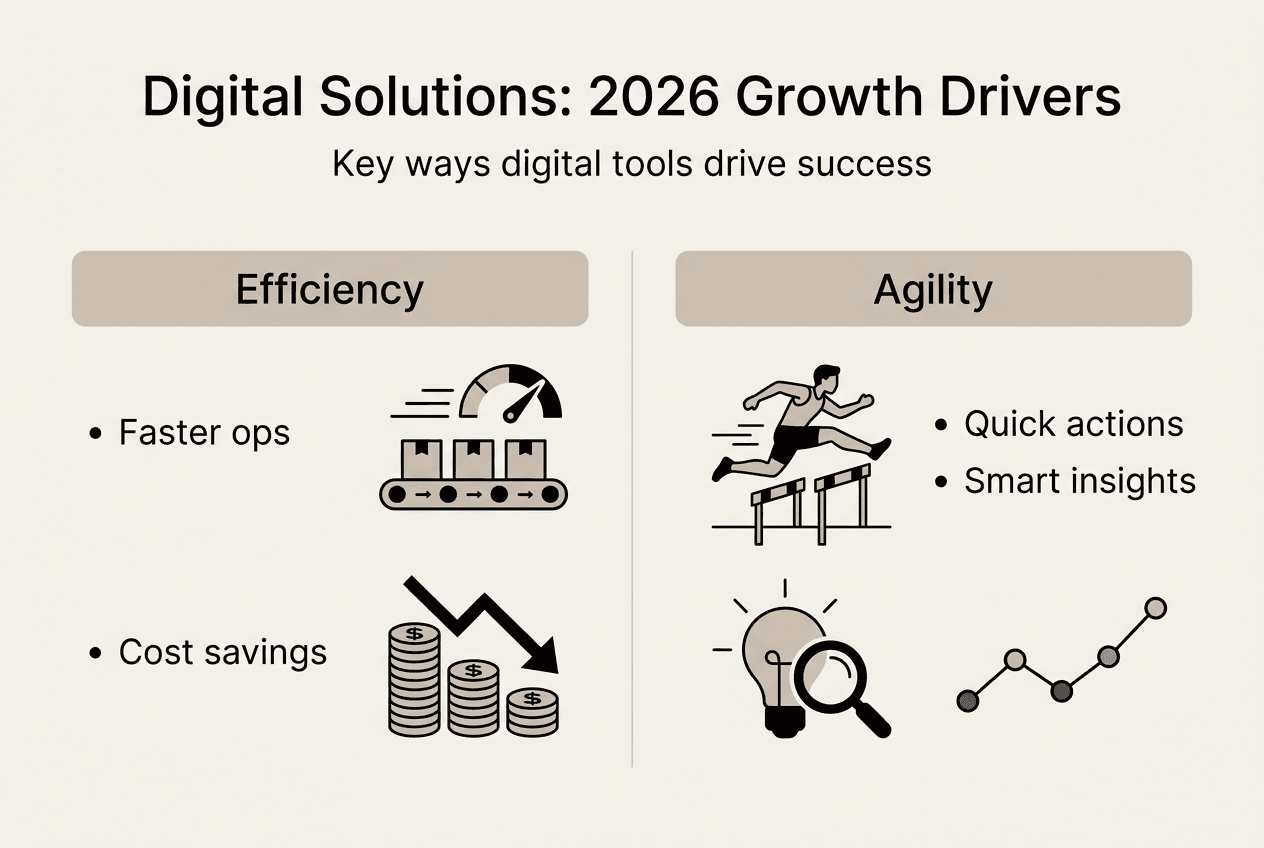
Data-driven decision making replaces intuition and delayed reporting with actionable insights available instantly. When executives access live dashboards showing customer behavior, operational performance, and market trends, they can adjust strategies before problems escalate or opportunities disappear. This responsiveness creates sustainable competitive advantages that traditional approaches cannot match.
Organizations implementing comprehensive digital strategies see 26% average revenue growth compared to industry peers. This performance gap reflects their ability to identify emerging customer needs faster, optimize pricing dynamically, and allocate resources based on real-time profitability data rather than quarterly reviews.
Steps to leverage digital solutions for competitive advantage:
- Establish unified data infrastructure connecting all business systems for comprehensive visibility
- Implement analytics capabilities that surface insights automatically rather than requiring manual analysis
- Create feedback loops between customer interactions and product development teams
- Deploy A/B testing frameworks allowing rapid experimentation with minimal risk
- Build agile governance structures that enable fast decisions without sacrificing oversight
- Invest in talent development so teams can interpret data and act on insights effectively
| Capability | Traditional Approach | Digital-Driven Approach |
|---|---|---|
| Market response speed | 3-6 months | 2-4 weeks |
| Decision data freshness | 30-90 days old | Real-time to 24 hours |
| Adaptation to trends | Reactive, after impact visible | Proactive, predictive signals |
| Revenue optimization | Annual pricing reviews | Dynamic, algorithm-driven |
| Innovation cycle | 18-24 months | 6-9 months |
The most successful organizations view digital transformation not as a project but as an ongoing capability. They continuously evaluate emerging technologies, test applications in controlled environments, and scale proven solutions rapidly. This approach requires cultural shifts toward experimentation and learning from failures, not just technology investments.
Pro Tip: Align your innovative tech strategies with fast feedback loops and market dynamics rather than long-term roadmaps set in stone. Build flexibility into architecture and governance so you can pivot when data reveals better opportunities. The goal is responsive adaptation, not rigid execution of predetermined plans. Create a digital transformation roadmap that includes regular reassessment points and clear criteria for continuing, adjusting, or abandoning initiatives.
Avoiding common pitfalls in digital solution adoption
Understanding why digital initiatives fail matters as much as knowing success factors. Research shows 70% of transformations fail when treated as technology projects rather than organizational change programs. The root cause isn't inadequate technology but neglecting the human and structural elements essential for adoption.
Culture resistance represents the most significant barrier. Employees comfortable with existing processes view new systems as threats rather than tools. Without addressing concerns, providing training, and demonstrating clear benefits, even the best platforms sit unused. This resistance intensifies when leadership mandates change without involving teams in design and implementation decisions.
Organizations that ignore organizational design, culture integration, and change management see failure rates exceeding 70%, with side effects including employee burnout from role overload and competing priorities.
Common pitfalls causing digital initiative failures:
- Treating transformation as an IT responsibility rather than a business strategy owned by executive leadership
- Deploying technology without redesigning workflows and processes to leverage new capabilities
- Underestimating change management needs and failing to support employees through transitions
- Creating siloed initiatives that don't integrate with existing systems or business objectives
- Lacking clear success metrics and accountability for adoption and business outcomes
- Overloading employees with transformation work on top of existing responsibilities without adjusting workloads
Successful adoption requires integrating people, culture, and strategy from the beginning. Executives should prioritize business-led strategies over technology-first approaches, involving stakeholders across functions in defining requirements and measuring progress. Use maturity benchmarks to assess readiness and identify capability gaps before major investments.
Measuring ROI through adoption analytics provides early warning signs of problems. Track user engagement, feature utilization, and process completion rates alongside business metrics like cost savings and revenue impact. Low adoption indicates training gaps, usability issues, or misalignment with actual work needs that require immediate attention.
Structured frameworks with executive sponsorship and agile governance prevent the chaos that derails initiatives. Establish clear decision rights, escalation paths, and review cadences. Break large transformations into manageable phases with defined outcomes and success criteria. This approach allows course correction based on results rather than continuing failed strategies due to sunk costs.
Learn from organizations reducing transformation failure by focusing on organizational readiness as much as technical capability. Assess leadership commitment, cultural openness to change, and existing digital maturity before selecting solutions. Understanding what digital transformation means for CIOs helps align technology decisions with business strategy rather than pursuing innovation for its own sake.
Explore tailored digital solutions with YS Lootah Tech
Transforming operational efficiency, customer experience, and competitive positioning requires more than off-the-shelf software. YS Lootah Tech specializes in application development, website development, and UX/UI design tailored to your specific business goals and industry requirements. Our approach integrates advanced technologies like AI, cloud computing, and enterprise systems with strategic planning that addresses organizational readiness and change management.
We partner with executives to design digital solutions that align with operational realities and growth objectives, not generic best practices. From e-commerce platforms to industrial management tools and fintech solutions, our portfolio demonstrates capability across diverse sectors. Our commitment extends beyond implementation to ongoing support, ensuring your digital investments deliver sustained value as your business evolves and market conditions shift.
Frequently asked questions about digital solutions
How can digital solutions increase operational efficiency?
Digital solutions automate repetitive tasks, streamline workflows, and provide real-time visibility across operations. Organizations typically see 32% efficiency gains and 15-20% cost reductions in supply chains through intelligent resource allocation and error elimination.
What are key factors for successful digital adoption?
Success requires treating digital transformation as a business strategy with executive sponsorship, not just a technology project. Integrate change management, culture initiatives, and process redesign from the start while measuring adoption and business outcomes continuously.
How do digital tools enhance customer satisfaction?
Digital platforms enable personalized interactions through unified customer data, seamless omnichannel experiences, and 24/7 self-service options. These capabilities increase satisfaction scores by 20% by reducing effort and providing consistent, relevant engagement across touchpoints.
What risks should executives be aware of in digital projects?
The primary risk is treating transformation as technology deployment rather than organizational change, which causes 70% of failures. Other critical risks include culture resistance, employee burnout from overload, siloed initiatives, and lack of clear ROI measurement frameworks.
How to measure ROI from digital solution investments?
Track both adoption metrics like user engagement and feature utilization alongside business outcomes including cost savings, revenue growth, and customer satisfaction improvements. Establish baseline measurements before implementation and monitor progress through your digital transformation roadmap with regular review cycles.
Why do many digital transformation initiatives fail despite strong technology?
Failures stem from organizational factors rather than technical limitations. Neglecting change management, ignoring culture resistance, lacking executive commitment, and failing to redesign processes around new capabilities prevent even excellent technology from delivering value.