The Future of AI in 2026: What Business Leaders Must Know

TL;DR:
- By 2026, AI shifts from individual tools to enterprise-wide, reusable workflows known as AI factories, transforming industries. Workforce impacts include reshaping 50% to 55% of US jobs, emphasizing reskilling and human-AI collaboration; governance and regulation remain critical for responsible deployment. Physical and agentic AI advance, with narrow autonomous systems deploying now, while multi-agent coordination and strict compliance frameworks are emerging priorities.
The future of AI in 2026 is defined by a decisive shift from individual productivity tools to enterprise-scale, agent-enabled workflows that reshape entire industries. Generative AI has crossed into mainstream territory, with 900 million ChatGPT users and Google Gemini surpassing 750 million active users. That scale signals something more significant than adoption numbers. It signals that AI is no longer a pilot program. It is an operational layer that business leaders must architect, govern, and scale with precision.
What does the future of AI in 2026 look like for enterprises?
The defining concept for enterprise AI in 2026 is the AI factory. AI factories combine technology, data, and methods to build AI systems fast and at scale, replacing the fragmented approach of deploying one-off tools across departments. MIT Sloan frames this as the critical shift: stop treating AI as a collection of productivity add-ons and start treating it as a reusable, integrated operational model. The difference in business value between these two approaches is not marginal. It is structural.
Scaling generative AI across an enterprise is harder than most organizations expect. The obstacles are not primarily technical. They are organizational: fragmented data, unclear ownership of AI outputs, and the absence of governance roles like AI product managers or data stewards. Companies that have moved past the pilot phase share one common trait. They invested in unified data infrastructure before scaling model deployment.
Here is the practical roadmap most enterprise AI teams follow in 2026:
- Audit existing workflows to identify where AI can replace repetitive decision steps, not just generate content.
- Centralize data governance by appointing dedicated AI data owners who control quality, access, and lineage.
- Build reusable workflow templates that encode AI logic once and deploy across multiple business units.
- Establish an AI center of excellence to standardize model evaluation, vendor selection, and output review.
- Track ROI at the workflow level, not the tool level, to justify continued investment and identify underperformers.
Industries leading this transition include financial services, healthcare, and logistics. In healthcare, for example, AI is scaling beyond personal productivity into clinical workflow integration, from automated triage documentation to predictive patient routing.
Pro Tip: Before selecting an AI platform, map your three highest-volume internal workflows. If AI cannot reduce cycle time or error rate in at least two of them, the platform is not the right fit for your current maturity level.

What workforce transformations does AI drive in 2026?
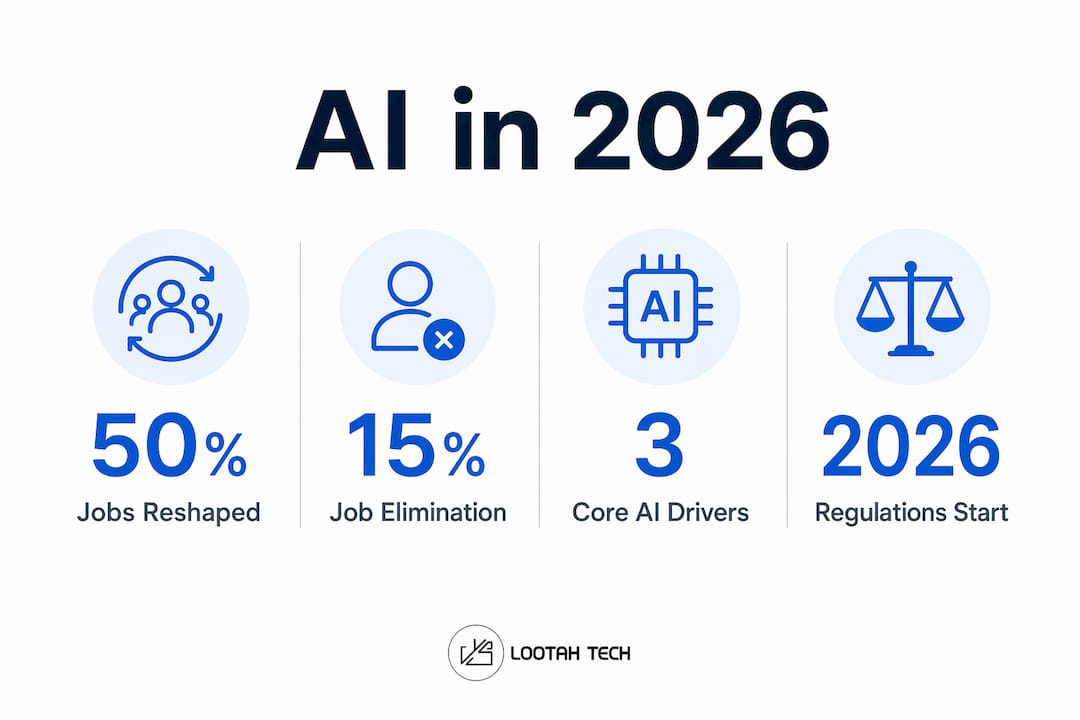
50% to 55% of US jobs will be reshaped by AI in the next two to three years, with 10% to 15% potentially eliminated over the longer term. BCG's analysis is based on microeconomic modeling, and the distinction between "reshaped" and "eliminated" matters enormously for planning. Most roles will not disappear. They will require new expectations, new skills, and new performance benchmarks.
The strategic error most organizations make is treating workforce planning as a downstream task. They deploy AI first and figure out the human side later. BCG advises the opposite: embed talent planning and reskilling as a strategic imperative from the start of any AI adoption program. Organizations that do this retain institutional knowledge while capturing AI efficiency gains.
Key workforce priorities for leaders in 2026:
- Identify augmentation candidates. Roles in legal review, financial analysis, and customer service are prime candidates for AI augmentation rather than replacement.
- Build AI literacy at every level. Frontline employees need prompt engineering basics. Managers need model evaluation skills. Executives need governance literacy.
- Create new role categories. AI trainers, output auditors, and workflow architects are emerging as distinct job functions with real hiring demand.
- Restructure performance metrics. Measuring output volume becomes less relevant when AI handles volume. Measure judgment quality, exception handling, and cross-functional coordination instead.
- Communicate transparently. Workforce anxiety about AI is highest when leadership is silent. Regular, honest communication about what will change and when reduces attrition risk.
For business leaders navigating this, the tech strategies for 2026 that generate the most durable value are those that treat automation and human development as complementary, not competing, investments.
Pro Tip: Run a "role impact audit" before any major AI deployment. For each affected role, document which tasks will be automated, which will be augmented, and which will require entirely new skills. This single exercise prevents most workforce disruption surprises.
Where does agentic AI stand in 2026 and what should you expect?
Agentic AI is defined as AI systems capable of taking sequences of actions autonomously to complete multi-step goals without continuous human prompting. The concept is compelling. The current reality is more constrained. Agentic AI faces practical hurdles in orchestration and governance rather than solely in model quality. Hallucinations, security vulnerabilities, and unpredictable failure modes make full autonomy premature for most business-critical workflows.
The honest picture for 2026 looks like this:
- Narrow agents work well. Agents handling single-domain tasks like invoice processing, IT ticket routing, or appointment scheduling are reliable and deployable now.
- Multi-agent coordination is the next frontier. Multi-agent systems enabling complex team-based goals represent where the field is heading, but require sophisticated orchestration infrastructure most enterprises do not yet have.
- Human-in-the-loop guardrails are non-negotiable. Any agentic deployment without defined escalation paths and human review checkpoints creates unacceptable operational risk.
- Governance infrastructure is the bottleneck. The limiting factor is not model capability. It is the organizational ability to monitor, audit, and correct agent behavior at scale.
"2026 is a level-set year. The companies that will lead in 2027 and beyond are those building reusable AI workflow patterns now, not those chasing the most autonomous agent architecture." — MIT Sloan Management Review
For a deeper look at how enterprises are recalibrating their agentic AI expectations, the 2026 enterprise AI strategy guide from Yslootahtech covers the specific workflow patterns that convert prototypes into reliable production use cases.
How is physical AI evolving and which industries benefit most?
Physical AI is defined as AI systems that perceive, reason about, and act within the physical world, distinct from text or image generation models. NVIDIA's Cosmos 3 world foundation model represents the current benchmark. It combines multimodal vision with action prediction, enabling robots and autonomous vehicles to reason about future states before executing physical tasks. This is fundamentally different from language models. Cosmos 3 produces numerical action data that links scene understanding directly to physical movement.
The practical implications are significant across three sectors:
| Industry | Physical AI Application | Measurable Impact |
|---|---|---|
| Manufacturing | Agentic factory operations via NVIDIA FOX Blueprint | Up to 80% root cause analysis improvement in production lines |
| Autonomous Vehicles | World model-based scene prediction before maneuver execution | Reduced edge-case failure rates in complex traffic scenarios |
| Logistics and Warehousing | Robot navigation using synthetic environment training data | Faster deployment cycles with less real-world training time |
The NVIDIA FOX Factory Operations Blueprint deserves specific attention. It uses agentic AI to orchestrate specialized agents across manufacturing workflows, shifting factory operations from episodic automation to continuous agent-driven monitoring. The result is an always-on operational intelligence layer that identifies failures before they cascade.
Synthetic data generation is the enabling technology behind much of this progress. By simulating complex physical environments, companies like NVIDIA can train robots on scenarios that would be dangerous, expensive, or impossible to recreate in the real world. This accelerates deployment timelines significantly.
Pro Tip: If your organization operates physical infrastructure, evaluate physical AI readiness by asking one question: does your current sensor and data architecture support real-time environment modeling? If not, that is your first investment priority before any robotics or autonomous systems deployment.
What regulatory and ethical considerations shape AI deployment in 2026?
The EU AI Act's August 2, 2026 compliance milestone triggers key rules affecting AI deployment strategies for any organization operating in or selling into the European Union. Kennedys notes that obligations extend sequentially through 2026 and 2027, meaning compliance is not a one-time checkbox. It is an ongoing governance program.
The practical compliance priorities for 2026 include:
- Data governance documentation. Organizations must demonstrate that training data meets quality, legality, and representational standards.
- Transparency requirements. High-risk AI systems require clear disclosure to users about AI involvement in decisions affecting them.
- Human oversight design. Systems must include defined mechanisms for human review and intervention, particularly in high-stakes domains like credit, hiring, and healthcare.
- Risk classification audits. Every deployed AI system needs a formal risk tier assessment under the Act's classification framework.
- Ongoing monitoring programs. Post-deployment monitoring for model drift, bias, and unintended outputs is now a compliance requirement, not just a best practice.
EU AI Act compliance requires early preparation in data governance, transparency, and human oversight design. Organizations that treat the August deadline as the starting point rather than the finishing line will face significant remediation costs. The security implications of non-compliant AI deployments also connect directly to broader cybersecurity strategy in 2026, where AI-generated vulnerabilities are an emerging attack surface.
Key takeaways
The most durable competitive advantage in 2026 belongs to organizations that build AI factories, plan workforce transformation proactively, and govern agentic systems with clear human oversight before scaling autonomy.
| Point | Details |
|---|---|
| AI factories drive enterprise scale | Shift from individual tools to reusable, integrated AI workflows to capture structural business value. |
| Workforce reshaping outpaces elimination | 50% to 55% of US jobs will be reshaped; embed reskilling into AI adoption strategy from day one. |
| Agentic AI needs governance first | Narrow agents are deployable now; multi-agent systems require orchestration infrastructure most enterprises lack. |
| Physical AI is production-ready in manufacturing | NVIDIA FOX Blueprint achieves up to 80% root cause analysis improvement in factory operations. |
| EU AI Act compliance is continuous | The August 2026 deadline is a milestone, not an endpoint; governance programs must run before and after it. |
What I've learned about managing AI expectations in 2026
The organizations I see struggling most with AI in 2026 are not the ones that moved too slowly. They are the ones that moved fast on the wrong things. They deployed agentic systems before building governance infrastructure. They announced workforce AI programs without a reskilling plan. They chased the most autonomous architecture instead of building the most reliable one.
The leaders getting this right share a specific mindset. They treat AI adoption as an organizational capability problem, not a technology procurement problem. They ask "what does our team need to know and do differently?" before they ask "which model should we buy?" That sequence matters more than most executives realize.
The AI factory concept resonates with me because it forces the right conversation. You cannot build a factory without a floor plan, a supply chain, and quality control. The same is true for AI at enterprise scale. The role of AI in invention and development is accelerating, but the organizations capturing that value are the ones treating AI as infrastructure, not as a feature.
My honest view: 2026 is the year that separates organizations building durable AI capability from those still running disconnected pilots. The gap between those two groups will be very difficult to close by 2027.
— YS
How Yslootahtech can accelerate your AI strategy in 2026
Building an AI factory, managing workforce transformation, and navigating regulatory compliance simultaneously is a significant operational challenge. Yslootahtech's AI and machine learning services are designed specifically for organizations at this inflection point, offering end-to-end support from AI strategy and architecture through deployment and ongoing governance.
Whether you are deploying narrow agents in a single workflow or building the data infrastructure for enterprise-scale AI, Yslootahtech brings the technical depth and industry experience to accelerate your roadmap. The team works across financial services, healthcare, logistics, and manufacturing, translating AI advancements in 2026 into measurable operational outcomes for clients across the UAE and beyond. Reach out to explore a tailored AI strategy session.
FAQ
What is an AI factory and why does it matter in 2026?
An AI factory is an operational model that combines technology, data, and methods to build and deploy AI systems at scale across an organization. MIT Sloan identifies it as the primary mechanism for enterprises to move beyond individual productivity tools and capture structural business value from AI.
How many jobs will AI actually eliminate by 2026?
BCG's microeconomic modeling estimates 10% to 15% of US jobs could be eliminated longer term, while 50% to 55% will be reshaped with new skill requirements. The larger risk for most workers is role transformation rather than outright job loss.
Is agentic AI ready for enterprise deployment in 2026?
Narrow, single-domain agents are deployable and reliable in 2026 for tasks like invoice processing or IT ticket routing. Full multi-agent autonomy for complex business workflows is not yet mature due to orchestration, governance, and hallucination risks.
What does the EU AI Act require by August 2026?
The August 2, 2026 milestone triggers compliance requirements around data governance, transparency disclosures, human oversight mechanisms, and risk classification for high-risk AI systems. Kennedys notes that obligations continue sequentially through 2027, making compliance an ongoing program.
What makes physical AI different from generative AI?
Physical AI systems reason about future states and physical actions in the real world, not just text or images. NVIDIA's Cosmos 3 model, for example, produces numerical action data linking scene understanding to physical task execution, which requires fundamentally different architecture than language models.