IT support services guide 2026: Cut breaches by 50% & boost uptime

Most IT managers treat support as reactive firefighting, waiting for systems to fail before taking action. Yet enterprises using proactive IT support models experience 60% fewer critical failures and demonstrably stronger security postures. This comprehensive guide examines how modern IT support services protect your infrastructure, accelerate digital transformation, and deliver measurable cost savings for Dubai enterprises navigating increasingly complex technology landscapes.
Table of Contents
- Introduction To It Support Services
- Core It Support Service Models
- Integrating Cybersecurity Within It Support
- Emerging Technologies Shaping It Support
- Cost-Benefit Analysis And Selection Criteria For It Support Providers
- Common Misconceptions About It Support
- Practical Implementation Strategies For Dubai Enterprises
- Elevate Your It Support With Ys Lootah Tech
Key takeaways
| Point | Details |
|---|---|
| Core IT support types differ in approach and cost-effectiveness | Managed services reduce downtime by 30% compared to reactive help desk models |
| Integrating cybersecurity within IT support halves breach likelihood | Unified security frameworks deliver faster incident response and fewer vulnerabilities |
| Emerging tech like AI and cloud drastically improve support speed | Cloud adoption enables 50% faster software deployment while AI cuts ticket resolution times |
| Proactive IT support models cut critical failures by up to 60% | Strategic monitoring prevents issues before they impact operations |
| Compliance with UAE regulations is essential for enterprise IT support | Local expertise ensures adherence to data protection and industry-specific requirements |
Introduction to IT support services
IT support services encompass the full spectrum of technical assistance that keeps enterprise systems running smoothly. These services include network monitoring, security management, software maintenance, hardware troubleshooting, and strategic planning. For Dubai enterprises, robust IT support becomes even more critical as organizations accelerate digital transformation roadmap initiatives and manage increasingly complex hybrid infrastructures.
The role of IT support extends far beyond fixing broken equipment. Modern support frameworks actively prevent downtime through continuous monitoring, apply security patches before vulnerabilities become breaches, and optimize system performance to support business growth. Enterprises using managed IT support report 30% fewer system downtimes, translating directly to improved productivity and revenue protection.
Dubai's rapidly digitizing business environment creates unique IT support demands. Organizations face pressure to integrate emerging technologies, maintain 24/7 availability for global operations, and comply with evolving UAE regulations. The complexity of modern enterprise IT, from multi-cloud architectures to IoT device networks, requires specialized expertise that traditional break-fix models cannot deliver. Understanding enterprise service support context helps managers recognize the strategic value of comprehensive IT support frameworks.
Core elements of enterprise IT support include:
- Network infrastructure monitoring and optimization
- Security incident prevention and response
- Software lifecycle management and updates
- Hardware maintenance and replacement planning
- User support and training programs
- Disaster recovery and business continuity
Core IT support service models
Three primary models define how enterprises structure IT support: help desk services, managed services, and onsite support. Help desk provides reactive assistance through ticketing systems, addressing issues as they arise. While cost-effective for basic needs, this model leaves enterprises vulnerable to prolonged downtime and security gaps between incidents.
Managed services offer comprehensive, proactive IT support through ongoing monitoring and maintenance. Service providers assume responsibility for infrastructure health, applying preventive measures before problems escalate. This model typically includes 24/7 monitoring, regular updates, security management, and strategic planning. For scaling enterprises, managed services deliver superior value by preventing costly failures and freeing internal teams to focus on innovation rather than crisis management.

Onsite support involves physical presence of technicians at enterprise locations for hands-on troubleshooting, hardware installations, and infrastructure upgrades. Many organizations combine onsite support with remote monitoring for optimal coverage. The choice between models depends on operational complexity, budget constraints, compliance requirements, and growth trajectory.
| Model | Cost Level | Response Speed | Prevention Capability |
|---|---|---|---|
| Help Desk | Low | Reactive only | Minimal |
| Managed Services | Medium-High | Proactive | Comprehensive |
| Onsite Support | Variable | Immediate for physical issues | Moderate |
| Hybrid Approach | Medium | Balanced | Strong |
Proactive versus reactive support represents a fundamental strategic choice. Reactive models wait for failures, resulting in emergency fixes, user frustration, and unpredictable costs. Proactive support anticipates issues through continuous monitoring, applies preventive maintenance, and reduces critical failures by up to 60%. The initial investment in proactive models pays dividends through improved uptime, enhanced security, and predictable operating costs.
Pro Tip: Enterprises experiencing rapid growth should prioritize managed services over traditional help desk models. The scalability and comprehensive coverage prevent infrastructure growing pains and security vulnerabilities that often accompany expansion. Consider exploring app development solutions alternatives as part of a broader IT modernization strategy.
Integrating cybersecurity within IT support
Cybersecurity integration transforms IT support from a maintenance function into a strategic defense layer. When security measures operate separately from support frameworks, response times lag and vulnerabilities persist longer. Unified approaches combine threat monitoring, incident response, and system maintenance under coordinated oversight, creating seamless protection that adapts to emerging threats.
Enterprise IT support with embedded cybersecurity typically includes:
- Real-time threat detection and automated response
- Security patch management and vulnerability assessments
- Access control and identity management
- Data encryption and backup verification
- Compliance monitoring and reporting
- Security awareness training for users
The quantified impact proves compelling. Enterprises that fail to prioritize cybersecurity within IT support face a 50% higher likelihood of data breaches. This elevated risk stems from delayed incident detection, fragmented response protocols, and gaps between security and operations teams. Integration eliminates these vulnerabilities by ensuring security considerations inform every support decision.
Integrated frameworks dramatically shorten incident response times. When security tools connect directly to monitoring systems, automated responses can isolate threats within minutes rather than hours. This speed limits damage, reduces recovery costs, and maintains business continuity during security events. For Dubai enterprises handling sensitive customer data or financial transactions, rapid response capability directly protects reputation and regulatory standing.
Building resilience requires aligning security tools with actual business processes. Generic security implementations often create friction, prompting users to bypass protections. Effective integration customizes security controls to match workflows, balancing protection with usability. This alignment increases compliance while maintaining productivity. Review digital strategy tips for broader context on technology-business alignment.
Pro Tip: When evaluating IT support providers, request specific metrics on their security incident response times and breach prevention track records. Providers should demonstrate integration between monitoring systems and security tools, not just offer security as an add-on service.
Emerging technologies shaping IT support
Artificial intelligence revolutionizes IT support through automated ticket routing, predictive maintenance, and intelligent troubleshooting. AI-driven systems analyze historical patterns to identify potential failures before they occur, reducing emergency interventions. Chatbots handle routine requests, freeing human technicians for complex problems. Machine learning continuously improves resolution accuracy by learning from each interaction.
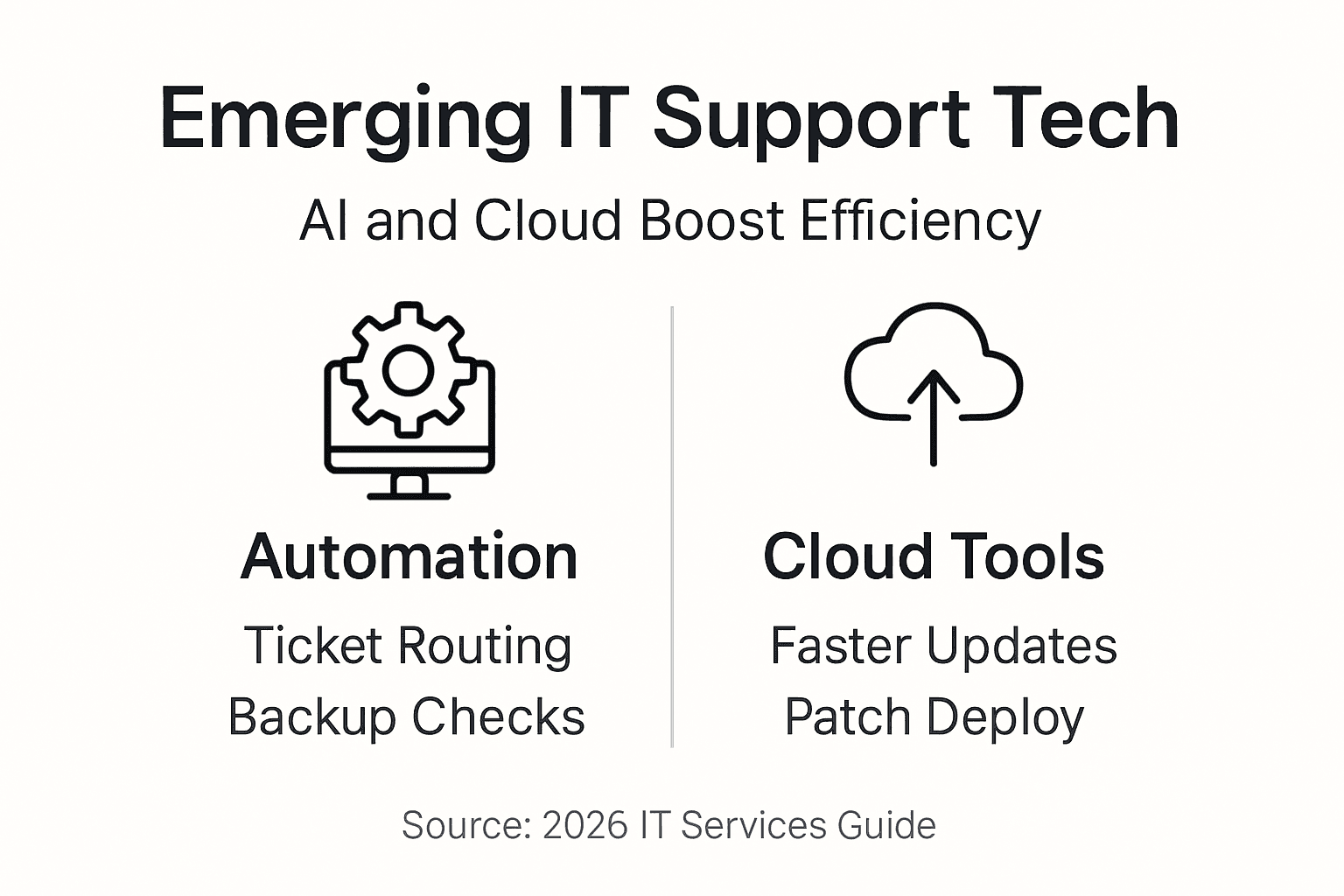
Cloud computing adoption in IT support services allows 50% faster deployment of software updates and patches. Cloud platforms enable centralized management of distributed systems, instant scalability during demand spikes, and seamless disaster recovery. For enterprises operating across multiple Dubai locations or managing remote teams, cloud-based support tools provide consistent coverage without physical infrastructure constraints.
Automation reduces human error while accelerating routine tasks. Automated backup verification, security scanning, and compliance reporting ensure critical processes execute reliably without manual intervention. This consistency proves especially valuable for regulatory compliance, where documentation gaps create audit risks. Automation also extends support coverage, maintaining protection during off-hours when human teams are unavailable.
| Technology | Primary Benefit | Impact on Enterprise IT |
|---|---|---|
| AI Automation | Faster ticket resolution | 40% reduction in average response time |
| Cloud Computing | Rapid software deployment | 50% faster update rollout |
| Predictive Analytics | Proactive failure prevention | 60% fewer critical system failures |
| Automated Monitoring | Continuous protection | 24/7 threat detection without staff increases |
These technologies work synergistically. AI analyzes data from cloud monitoring tools to predict failures, triggering automated preventive actions before users experience disruptions. This integrated approach transforms IT support from reactive problem-solving into strategic infrastructure optimization. Enterprises gain competitive advantage through superior uptime, faster innovation cycles, and reduced technology risks. Explore cloud computing trends for deeper insights into implementation strategies.
Cost-benefit analysis and selection criteria for IT support providers
Managed IT support typically costs 40-60% less than maintaining equivalent in-house teams when accounting for salaries, benefits, training, and tool licensing. External providers spread expertise costs across multiple clients, delivering specialized skills at fractions of direct hire expenses. This efficiency becomes more pronounced for smaller enterprises lacking resources for full IT departments.
However, cost comparisons must include operational benefits. While managed services carry monthly fees, they prevent costly downtime, reduce security breach risks, and eliminate emergency repair expenses. The total cost of ownership calculation should factor in prevented losses, not just service fees. Organizations experiencing frequent outages or security incidents often find managed services deliver net savings through risk reduction alone.
| Support Model | Monthly Cost Range | Downtime Risk | Security Coverage | Best For |
|---|---|---|---|---|
| In-House Team | High | Moderate | Variable | Large enterprises with complex needs |
| Managed Services | Medium | Low | Comprehensive | Growing mid-sized organizations |
| Help Desk Only | Low | High | Minimal | Small businesses with simple IT |
| Hybrid Approach | Medium-High | Low | Strong | Enterprises needing specialized onsite support |
Selection criteria for IT support providers in Dubai should prioritize:
- Demonstrated experience with UAE regulatory requirements and industry-specific compliance
- Comprehensive cybersecurity capabilities integrated with support services
- Proven track record with Dubai enterprises of similar size and complexity
- Scalability to support business growth without service degradation
- Transparent pricing models with clear service level agreements
- Local presence enabling rapid onsite response when needed
- Technology partnerships ensuring access to latest tools and platforms
Evaluate providers through pilot projects before committing to long-term contracts. Request references from current clients in your industry, focusing on uptime metrics and incident response experiences. The right provider should function as a strategic partner, contributing to technology planning beyond basic support tasks. Consider how providers approach digital transformation start guide initiatives as part of their service philosophy.
Common misconceptions about IT support
Many IT managers still view support as purely reactive, a team to call when systems fail. This outdated perspective ignores how modern IT support prevents failures through continuous monitoring and strategic maintenance. Proactive support identifies performance degradation, security vulnerabilities, and capacity constraints before they impact operations. Organizations clinging to reactive models pay premium prices for emergency fixes that proactive approaches would have prevented.
Another persistent myth suggests reactive support suffices for enterprise demands. Small businesses with simple IT might manage with break-fix models, but enterprises face too much complexity for reactive approaches. Multi-layered systems, integrated applications, and distributed teams create interdependencies where single failures cascade across operations. Enterprise-grade support requires comprehensive monitoring, redundancy planning, and coordinated response capabilities that reactive models cannot deliver.
The separation of cybersecurity from IT support represents perhaps the most dangerous misconception. Security treated as a standalone function creates response delays, communication gaps, and conflicting priorities between teams. Modern threats exploit these organizational silos, moving faster than disconnected teams can respond. Effective enterprise security demands integration where support teams apply security expertise to every decision, and security teams leverage support infrastructure for threat detection.
Additional misconceptions include:
- Assuming cloud services eliminate need for IT support (cloud requires specialized management)
- Believing small IT teams can handle enterprise complexity (specialized skills require dedicated focus)
- Expecting technology alone to solve support challenges (people and processes remain critical)
- Thinking compliance is one-time effort (regulations evolve requiring ongoing adaptation)
Recognizing these myths helps IT managers make strategic decisions based on actual requirements rather than outdated assumptions. Modern IT support functions as a strategic capability enabling digital transformation, not a cost center fixing broken equipment.
Practical implementation strategies for Dubai enterprises
Begin by assessing your current IT support capabilities against business requirements. Document existing response times, recurring issues, security incidents, and user satisfaction levels. Identify gaps between current performance and operational needs, particularly regarding uptime requirements, compliance obligations, and growth plans. This baseline establishes clear improvement targets and justifies investment in enhanced support models.
Implementation steps for optimized IT support:
- Evaluate current IT infrastructure, identifying critical systems and vulnerability points
- Define service level requirements based on business impact of different system failures
- Research providers specializing in your industry sector with Dubai market experience
- Request detailed proposals including security integration, compliance support, and scalability options
- Conduct pilot programs testing provider responsiveness and technical capabilities
- Negotiate service level agreements with specific uptime guarantees and response time commitments
- Implement comprehensive monitoring covering all critical systems and applications
- Establish regular review cycles to assess performance and adjust services as needs evolve
Prioritize proactive service models incorporating continuous monitoring, preventive maintenance, and strategic planning. These approaches prevent expensive emergencies while providing predictable costs. Ensure cybersecurity integrates throughout support frameworks rather than functioning as separate service. The unified approach accelerates threat response and reduces breach risks.
Compliance with UAE data protection laws, industry regulations, and international standards must guide provider selection. Experienced Dubai providers understand local requirements and maintain processes ensuring ongoing compliance. Request documentation of compliance certifications and regulatory expertise during provider evaluation.
Customization by industry sector improves support effectiveness. Healthcare enterprises need HIPAA-equivalent protections and patient data security. Financial services require transaction monitoring and fraud detection integration. Retail organizations benefit from point-of-sale system expertise and inventory management support. Choose providers demonstrating sector-specific knowledge relevant to your operations. Implementing custom software solutions often requires specialized support capabilities.
Ongoing performance monitoring ensures support services deliver promised value. Track uptime percentages, incident response times, user satisfaction scores, and security event frequency. Regular reviews identify improvement opportunities and verify providers meet contractual obligations. Strong provider relationships include collaborative planning for technology upgrades and business expansion.
Pro Tip: Leverage local technology partners with deep Dubai market knowledge for optimal support outcomes. Providers understanding regional business culture, regulatory environment, and infrastructure characteristics deliver more relevant solutions than international firms lacking local presence. Consider exploring local context expertise when evaluating partner capabilities.
Elevate your IT support with YS Lootah Tech
Transforming IT support from reactive troubleshooting into strategic advantage requires partners who understand both technology and business. YS Lootah Tech delivers custom software solutions UAE 2026 alongside comprehensive IT support integrating cybersecurity, cloud computing, and emerging technologies. Our application development services and AI and machine learning solutions enable Dubai enterprises to implement the proactive, technology-driven support models detailed throughout this guide.
We specialize in supporting enterprises navigating digital transformation while maintaining operational excellence and regulatory compliance. Our approach combines deep UAE market expertise with cutting-edge technology capabilities, ensuring your IT infrastructure supports business growth rather than constraining it. Whether you need comprehensive managed services, specialized security integration, or strategic technology planning, our team delivers customized solutions matching your specific requirements and industry context.
FAQ
What are the main types of IT support services for enterprises?
Help desk provides reactive support addressing issues as they arise through ticketing systems. Managed services offer comprehensive, proactive support including monitoring, maintenance, security, and strategic planning. Onsite support involves physical technician presence for hands-on troubleshooting and infrastructure work. Most enterprises combine these models, tailoring coverage to operational complexity and business requirements.
How does integrating cybersecurity into IT support reduce risks?
Integration creates unified frameworks where security monitoring connects directly to support systems, enabling automated threat responses within minutes. This coordination eliminates communication delays between separate security and IT teams. Enterprises that fail to prioritize cybersecurity within IT support face a 50% higher likelihood of data breaches due to fragmented response protocols and persistent vulnerability gaps.
What emerging technologies have the biggest impact on IT support efficiency?
AI-driven automation reduces ticket resolution times by 40% through intelligent routing and predictive maintenance. Cloud computing adoption in IT support services allows 50% faster deployment of software updates and patches, while enabling centralized management of distributed systems. These technologies work together, with AI analyzing cloud monitoring data to prevent failures before they impact operations.
What criteria should IT managers use to select IT support providers in Dubai?
Prioritize demonstrated experience with UAE regulatory requirements and proven track records supporting Dubai enterprises of similar complexity. Evaluate comprehensive cybersecurity capabilities integrated within support services, not offered as separate add-ons. Assess scalability to support business growth, local presence for rapid response, and industry-specific expertise relevant to your operational requirements. Request client references and conduct pilot projects before long-term commitments.