What is custom software: benefits for business 2026

Most businesses assume off-the-shelf software saves money and time. Yet 65% face inefficiencies adapting generic software to their unique workflows, leading to costly workarounds and poor customer experiences. Custom software solutions eliminate these friction points by aligning directly with your operational needs and strategic goals, transforming how you serve customers and run your business.
Table of Contents
- Understanding Custom Software: Definition And Differentiation
- How Custom Software Enhances Operational Efficiency
- Boosting Customer Experience Through Custom Software
- Cost, Timeline, And Strategic Considerations For Custom Software Projects
- Common Misconceptions And Reality Checks
- Framework For Deciding Whether To Invest In Custom Software
- Industry Applications And Real-World Case Studies
- Best Practices For Successful Custom Software Implementation
- Explore Expert Custom Software Development Services
Key takeaways
| Point | Details |
|---|---|
| Custom software fits unique needs | Engineered specifically for your processes, eliminating generic tool compromises. |
| Boosts efficiency and customer experience | Automates workflows and personalizes service delivery for measurable improvements. |
| Higher upfront cost, better long-term ROI | Initial investment pays off through reduced workarounds and operational gains. |
| Clear decision framework needed | Evaluate complexity, TCO, and competitive advantage before committing. |
| Implementation best practices matter | Thorough requirements and iterative development reduce failure risks significantly. |
Understanding custom software: definition and differentiation
Custom software is engineered from the ground up to address your specific business requirements, workflows, and goals. Unlike off-the-shelf products built for mass markets, custom solutions adapt to you rather than forcing you to adapt to them.
Off-the-shelf software serves broad audiences with generalized features. You get preset functionality that rarely matches your exact needs. Most companies end up creating complex workarounds, purchasing multiple add-ons, or tolerating inefficient processes because generic tools cannot accommodate unique operational demands.
Custom solutions eliminate these compromises entirely. When you build software tailored to your workflows, you remove the friction that generic tools create. Over 70% report better operational alignment with custom software compared to off-the-shelf alternatives.
Several misconceptions persist about custom development:
- Only large enterprises can afford custom software
- Off-the-shelf tools always cost less over time
- Generic software meets most business needs adequately
- Custom projects always run over budget and timeline
The reality differs sharply. Small and mid-sized businesses increasingly adopt custom solutions as development costs decrease and competitive pressures mount. When you factor in licensing fees, integration costs, and productivity losses from workarounds, generic software often costs more across five to ten years.
Custom software scales with your growth. As your business evolves, you modify the system rather than replacing it or stacking more generic tools together. This flexibility proves invaluable for companies experiencing rapid change or operating in specialized niches.
How custom software enhances operational efficiency
Custom software transforms operational efficiency by automating the exact processes that consume your team's time. Generic tools offer broad automation, but they miss the specific workflows unique to your business model.

Consider invoice processing. Off-the-shelf accounting software handles standard invoicing, but what if your business requires multi-tier approval workflows, custom data extraction from client portals, or integration with legacy inventory systems? Custom software automates these exact steps without manual intervention.
Automation reduces manual tasks by 40% when tailored to specific workflows. This efficiency gain comes from eliminating redundant data entry, reducing error rates, and accelerating decision cycles.
Key efficiency improvements include:
- Seamless integration across disparate systems, centralizing data in real time
- Elimination of duplicate data entry between platforms
- Automated compliance reporting tailored to your regulatory requirements
- Custom dashboards surfacing the exact metrics your leadership needs
- Workflow automation matching your approval hierarchies and business rules
Integration capabilities prove especially valuable. Most businesses run five to ten different software systems that don't communicate effectively. Custom solutions connect these systems, creating a unified data ecosystem. Your sales team sees inventory status instantly. Your finance team receives automated alerts when invoices require attention. Your operations team accesses real-time production data without logging into multiple platforms.
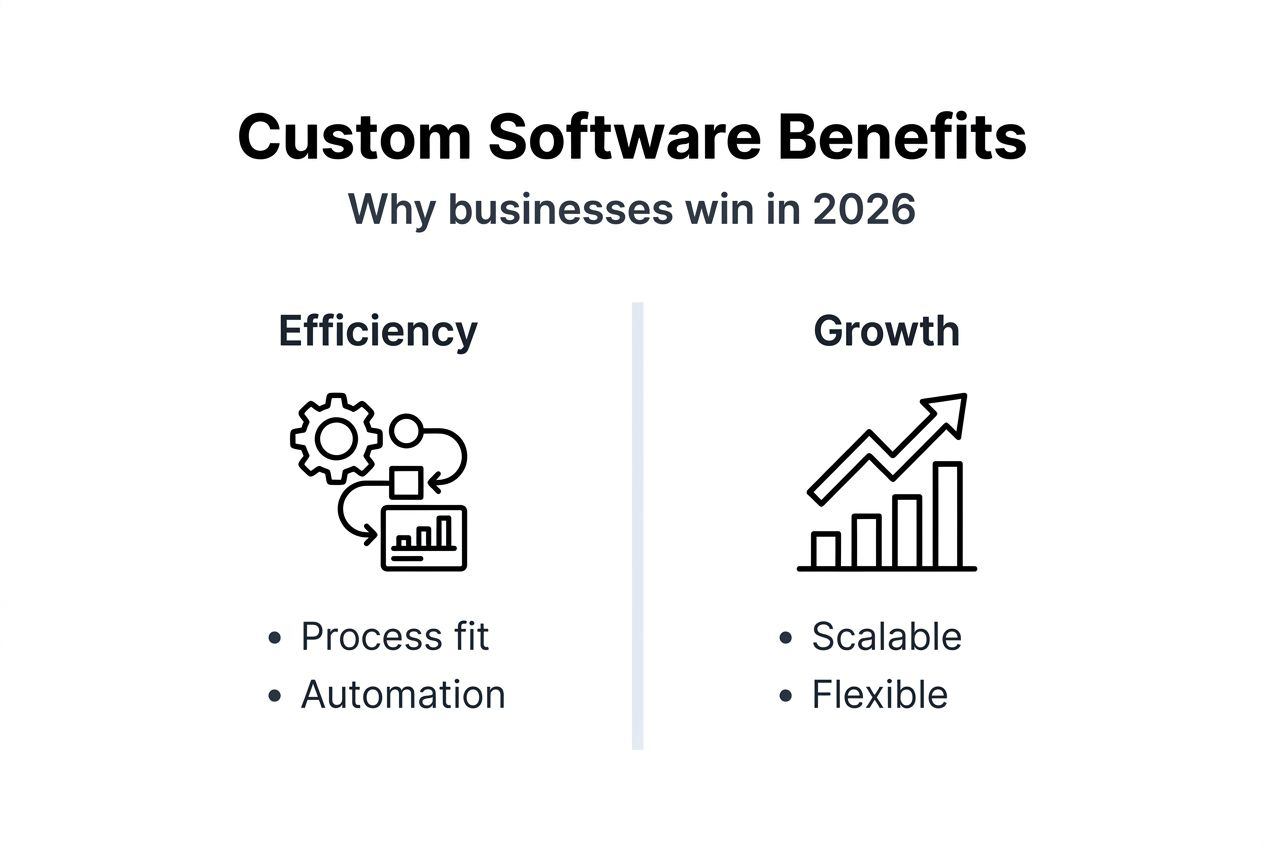
Scalability matters as much as immediate efficiency. When you experience growth spurts or enter new markets, custom software adapts. You add modules, modify workflows, and extend functionality without replacing core systems. This adaptability prevents the painful software migrations that disrupt operations and drain resources.
Explore how custom software solutions drive efficiency across diverse industries. The custom software trends report highlights emerging patterns shaping development priorities through 2026.
Boosting customer experience through custom software
Custom software enables personalization at scales impossible with generic platforms. When you control every aspect of customer interaction software, you create experiences that feel individually crafted rather than mass-produced.
Custom CRM systems exemplify this advantage. Standard CRMs offer contact management and basic automation. Custom CRMs integrate your unique service workflows, customer communication preferences, and product recommendation logic. Your support team sees complete customer histories including interactions across all touchpoints. Your sales team receives AI-driven insights based on your specific sales methodology, not generic best practices.
Businesses implementing custom CRM solutions report 20% to 25% improvements in customer retention rates. This gain stems from faster response times, more accurate service delivery, and personalized communication that resonates with individual customer needs.
Customer portals represent another high-impact application. Generic portals provide basic account access and support ticket submission. Custom portals deliver:
- Self-service tools matching your exact service catalog
- Real-time order tracking integrated with your fulfillment systems
- Personalized product recommendations based on purchase history and browsing behavior
- Interactive tools helping customers configure complex products or services
- Seamless escalation to human support with full context transfer
Data-driven marketing becomes more sophisticated with custom software. You capture behavioral data specific to your customer journey, analyze patterns unique to your market segment, and automate campaigns reflecting your brand voice and value propositions. Generic marketing platforms force you into template-based approaches that dilute your differentiation.
Faster, more accurate service delivery enhances brand reputation measurably. When customers receive precisely what they need without friction, they become advocates. Custom software eliminates the "sorry, our system can't do that" conversations that erode trust and satisfaction.
Discover how custom software enhances efficiency and experience in your industry. Connect with IT consulting services to explore personalization strategies tailored to your customer base.
Cost, timeline, and strategic considerations for custom software projects
Custom software projects typically range from $50,000 to $250,000 depending on complexity, scope, and integration requirements. Simple applications with limited integrations fall toward the lower end. Enterprise-grade systems with extensive third-party connections and advanced features reach the higher range.
Timelines span six to twelve months for most projects. Requirements gathering and design consume the first two to three months. Development and iterative testing occupy the next four to six months. Deployment and initial optimization complete the cycle. Complex projects requiring regulatory compliance or legacy system integration may extend to 18 months.
Total cost of ownership (TCO) considerations shift the financial calculus significantly:
| Cost Factor | Off-the-Shelf | Custom Software |
|---|---|---|
| Initial Investment | Lower ($5K-$50K) | Higher ($50K-$250K) |
| Annual Licensing | $10K-$50K | $5K-$15K maintenance |
| Integration Costs | $20K-$100K | Included in build |
| Workaround Labor | $30K-$80K annually | Eliminated |
| 5-Year TCO | $200K-$400K | $150K-$300K |
Hidden costs with generic software accumulate rapidly. You pay for features you never use. You purchase add-ons to fill functionality gaps. You hire staff to manage workarounds and manual processes. Over five years, these expenses often exceed custom software TCO.
Strategic alignment proves more valuable than cost savings alone. Custom software embeds your competitive advantages directly into operational systems. If superior customer service differentiates your brand, custom CRM and support tools amplify that strength. If rapid product customization wins deals, custom configuration engines become force multipliers.
Pro Tip: Budget 15% to 20% of initial development costs annually for maintenance, security updates, and feature enhancements. This ongoing investment keeps your software current and prevents technical debt accumulation.
Strategic planning connects software functionality to business objectives. Define clear success metrics before development begins. Identify which operational bottlenecks or customer pain points the software must address. Prioritize features delivering the highest ROI in year one. This discipline prevents scope creep and ensures you build tools that move business needles.
Common misconceptions and reality checks
Myth: Custom software always costs more than off-the-shelf solutions over time.
Reality: When you calculate licensing fees, integration expenses, and productivity losses from workarounds, generic software often exceeds custom software TCO. The 65% of businesses facing inefficiencies with generic tools spend thousands annually compensating for poor system fit.
Myth: Off-the-shelf software meets most business needs adequately with minimal customization.
Reality: Standard software serves standard businesses. If your competitive advantage relies on unique processes, exceptional service delivery, or specialized workflows, generic tools become operational bottlenecks rather than enablers. You either compromise your differentiation or build expensive workarounds.
Myth: Custom software projects inevitably run over budget and past deadlines.
Reality: Projects fail when requirements remain unclear and stakeholder engagement stays minimal. Well-managed custom projects with thorough planning, iterative development, and active client participation deliver on time and budget at rates exceeding 70%. The key lies in process discipline, not the custom nature of the work.
Myth: Only large enterprises with massive IT budgets can afford custom software.
Reality: Development costs have decreased substantially as tools, frameworks, and development methodologies mature. Small and mid-sized businesses increasingly adopt custom solutions, particularly for customer-facing applications and operational automation. Cloud infrastructure further reduces deployment and scaling costs.
Myth: Maintaining custom software requires expensive in-house development teams.
Reality: Most businesses partner with development firms for ongoing maintenance, paying predictable monthly fees rather than carrying full-time developer salaries. Modern development practices emphasize clean code and documentation, making systems maintainable by different teams if partnerships change.
Understanding these realities helps you evaluate custom software objectively rather than defaulting to generic solutions based on outdated assumptions. The decision hinges on strategic fit, operational needs, and long-term value rather than initial sticker shock.
Framework for deciding whether to invest in custom software
Use this structured approach to evaluate whether custom software makes strategic and financial sense for your business:
-
Assess process complexity and uniqueness: Document workflows that differentiate your business or consume disproportionate staff time. If these processes represent competitive advantages or major cost centers, custom software warrants serious consideration.
-
Calculate true comparison costs: Build comprehensive TCO models for both custom and off-the-shelf options spanning five years. Include licensing, integration, workaround labor, and opportunity costs from operational inefficiencies.
-
Evaluate competitive advantage potential: Determine whether custom features could accelerate growth, improve customer retention, or enable new revenue streams. Quantify these benefits conservatively to assess whether they justify investment.
-
Analyze scalability requirements: Project business growth over three to five years. Will generic software scale with you, or will you face painful migrations and disruptions? Custom software built with growth in mind adapts continuously.
-
Review technical integration needs: List all systems requiring integration. Complex integration landscapes often tip the balance toward custom solutions that unify disparate platforms seamlessly.
| Decision Factor | Custom Software Favored | Off-the-Shelf Favored |
|---|---|---|
| Process Uniqueness | High differentiation | Standard workflows |
| Integration Complexity | 5+ systems | 1-2 systems |
| Growth Trajectory | Rapid, unpredictable | Stable, incremental |
| Competitive Pressure | High need for differentiation | Commodity market |
| Budget Horizon | 3-5 year view | 1-2 year view |
Pro Tip: Start with a minimum viable product (MVP) approach. Build core functionality first, deploy it, gather user feedback, then expand. This iterative method reduces risk and ensures you invest in features that deliver actual value rather than theoretical benefits.
Poor requirements gathering causes project failures in nearly one-third of cases. Invest adequate time upfront defining needs, involving stakeholders, and validating assumptions. This foundation determines project success more than any other factor.
Explore Yottasoft.net alternatives for context on evaluating different software approaches. Review software project failure research to understand common pitfalls and prevention strategies.
Industry applications and real-world case studies
Manufacturing operations achieve remarkable efficiency gains through custom software. Automated production scheduling systems optimize machine utilization based on real-time order data and inventory levels. Quality control applications integrate directly with equipment sensors, flagging defects instantly. Compliance tracking tools document every process step, simplifying audits and regulatory reporting. Manufacturing firms report 25% to 35% ROI from custom automation and compliance solutions.
Fintech companies depend on custom software for competitive differentiation and regulatory adherence. Generic banking platforms cannot accommodate innovative financial products or meet evolving compliance requirements. Custom solutions enable:
- Real-time fraud detection algorithms trained on company-specific transaction patterns
- Secure multi-party transaction workflows meeting jurisdictional regulations
- Customer-facing tools for complex financial planning and portfolio management
- Automated reporting satisfying regulatory bodies across multiple markets
Healthcare organizations leverage custom software for patient engagement and operational coordination. Custom portals allow patients to schedule appointments, access test results, and communicate with providers through HIPAA-compliant channels. Behind the scenes, custom systems coordinate care teams, manage referrals, and integrate with diverse electronic health record platforms.
Retail and e-commerce businesses use custom solutions to personalize shopping experiences and optimize fulfillment. Recommendation engines analyze purchase history, browsing behavior, and demographic data to suggest products with uncanny accuracy. Inventory management systems coordinate across multiple warehouses and sales channels, preventing stockouts while minimizing carrying costs.
Logistics companies depend on custom route optimization and load planning software. These tools factor in vehicle capacity, delivery time windows, traffic patterns, and fuel costs to generate optimal delivery schedules. Real-time tracking integrations keep customers informed and enable rapid response to delays or issues.
Explore application development services tailored to your industry needs. Review the enterprise application guide to understand how large-scale custom systems address complex organizational requirements.
Best practices for successful custom software implementation
Thorough requirements gathering forms the foundation of successful projects. Involve stakeholders from all affected departments early. Document current workflows in detail, identifying pain points and inefficiencies. Define success metrics clearly so you can measure impact post-launch. Ambiguous requirements lead to costly revisions and missed expectations.
Iterative development and early testing catch issues before they become expensive problems. Deploy working prototypes quickly, even with limited functionality. Gather user feedback continuously and adjust based on real-world usage patterns. This agile approach prevents the "big reveal" disasters where software misses the mark entirely.
Plan for ongoing maintenance from day one. Software requires security updates, performance optimization, and feature enhancements over time. 31% of projects fail due to inadequate post-launch support. Budget 15% to 20% of development costs annually for maintenance and evolution.
Choose development partners carefully based on:
- Proven experience in your industry or with similar project types
- Transparent communication practices and project management methodologies
- References from clients with comparable business sizes and complexity
- Technical expertise in required platforms, integrations, and security standards
- Cultural fit and alignment with your business values and working style
Document everything comprehensively. Maintain detailed records of requirements, design decisions, code architecture, and system integrations. This documentation proves invaluable when expanding functionality, onboarding new team members, or transitioning to different support partners.
Pro Tip: Appoint an internal project champion with authority to make decisions and remove obstacles. This person bridges business stakeholders and technical teams, ensuring alignment and momentum throughout development.
Risk mitigation strategies include phased rollouts rather than big-bang launches. Deploy to pilot user groups first, validate functionality under real conditions, address issues before wider release. This approach minimizes disruption and builds user confidence through early wins.
Learn enterprise app development steps for implementing large-scale projects successfully. Access custom software project success tips based on extensive research into what separates successful initiatives from failures.
Explore expert custom software development services
Ready to transform operational efficiency and customer experience through tailored software solutions? YS Lootah Tech specializes in custom application development that aligns precisely with your business needs and growth trajectory. Our team brings deep expertise across web development, AI integration, and user experience design to create solutions that drive measurable results.
We understand that every business faces unique challenges requiring specialized tools. Whether you need workflow automation, customer engagement platforms, or enterprise system integration, our application development services deliver scalable solutions built for long-term value. Our website development services ensure your digital presence supports business objectives seamlessly. Explore how AI and machine learning solutions can unlock new capabilities and competitive advantages for your organization.
Frequently asked questions
What is custom software development?
Custom software development creates applications engineered specifically for your organization's unique workflows, requirements, and strategic goals. Unlike generic off-the-shelf products designed for broad markets, custom solutions adapt entirely to your business rather than forcing you to adapt to them. This tailored approach eliminates compromises and workarounds common with standard software.
How long does a typical custom software project take?
Most custom software projects require six to twelve months from initial requirements gathering through deployment and optimization. Complex systems with extensive integrations or regulatory compliance needs may extend to 18 months. Iterative development approaches allow you to deploy core functionality earlier while continuing to build additional features based on real-world feedback.
Is custom software always more expensive than off-the-shelf?
Custom software typically requires higher upfront investment, ranging from $50,000 to $250,000 depending on complexity. However, total cost of ownership over five years often favors custom solutions when you factor in licensing fees, integration costs, and productivity losses from workarounds required with generic software. The financial advantage grows as you eliminate inefficiencies and scale operations without switching platforms.
What industries benefit most from custom software?
Manufacturing and fintech sectors report the highest ROI from custom software, often achieving 25% to 35% returns through automation and compliance improvements. Healthcare, logistics, and retail also gain substantially from tailored solutions addressing their specialized workflows. Any industry with complex processes, strict compliance requirements, or competitive pressure to differentiate benefits significantly from custom development.