What is IT modernization: A 2026 guide for UAE businesses
Legacy IT systems are costing UAE businesses more than they realize. In 2026, organizations clinging to outdated infrastructure face mounting operational costs, security vulnerabilities, and an inability to leverage transformative technologies like AI and cloud computing. Strategic IT modernization isn't just a technical upgrade. It's a business imperative that determines whether your organization thrives or falls behind competitors who've already embraced agility, scalability, and innovation. This guide explains what IT modernization truly means, the challenges you'll face, and proven strategies to execute it successfully in the UAE market.
Table of Contents
- What Is IT Modernization And Why Does It Matter In 2026?
- Key Challenges In IT Modernization For UAE Businesses
- How To Modernize: Strategic Approaches And Best Practices
- The Role Of Emerging Technologies In Accelerating IT Modernization
- How YS Lootah Tech Supports Your IT Modernization Journey
- Frequently Asked Questions
Key takeaways
| Point | Details |
|---|---|
| IT modernization replaces legacy systems | Upgrading outdated infrastructure improves efficiency, scalability, and enables adoption of emerging technologies. |
| Legacy systems create barriers | Outdated technology drives up maintenance costs, blocks innovation, and prevents competitive differentiation. |
| Modernization requires strategic planning | Technical debt, business continuity risks, and integration complexity demand careful, phased approaches. |
| Modular upgrades minimize disruption | Incremental, integration-first strategies reduce risk while maintaining operational stability during transition. |
| Emerging tech drives modernization | AI, cloud computing, and advanced analytics are essential drivers for successful IT transformation in 2026. |
What is IT modernization and why does it matter in 2026?
IT modernization is the process of upgrading or replacing legacy IT systems with contemporary technologies, architectures, and practices that align with current business needs. This transformation goes beyond simple software updates. It involves rethinking how your entire technology infrastructure supports business objectives, from application architectures to data management and integration strategies.
Legacy IT systems hinder innovation, efficiency, and scalability, creating a cascade of problems that compound over time. Organizations struggle with digital transformation when their foundation consists of inflexible, monolithic applications built decades ago. These systems weren't designed for today's demands: real-time data processing, mobile accessibility, cloud integration, or AI-powered analytics.
The financial impact is staggering. Outdated systems consume up to 80% of IT budgets on maintenance alone, leaving minimal resources for innovation. Security vulnerabilities multiply as vendors discontinue support for aging platforms. Meanwhile, competitors leveraging modern architectures gain speed, agility, and customer experience advantages that translate directly to market share.
"Organizations with legacy systems face a critical choice: invest in modernization now, or accept escalating costs and diminishing competitiveness as the technology gap widens irreversibly."
For UAE businesses in 2026, modernization enables three critical capabilities:
- Scalability: Cloud-native architectures handle demand spikes without infrastructure overhauls, essential for seasonal businesses and rapid growth scenarios
- Agility: Modular systems allow quick feature deployment and market response, reducing time-to-market from months to weeks
- Customer experience: Modern platforms support omnichannel engagement, personalization, and real-time interactions that customers now expect
Business executives must prioritize modernization as a strategic initiative, not a technical project. The question isn't whether to modernize, but how quickly you can execute before the digital transformation impact gap becomes insurmountable. Organizations that delay face a compounding disadvantage as competitors build capabilities impossible to replicate on legacy foundations.
Key challenges in IT modernization for UAE businesses
Technical debt represents the accumulated cost of shortcuts, workarounds, and outdated design decisions embedded in legacy applications. This hidden complexity surfaces during modernization, often revealing systems far more interconnected and fragile than documentation suggests. Legacy applications often lack documentation, with critical business logic buried within monolithic codebases that no current employee fully understands.
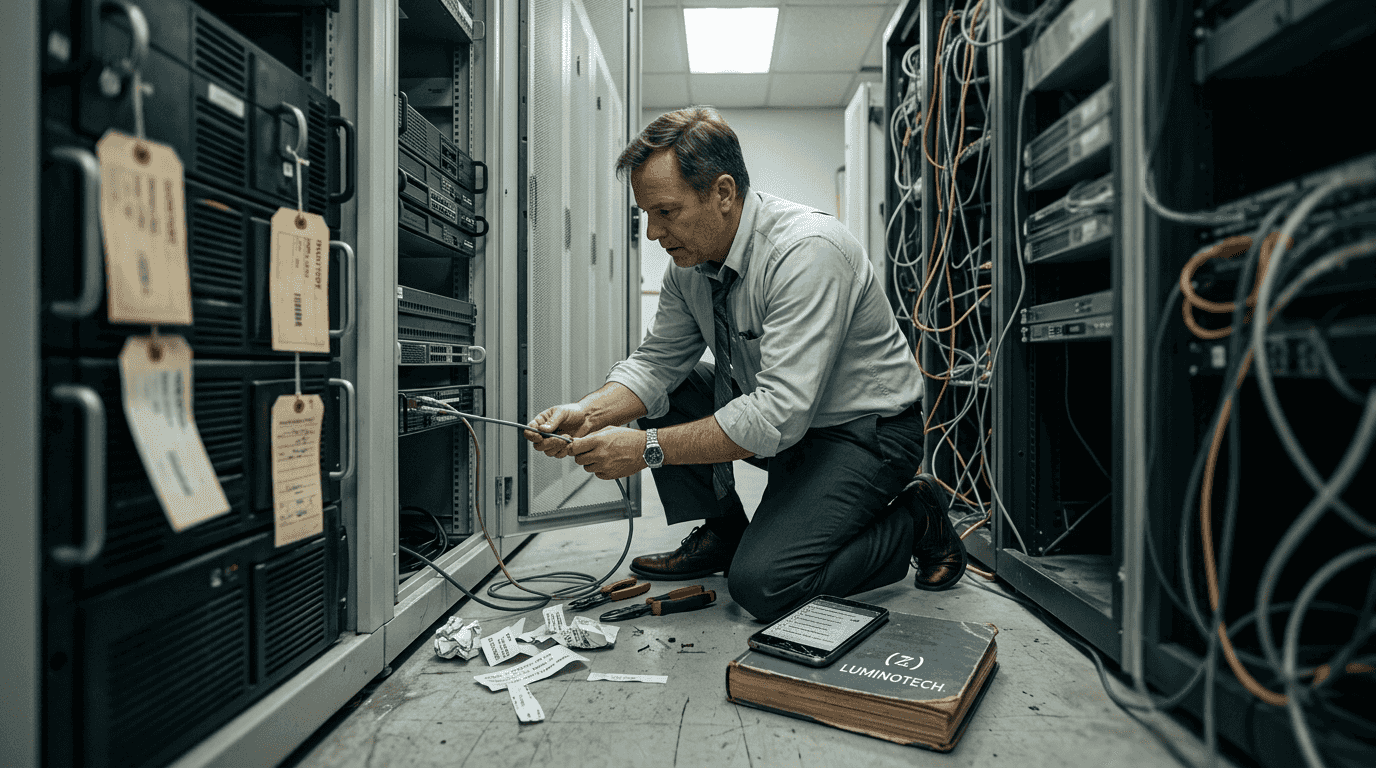
Balancing immediate operational needs with long-term modernization vision creates constant tension. Business units demand quick fixes for pressing problems, while IT teams know these patches add more technical debt. This short-term thinking perpetuates the cycle, making eventual modernization more difficult and expensive. Modernization complexity involves technical debt management, strategic balance, and business continuity assurance simultaneously.
Business continuity during migration ranks as the top concern for executives. Any system downtime translates to revenue loss, customer dissatisfaction, and operational chaos. Legacy systems often run mission-critical processes that cannot tolerate interruption, yet modernization requires touching these exact systems. The risk calculus becomes paralyzing: maintain expensive, vulnerable systems or risk disruption during transformation.
Key challenges UAE organizations face include:
- Integration complexity: Legacy systems use proprietary protocols and data formats incompatible with modern APIs and microservices architectures
- Skills gap: Existing IT staff trained on legacy platforms lack expertise in cloud-native development, containerization, and modern DevOps practices
- Data migration: Moving decades of data while maintaining integrity, relationships, and compliance with UAE data protection regulations
- Vendor lock-in: Proprietary technologies create dependencies that increase switching costs and limit modernization options
- Budget constraints: Modernization requires upfront investment while maintaining existing system operations, straining already tight IT budgets
Pro Tip: Engage cross-functional teams early to document and map business-critical processes before modernization. Hidden dependencies and undocumented workflows emerge through collaborative discovery sessions with actual system users, preventing costly surprises during migration.
The challenge isn't purely technical. Organizational resistance compounds technical complexity. Employees comfortable with familiar systems fear change, while departments worry about process disruptions. Successful modernization requires change management alongside tech strategies for business leaders that address both human and technical dimensions.
How to modernize: strategic approaches and best practices
Modular, integration-first architecture allows enterprises to transition incrementally rather than attempting risky big-bang replacements. This approach decomposes monolithic applications into loosely coupled services that can be modernized independently. Each module operates through well-defined APIs, enabling gradual replacement without disrupting the entire system.
Incremental modernization follows a proven sequence that minimizes risk while building momentum:
- Assessment phase: Catalog existing systems, identify technical debt hotspots, and map business process dependencies to understand the full modernization scope
- Prioritization: Rank applications by business value, technical risk, and modernization complexity to determine optimal sequencing
- Pilot modernization: Select a non-critical but representative system for initial modernization to validate approaches and build team expertise
- Iterative rollout: Expand modernization to additional systems in waves, applying lessons learned and refining methodology with each iteration
- Integration validation: Continuously test interfaces between modernized and legacy components to ensure seamless operation during transition
- Decommissioning: Systematically retire legacy systems only after confirming modernized replacements handle all business requirements
Selective data migration enables organizations to leave behind obsolete records and configurations accumulated over decades. This approach reduces migration complexity, improves data quality, and accelerates the transition. Rather than moving every historical record, focus on active data and recent history that serves current business needs.
| Approach | Big-bang replacement | Modular incremental modernization |
|---|---|---|
| Risk level | High | Low to moderate |
| Business disruption | Significant downtime likely | Minimal with proper planning |
| Timeline | Compressed but inflexible | Extended but adaptable |
| Cost predictability | Low | High |
| Rollback capability | Difficult | Straightforward |
Pro Tip: Prioritize mission-critical systems integration to maintain operational continuity during transition. Establish integration layers that allow legacy and modern systems to coexist, enabling gradual migration without forcing simultaneous replacement of interdependent components.
Successful modernization requires governance structures that balance speed with control. Establish clear decision-making frameworks, define success metrics beyond technical completion, and maintain executive sponsorship throughout the journey. The digital transformation roadmap provides strategic alignment that keeps modernization efforts focused on business outcomes rather than technology for its own sake.
Avoid the temptation to recreate legacy functionality exactly in modern platforms. Modernization offers an opportunity to eliminate unnecessary features, streamline workflows, and incorporate best practices impossible in old architectures. Question every legacy process and requirement rather than blindly replicating outdated approaches.
The role of emerging technologies in accelerating IT modernization
Cloud computing enables scalable infrastructure that adapts to demand without capital expenditure on physical hardware. This elasticity is fundamental to modernization, allowing organizations to provision resources instantly, experiment with new architectures, and scale globally without infrastructure constraints. Cloud platforms provide managed services that eliminate undifferentiated heavy lifting, letting IT teams focus on business value rather than infrastructure management.
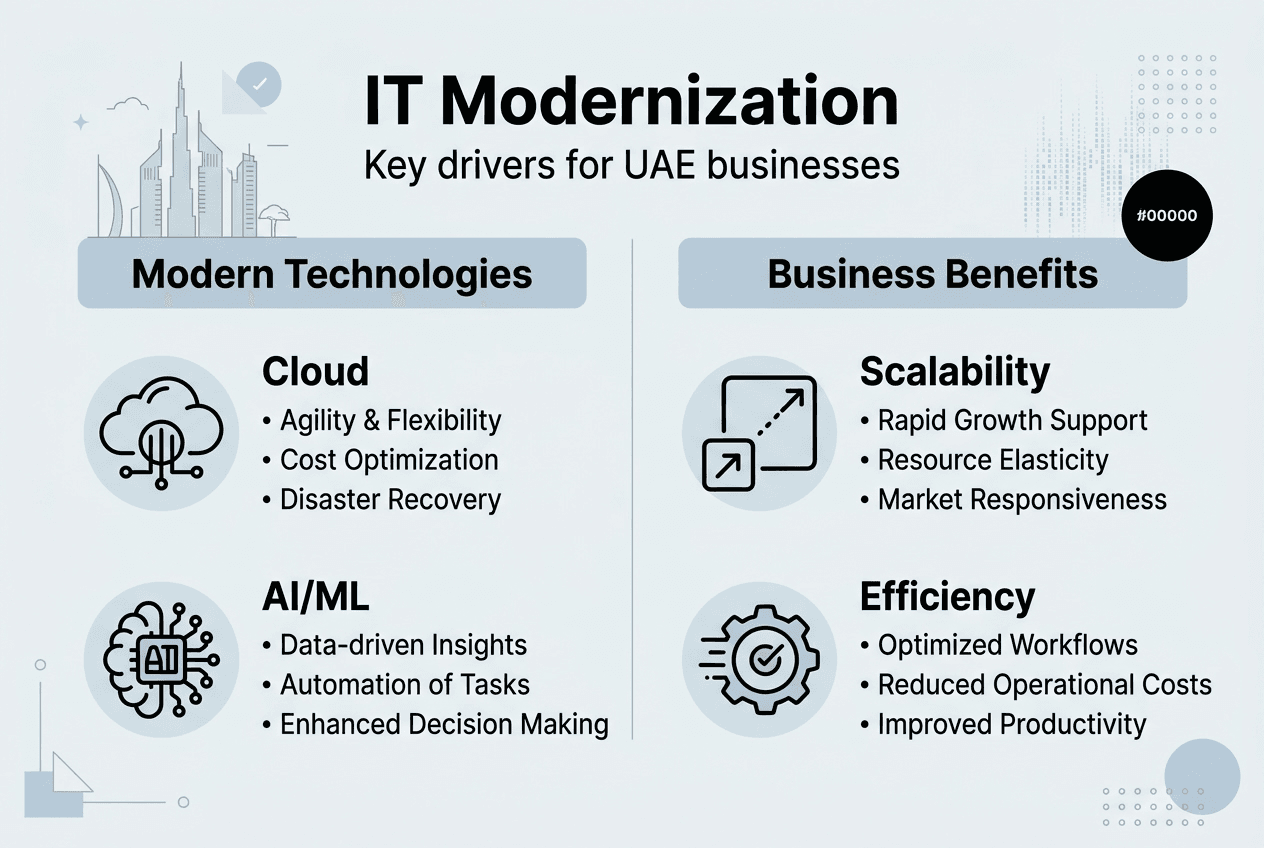
AI and machine learning enhance analytics, decision making, and automation in ways impossible with legacy systems. Modern platforms process vast data volumes in real time, identifying patterns and insights that drive competitive advantage. Predictive maintenance, customer behavior analysis, and intelligent process automation all require contemporary architectures capable of supporting these advanced capabilities.
Legacy systems simply cannot accommodate AI workloads or advanced analytics. Their rigid data structures, limited processing power, and inability to integrate with modern data pipelines create insurmountable barriers. Converting code is usually easiest, but application modernization encompasses data architecture, integration patterns, and operational models that legacy platforms fundamentally lack.
Emerging technologies deliver transformative benefits when integrated into modernized IT environments:
- Real-time processing: Stream processing and event-driven architectures enable instant response to business events, replacing batch processing that delays insights by hours or days
- Intelligent automation: AI-powered workflows reduce manual tasks, minimize errors, and free employees for higher-value activities requiring human judgment
- Advanced security: Modern platforms incorporate AI-driven threat detection, automated response capabilities, and zero-trust architectures that legacy systems cannot support
- Edge computing: Distributed processing brings computation closer to data sources, reducing latency and enabling new use cases in IoT and mobile scenarios
- API ecosystems: Modern architectures expose business capabilities through APIs, enabling rapid integration with partners, customers, and emerging platforms
UAE businesses face intensifying pressure to adopt these technologies for competitive advantage in 2026. Regional competitors and global players entering the market leverage cloud computing capabilities to deliver superior customer experiences and operational efficiency. Organizations that delay modernization find themselves unable to compete on the dimensions that increasingly determine market success.
The business impact of data analytics multiplies when built on modern foundations. Cloud-native data platforms enable sophisticated analytics that were previously cost-prohibitive or technically impossible. Organizations gain the ability to experiment rapidly, test hypotheses with real data, and pivot strategies based on evidence rather than intuition.
Modernization isn't about adopting every emerging technology indiscriminately. Strategic technology adoption aligns with specific business objectives, focusing investment on capabilities that differentiate your organization or remove critical operational constraints. The goal is building a flexible foundation that accommodates future innovation without requiring another wholesale transformation.
How YS Lootah Tech supports your IT modernization journey
Navigating IT modernization requires expertise spanning legacy systems, modern architectures, and the complex transition between them. YS Lootah Tech brings comprehensive capabilities specifically designed for organizations embarking on modernization initiatives in 2026.
Our application development services emphasize modular, cloud-native architectures that replace monolithic legacy systems with flexible, scalable solutions. We design applications that integrate seamlessly with existing infrastructure while providing clear migration paths for gradual modernization.
AI and machine learning integration transforms modernized platforms into intelligent systems that drive competitive advantage. Our expertise helps UAE organizations leverage advanced analytics, automation, and predictive capabilities impossible with legacy technology.
Modernization introduces new security considerations that require specialized expertise. Our data protection solutions ensure your modernized environment maintains compliance with UAE regulations while implementing robust security controls appropriate for cloud and hybrid architectures.
Key YS Lootah Tech offerings for modernization projects:
- Legacy system assessment: Comprehensive analysis identifying technical debt, integration dependencies, and optimal modernization sequencing
- Cloud migration planning: Strategic roadmaps balancing risk, cost, and business continuity throughout the transition
- Integration architecture: API and middleware solutions enabling coexistence of legacy and modern systems during phased migrations
- Change management support: Organizational readiness programs ensuring successful adoption of modernized platforms
"YS Lootah Tech partners with UAE enterprises to transform IT from a cost center into a strategic enabler, building modern foundations that support innovation, agility, and sustainable competitive advantage."
Frequently asked questions
What is IT modernization?
IT modernization is the strategic process of upgrading or replacing legacy technology systems with contemporary platforms, architectures, and practices that align with current business needs. It encompasses application refactoring, infrastructure migration to cloud environments, data architecture improvements, and integration pattern updates. The goal is creating flexible, scalable IT capabilities that support innovation rather than constraining it.
How long does IT modernization typically take?
Modernization timelines vary dramatically based on system complexity, organizational size, and chosen approach. Small-scale modernization of individual applications may complete in 3 to 6 months, while enterprise-wide transformations typically span 18 to 36 months. Incremental, modular approaches extend overall timelines but deliver value continuously and reduce risk compared to big-bang replacements. Realistic planning accounts for discovery of hidden dependencies and technical debt that inevitably surface during execution.
What are the biggest risks in IT modernization projects?
Business disruption during migration represents the primary risk, potentially causing downtime, data loss, or operational chaos if not managed carefully. Technical risks include underestimating integration complexity, discovering undocumented dependencies, and encountering compatibility issues between legacy and modern components. Organizational risks involve resistance to change, skills gaps in modern technologies, and loss of institutional knowledge as systems evolve. Budget overruns frequently occur when initial assessments miss hidden complexity or scope expands during execution.
Should we modernize all systems simultaneously or incrementally?
Incremental modernization dramatically reduces risk while enabling learning and adaptation throughout the journey. Simultaneous replacement of multiple systems amplifies complexity, strains resources, and eliminates fallback options if problems arise. Phased approaches allow validation of strategies on lower-risk systems before tackling mission-critical applications. They also distribute costs over time and enable continuous delivery of business value rather than requiring years before any benefits materialize.
How do we maintain business operations during modernization?
Maintaining operations requires integration layers that enable legacy and modern systems to coexist and communicate during transition periods. Implement robust testing protocols that validate functionality before cutover, and establish clear rollback procedures for rapid recovery if issues arise. Schedule migrations during low-activity periods when possible, and maintain parallel operations temporarily for critical systems until confidence in replacements is absolute. Communication with stakeholders about expected impacts and contingency plans is essential for managing expectations and coordinating responses to any disruptions.
What role does cloud computing play in modernization?
Cloud computing provides the scalable, flexible infrastructure foundation that modern applications require. It eliminates capital expenditure on hardware, enables rapid provisioning of resources, and offers managed services that reduce operational complexity. Cloud platforms support the microservices architectures, containerization, and DevOps practices that characterize modern application development. For most organizations, cloud migration is integral to modernization strategy rather than a separate initiative, though hybrid approaches maintaining some on-premises infrastructure remain viable for specific regulatory or performance requirements.