The Role of AI in Business: A 2026 Strategy Guide

TL;DR:
- Artificial intelligence transforms organizational operations, decision-making, and competitive strategies at an enterprise level.
- Success depends on aligning strategy, governance, leadership, and workflow redesign, not just deploying AI tools.
Artificial intelligence is defined as the enterprise-level capability that transforms how organizations operate, decide, and compete. The role of AI in business now spans every function, from supply chain forecasting to customer personalization, and U.S. companies spent about $37 billion on generative AI in 2025 alone. That figure signals a fundamental shift in how leaders allocate capital. Tools like Microsoft Copilot and platforms built on large language models are no longer experimental. They are production-grade infrastructure. The question for business leaders is no longer whether to adopt AI, but how to extract measurable value from it at scale.
How does AI improve operational efficiency and productivity in business?
The impact of AI on business operations is measurable, though not yet universal. A Federal Reserve Bank of Atlanta survey of 6,000 executives across the U.S., U.K., Germany, and Australia found that about 70% of firms actively use AI, yet 80% have seen no productivity or employment change yet. The forecasted productivity boost sits at roughly 1.4% over the next three years. That gap between adoption and results is the defining challenge for leaders right now.

Where AI does deliver, the gains are concrete. Microsoft 365 Copilot reduces time spent on repetitive knowledge work, including drafting documents, summarizing meetings, and generating reports, by automating tasks that previously required hours of human effort. Predictive analytics tools built on machine learning allow manufacturers to forecast equipment failures before they occur, cutting unplanned downtime by significant margins. In financial services, AI-powered fraud detection systems process millions of transactions per second with accuracy that no human team can replicate.
The productivity gap exists because most organizations deploy AI as a point solution rather than integrating it into core workflows. A customer service team that uses an AI chatbot for tier-one queries but keeps its escalation process manual will see limited gains. The same team redesigning its entire service workflow around AI, including routing, resolution tracking, and agent coaching, will see compounding returns.
- Automate repetitive tasks: AI handles data entry, invoice processing, and scheduling at scale, freeing staff for higher-value work.
- Predict operational outcomes: Machine learning models forecast demand, inventory needs, and maintenance windows with greater accuracy than rule-based systems.
- Augment knowledge work: Tools like Microsoft 365 Copilot accelerate drafting, analysis, and synthesis across finance, legal, and HR functions.
- Personalize at scale: AI recommendation engines, used by retailers and media platforms alike, deliver individualized experiences to millions of users simultaneously.
Pro Tip: Before deploying any AI tool, map the full workflow it will touch. Identify where human handoffs occur and redesign those points first. Partial automation rarely delivers the efficiency gains leaders expect.
What strategic approaches help businesses realize AI's full value?
AI in business strategy requires more than selecting the right technology. MIT Sloan Executive Education frames effective AI strategy as enterprise-wide orchestration, where technology, governance, and business goals align to transform pilots into scalable initiatives. Without that orchestration, organizations accumulate disconnected proofs of concept that never graduate to production.
The Microsoft Cloud Adoption Framework outlines four planning pillars that define a sound AI strategy:
- Identify measurable use cases. Prioritize applications where AI solves a defined business problem with a quantifiable outcome. Reducing customer churn by 15% is a use case. "Exploring AI for customer experience" is not.
- Align technology to existing skills and infrastructure. Deploying a large language model on infrastructure your team cannot maintain creates technical debt faster than it creates value. Match the tool to your team's capability and your data architecture.
- Establish data governance. AI models are only as reliable as the data they consume. Define data ownership, quality standards, and access controls before training or fine-tuning any model.
- Implement responsible AI practices. Build fairness, transparency, and accountability into every deployment. This is not optional. It is the foundation that allows AI to scale without regulatory or reputational risk.
The ROI pressure is real and immediate. 71% of CIOs say AI budgets may be cut if value is not demonstrated within two years. That timeline forces leaders to prioritize use cases with short feedback loops and visible business impact over ambitious multi-year transformation programs with no interim milestones.
| Strategic pillar | Common failure mode | Corrective action |
|---|---|---|
| Use case identification | Vague goals with no measurable outcome | Define KPIs before selecting technology |
| Technology alignment | Tools that outpace team capability | Assess skills gap before procurement |
| Data governance | Inconsistent or ungoverned training data | Appoint a data steward per domain |
| Responsible AI | Ethics treated as a compliance checkbox | Embed review into the development cycle |
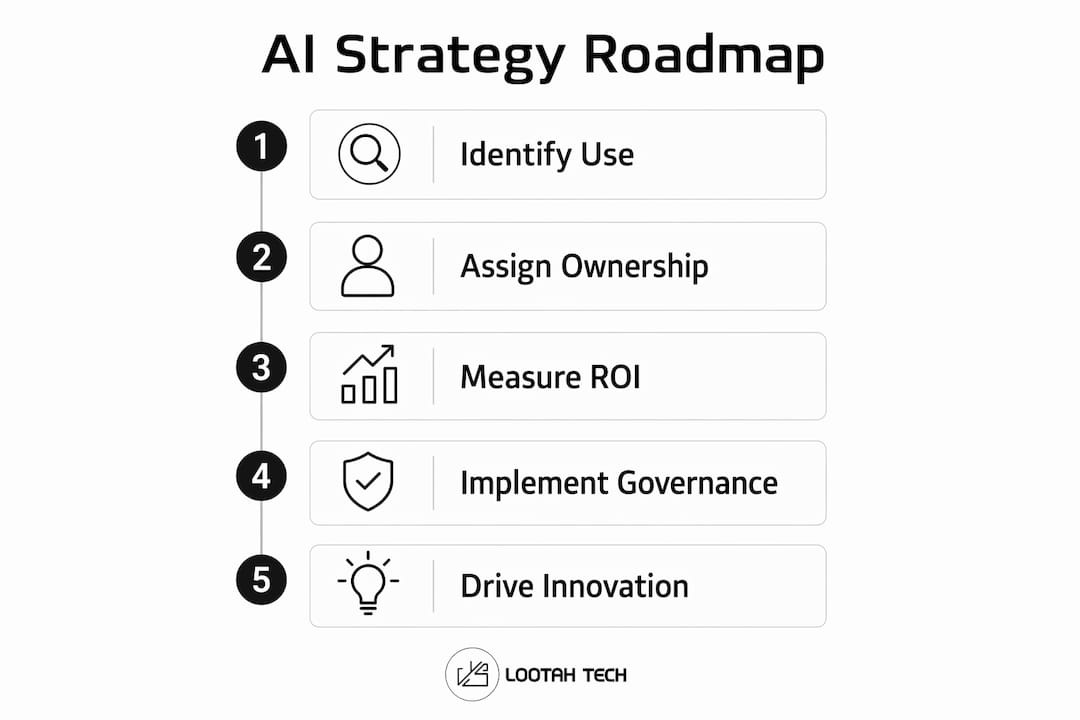
Pro Tip: Assign executive ownership to each AI initiative, not just a project manager. When a C-suite leader is accountable for ROI, use cases get resourced properly and governance decisions get made faster.
How do organizational factors influence AI success beyond the technology itself?
The technology is rarely the limiting factor. A Stanford Digital Economy Lab analysis of 51 enterprise AI deployments found that success varies dramatically by organizational readiness, leadership quality, and process adaptation rather than by which AI model was used. Two companies using identical tools can produce radically different outcomes based on how they manage change.
"AI value capture depends primarily on how an organization orchestrates change across strategy, people, and processes, not just technology deployment." — Stanford Digital Economy Lab
This finding has direct implications for how you budget and plan. Spending more on a better model will not fix a broken workflow. The organizations that outperform their peers treat AI deployment as an operating-model transformation. They redesign workflows, redefine accountability structures, and retrain teams before expecting returns.
Leadership behavior is the single most influential variable. Leaders who champion experimentation, tolerate early failures, and visibly use AI tools themselves create cultures where adoption accelerates. Leaders who delegate AI to IT and wait for results create cultures where pilots stall. The phenomenon known as "pilot purgatory," where AI proofs of concept never scale because no executive owns the transition to production, is the most common failure mode Yslootahtech observes across enterprise clients.
- Redesign workflows before deploying tools. AI inserted into a broken process produces faster broken results.
- Redefine accountability. Identify who owns AI-driven decisions and what happens when the model is wrong.
- Measure organizational readiness. Assess data maturity, change management capacity, and leadership alignment before committing to a deployment timeline.
- Avoid narrow success metrics. Measuring only cost savings from one AI tool misses the broader enterprise value that links AI ROI to sustained funding.
What are the risks and governance requirements for responsible AI deployment?
AI applications in enterprises carry risks that generic technology governance does not cover. Bias in training data produces discriminatory outputs. Generative AI models hallucinate, producing confident but factually incorrect content. Intellectual property exposure arises when models trained on proprietary data generate outputs that inadvertently reproduce protected material. Privacy violations occur when AI systems process personal data without adequate controls.
The NIST AI Risk Management Framework structures governance around four core functions: Govern, Map, Measure, and Manage. This voluntary standard gives organizations a repeatable process for identifying AI risks, assessing their severity, and building controls that scale with deployment complexity. Adopting NIST AI RMF as a baseline is the fastest path to auditable, defensible AI governance.
Generative AI demands additional controls. The NIST Generative AI Profile (NIST AI 600-1) expands the core framework to address hallucinations, IP concerns, and the amplified risks that large language models introduce. Standard AI risk controls are insufficient for generative systems. Organizations deploying tools like GPT-4, Claude, or Gemini in production need governance layers specifically designed for probabilistic, generative outputs.
| Risk category | Example | Governance control |
|---|---|---|
| Bias | Hiring model favoring certain demographics | Fairness audits and diverse training data |
| Hallucination | Generative AI producing false legal citations | Human review gates for high-stakes outputs |
| Privacy | AI processing unmasked personal data | Data anonymization and access controls |
| IP exposure | Model reproducing proprietary content | Output filtering and legal review protocols |
Pro Tip: Integrate AI risk reviews into your existing enterprise risk management cycle. Treating AI governance as a separate program creates silos. Embedding it into quarterly risk reviews keeps it funded and visible to the board.
How can businesses apply AI insights to drive innovation and competitive advantage?
The future of AI in business is not just operational efficiency. It is the capacity to sense market shifts faster, develop products more quickly, and personalize customer experiences at a depth that was previously impossible. AI-powered market intelligence tools analyze competitor pricing, customer sentiment, and regulatory changes in near real time, giving strategy teams signal that used to take weeks to compile manually.
Product development cycles shorten when AI handles hypothesis testing, prototype evaluation, and customer feedback analysis. Pharmaceutical companies use AI to screen molecular compounds at a scale no human research team can match. Retailers use AI to predict which product categories will spike before the trend appears in sales data. These are not incremental improvements. They represent a structural shift in how organizations generate and act on insight.
- Accelerate customer personalization. AI recommendation engines and dynamic pricing models adapt to individual behavior in real time, increasing conversion and retention.
- Compress decision cycles. AI scenario planning tools model the financial impact of strategic choices in hours rather than weeks, giving executives faster, more grounded options.
- Enable continuous learning. AI systems that retrain on new data improve over time, compounding their value in ways that static software cannot.
- Identify white space. Natural language processing tools scan patent filings, academic research, and market data to surface innovation opportunities before competitors act.
For leaders exploring 2026 AI enterprise trends, the competitive advantage from AI is not a one-time gain. It accumulates in organizations that build learning loops between their AI systems, their data, and their decision-making processes.
Key takeaways
The role of AI in business delivers measurable value only when strategy, governance, organizational readiness, and execution align, not when technology is deployed in isolation.
| Point | Details |
|---|---|
| Adoption does not equal productivity | 70% of firms use AI, but 80% report no productivity change yet. Redesign workflows before expecting returns. |
| Strategy requires four pillars | Use case clarity, technology alignment, data governance, and responsible AI practices must all be in place to scale. |
| Organizational factors outweigh model choice | Stanford's analysis of 51 deployments shows leadership and process adaptation determine outcomes more than AI model selection. |
| Generative AI needs specialized governance | NIST AI 600-1 addresses hallucinations and IP risks that standard AI frameworks do not cover. |
| ROI timelines are short | 71% of CIOs will cut AI budgets without demonstrated value within two years. Prioritize use cases with fast feedback loops. |
Why execution is the real AI challenge
Working with enterprise clients across industries, I have seen the same pattern repeat: organizations invest heavily in AI tools, run successful pilots, and then stall. The technology works. The organization does not adapt around it.
The uncomfortable truth is that most AI failures are leadership failures. When executives treat AI as an IT project rather than a business transformation, they underfund change management, skip workflow redesign, and measure success with metrics that do not connect to enterprise value. The execution-focused approach that Boston University Questrom research describes, embedding AI into workflows and governance rather than experimenting with tools, is the only approach that produces sustained results.
What I have found works is assigning a senior business leader, not a technologist, as the owner of each AI initiative. That leader is accountable for the workflow redesign, the change management, and the business outcome. Technology teams support them. When accountability sits with the business, AI stops being a tool experiment and starts being an operating model change. That shift is where the real value lives.
The organizations that will lead in the next five years are not those with the most AI tools. They are those that have built the governance, culture, and execution discipline to turn AI capability into business results continuously. That is a leadership challenge, and it is one worth taking seriously.
— YS
Ready to build your AI strategy with expert support?
Yslootahtech works with business leaders to design and deploy AI solutions that connect directly to operational and strategic goals. From custom machine learning models to enterprise AI integration, the team brings technical depth and business context to every engagement.
Whether you are moving from pilot to production or building your first AI use case, Yslootahtech's AI and machine learning services are built to deliver measurable outcomes, not just working software. The team also supports leaders navigating the AI integration checklist process, helping translate strategic intent into deployed, governed systems. Reach out to discuss where AI can create the most value for your organization.
FAQ
What is the role of AI in business today?
AI functions as an operational and strategic enabler, automating routine tasks, improving decision-making through data analysis, and accelerating product and service innovation. Its value depends on how well organizations integrate it into workflows and governance structures.
Why are so many companies not seeing productivity gains from AI?
A Federal Reserve Bank of Atlanta survey found that 80% of firms using AI report no productivity or employment change yet. The primary reason is that organizations deploy AI as a point solution without redesigning the workflows around it.
What framework should businesses use for AI governance?
The NIST AI Risk Management Framework provides a structured approach built around four functions: Govern, Map, Measure, and Manage. For generative AI specifically, the NIST AI 600-1 profile adds controls for hallucinations and intellectual property risks.
How long do businesses have to show AI ROI before budgets are cut?
According to HBR research, 71% of CIOs say AI budgets will be cut if value is not demonstrated within two years. Leaders should prioritize use cases with short feedback loops and quantifiable business outcomes from the start.
What separates successful AI deployments from failed ones?
Stanford's analysis of 51 enterprise AI deployments shows that organizational readiness, leadership quality, and process adaptation determine success more than the AI model selected. Companies that treat AI as an operating-model transformation consistently outperform those focused solely on technology selection.