Unlock big data analytics for strategic advantage

Companies that embrace data-driven decision-making are 23% more likely to acquire customers, 6% more profitable, and 19% better at retaining them than competitors. Yet many executives still view big data analytics as a complex tech buzzword rather than a strategic imperative. This guide reveals how business leaders and analysts can harness big data analytics to transform decision-making processes, overcome implementation challenges, and build sustainable competitive advantages across any industry in 2026.
Table of Contents
- Understanding Big Data Analytics And Data-Driven Decision-Making
- Core Big Data Architectures And Analytical Methodologies
- Navigating Challenges And Building A Data-Driven Culture
- Leveraging Big Data Analytics For Strategic Decision-Making And Competitive Advantage
- Explore YS Lootah Tech's Big Data And AI Services
- Frequently Asked Questions About The Role Of Big Data Analytics
Key takeaways
| Point | Details |
|---|---|
| Strategic impact | Big data analytics drives measurably superior customer acquisition, profitability, and retention outcomes. |
| Core technologies | Hadoop, Spark, Lambda, and Kappa architectures power modern big data processing at scale. |
| Decision precision | Data-driven decision-making delivers faster, more accurate, and adaptive strategic insights. |
| Privacy balance | Organizations must navigate regulatory compliance while extracting analytics value ethically. |
| Cultural foundation | Building a data-driven culture matters more than technology investments for analytics success. |
Understanding big data analytics and data-driven decision-making
Big data analytics refers to the systematic examination of massive, diverse datasets to uncover patterns, correlations, and insights that inform strategic business decisions. Data-driven decision-making enables organizations to derive more accurate, adaptive, and scalable insights than traditional intuition-based approaches. This methodology transforms how companies operate across every function, from supply chain optimization to customer experience personalization.
The business impact is quantifiable and dramatic. Research shows data-driven companies outperform competitors by substantial margins in customer acquisition, profitability, and retention metrics. These organizations make faster strategic pivots, identify market opportunities earlier, and allocate resources with greater precision. The competitive gap continues widening as analytics capabilities mature and data volumes expand exponentially.
Consider how retailers use big data analytics to predict inventory needs with 95% accuracy, reducing waste while ensuring product availability. Financial institutions detect fraudulent transactions in milliseconds, protecting customers and minimizing losses. Healthcare providers identify disease patterns across populations, enabling preventive interventions that save lives and reduce costs. These applications demonstrate analytics value across diverse sectors.
Pro Tip: Schedule monthly cross-functional sessions where data analysts present findings directly to executive teams, fostering mutual understanding of both business context and analytical possibilities.
Successful implementation requires more than technology investments. You need skilled analysts who understand your industry, executives who ask the right questions, and systems that deliver insights when decisions happen. The synergy between human expertise and computational power creates breakthrough advantages. Organizations that maximize business impact with data analytics recognize this human-machine partnership as essential.
"The biggest impediment to widespread analytics adoption is not technology but people and process. Organizations must cultivate analytical thinking at every level to realize data's transformative potential." - Dr. Michael Stonebraker, Turing Award Winner
This cultural dimension separates analytics leaders from laggards. Technology alone cannot drive transformation. You must embed data literacy throughout your organization, align incentives with evidence-based decision-making, and celebrate insights that challenge conventional wisdom. Companies applying data-driven digital marketing strategies exemplify this integrated approach, combining technical sophistication with strategic marketing acumen.
The journey toward becoming truly data-driven involves continuous learning, experimentation, and refinement. Early wins build momentum and demonstrate value to skeptics. As capabilities mature, analytics becomes embedded in daily operations rather than special projects. This evolution positions organizations to capitalize on emerging opportunities while competitors remain reactive.
Core big data architectures and analytical methodologies
Modern big data analytics relies on sophisticated architectures designed to process petabytes of information efficiently. Understanding these foundational technologies helps you select the right approach for your specific business needs and data characteristics.
Major big data architectures include:
- Hadoop: Distributed storage and processing framework ideal for batch processing massive datasets across commodity hardware clusters
- Apache Spark: In-memory processing engine that can process data up to 100x faster than Hadoop for certain workloads
- Cloud platforms: Managed services from AWS, Azure, and Google Cloud that eliminate infrastructure complexity and scale elastically
- NoSQL databases: Document, graph, and columnar stores optimized for specific data types and query patterns
Spark's speed advantage comes from keeping data in memory rather than writing intermediate results to disk. This makes it superior for iterative algorithms common in machine learning and interactive analytics. However, Hadoop remains valuable for extremely large batch jobs where cost per terabyte matters more than processing speed. Many organizations use both technologies strategically.

Cloud platforms democratize big data analytics by offering pay-as-you-go pricing and eliminating upfront hardware investments. You can spin up clusters in minutes, process data, and shut down resources when finished. This flexibility accelerates experimentation and reduces financial risk for analytics initiatives. Organizations leveraging AI and machine learning services often combine cloud infrastructure with specialized analytics tools.
Pro Tip: Start with cloud-based managed services rather than building on-premise infrastructure, allowing your team to focus on extracting insights rather than managing servers and storage.
Two architectural patterns dominate real-time analytics implementations:
| Architecture | Use Cases | Complexity | Key Benefits |
|---|---|---|---|
| Lambda | Financial fraud detection, real-time dashboards with historical context | High (maintains separate batch and streaming layers) | Combines batch accuracy with streaming speed; handles reprocessing elegantly |
| Kappa | IoT sensor monitoring, live user behavior tracking | Medium (single streaming pipeline) | Simpler to maintain; reduces code duplication; faster development cycles |
Lambda Architecture processes data through both batch and real-time layers, merging results to provide comprehensive views. This dual-path approach ensures accuracy while delivering low-latency insights. The trade-off is operational complexity from maintaining two separate processing pipelines with different code bases.
Kappa Architecture simplifies this by using a single streaming pipeline for all data processing. Everything flows through the stream, and you replay historical data when needed by resetting stream positions. This reduces maintenance burden and accelerates development. However, it requires more sophisticated streaming infrastructure and may not suit all analytical workloads.
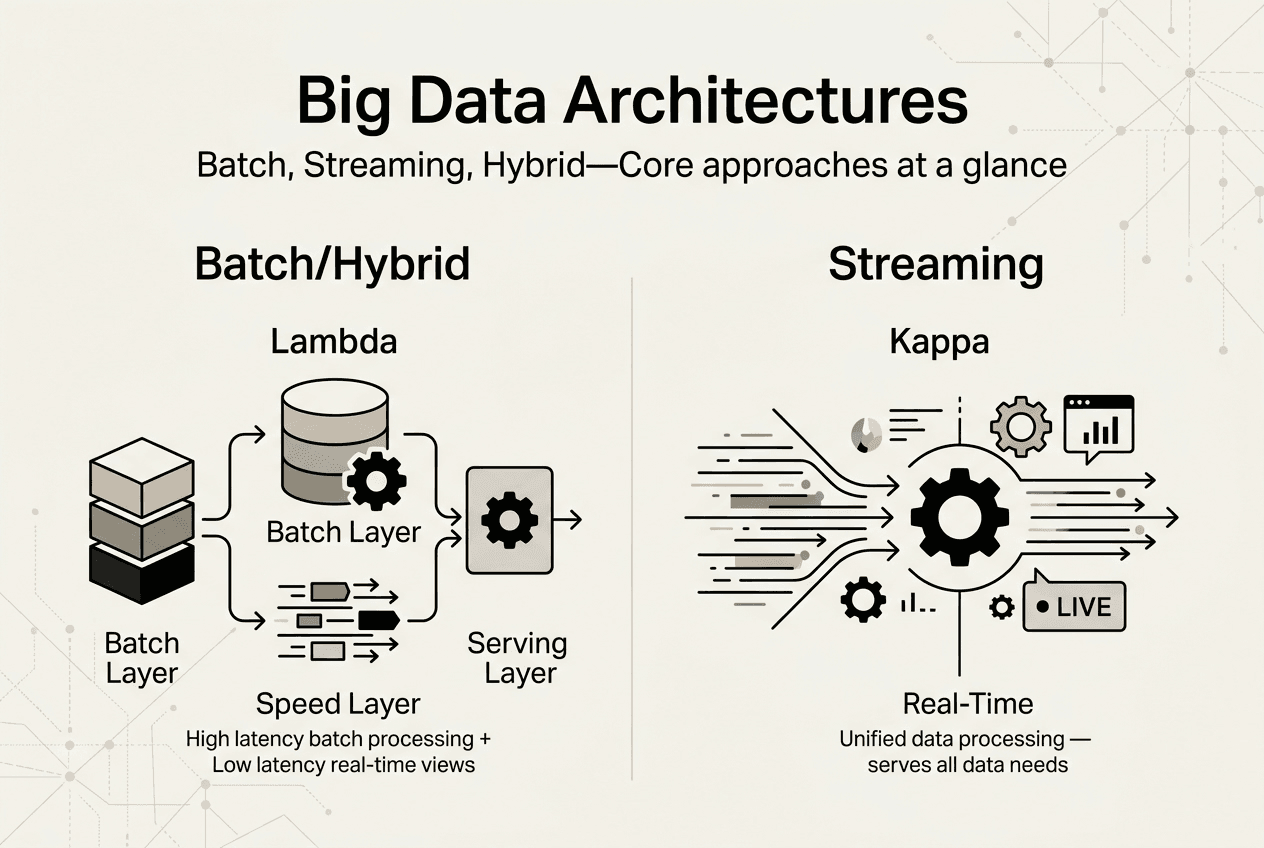
Your choice depends on specific requirements. If you need to frequently reprocess historical data with updated algorithms, Lambda's batch layer provides advantages. For pure streaming scenarios where real-time matters most, Kappa's simplicity wins. Many innovative tech strategies for business leaders involve hybrid approaches that blend architectural patterns strategically.
Navigating challenges and building a data-driven culture
Implementing big data analytics involves significant challenges beyond technology selection. Organizations must address privacy concerns, regulatory compliance, cultural resistance, and alignment between analytical capabilities and business objectives.
Top implementation challenges include:
- Data privacy: Balancing analytics benefits with privacy protection under GDPR, CCPA, and emerging regulations
- Regulatory compliance: Meeting industry-specific requirements for data handling, retention, and auditing
- Cultural resistance: Overcoming skepticism from employees accustomed to intuition-based decision-making
- Skill gaps: Finding and retaining talent with both analytical expertise and business domain knowledge
- Goal alignment: Ensuring analytics initiatives address actual strategic priorities rather than interesting but irrelevant questions
Privacy regulations fundamentally reshape how organizations collect, process, and store data. Differential privacy techniques allow extracting valuable insights while mathematically guaranteeing individual privacy protection. These methods add carefully calibrated noise to datasets, preventing identification of specific individuals while preserving statistical patterns. Smart companies view privacy as a design principle rather than a compliance burden.
Cultural transformation represents the deepest challenge. Analytics threatens established power structures built on experience and intuition. Department heads may resist data-driven recommendations that contradict their judgment. Successful change requires visible executive sponsorship, celebrating analytical wins, and gradually building trust in evidence-based approaches.
"Culture and people, not technology, are the biggest barriers to analytics adoption. Organizations must invest as heavily in developing analytical mindsets as in purchasing software and infrastructure." - Dr. Michael Stonebraker
Building a sustainable data-driven culture requires deliberate strategies:
- Leadership commitment: Executives must consistently demand data to support recommendations and decisions
- Democratized access: Provide self-service analytics tools so employees can explore data without waiting for IT
- Continuous training: Develop data literacy across all functions through workshops, certifications, and mentoring
- Ethical frameworks: Establish clear guidelines for responsible data use that balance innovation with privacy
- Governance structures: Create cross-functional committees to prioritize analytics initiatives and resolve conflicts
Pro Tip: Implement privacy-by-design principles from project inception rather than retrofitting compliance later, and maintain ongoing cultural engagement through regular town halls showcasing analytics successes.
Organizations navigating digital transformation challenges and solutions recognize that technology enables change but culture determines success. You cannot mandate analytical thinking through policy alone. It emerges from repeated positive experiences where data-driven decisions produce superior outcomes.
Start with quick wins that demonstrate value and build credibility. A marketing team that increases conversion rates 30% through A/B testing becomes an internal case study. A supply chain optimization that cuts costs 15% generates executive attention. These successes create momentum for broader transformation.
Alignment between analytics and strategy prevents wasted effort on technically impressive but strategically irrelevant projects. Regularly revisit your analytics roadmap against evolving business priorities. The most sophisticated machine learning model provides zero value if it solves the wrong problem. Following a clear digital transformation roadmap keeps initiatives focused on measurable business outcomes.
Leveraging big data analytics for strategic decision-making and competitive advantage
Transforming analytical capabilities into competitive advantage requires deliberate strategies that embed insights into strategic planning, operational execution, and continuous improvement cycles. The gap between possessing data and deriving value from it separates market leaders from followers.
Data-driven companies lead significantly in customer acquisition, profitability, and retention because they make faster, more precise decisions across all functions. Marketing teams optimize campaigns in real-time based on performance data. Product developers prioritize features using actual usage patterns rather than assumptions. Operations managers predict maintenance needs before equipment fails.
This decision-making precision accelerates as organizations mature their analytics practices. Early efforts focus on descriptive analytics, understanding what happened. Intermediate stages add diagnostic capabilities, explaining why events occurred. Advanced practitioners achieve predictive and prescriptive analytics, forecasting future outcomes and recommending optimal actions.
Actionable steps to leverage big data analytics effectively:
- Define strategic KPIs: Identify the 5-10 metrics that truly drive your business success and ensure data infrastructure captures them accurately
- Invest strategically: Allocate budget to cloud infrastructure, analytics platforms, and visualization tools that match your technical maturity level
- Build hybrid teams: Recruit data scientists with industry expertise or pair analytical specialists with business domain experts
- Cultivate data culture: Require data to support major decisions, celebrate analytical wins, and provide training to build organization-wide literacy
- Monitor and iterate: Track analytics ROI through business outcomes, not technical metrics, and continuously refine approaches based on results
These steps apply across industries with appropriate customization. Retailers use analytics to optimize inventory and personalize recommendations. Manufacturers predict equipment failures and optimize production schedules. Healthcare providers identify high-risk patients and improve treatment protocols. Financial services detect fraud and assess credit risk with greater accuracy.
The business analytics implementation impact spans sectors, with significant decision-making improvements documented across retail, finance, healthcare, and manufacturing. Organizations that systematically apply these frameworks outperform competitors who approach analytics opportunistically.
Consider how enterprise app examples transform operations by embedding analytics directly into daily workflows. Sales representatives receive real-time recommendations during customer calls. Warehouse managers see predictive alerts about inventory shortages before they impact fulfillment. Customer service agents access complete interaction histories that enable personalized support.
This operational embedding ensures insights drive action rather than languishing in reports. The most sophisticated analysis provides zero value if it never influences decisions. Design your analytics initiatives with clear paths from insight to action, including defined owners responsible for implementing recommendations.
Competitive advantage compounds over time as your analytics capabilities mature. Early investments in data infrastructure, talent, and culture create foundations for increasingly sophisticated applications. Organizations that maximize business impact with data analytics view it as a continuous journey rather than a destination.
The strategic imperative intensifies as data volumes grow and analytical techniques advance. Artificial intelligence and machine learning enable pattern recognition at scales impossible for human analysts. Real-time processing delivers insights when they matter most. Cloud platforms democratize access to enterprise-grade capabilities.
Your competitive position in 2026 and beyond depends on how effectively you harness these tools to inform strategy, optimize operations, and deliver superior customer experiences. The companies winning this race treat analytics as a core competency, not a supporting function. They invest accordingly and reap measurable rewards in market share, profitability, and growth.
Explore YS Lootah Tech's big data and AI services
Transforming your organization into a data-driven powerhouse requires more than vision. You need experienced partners who understand both the technology landscape and your specific business challenges. YS Lootah Tech delivers comprehensive solutions that bridge this gap.
Our expertise spans the complete analytics lifecycle, from infrastructure design through insight delivery and organizational change management. We help you navigate architectural decisions, implement robust data pipelines, and build analytical capabilities that drive measurable business outcomes. Whether you're launching your first analytics initiative or scaling existing capabilities, our team brings proven frameworks and industry-specific knowledge.
Key service areas supporting your analytics journey include IT consulting services for strategic roadmap development, AI and machine learning services for advanced analytical models, and application development services that embed insights into operational workflows. We partner with business executives and analysts to unlock competitive advantages through tailored big data solutions designed for your industry and maturity level.
Frequently asked questions about the role of big data analytics
What industries benefit most from big data analytics?
Every industry gains value from big data analytics, though applications vary. Retail, finance, healthcare, manufacturing, and logistics see particularly dramatic impacts through personalized experiences, fraud detection, predictive maintenance, and supply chain optimization.
How does big data analytics improve customer retention?
Analytics identifies at-risk customers through behavior pattern analysis, enabling proactive retention interventions. Personalization engines deliver relevant experiences that increase satisfaction and loyalty. Predictive models optimize timing and messaging for retention campaigns, significantly improving effectiveness compared to generic approaches that organizations using business impact of data analytics demonstrate consistently.
What are the key privacy concerns with big data analytics?
Primary concerns include unauthorized data collection, inadequate security leading to breaches, lack of transparency about data usage, and potential discrimination from algorithmic bias. Organizations must implement privacy-by-design principles, obtain proper consent, and apply techniques like differential privacy to protect individuals while extracting insights.
How can organizations overcome data culture barriers?
Start with visible executive sponsorship and quick wins that demonstrate value. Provide training to build data literacy across all levels. Celebrate analytical successes and share case studies internally. Require data to support major decisions consistently. This gradual approach builds trust and competence over time, similar to strategies in digital transformation success strategies.
What future trends should executives watch in big data analytics?
Edge analytics processing data closer to sources for faster insights, automated machine learning democratizing advanced techniques, real-time streaming analytics becoming standard, enhanced privacy-preserving methods, and tighter integration between analytics and operational systems. Organizations investing now in foundational capabilities will capitalize on these emerging trends most effectively.