Role of AI in Digital Transformation for Healthcare

Many healthcare leaders in the United Arab Emirates now face a complex challenge: improving patient care while keeping operations efficient under rising demands. Adopting artificial intelligence means more than following a global trend—it introduces powerful tools that help teams diagnose, treat, and engage patients with greater precision. This guide clarifies what AI really means for your organization, highlighting key concepts and practical steps as you drive digital transformation in a competitive healthcare market.
Table of Contents
- Defining AI in Digital Healthcare Transformation
- Major AI Types and Applications in Healthcare
- Key Benefits: Operational Efficiency and Patient Care
- Challenges, Risks, and Compliance Requirements
- Avoiding Missteps: Common Pitfalls and Solutions
Key Takeaways
| Point | Details |
|---|---|
| Integration of AI | AI enhances healthcare by augmenting clinician expertise, improving workflows, and patient outcomes rather than replacing human professionals. |
| Operational Efficiency | AI-driven automation reduces administrative burdens, allowing healthcare teams to focus more on patient care, thereby improving clinical quality. |
| Compliance and Ethics | The implementation of AI in healthcare must address compliance challenges related to data privacy, algorithmic bias, and transparency to prevent legal and ethical issues. |
| Stakeholder Engagement | Successful AI deployments involve all stakeholders, including clinicians and IT specialists, ensuring alignment and reducing resistance to new technologies. |
Defining AI in Digital Healthcare Transformation
Artificial intelligence in healthcare isn't about robots replacing doctors. It's about augmenting human expertise with computational power to solve real clinical problems.
For mid-sized healthcare organizations in the UAE, understanding what AI actually means in your operational context is crucial. The technology integrates into your existing workflows to enhance patient outcomes rather than disrupting them entirely.
At its core, AI in digital healthcare transformation refers to systems that leverage large datasets to improve diagnosis, treatment recommendations, and patient engagement across your organization. Your clinical teams can access faster, more accurate insights without fundamentally changing how they practice medicine.
What AI Actually Does in Your Healthcare Operations
AI handles three specific responsibilities that directly impact your bottom line and patient satisfaction:
- Pattern recognition: Analyzes imaging scans and patient records to detect abnormalities faster than manual review
- Predictive analytics: Identifies high-risk patients before they require emergency interventions
- Administrative automation: Processes insurance claims, schedules appointments, and manages inventory without human intervention
These aren't theoretical capabilities. They're functioning today in healthcare facilities managing thousands of patients daily.
The transformation piece matters just as much as the AI piece. Digital healthcare transformation means restructuring how your teams work, what data you collect, and how clinical decisions flow through your organization. AI amplifies these changes.
Your competitive advantage comes from combining AI capabilities with redesigned workflows, not from adopting the technology alone.
You might already be collecting patient data through electronic health records. AI helps you extract actionable intelligence from that data at scale. A radiologist reviewing 50 chest X-rays daily might miss subtle findings. An AI system trained on thousands of images catches patterns humans naturally overlook.
The human element remains central. AI doesn't diagnose patients—it provides your clinicians with a second opinion backed by statistical analysis. Your physicians make the final decision based on their expertise and patient context.
For digital transformation leaders specifically, understanding what digital transformation actually means helps you position AI as a strategic enabler rather than a standalone technology project. Your organization succeeds when AI integrates into broader digital initiatives that address operational inefficiencies and improve patient experiences simultaneously.
Implementation challenges differ from understanding. Your mid-sized organization likely lacks the AI expertise of larger hospital networks. That's why partnering with technology providers who understand both healthcare workflows and AI capabilities matters significantly.
Pro tip: Start by mapping which specific clinical or administrative problems cause your teams the most frustration—these are your highest-impact AI opportunities, not the flashiest use cases.
Major AI Types and Applications in Healthcare
Not all AI works the same way. Different AI types solve different healthcare problems, and understanding which type addresses your specific operational challenge is where strategy begins.
Your mid-sized healthcare organization likely operates with limited data science resources. Knowing which AI modality fits your problem prevents expensive missteps and wasted implementation time.
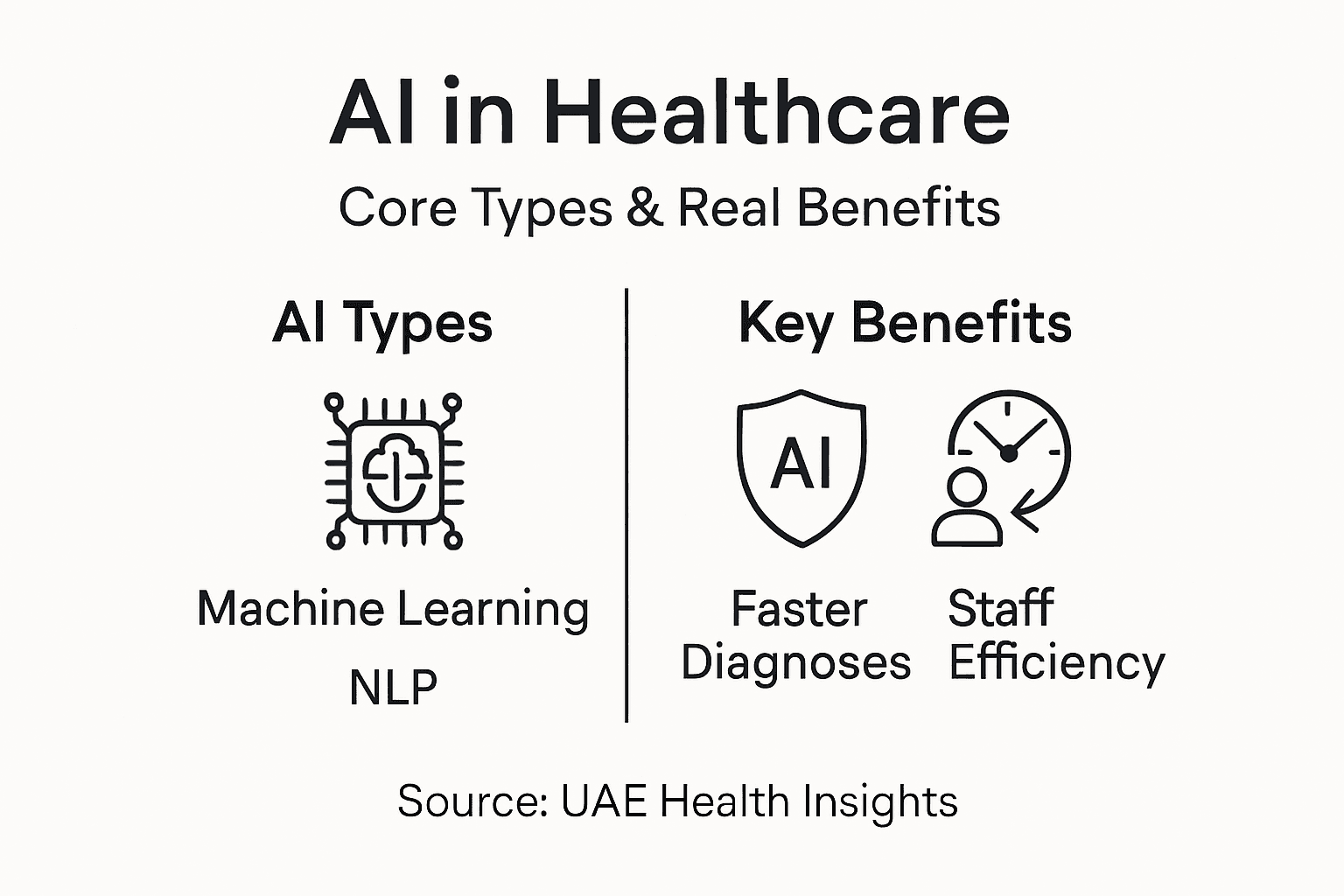
The Core AI Types Transforming Healthcare
Machine learning and deep learning form the backbone of most healthcare AI applications today. Machine learning identifies patterns in your existing data without being explicitly programmed for each scenario. Deep learning processes complex, unstructured data like medical images with remarkable accuracy.
Here are the AI types your organization will encounter:
- Machine learning: Learns patterns from historical patient data to predict outcomes and flag anomalies
- Deep learning: Analyzes medical imaging, pathology slides, and complex diagnostic data at scale
- Natural language processing: Extracts clinical insights from unstructured notes, lab reports, and patient communications
- Robotics and autonomous systems: Performs precision surgical procedures and automates repetitive clinical tasks
- Supervised learning: Trains on labeled examples where correct answers already exist in your records
- Unsupervised learning: Discovers hidden patterns in patient populations without predefined categories
Each type has distinct strengths. Machine learning excels at structured data problems. Deep learning dominates image analysis and pattern recognition. Natural language processing unlocks insights locked in clinical documentation your teams write daily.
To clarify the strengths and typical uses of each AI type in healthcare, here's a concise comparison:
| AI Type | Best-Suited Data | Primary Operational Benefit |
|---|---|---|
| Machine learning | Structured patient data | Predicts outcomes, flags anomalies |
| Deep learning | Medical images, signals | Accurate complex pattern recognition |
| Natural language processing | Unstructured text | Extracts insights from clinical notes |
| Robotics/Autonomous systems | Real-time sensor input | Enables precision and automates tasks |
| Supervised learning | Labeled historical data | Optimizes with known outcomes |
| Unsupervised learning | Unlabeled patient data | Discovers unknown patient groupings |
Where Each AI Type Creates Real Impact
Supervised and unsupervised learning approaches map directly to your operational challenges. Diagnostic imaging departments benefit most from deep learning. Administrative teams see automation gains from natural language processing applied to prior authorization and discharge summaries.
Practical applications include:
- Clinical decision support: AI recommends treatment protocols based on similar patient outcomes
- Diagnostic imaging: Detects tumors, fractures, and abnormalities faster than manual interpretation
- Personalized medicine: Tailors treatment recommendations to individual patient genetics and history
- Robotic surgery: Enables precision interventions with reduced tissue trauma and faster recovery
- Predictive prognosis: Identifies high-risk patients before complications develop
- Public health surveillance: Tracks disease patterns and outbreak risks across populations
Your organization's AI success depends on matching the right technology type to your actual clinical or operational bottleneck, not adopting the flashiest capability.
Robotic surgery illustrates this perfectly. Your surgical team doesn't need robotic automation for every procedure. But for complex cases requiring micron-level precision, robotic systems outperform human hands. The technology amplifies surgeon expertise rather than replacing it.
Natural language processing often delivers quick wins for mid-sized organizations. Your clinical teams already generate thousands of text notes monthly. Extracting structured data from that text automates routine documentation tasks and surfaces clinical patterns your teams would never manually identify.
Partnership with experienced technology providers matters here. AI and machine learning implementation requires both technical expertise and healthcare workflow understanding. Vendors who understand your specific operational context can recommend the right AI type rather than overselling capabilities you don't need.
Pro tip: Audit your biggest time-drains first—whether that's imaging backlogs, prior authorization denials, or clinical documentation burden—then select the AI type that directly addresses that specific problem rather than starting with technology and searching for use cases.
Key Benefits: Operational Efficiency and Patient Care
AI doesn't just handle administrative busywork. When implemented thoughtfully, it transforms how your clinicians work and fundamentally improves patient outcomes.

For mid-sized healthcare organizations, the real value comes from gains across two interconnected areas: how efficiently your teams operate and how effectively they care for patients. These aren't separate benefits—they reinforce each other.
Operational Efficiency That Frees Your Teams
AI-driven tools automate administrative tasks that consume enormous amounts of clinical time. Your nurses spend hours documenting rather than monitoring patients. Your billing department processes prior authorizations manually. Your scheduling coordinators juggle appointment conflicts repeatedly.
Here's where automation creates immediate relief:
- Documentation automation: Extracts clinical data from voice notes and charts, reducing charting time by 30-40 percent
- Prior authorization: AI predicts insurance requirements and flags needed documentation before submission
- Appointment scheduling: Matches patient availability with provider openings automatically
- Lab result routing: Delivers abnormal results directly to appropriate clinicians with context
- Billing optimization: Identifies coding gaps before claims submission, reducing denials
- Inventory management: Predicts supply needs and prevents stockouts of critical items
These efficiency gains translate to real money. When your staff spends less time on paperwork, they spend more time delivering care. Your operational costs per patient decrease while clinical quality increases simultaneously.
Patient Care That Actually Gets Better
AI improves health outcomes, patient safety, and diagnostic accuracy through multiple mechanisms. Diagnostic tools catch diseases earlier when treatment proves more effective. Clinical decision support recommends evidence-based protocols tailored to each patient's unique situation.
Specific patient care improvements include:
- Earlier detection: AI identifies cancers and cardiovascular disease at earlier, more treatable stages
- Reduced human error: Catches medication interactions and dosing mistakes before administration
- Personalized protocols: Recommends treatments based on individual patient genetics and medical history
- Faster treatment access: Streamlined workflows mean patients move through your facility quicker
- Continuous monitoring: Alerts your team to patient deterioration before clinical signs become obvious
- Reduced readmissions: Identifies high-risk patients for intensive post-discharge support
The best healthcare organizations don't choose between efficiency and quality—AI enables both simultaneously by eliminating waste that never benefited patients anyway.
Consider your emergency department. AI can predict patient flow surges hours in advance, allowing you to schedule staff accordingly. Simultaneously, diagnostic support accelerates imaging interpretation so critical patients get treatment faster. Your staff operates in a less chaotic environment while patients experience dramatically shorter wait times.
Your workforce shortage challenges compound these benefits. Precision medicine and personalized treatment approaches powered by AI mean your existing clinicians deliver more sophisticated care without requiring additional specialists. One cardiologist supported by AI diagnostic tools can manage a larger patient panel effectively.
The financial impact matters too. Lower operational costs plus better outcomes means improved margins. You can reinvest savings into staff development, facility upgrades, or expanded services rather than just surviving financially.
Pro tip: Start by measuring your current state across three areas: staff time spent on documentation and administrative tasks, your clinical error rates, and average time-to-diagnosis for common conditions—these baseline metrics prove the impact once AI implementation begins.
Challenges, Risks, and Compliance Requirements
AI in healthcare isn't a regulatory blank slate. Your organization faces real legal and ethical obligations before deploying any AI system—and the consequences of missteps extend beyond financial penalties.
Mid-sized healthcare organizations often underestimate the compliance complexity. You can't simply implement AI because the technology works. You must implement it responsibly.
The Critical Compliance Challenges
Data privacy, algorithmic bias, and transparency represent core compliance concerns that regulators increasingly scrutinize. Your patient data contains protected health information governed by strict regulations. When you feed that data into AI systems, you create new legal obligations.
Specific compliance areas your organization must address:
- Data privacy and security: Patient information must remain protected throughout the AI training and deployment process
- Algorithmic bias: AI systems trained on biased historical data perpetuate discrimination in diagnosis and treatment recommendations
- Transparency and explainability: Your clinicians need to understand why an AI system made a specific recommendation
- Informed consent: Patients must understand when AI influences their care decisions
- Regulatory documentation: You must maintain audit trails proving your AI systems meet safety and efficacy standards
- Liability clarity: Legal frameworks don't clearly define responsibility when AI errors contribute to patient harm
The regulatory landscape keeps shifting. UAE healthcare authorities increasingly demand compliance documentation before AI implementation. European standards now require explainability—you can't deploy AI that makes decisions physicians can't understand.
Real Risks That Extend Beyond Compliance
Commercial interests in AI healthcare create tensions between innovation and patient safety01668-9/fulltext), sometimes marginalizing vulnerable populations. An AI system trained primarily on affluent patient populations may perform poorly for lower-income patients with different disease presentations or comorbidities.
Practical risks your organization faces:
- Biased outcomes: AI recommends different treatments based on patient demographics rather than clinical factors
- Reduced transparency: Vendors withhold information about how their systems work, preventing your quality control
- System failures: AI misses critical findings or makes incorrect recommendations with no built-in safety checks
- Reputational damage: Public trust erodes when patients discover biased or failing AI systems
- Staff resistance: Your clinicians refuse to use AI tools they don't understand or trust
Implementing AI without addressing bias, transparency, and regulatory requirements doesn't save time—it creates liability.
Consider your emergency department again. If your AI triage system consistently routes certain patient populations to lower-acuity assessments, you've created both a patient safety problem and a discrimination issue. The financial cost of one lawsuit exceeds years of efficiency savings.
Your organization needs governance structures before implementation. Data governance, AI ethics committees, and bias testing aren't bureaucratic overhead—they're essential risk management. Experienced IT consulting partners help you build these safeguards into your AI strategy from the start.
Validation and continuous monitoring matter critically. Once deployed, AI systems drift. Patient populations change. Your team must monitor performance across different demographic groups and clinical scenarios continuously.
Pro tip: Establish your AI governance framework and bias testing protocols before selecting any AI vendor or solution—waiting until after implementation discovery means expensive retrofitting and regulatory friction.
Avoiding Missteps: Common Pitfalls and Solutions
Most healthcare AI failures don't happen because the technology is flawed. They happen because organizations rush implementation without proper preparation, stakeholder alignment, or realistic expectations.
Your mid-sized organization can avoid these expensive mistakes by understanding what typically derails AI projects and implementing proven safeguards upfront.
The Pitfalls That Actually Sink Projects
Over-reliance on unvalidated algorithms, poor data quality, and lack of clinician engagement represent common implementation failures. Your IT team may find a promising AI solution and want to deploy it immediately. Your clinicians weren't consulted. Your data hasn't been properly prepared. The system launches and fails spectacularly.
Specific pitfalls your organization must avoid:
- Unvalidated algorithms: Deploying AI systems without rigorous testing on your specific patient population
- Poor data quality: Using incomplete, inconsistent, or biased historical data to train or validate systems
- Clinician exclusion: Implementing AI without input from the physicians and nurses who'll actually use it
- Inadequate infrastructure: Lacking the technical foundation to securely integrate AI into existing systems
- Unrealistic timelines: Expecting transformational results within weeks rather than months of iterative refinement
- Poor change management: Assuming staff will naturally adopt AI tools without training or psychological preparation
- Interoperability gaps: Deploying AI systems that can't communicate with your electronic health records or other clinical tools
Your team sees efficiency promises and gets excited. But cutting corners on validation, data preparation, or stakeholder engagement guarantees problems.
To summarize the main challenges and solutions for successful healthcare AI implementation:
| Implementation Challenge | Common Pitfall | Best Practice Solution |
|---|---|---|
| Algorithm validation | Insufficient local testing | Rigorous validation with real data |
| Stakeholder engagement | Clinician exclusion | Multidisciplinary project teams |
| Data accuracy | Poor data quality | Thorough data cleaning and review |
| Change management | Resistance to adoption | Comprehensive staff training |
| System integration | Interoperability issues | Prioritize EHR compatibility |
| Monitoring and governance | Lack of ongoing oversight | Continuous performance metrics |
Solutions That Actually Work
Robust data governance, iterative testing, and human-AI collaboration strategies overcome adoption barriers and optimize AI's transformative potential. The organizations succeeding with AI invest heavily in preparation before deployment.
Here's what separates successful implementations:
- Rigorous validation: Test AI systems extensively on your actual patient data and clinical scenarios before deployment
- Multidisciplinary teams: Involve clinicians, IT specialists, data experts, and administrators from the start
- Continuous monitoring: Establish metrics tracking AI performance across different patient demographics and clinical contexts
- Transparent communication: Help your teams understand what AI does, why it makes recommendations, and when human judgment overrides it
- Iterative refinement: Deploy in controlled environments first, gather feedback, improve, then expand gradually
- Comprehensive training: Your staff needs hands-on practice with AI tools, not just theory
- Clear governance: Document who approves AI implementation, who monitors performance, and who handles issues
Consider starting small. Implement AI in one department or for one specific problem. Your team learns what works. You gather real performance data. You build organizational confidence. Success in one area makes expansion to other departments much smoother.
The fastest path to organizational AI adoption isn't deploying the flashiest technology immediately—it's proving value convincingly in a limited scope first.
Your staff resistance often signals legitimate concerns, not Luddite thinking. Clinicians worry about liability when AI makes recommendations. They don't trust systems they don't understand. Address these concerns directly through transparency, validation, and clear protocols defining when AI informs versus decides.
Data quality determines everything. Spend extra time cleaning, validating, and documenting your training data. Biased or incomplete data produces biased or unreliable AI systems regardless of how sophisticated the underlying technology is.
Pro tip: Establish your validation and monitoring protocols before selecting any specific AI solution—this ensures you evaluate vendors based on your actual requirements rather than their marketing claims.
Unlock the Full Potential of AI in Your Healthcare Transformation Journey
The role of AI in digital transformation for healthcare is undeniable but implementing it successfully requires more than adopting technology. Your mid-sized healthcare organization in the UAE faces challenges like data quality, clinician engagement, compliance, and integrating AI into existing workflows — challenges that demand expert guidance and tailored solutions. At YS Lootah Tech, we understand these pain points and help you harness AI for real operational efficiency, improved patient care, and sustainable growth.
Our comprehensive digital transformation services combine advanced AI capabilities with deep healthcare workflow knowledge to build solutions that amplify your clinical teams rather than disrupt them. Whether you need AI-powered predictive analytics, natural language processing for clinical documentation, or secure system integration, our expert team crafts strategies and tools that align perfectly with your unique challenges and compliance requirements.
Take the next step to empower your healthcare organization with trusted AI solutions designed for the digital age. Discover how YS Lootah Tech brings innovation, quality, and sustainability together to help you lead transformation today.
Explore our expert digital transformation services and contact us now to start building AI solutions that actually work for your healthcare operations.
Frequently Asked Questions
What is the role of AI in digital healthcare transformation?
AI enhances human expertise in healthcare by utilizing large datasets to improve diagnosis, treatment recommendations, and patient engagement, thus augmenting operational workflows.
How does AI improve operational efficiency in healthcare facilities?
AI automates administrative tasks such as processing insurance claims and scheduling appointments, allowing healthcare professionals to focus more on patient care and reducing operational costs.
What types of AI applications are commonly used in healthcare?
Common AI applications in healthcare include machine learning for predictive analytics, deep learning for analyzing medical imaging, and natural language processing for extracting insights from unstructured data.
What are the compliance challenges associated with implementing AI in healthcare?
Compliance challenges include ensuring data privacy, addressing algorithmic bias, maintaining transparency, acquiring informed consent from patients, and adhering to regulatory documentation requirements.