Data Privacy in 2026: What Business Leaders Must Know

TL;DR:
- By 2026, data privacy regulation has become highly complex, requiring organizations to adopt integrated, operational governance strategies.
- AI's enforcement deadline and combined penalties amplify risks, highlighting the need for technical controls and transparent practices.
Data privacy in 2026 is defined by the convergence of 19+ U.S. state laws, 144 countries with enforceable privacy frameworks, and the EU AI Act's first major enforcement milestone, making proactive governance a non-negotiable business priority. The regulatory environment has shifted from a manageable set of rules into a multi-layered compliance obligation that touches every function from HR to product development. For business leaders, the question is no longer whether to invest in privacy programs. It is how fast and how deep. Privacy has moved from a legal checkbox to a strategic differentiator that builds consumer trust and signals accountability to investors. The future of data privacy belongs to organizations that treat it as an operational discipline, not a compliance exercise.
What are the key data privacy regulations shaping business in 2026?
The regulatory map for data protection trends 2026 is more complex than any prior year. 19 U.S. states now have comprehensive consumer privacy laws in effect, with Indiana, Kentucky, and Rhode Island activating their statutes on January 1, 2026, and Arkansas adding its law in July 2026. That means a mid-size company operating across multiple states faces a patchwork of consent requirements, opt-out rights, and data minimization obligations that cannot be satisfied with a single policy document.
Globally, the picture is equally demanding. The EU's GDPR remains the gold standard, but China's PIPL, Brazil's LGPD, and India's Digital Personal Data Protection Act are each adding enforcement teeth. By 2026, 144 countries have enforceable privacy laws, meaning any organization with international customers or vendors carries cross-border transfer obligations that require active management.
Enforcement priorities have also shifted. Regulators are no longer satisfied with documentation. Enforcement now focuses on operational ability: can you consistently honor deletion requests, explain AI-driven decisions, and demonstrate real-time transparency? The EU GDPR has issued over €7.1 billion in cumulative fines, with an average of 443 breach notifications filed daily. That volume signals regulators are not waiting for egregious violations. They are auditing operational readiness.
| Regulation | Jurisdiction | Key 2026 Development |
|---|---|---|
| GDPR | European Union | €7.1B+ cumulative fines; AI Act overlap penalties |
| CCPA/CPRA | California, U.S. | Expanded enforcement of opt-out and data deletion |
| Indiana, Kentucky, Rhode Island | U.S. States | Laws effective January 1, 2026 |
| DPDP Act | India | Active enforcement framework operational |
| EU AI Act | European Union | High-risk system deadline: August 2, 2026 |
The dual penalty risk is the detail most business leaders miss. A company violating both GDPR and the EU AI Act in the same incident faces separate penalty calculations under each framework. That is not a theoretical scenario. It is the direct consequence of deploying AI systems that process personal data without proper governance.
How does AI affect data privacy compliance in 2026?
The impact of AI on data privacy is the defining compliance challenge of this year. The EU AI Act's August 2, 2026 enforcement deadline for high-risk AI systems carries penalties up to €35 million or 7% of global annual turnover. High-risk systems include AI used in hiring, credit scoring, healthcare triage, and critical infrastructure. If your organization uses any of these, the clock has already run out on preparation.
The core problem is consent decay. When personal data collected for one purpose gets fed into an AI training pipeline, the original legal basis for processing may no longer apply. Without technical guardrails, organizations lose legal authority to use that data in AI models without even realizing it. This is not a legal abstraction. It is an operational failure that requires engineering solutions, not just policy updates.

Privacy regulations 2026 also demand explainability. Regulators now scrutinize whether AI systems have named accountable owners and clear review paths. A black-box model that influences a consumer decision cannot be defended in an audit by pointing to a privacy policy. You need documented data lineage, consent records tied to specific model versions, and a named person responsible for each AI system's outputs.
Here is the practical sequence for bringing AI systems into compliance:
- Inventory every AI system that processes personal data, including third-party tools embedded in your stack.
- Map data lineage from collection point to model training, identifying where consent was obtained and for what purpose.
- Classify each system against the EU AI Act's risk tiers to determine which face the August 2026 deadline.
- Implement technical controls that prevent personal data from entering training pipelines without verified consent.
- Assign named owners to each high-risk AI system with documented review and escalation procedures.
Pro Tip: Privacy and data engineering teams must work from the same data catalog. If your privacy officer does not have access to your data warehouse schema, consent decay is already happening in your organization.
What practical steps build a resilient privacy program in 2026?
Building a program that survives 2026 enforcement scrutiny requires moving beyond annual audits. Effective programs depend on a Record of Processing Activities (ROPA), vendor due diligence workflows, and privacy-by-design embedded into engineering sprints. These are not one-time deliverables. They are living operational systems.
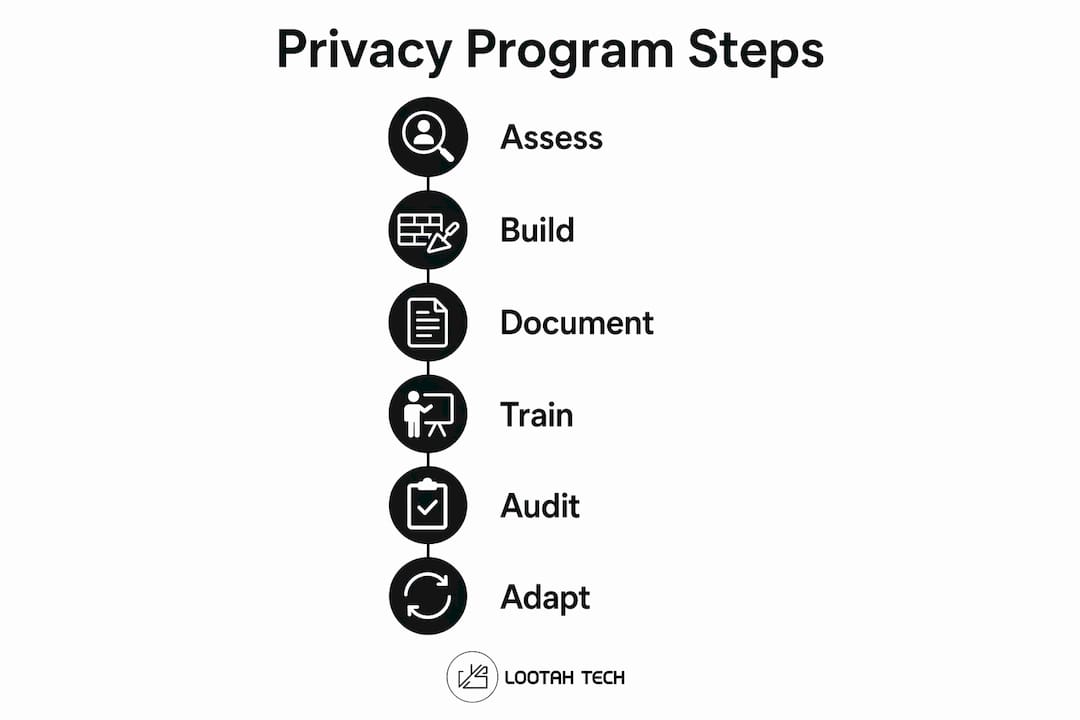
The GDPR framework remains the most practical foundation for multi-jurisdiction compliance. Start with GDPR requirements, then layer state-specific adjustments for California, Virginia, Texas, and the 2026 additions. This approach avoids building 19 separate programs. It builds one program with documented local variations. For cross-border data transfers, Standard Contractual Clauses remain the primary mechanism under GDPR, but India's DPDP and China's PIPL each require separate transfer impact assessments.
| Compliance approach | Strengths | Limitations |
|---|---|---|
| GDPR-first framework | Covers most global requirements; investor-recognized | Requires local adjustments for U.S. state opt-out rights |
| State-by-state approach | Precise local compliance | Operationally unsustainable at scale |
| Privacy-by-design integration | Embeds compliance into product development | Requires engineering team buy-in and training |
Individual rights management deserves specific attention. Consumer data deletion requests have increased 567% since 2021 without proportional staff growth. That gap is not closeable with manual processes. Organizations that have not automated rights request workflows are already behind. Tools that integrate with your CRM, data warehouse, and HR systems to execute deletion, correction, and portability requests are now a compliance necessity, not a luxury.
Vendor management is the other gap most programs underestimate. Your privacy obligations extend to every processor that touches personal data on your behalf. Contracts must specify data processing terms, audit rights, and breach notification timelines. A vendor's data breach is your regulatory exposure.
Pro Tip: Treat your annual privacy audit as a stress test, not a report card. Simulate a regulator's data subject access request against your live systems. If your team cannot fulfill it within the statutory deadline using documented procedures, you have a gap that a policy update will not fix.
How are employee data and biometric data reshaping compliance?
Employee data privacy is the blind spot in most corporate privacy programs. Employees are gaining rights to access, correct, and delete their personal data under an expanding set of state and national laws. Most organizations have invested heavily in consumer-facing privacy infrastructure while leaving HR systems, performance management platforms, and workforce monitoring tools outside the program's scope.
Remote work has made this worse. A company with employees in California, Colorado, Texas, and the UK faces four different sets of employee data rights, each with different response timelines and scope. Failure to govern workforce data creates litigation exposure that is distinct from regulatory fines. Employment attorneys are increasingly using privacy law violations as leverage in wrongful termination and discrimination cases.
Biometric data carries the highest risk per record of any data category. Illinois' Biometric Information Privacy Act (BIPA) allows private rights of action with statutory damages of $1,000 to $5,000 per violation. Facial recognition in access control systems, body scanning in warehouses, and voiceprint authentication in call centers all trigger these obligations. Several other states have followed Illinois with their own biometric statutes, and the trend is accelerating.
Key areas where organizations consistently underestimate biometric and employee data exposure:
- Workforce monitoring tools that capture keystrokes, screen activity, or location data
- AI-powered recruitment platforms that analyze video interviews or writing samples
- Health and wellness programs that collect wearable device data from employees
- Access control systems using fingerprint or facial recognition
- Performance analytics platforms that profile individual employee behavior patterns
Pro Tip: Map your HR technology stack the same way you map customer data flows. Every platform that processes employee personal data needs a data processing agreement, a retention schedule, and a deletion workflow tied to offboarding.
Key takeaways
Data privacy in 2026 demands operational governance across AI systems, employee data, and multi-jurisdictional regulations. Organizations that treat it as a strategic function rather than a legal obligation will outperform those that do not.
| Point | Details |
|---|---|
| Regulatory complexity is real | 19 U.S. state laws plus 144 global frameworks require layered, not siloed, compliance programs. |
| AI Act enforcement is live | The August 2, 2026 deadline for high-risk AI systems carries penalties up to €35M or 7% of global turnover. |
| Consent decay is an engineering problem | Technical guardrails must prevent personal data from entering AI pipelines without verified, current consent. |
| Employee data is underprotected | HR systems, monitoring tools, and biometric data must be integrated into privacy programs to avoid litigation exposure. |
| Automation is no longer optional | A 567% increase in deletion requests since 2021 makes manual rights management operationally indefensible. |
Why privacy must be a board-level priority, not a compliance task
I have worked with organizations across the Gulf and broader MENA region that treat privacy as something the legal team handles. That model is broken, and 2026 is the year it visibly fails for companies that have not changed course.
The volume argument alone should be enough. A 567% surge in deletion requests since 2021 means your privacy team is already underwater. Adding AI governance, employee data rights, and biometric compliance on top of that without automation and cross-functional ownership is not a resource problem. It is a structural failure.
What I find most telling is how many organizations still separate their privacy program from their data engineering team. Active governance around data lineage and AI model data use requires privacy and engineering to work from shared systems. A privacy officer who cannot query the data catalog is writing policies that do not reflect reality. That gap is exactly what regulators find when they audit.
The competitive argument is equally clear. Brands that demonstrate transparent data practices and accountability win customer trust and pass investor due diligence faster. Privacy is now a deal factor in M&A and enterprise procurement. If your program cannot be explained in a board presentation, it cannot be defended in a regulator's office either.
The organizations I respect most in this space have made privacy a product discipline. They embed it in sprint planning, vendor onboarding, and AI deployment reviews. They do not wait for a breach to discover their gaps. You should be reading about AI cybersecurity strategies alongside your privacy program development, because the two are now inseparable.
— YS
How Yslootahtech helps businesses navigate AI and privacy compliance
Yslootahtech works with business leaders who need more than a policy document. The team builds AI governance frameworks that integrate consent management, data lineage tracking, and privacy-by-design directly into machine learning pipelines and operational data flows.
For organizations facing the EU AI Act's high-risk system requirements or managing multi-jurisdiction data rights programs, Yslootahtech provides expert consultation and implementation support tailored to your technology stack. Whether you are mapping employee data flows, automating rights request workflows, or embedding privacy controls into a new AI deployment, the AI and machine learning services at Yslootahtech are built to make compliance operationally sustainable. Explore how Yslootahtech's AI implementation work translates governance frameworks into working systems.
FAQ
What are the major new privacy laws effective in 2026?
Indiana, Kentucky, and Rhode Island activated comprehensive consumer privacy laws on January 1, 2026, and Arkansas follows in July 2026. Globally, 144 countries now have enforceable privacy frameworks, including India's DPDP Act.
What is the EU AI Act deadline for high-risk systems?
The EU AI Act's enforcement milestone for high-risk AI systems is August 2, 2026, with penalties reaching €35 million or 7% of global annual turnover. Organizations using AI in hiring, credit, healthcare, or critical infrastructure must have compliant governance in place now.
How does consent decay affect AI compliance?
Consent decay occurs when personal data collected for one purpose is later used in AI model training without a valid legal basis. Technical controls that enforce data lineage and consent verification are required to prevent unauthorized AI training on personal data.
Why is employee data a growing privacy risk?
Employees now hold access, correction, and deletion rights under multiple state and national laws, and most HR systems are not integrated into corporate privacy programs. Remote work across jurisdictions multiplies this exposure significantly.
How should business leaders approach multi-jurisdiction compliance?
Build a GDPR-based framework as the foundation, then document jurisdiction-specific adjustments for U.S. state laws, India's DPDP, and China's PIPL. This approach is more sustainable than maintaining separate programs for each regulation.