The Role of Customer Data in Transformation

Customer data is the operational fuel that converts business strategy into measurable CX and efficiency gains. Without it, personalization stalls, AI initiatives fail to launch, and bad marketing data costs U.S. businesses $611 billion per year. The leaders who move fastest are not the ones with the most data. They are the ones who resolve identity, govern permissions, and run targeted pilots before attempting any enterprise-wide overhaul.
Three actions to take before your next planning cycle:
- Verify identity resolution capability. Can your systems match a customer across web, app, CRM, and support channels into a single profile? If not, every downstream initiative sits on a cracked foundation.
- Choose one high-payoff pilot use case. Personalization, media suppression, or churn prediction each deliver fast, measurable returns. Pick one, fund it, and use the results to justify the next phase.
- Assign executive ownership for customer data. MIT Sloan's position is unambiguous: data transformation is the CEO's business, not the CIO's alone. Without a named executive accountable for data quality and lifecycle, governance stays theoretical.
Pro Tip: Frame your pilot around a business outcome the CFO already cares about, such as reducing wasted media spend or improving conversion on a specific segment. That framing gets budget approved faster than any technology pitch.
Table of Contents
- What "customer data transformation" actually means
- How the transformation pipeline actually works
- Concrete ways customer data changes CX and operations
- How to measure the business impact: ROCD and practical KPIs
- How to implement: a pilot-first approach that actually scales
- Technology building blocks and how to evaluate vendors
- Common pitfalls and how to avoid them
- A realistic roadmap with cost buckets
- Key Takeaways
- Why the conventional wisdom on data transformation gets it backward
- Yslootahtech helps leaders scope and execute data pilots
- Useful sources for further reading
What "customer data transformation" actually means
Customer data transformation is the process of converting raw, fragmented customer records into identity-resolved, integrated, governed data products that can be activated for CX and operations. The word "transformation" matters here. A one-off data cleanup is not transformation. Transformation means building a living system that continuously ingests, resolves, governs, and activates customer signals at scale.
The scope of customer data breaks into four practical types:
- Profile data: demographics, contact identifiers, loyalty IDs, account attributes
- Transactional data: purchases, billing history, returns, subscription events
- Behavioral data: web and app events, product interactions, search queries
- Engagement data: support tickets, NPS responses, email opens, chat transcripts
Most organizations have all four types sitting in separate systems. The transformation work is connecting them into a single, governed customer profile, then making that profile available to the teams and tools that need it. That is a fundamentally different project from cleaning a CRM export or migrating a database. It requires identity resolution, data governance, and an activation layer, all operating continuously.
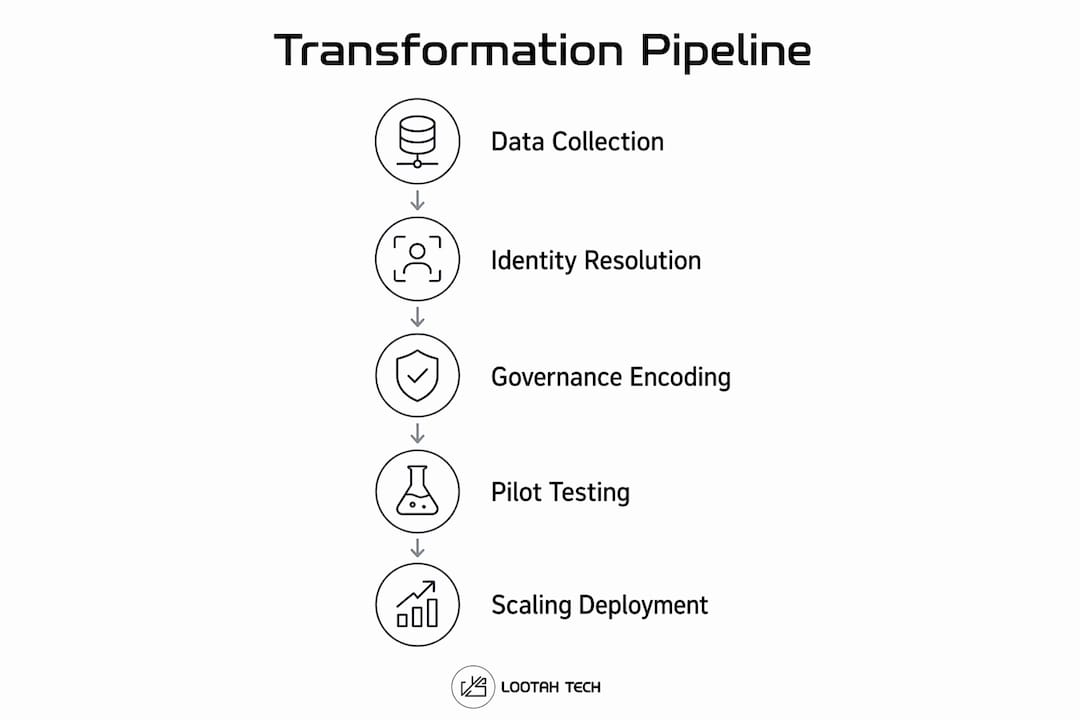
How the transformation pipeline actually works
The practical pipeline runs through six components. Leaders who fund only part of it typically get data infrastructure without business outcomes.
- Source discovery: Catalog every system that holds customer data, including shadow IT and third-party platforms. You cannot resolve identity across sources you have not mapped.
- Ingestion and ELT: Pull data from source systems into a central layer, whether a cloud data warehouse like Snowflake or BigQuery, or a data lake. Real-time and batch pipelines serve different use cases.
- Cleaning and normalization: Standardize formats, remove duplicates, and enforce schema consistency. Identity fragmentation compounds at every step downstream if this is skipped.
- Identity resolution and MDM: Match records across sources using deterministic signals (email, phone, loyalty ID) and probabilistic machine-learning approaches. This must be a living system, not a one-time merge job.
- Data productization and governance: Package resolved profiles into reusable data products with encoded permissions, consent flags, and business rules. Governance built into the pipeline beats governance enforced by process every time.
- Activation layer: Expose unified profiles to CDPs, marketing platforms, service tools, and analytics via APIs. This is where business value is actually realized.
Ownership matters as much as architecture. Source owners sit in business units. Identity and MDM ownership typically belongs to a central data team. Activation ownership sits with the teams running CX, marketing, and operations. Without clear handoffs between these three groups, data products stall between engineering and the business.
BCG's three-phase framing maps cleanly onto this pipeline: a rapid pilot that proves value in weeks, a use-case roadmap that extends the approach to priority domains, and an industrialization phase that embeds data products and governance across the enterprise. The BCG analysis is explicit that companies attempting a single centralized IT overhaul almost always fail. Pilots win.

| Phase | Typical Duration | Success Signal |
|---|---|---|
| Pilot | 6–12 weeks | One use case delivering measurable lift |
| Scale | 3–6 months | Use-case roadmap funded by pilot ROI |
| Industrialize | 6–18 months | Reusable data products, encoded governance |
Concrete ways customer data changes CX and operations
A unified customer profile does not just improve marketing. It changes how the entire organization operates.
On the CX side:
- Identity-driven personalization delivers the right offer to the right customer at the right moment, across channels, without requiring the customer to repeat themselves.
- Consistent omnichannel journeys become possible when a service agent, a mobile app, and a website all read from the same profile. The customer experience feels coherent rather than fragmented.
- Proactive service replaces reactive support when behavioral signals, such as a drop in app engagement or a failed transaction, trigger outreach before the customer contacts you.
On the operations side:
- Accurate customer audiences reduce media waste. Suppressing existing customers from acquisition campaigns, or targeting high-CLV lookalikes, cuts cost per acquisition materially.
- Forecasting improves when transactional and behavioral data feed demand models rather than aggregate sales reports.
- Service resolution time drops when agents have a single view of a customer's history, rather than toggling between five systems.
Personalization leaders consistently capture higher revenue than peers who rely on generic campaigns. McKinsey's research on data-driven enterprises shows that the gap between leaders and laggards widens as AI capabilities mature, because AI models trained on unified, identity-resolved data outperform those trained on fragmented records.
The single most underestimated operational benefit of customer data transformation is speed-to-decision. When a unified profile answers "who is this customer and what do they need?" in milliseconds, every downstream process, from pricing to service routing to campaign selection, accelerates. That speed compounds across thousands of daily decisions in ways that aggregate revenue figures rarely capture.
You can see the digital optimization benefits play out across industries when leaders treat customer data as infrastructure rather than a reporting asset.

How to measure the business impact: ROCD and practical KPIs
Return on Customer Data (ROCD) is the measurement framework that shifts the conversation from IT modernization to business outcomes. Amperity's guidance on ROCD frames it across three dimensions: revenue uplift, cost reduction, and speed-to-decision. Each dimension maps to KPIs that a CFO will recognize.
$611 billion. That is the annual cost of bad marketing data to U.S. businesses, driven primarily by fragmented customer identity. Every dollar spent on identity resolution and data quality directly reduces that drag. (source: Insycle)
| KPI | What It Measures | Typical Owner |
|---|---|---|
| Personalization revenue lift | Incremental revenue from identity-driven campaigns vs. control | Marketing |
| Media cost reduction | Suppression and targeting efficiency gains | Paid media / growth |
| CLV accuracy | Forecast error on customer lifetime value models | Analytics / finance |
| AI model performance uplift | Accuracy improvement when models use unified vs. fragmented data | Data science |
| Time-to-insight | Hours from data event to actionable decision | Data engineering |
BCG's modeling shows that phased pilots can achieve 15–20% of full-transformation potential within six to nine months. That is a meaningful early-phase benchmark for ROCD conversations with finance. Tracking these KPIs from the first pilot creates the evidence base for funding subsequent phases, which is exactly how agile transformation programs sustain momentum.
For a deeper look at analytics-led measurement, the data analytics impact guide covers how to connect KPI frameworks to funding decisions.
How to implement: a pilot-first approach that actually scales
The single most common failure mode is attempting a full IT overhaul before proving value. BCG's analysis of transformation programs is unambiguous on this point: incremental, use-case-driven pilots outperform centralized big-bang projects on speed, cost, and sustainability.
A practical implementation path runs through three phases:
- Pilot (weeks 1–12): Select one high-payoff use case, such as media suppression, churn prediction, or next-best-offer personalization. Build the minimum data pipeline needed to activate it. Measure ROCD dimensions from day one.
- Scale (months 3–9): Use pilot ROI to fund a prioritized use-case roadmap. Extend the identity layer and governance model to additional data sources. Add cross-functional squads aligned to each data product.
- Industrialize (months 6–18): Embed data products, encoded governance, and activation APIs into standard operating procedures. Build the capability library that makes future use cases faster and cheaper to launch.
Best practices that separate successful programs from stalled ones:
- Executive ownership is non-negotiable. Assign a named C-suite leader accountable for data quality, lifecycle, and governance outcomes, not just a steering committee.
- Multi-disciplinary squads outperform centralized data teams. Embed data engineers, analysts, and business owners together on each use case.
- Encode permissions into systems, not spreadsheets. Consent flags and business rules that live in processing pipelines answer "Can I use this data?" in real time. Rules that live in documents do not.
- Use contextual identity strategies. Different channels and use cases may require different identity graphs. A single rigid identity model often breaks in practice.
Pro Tip: When presenting pilot results to the executive team, lead with the cost or revenue figure, not the technical achievement. "We reduced wasted media spend by X%" gets the next phase funded. "We unified 4 million customer records" does not.
Pilot selection checklist: Does the use case have a clear, measurable business outcome? Is the data already available, even if messy? Can the team deliver a working version in 12 weeks or fewer? Does the business owner have authority to act on the output? If the answer to all four is yes, fund it.
Technology building blocks and how to evaluate vendors
The architecture that supports customer data transformation has five essential layers. Leaders evaluating vendors should assess each layer independently rather than assuming a single platform covers all of them.
- Customer Data Platform (CDP): Handles real-time profile unification and activation. Evaluate on identity strategy, API flexibility, and latency at scale.
- Master Data Management (MDM): Governs the authoritative customer record across enterprise systems. Critical for regulated industries and multi-brand organizations.
- Data lake or warehouse: Stores raw and processed data at scale. Cloud-native options like Snowflake, Databricks, or BigQuery offer open architectures that avoid vendor lock-in.
- APIs and integration layer: Connects data products to activation tools, service platforms, and analytics. Real-time API performance is a hard requirement for personalization use cases.
- Analytics and AI readiness: The ability to train and serve models on unified, governed data. Fragmented data is the primary reason AI initiatives stall.
Vendor-selection criteria that matter more than feature lists:
- Identity strategy: Does the vendor support both deterministic and probabilistic matching? Can it run multiple identity graphs for different contexts?
- Governance and permissioning: Are consent and business rules encoded at the platform level, or managed externally? Only a minority of enterprises can currently answer "Can I use this data?" in real time, according to Transcend's State of Customer Data report. Platforms that encode this capability are a structural advantage.
- Integration patterns: Does the vendor support your existing stack without requiring a full replatform?
- Total cost of ownership shape: Beware platforms that price on data volume alone. Activation frequency and identity resolution complexity drive real costs.
On the build-versus-buy question: buy identity resolution and CDP capabilities where mature vendors exist. Build custom activation logic and analytics layers where your use cases are genuinely differentiated. Scoping an RFP around specific use cases, rather than a full platform replacement, keeps projects manageable and avoids the multiyear overhaul trap. The big data analytics guide covers technical architecture decisions in more depth.
For leaders thinking about data governance as an enabler rather than a constraint, encoded permissioning is the single highest-leverage architectural decision in the stack.
Common pitfalls and how to avoid them
Most customer data programs fail for predictable reasons. Recognizing them early saves months of wasted effort.
- Identity fragmentation left unresolved: Launching personalization or AI on top of fragmented records produces poor results and erodes confidence in the program. Resolve identity first, even if it delays activation by a few weeks.
- Attempting a full IT overhaul: The temptation to "fix everything at once" is the most expensive mistake in transformation. Start narrow, prove value, then expand.
- Weak or absent governance: Data products without encoded permissions create compliance exposure and slow activation. Stalled AI initiatives are frequently traced back to governance gaps, not model quality.
- Unclear ownership: When no one is explicitly accountable for data quality and lifecycle, problems accumulate silently until they surface as a failed campaign or a compliance incident.
- Privacy treated as a blocker rather than infrastructure: CCPA and CPRA compliance in the U.S. is not optional, but it does not have to slow activation. Encoding consent and preference signals into the pipeline means privacy answers are available at query time, not after a legal review.
Pro Tip: Build your CCPA/CPRA consent model into the identity resolution layer from the start. Retrofitting consent management onto an existing pipeline is significantly more expensive and disruptive than designing for it upfront. U.S. leaders should review the data privacy guidance before scoping their governance architecture.
Mitigation is straightforward in principle: start with a targeted pilot, assign executive data owners, encode permissioning into systems, and treat identity resolution as a continuous process rather than a project milestone.
A realistic roadmap with cost buckets
A well-structured transformation program has three phases with clear deliverables and defined cost buckets at each stage.
- Pilot phase (weeks 1–12): Deliverables include a mapped source inventory, a working identity resolution layer for the pilot scope, one activated use case, and a baseline ROCD measurement. Cost buckets: data engineering time, identity tooling licensing, and change management for the pilot squad.
- Scale phase (months 3–9): Deliverables include a prioritized use-case roadmap, extended identity coverage across additional data sources, and two to three additional activated use cases. Cost buckets: platform licensing expansion, additional data engineering capacity, and governance tooling. Fund this phase from pilot ROI wherever possible.
- Industrialize phase (months 6–18): Deliverables include reusable data products, encoded governance across all active use cases, a self-service analytics layer, and a change management program that embeds data-first behaviors. Cost buckets: platform infrastructure, ongoing data engineering, privacy and compliance tooling, and organizational capability building.
BCG's guidance is explicit: avoid nine-figure single-project commitments. The transformation roadmap framework that works is agile, use-case-driven, and funded incrementally. Leaders who tie each phase's budget to the previous phase's measured returns build programs that sustain executive support through the full industrialization arc. Cloud cost management is a real consideration at scale; cloud cost guidance for data-intensive programs offers useful framing for budgeting the infrastructure layer.
Key Takeaways
Customer data transformation succeeds when identity resolution, encoded governance, and agile pilots are treated as prerequisites, not afterthoughts, to any CX or AI initiative.
| Point | Details |
|---|---|
| Identity resolution comes first | Personalization and AI initiatives built on fragmented data consistently underperform; resolve identity before activating. |
| Pilot-first beats big-bang | BCG's analysis shows phased pilots can reach 15–20% of full-transformation potential within six to nine months. |
| Measure ROCD, not just activity | Track revenue uplift, cost reduction, and speed-to-decision from the first pilot to build the funding case for scale. |
| Governance belongs in the system | Encoding consent and business rules into pipelines answers "Can I use this data?" in real time, turning compliance into an enabler. |
| Yslootahtech accelerates pilots | Yslootahtech's AI, data engineering, and governance capabilities help leaders scope and execute identity-first pilots without a full replatform. |
Why the conventional wisdom on data transformation gets it backward
Most transformation programs are sold as technology projects. Buy the CDP, migrate to the cloud, deploy the AI model. The technology is real, but treating it as the starting point is why so many programs stall after the first phase.
The actual constraint is almost never the platform. It is identity. When a customer's records are split across four systems under three different email addresses, no amount of AI sophistication closes that gap. The model trains on noise and produces noise. The personalization engine fires the wrong offer. The churn prediction misses the customers who actually leave.
What I have seen work, repeatedly, is starting with the smallest possible scope that still produces a measurable business outcome. Not "unify all customer data." Instead: "Resolve identity for our top 20% of customers by revenue, activate one suppression campaign, and measure the media cost reduction." That is a 10-week project. It produces a number the CFO recognizes. And it creates the organizational proof of concept that unlocks the next phase.
The governance piece is where most leaders underinvest. Encoding consent and permissions into the pipeline feels like overhead until the day a campaign fires to an opted-out segment or an AI model is blocked by legal because no one can confirm the training data was permissioned. Building governance into the system from the start is cheaper than retrofitting it after an incident.
The leaders who get this right treat customer data as a strategic asset with an owner, a quality standard, and a measurement framework, not as a byproduct of transactions that IT manages. That shift in framing, from data as exhaust to data as infrastructure, is what separates programs that scale from programs that stall.
Yslootahtech helps leaders scope and execute data pilots
Transformation programs that start with the right architecture and governance model move faster and cost less than those that retrofit both later. Yslootahtech brings together AI and machine learning, data engineering, and enterprise integration capabilities to help business leaders run identity-first pilots that produce measurable ROCD results within weeks, not quarters.
The difference is specificity. Rather than proposing a platform replacement, Yslootahtech scopes engagements around a single high-payoff use case, builds the minimum viable data pipeline to activate it, and delivers a measurement baseline that funds the next phase. No nine-figure commitment required. The approach works for organizations at any stage of data maturity, from first-time identity resolution projects to scaling an existing CDP investment.
If you are ready to scope a pilot or evaluate your current identity and governance architecture, the AI and machine learning services page is the right starting point. Reach out to discuss your use case and get a realistic timeline and cost estimate.
Useful sources for further reading
Key reports and references cited in this article:
- BCG, "Data-Driven Transformation": The foundational case for pilot-first, agile transformation programs. Required reading for any leader being pitched a large-scale replatform.
- MIT Sloan, "Data Transformation Is the CEO's Business": Covers executive accountability and cultural prerequisites for data transformation to scale beyond IT.
- Amperity, "Return on Customer Data": Practical ROCD framework with KPI definitions. Useful for finance conversations and pilot measurement design.
- Amperity, "The Hidden Cost of Bad Customer Data": Covers identity fragmentation, the 1–10–100 compounding rule, and why identity resolution is the highest-leverage first step.
- Transcend, "2026 State of Customer Data in the World of AI": Documents the governance gap that blocks AI initiatives and makes the case for encoded permissioning as infrastructure.
- McKinsey, "The Evolution of the Data-Driven Enterprise": Seven shifts required to build a data-driven organization, with practical guidance on data products and squad models.
- Yslootahtech, "What Is Data-Driven Transformation for Business Leaders": Covers the leadership and cultural shifts required to harness customer data in technology transformations.
- Yslootahtech, "Data Privacy in 2026: What Business Leaders Must Know": U.S.-focused guidance on CCPA/CPRA compliance and how to build privacy into data architecture from the start.
- California Privacy Protection Agency (cppa.ca.gov): Primary source for CCPA and CPRA regulatory requirements. Confirm current rules directly with the CPPA or qualified legal counsel for your specific situation.
This article is general information for business leaders, not legal or compliance advice. Confirm current CCPA/CPRA requirements with the California Privacy Protection Agency or a qualified privacy attorney for your organization's specific situation.