Platform Modernization Strategy: A Practical Guide for IT Leaders

TL;DR:
- A platform modernization strategy combines structured planning, phased execution, and measurable KPIs to update legacy systems. Organizations should diagnose constraints, apply the 6 Rs framework, and prioritize business value to reduce risks and improve agility. Continuous measurement and organizational change are essential for sustaining modernization gains.
A platform modernization strategy is a structured plan to update, migrate, or replace legacy systems so they meet current and future business requirements — the goal being measurable gains in agility, cost efficiency, and competitive speed. The bottom line for enterprise leaders: prioritize value-driven, phased modernization using the 6 Rs rationalization framework, and tie every initiative to clear KPIs before committing budget.
"Modernization is not a one-off project. It requires rewiring operations, data access, and decision-making processes — not just installing new technology." — McKinsey
TL;DR for leaders:
- The 6 Rs (Rehost, Replatform, Refactor, Rebuild, Retire, Retain) give you a decision lens for every workload in your portfolio.
- A phased roadmap (discovery, MVP, migration waves, operate) reduces risk and accelerates adoption.
- Measurable KPIs — deployment frequency, cost per transaction, MTTR — are what separate a successful program from a multi-year money pit.
Table of Contents
- Why platform modernization is now a strategic priority
- What are the 6 Rs and which one fits your workload?
- Which technical patterns actually deliver on the strategy?
- How do you build a modernization roadmap that actually ships?
- How do you measure whether modernization is working?
- What risks derail modernization programs, and how do you prevent them?
- Research-backed guidance: what actually works in practice
- 12 questions every IT leader should answer before starting
- Key Takeaways
- The gap between modernization ambition and what actually moves the needle
- How Yslootahtech can accelerate your modernization program
- Authoritative references and further reading
Why platform modernization is now a strategic priority
Legacy platforms are not just a technical liability. They are a business constraint. When your infrastructure cannot ship a new feature in days, cannot integrate with a partner API without a six-week project, or cannot scale for a seasonal spike without manual intervention, the cost shows up in lost revenue and customer churn — not just in the IT budget.
The business case for modernization maps directly to what each stakeholder group cares about:
- Executives and board: faster time-to-market, lower total cost of ownership, and reduced exposure to operational outages that make headlines.
- Product owners: the ability to release features continuously rather than waiting for quarterly release windows.
- Security and compliance teams: modern platforms support zero-trust architectures, automated patching, and audit-ready logging — capabilities that aging monoliths rarely offer.
- Finance: shifting from capital expenditure on owned hardware to operational expenditure on cloud consumption gives finance teams predictable, scalable cost models.
"A digital transformation strategy positions organizations to survive and thrive in a future where technology is the critical economic driver." — TechTarget
What is digital transformation, at its core? It is the broader organizational shift that platform modernization enables. Modernizing your platforms is the technical foundation; the cultural and process changes that follow are what make the investment stick. Organizations that treat modernization as a pure IT project — without aligning it to business domains and outcomes — consistently underdeliver. The digital transformation roadmap that works is one built around business capability, not system names.
What are the 6 Rs and which one fits your workload?
The 6 Rs of application modernization give you a rationalization framework to assess every workload in your portfolio against three variables: time, cost, and long-term agility. Here is what each R means in practice.
Rehost (Lift-and-Shift): Move the application to cloud infrastructure with no code changes. Fastest path, lowest immediate cost, but you carry all the architectural debt with you. Best for stable workloads where speed of migration matters more than optimization.
Replatform: Make targeted infrastructure changes — swap the database engine, move to a managed service — without redesigning the application. Moderate effort, moderate gain. Good for workloads that are architecturally sound but running on unsupported or expensive infrastructure.
Refactor (Re-architect): Restructure the code to use cloud-native services, microservices, or containers without changing external behavior. Higher effort, but the agility payoff is significant. This is the right call when a workload is business-critical and needs to scale or integrate with modern APIs.

Rebuild: Rewrite the application from scratch using modern architecture. The highest effort and cost, but justified when the existing codebase is too brittle to refactor or when the business domain has changed enough that the old design is simply wrong.
Retire: Decommission applications that no longer serve a business purpose. Often overlooked, but retiring dead weight reduces licensing, support, and security exposure immediately.
Retain: Leave the application as-is, at least for now. Appropriate when the cost and risk of change outweigh the benefit — typically for stable, low-risk systems with a defined end-of-life date.
| Approach | Typical Use Case | Effort Level | Business Impact |
|---|---|---|---|
| Rehost | Stable workloads, data center exit | Low | Cost savings, speed |
| Replatform | Unsupported DB, managed service swap | Medium | Reduced ops overhead |
| Refactor | Business-critical, scalability needed | High | Agility, integration |
| Rebuild | Brittle codebase, domain redesign | Very High | Full modernization |
| Retire | Redundant or unused systems | Minimal | Cost and risk reduction |
| Retain | Low-risk, stable, near end-of-life | None | Status quo |
A capability matrix — a spreadsheet scoring each application on complexity, dependencies, integrations, business value, and priority — is the most practical tool for applying the 6 Rs across a large portfolio. Without it, prioritization becomes political rather than evidence-based.
Pro Tip: Don't apply the same R to every workload in a domain just because they share a business function. A billing engine and a reporting dashboard in the same ERP suite may warrant completely different approaches — one Refactor, one Retire.
Which technical patterns actually deliver on the strategy?
Choosing a modernization approach is one decision. Choosing the architecture patterns that implement it is another, and conflating the two is where many programs go wrong.
"Modern applications pair architecture changes — microservices, serverless — with operational models and tooling like CI/CD and observability to realize agility and scalability without disruption." — AWS Prescriptive Guidance
The core patterns worth understanding:
- Cloud-native: Design applications to run on cloud infrastructure from the ground up, using managed services, auto-scaling, and cloud-native storage. Reduces operational burden but requires teams to learn new operational models.
- Microservices: Decompose a monolith into independently deployable services, each owning its data and business logic. Enables team autonomy and faster releases, but adds distributed-systems complexity (service discovery, eventual consistency, network latency).
- Containers and Kubernetes: Package applications and their dependencies into portable containers orchestrated by Kubernetes. Solves the "works on my machine" problem and enables consistent deployments across environments.
- Serverless: Run code in response to events without managing servers. Excellent for event-driven workloads, batch processing, and APIs with variable traffic — less suited for long-running or stateful processes.
- API-first design: Expose all capabilities through well-defined APIs before building the UI or integration layer. Enables partner ecosystems, mobile channels, and future integrations without rearchitecting the core.
- Strangler pattern: Incrementally replace legacy functionality by routing traffic to new services while the old system continues to run. The safest path for large monoliths — you never do a big-bang cutover.
- Event-driven architecture: Services communicate through events rather than direct calls, decoupling producers from consumers. Pairs well with microservices and enables real-time data flows.
- Data modernization: Moving to purpose-built data stores — columnar databases for analytics, document stores for flexible schemas — is inseparable from application modernization. Ignoring the data layer while modernizing the application layer consistently produces higher long-term costs and degraded performance.
For security: every pattern above requires a deliberate security design. Zero-trust network policies, secrets management (HashiCorp Vault, AWS Secrets Manager), and automated vulnerability scanning in the CI/CD pipeline are not optional add-ons — they are part of the architecture.
For IT infrastructure modernization specifically, the strangler pattern and API-first design are the two patterns that most consistently reduce migration risk while keeping the business running.
How do you build a modernization roadmap that actually ships?
A phased, diagnostic-driven approach — evaluate maturity, deliver an MVP, then scale using split-and-seed — is the model that consistently accelerates adoption and reduces risk in large programs.
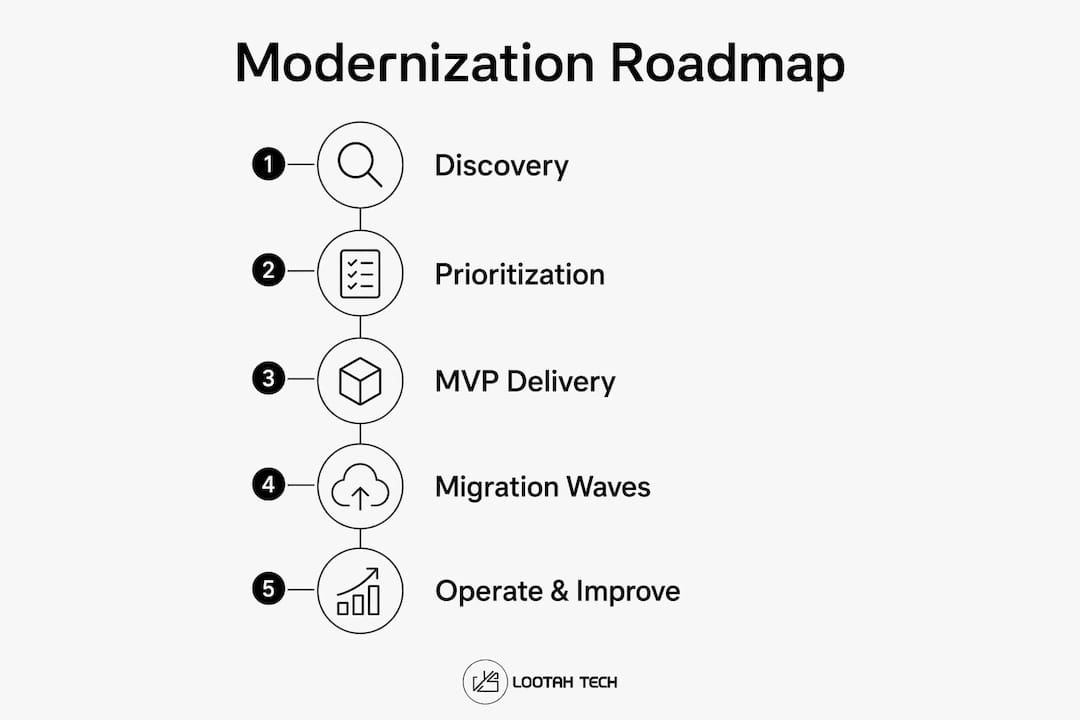
Phase 1: Discovery and diagnostic (weeks 1–6) Map your application portfolio. Score each workload using a capability matrix (complexity, dependencies, business value, technical stack). Identify quick wins (Retire candidates, obvious Rehost targets) and high-value transformation targets. Establish baseline metrics: deployment frequency, MTTR, cost per transaction.
Phase 2: Prioritization and planning (weeks 6–10) Apply the 6 Rs to your scored portfolio. Define migration waves — grouping workloads by dependency and business priority. Set exit criteria for each wave: what does "done" look like, and what KPI threshold signals readiness to proceed? Lock funding for the pilot phase only.

Phase 3: MVP/pilot delivery (weeks 10–26) Select one high-value, moderate-complexity workload and deliver a working modernized version. A 12–16 week MVP window is a practical target for most enterprise pilots. The goal is not perfection — it is validated learning: does the architecture hold, do the teams have the skills, and does the business metric move?
Phase 4: Migration waves Use wave-based refactoring to replace legacy functionality with microservices or serverless in prioritized waves. Each wave follows the same pattern: discovery, analysis, implementation, and validation. Canary deployments and blue-green releases keep production risk low.
Phase 5: Operate and improve Modernization does not end at migration. Establish SRE practices, observability dashboards, and a continuous improvement cadence. Track KPIs against baseline and report to sponsors quarterly.
Governance model: Use funding rings — a pilot fund, a scale fund, and an operations fund — so money follows validated value rather than speculative roadmaps. Assign a CIO or VP of Engineering as program sponsor with clear decision authority. Product owners own the business case for each wave; platform engineering owns the technical standards and shared services.
Pro Tip: After the MVP, use split-and-seed: take two or three engineers from the pilot team and embed them in the next wave's team. This spreads modernization skills and culture organically, without a training program. It is the fastest way to scale capability across a large organization.
For a detailed look at cloud migration execution, Yslootahtech's step-by-step cloud migration guide covers the operational specifics of each phase.
How do you measure whether modernization is working?
Measurement is where most programs fail. Teams track activity (tickets closed, services migrated) instead of outcomes (cost per transaction, deployment frequency). The distinction matters because activity metrics cannot tell you whether the investment is paying off.
Executive-level KPIs:
- Time-to-market for new features (target: reduce by 50% within 12 months of MVP)
- Business availability / uptime (target: 99.9%+ for critical services)
- Cost per transaction (track against pre-modernization baseline)
- Feature throughput (features shipped per sprint, per quarter)
Technical metrics:
- Deployment frequency (from monthly to weekly or daily)
- Mean time to recovery (MTTR) after incidents
- Error rates and p95 latency per service
- Test coverage and pipeline pass rate
ROI structure: Calculate total cost of ownership before and after. Migration cost is a one-time investment; run-cost savings (reduced licensing, infrastructure, manual operations) compound annually. Add the business value enabled — revenue from features that could not ship on the legacy platform — and the ROI case becomes clear for finance.
| Metric | Owner | Target Direction |
|---|---|---|
| Time-to-market | Product / CIO | Decrease |
| Cost per transaction | Finance / Engineering | Decrease |
| Deployment frequency | SRE / Platform Engineering | Increase |
| MTTR | SRE | Decrease |
| Business availability | SRE / Product | Increase |
| Feature throughput | Product | Increase |
| Error rate / p95 latency | SRE / Engineering | Decrease |
For the business case framing, the cloud migration ROI guide from Yslootahtech walks through how to structure the cost-benefit analysis for finance and board audiences.
What risks derail modernization programs, and how do you prevent them?
Most modernization failures are not technical. They are organizational and governance failures that show up as technical problems.
Scope creep and over-modernization: The single most common failure mode. Teams start with a clear target and end up refactoring adjacent systems, adding new features mid-wave, and losing sight of the original business case. Every modernization activity should be tied to measurable business value with explicit exit criteria. If a change cannot be linked to a KPI, it does not belong in the current wave.
Underestimated dependencies: Legacy systems are rarely as isolated as the architecture diagrams suggest. A capability matrix that captures integrations, APIs, and data flows before each wave starts is the mitigation. Surprises mid-wave are expensive; surprises discovered in the capability matrix are just planning inputs.
Data migration risks: Schema mismatches, data quality issues, and transformation errors are the most common cause of wave delays. Run parallel writes (write to both old and new data stores simultaneously) during transition, and validate data integrity with automated reconciliation scripts before cutover.
Security and compliance gaps: Moving to cloud or microservices without updating your security model creates new attack surfaces. Conduct a threat model review at the start of each wave, not at the end.
Talent shortages: Cloud-native skills are scarce. Identify skill gaps during the diagnostic phase and plan for a mix of upskilling, hiring, and external partnership. Waiting until wave 3 to discover your team has never used Kubernetes is a program risk, not a training issue.
Pro Tip: The most underrated modernization risk is change fatigue in the business. If product teams are constantly context-switching between supporting the legacy system and adopting the new one, quality drops on both sides. Design waves with clean handoff points — a date when the old system is read-only and the new one is the system of record — so teams can fully commit to one mode at a time.
Research-backed guidance: what actually works in practice
Modernization is continuous — organizations that treat it as a one-time project consistently underperform those that build it into their operating model. The practical implication: your modernization program needs a permanent home in the org chart, not just a project code.
Three evidence-backed recommendations for leaders:
- Align to business domains, not system names. Organize modernization waves around business capabilities (order management, customer identity, billing) rather than technology layers. This keeps product owners engaged and ensures the business case stays visible throughout.
- Spend as much on adoption as on code. Change management, training, and internal communication are not soft costs — they are the difference between a modernized platform that teams actually use and one that gets shadow-IT'd around within six months.
- Use a decision lens for every workload. Before assigning an R to a workload, answer three questions: What is the business value of changing it? What is the cost and complexity of the change? What happens if we do nothing for 18 months? The answers determine the right approach faster than any framework diagram.
A short validation checklist before committing to a modernization initiative:
- Is there a documented value hypothesis (what business outcome improves, by how much, by when)?
- Are KPIs defined and baselined before work starts?
- Is funding secured for at least the pilot phase, with gates before scale funding releases?
- Are the required skills available internally or through a partner?
- Is there an executive sponsor with decision authority and budget control?
Pro Tip: When choosing between Refactor and Rebuild for a workload, run a two-day technical spike: have your best engineers assess the existing codebase for testability, modularity, and dependency isolation. If they cannot add a meaningful unit test to a core function in two days, Rebuild is almost certainly cheaper in the long run than trying to refactor untestable code.
For early-stage product validation during the MVP phase, tools like Spark Concept's idea checker can help teams stress-test assumptions before committing engineering resources.
12 questions every IT leader should answer before starting
Use this checklist during board briefings, vendor reviews, or program kickoffs. A "no" or "not yet" on any item is a planning gap, not a reason to delay — but it needs a resolution plan before the next phase gate.
Strategy alignment
- Does the modernization initiative map to a named business outcome (revenue, cost, risk)?
- Has the CIO or equivalent executive sponsor committed publicly to the program?
- Is there a documented portfolio assessment covering all in-scope applications?
Prioritization and funding
- Have workloads been scored on business value, complexity, and dependencies?
- Is funding structured in rings (pilot, scale, operations) rather than a single upfront commitment?
- Are exit criteria defined for each wave before work begins?
Talent and skills
- Has a skills gap assessment been completed against the target architecture?
- Is there a plan to embed modernization skills using split-and-seed or equivalent?
Risk and governance
- Is there a data migration and validation plan for each wave?
- Has a security threat model been reviewed for the target architecture?
Vendor and partner selection
- Does the selected partner have demonstrable experience with the specific R (Rehost, Refactor, etc.) you are executing? For guidance on evaluating external partners, the digital transformation agencies overview is a useful reference.
Measurement
- Are baseline KPIs captured and agreed upon with finance and product before wave 1 starts?
Key Takeaways
A platform modernization strategy succeeds when every workload decision is grounded in the 6 Rs framework, governed by phased funding gates, and measured against baselined KPIs from day one.
| Point | Details |
|---|---|
| Use the 6 Rs as your decision lens | Map every workload to Rehost, Replatform, Refactor, Rebuild, Retire, or Retain before committing resources. |
| Phase the roadmap with funding gates | Secure pilot funding first; release scale funding only after the MVP validates the architecture and KPIs. |
| Baseline metrics before wave 1 | Deployment frequency, MTTR, and cost per transaction must be measured before modernization starts to prove ROI. |
| Modernization is continuous | Treat it as an operating model change, not a project — organizations that do sustain the gains; those that don't lose them. |
| Yslootahtech as your modernization partner | Yslootahtech delivers application development, cloud migration, UX/UI, and AI/ML services aligned to each roadmap phase. |
The gap between modernization ambition and what actually moves the needle
Most organizations I work with arrive at modernization with a technology-first framing: "We need to move to microservices" or "We need to be on Kubernetes." That framing is almost always wrong, and it is expensive to discover that mid-program.
The organizations that get modernization right start with a different question: "Which business constraint is costing us the most, and what is the minimum architectural change that removes it?" That question leads to a much smaller, faster, and more defensible scope. It also produces a KPI that finance can verify, which is what keeps the program funded through the inevitable rough patches.
The second thing most guides understate is the operating model change. You can migrate every application to cloud-native architecture and still ship features at the same quarterly cadence if your release process, team structure, and funding model do not change alongside the technology. The architecture is the easy part. The governance and culture are where programs stall.
At Yslootahtech, the approach starts with a diagnostic — not a proposal. Understanding what is actually constraining the business before recommending a pattern is what separates a modernization program that delivers from one that produces a beautifully architected system nobody uses.
How Yslootahtech can accelerate your modernization program
Platform modernization is one of the highest-stakes investments an enterprise makes — and the difference between a program that delivers and one that drags for years usually comes down to how the first 90 days are structured.
Yslootahtech brings end-to-end capability across the full modernization lifecycle: application development and modernization for Refactor and Rebuild workloads, cloud migration for Rehost and Replatform decisions, UX/UI design for customer-facing platform rework, and AI and machine learning integration for organizations ready to productize their data. Every engagement starts with a structured diagnostic — a clear picture of your portfolio, your constraints, and the highest-value modernization target — before a single line of code is written. If you are ready to define your modernization roadmap, start with a discovery consultation to scope the right first wave for your organization.
Authoritative references and further reading
The sources below were used to build this guide. Each is worth reading directly if you are planning or sponsoring a modernization program.
- The 6 Rs of Application Modernization — Microsoft Learn: The definitive reference for the rationalization framework, with decision criteria tables for each R across complexity, scalability, and integration requirements.
- Evaluate Strategies Through the 6 Rs — Microsoft Learn: Extends the 6 Rs with architecture pattern mapping and mission-critical workload guidance — useful for architects selecting PaaS options.
- Plan Cloud Modernization — Microsoft Cloud Adoption Framework: Covers funding rings, exit criteria, and the governance model for avoiding over-modernization and scope creep.
- AWS Prescriptive Guidance: Phased Approach to Modernizing Applications: The source for the phased roadmap model, MVP timing, split-and-seed scaling, and the case for modernizing data alongside applications.
- AWS Prescriptive Guidance: Wave-Based Refactoring: Detailed playbook for wave-based implementation, including the capability matrix structure and prioritization criteria.
- What Is Digital Transformation? — McKinsey: The authoritative framing of modernization as a continuous organizational commitment, not a one-time technology project.
- Digital Transformation Definition and Guide — TechTarget: Practical five-step framework for developing a digital transformation strategy, with C-suite governance guidance.
- Yslootahtech: IT Infrastructure Modernization Guide: Covers infrastructure-layer modernization considerations and cost-saving patterns relevant to Rehost and Replatform decisions.
- Yslootahtech: Cloud Migration Process Guide: Best practices and decision factors for cloud migration waves, including trade-offs between migration approaches.