The Role of Data Governance in Transformation

TL;DR:
- Data governance transforms raw data into reliable decision assets, key for successful transformation. It enables faster product launches, safer AI, regulatory compliance, and reduced costs by balancing access and control. Organizations should start small, embed governance into processes, and measure success through quality, adoption, and decision speed.
Data governance is the control plane that turns raw data into decision-ready assets — without it, transformation initiatives stall on conflicting numbers, unaccountable owners, and analytics no one trusts. According to a 2024 survey of 350 CDOs, 45% of data leaders rank governance as a top priority, and data quality metrics are the most commonly used indicator of governance success. This guide covers the core components, a realistic assess→pilot→scale roadmap, the KPIs that actually matter, and the failure modes that quietly kill transformation programs.
Table of Contents
- Why governance is a strategic enabler of transformation
- What does an effective governance program actually contain?
- How does governance enable analytics, ML, and AI?
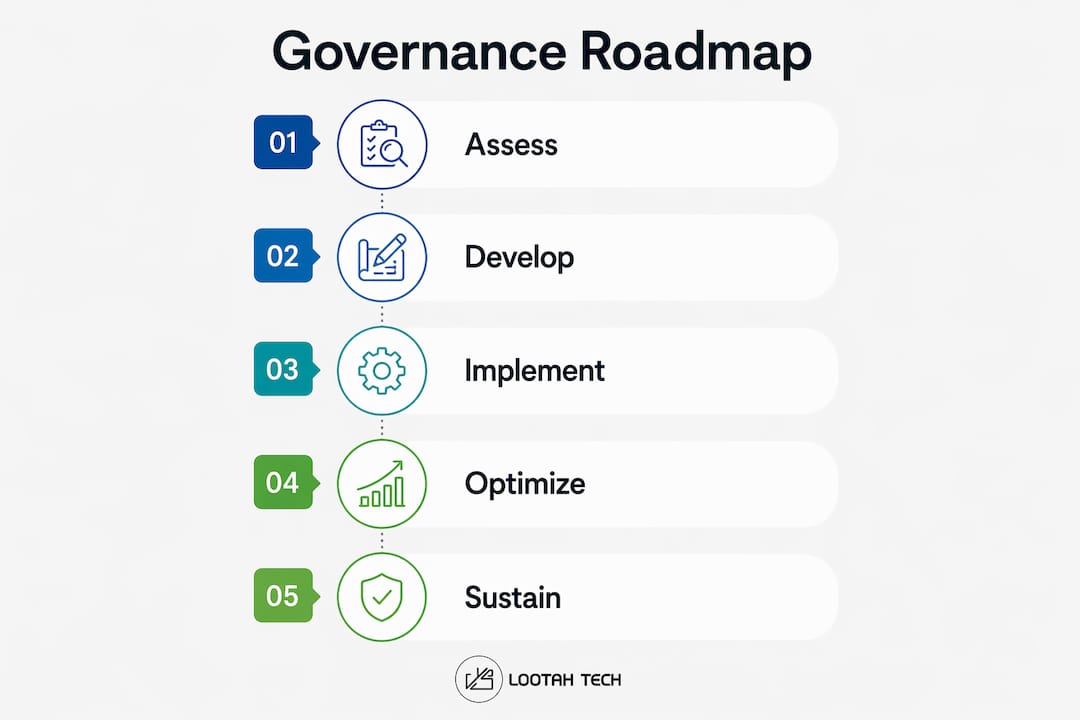
- What does a realistic governance roadmap look like?
- How do you measure governance success?
- What are the most common governance failure modes?
- What do governance wins look like in practice?
- What tools and roles does a governance program need?
- Key Takeaways
- A practitioner's view on what actually separates resilient governance from fragile governance
- Yslootahtech's governance assessment and implementation services
- Useful sources and suggested reading
Why governance is a strategic enabler of transformation
Governance converts raw data into reliable inputs for strategic decisions and automation. Without it, every analytics project starts from scratch, every AI model inherits the same dirty inputs, and every compliance audit becomes a fire drill.
45% of CDOs in the MIT CDOIQ 2024 survey ranked data governance as a top priority — ahead of cloud migration, AI adoption, and cost reduction.
The business outcomes governance unlocks are concrete:
- Faster product launches, because teams reuse trusted data assets instead of rebuilding pipelines
- Repeatable analytics, because definitions are shared and enforced across business units
- Safer AI rollout, because training data is documented, versioned, and auditable
- Regulatory compliance with HIPAA, CCPA, and FedRAMP without last-minute scrambles
- Reduced data management costs by eliminating duplicate data stores and manual reconciliation
The trade-off every leader faces is access versus control. Lock data down too tightly and you create silos; open it without controls and you invite misuse. The right governance posture holds both levers simultaneously, enabling safe sharing while protecting sensitive assets.
What does an effective governance program actually contain?
The core components are policy and standards, roles and stewardship, metadata catalog, lineage and observability, data quality controls, and a tiered risk model. Each one has a practical artifact that makes it operational rather than theoretical.
| Component | Typical Owner | Success Metric |
|---|---|---|
| Policy and standards | Chief Data Officer | Policy coverage rate across critical domains |
| Roles and stewardship | Domain data owners | % of datasets with a named, active steward |
| Metadata catalog | Data engineering | Catalog adoption rate among analysts |
| Lineage and observability | Data platform team | % of production pipelines with documented lineage |
| Data quality controls | Data stewards | Completeness and accuracy rates by domain |
| Tiered risk model | Governance PM | % of high-risk use cases with approved controls |
Practical artifacts for each component:
- Policy: a one-page decision template that names the data owner, the change protocol, and the escalation path
- Stewardship: a role charter that distinguishes data owner (accountable) from data steward (operational)
- Catalog: a minimum set of metadata fields: owner, classification, freshness SLO, and lineage pointer
- Lineage: automated checks that flag when a pipeline's upstream source changes without a registered change event
- Data quality: service-level objectives (SLOs) for completeness, accuracy, and timeliness, reviewed monthly
Pro Tip: Start with the minimum viable governance artifact: a decision template that captures the metric owner, one lineage pointer, and a change protocol. A two-page document that people actually use beats a 40-page policy that sits in a shared drive.
How does governance enable analytics, ML, and AI?
Governance is a precondition for reliable analytics and responsible AI, not a downstream concern. When data quality, traceability, and reproducibility are absent, models inherit the problem silently.
The mechanisms that connect governance to analytics outcomes:
- Curated feature stores with documented lineage prevent the same feature from being computed differently by two teams
- Versioned training data makes model retraining reproducible and auditable
- Model input validation catches schema drift before it reaches production inference
- Drift and bias monitoring requires a baseline, which only exists when training data is governed
When two business units define "active customer" differently and neither definition is registered in a catalog, the executive dashboard shows two numbers for the same metric. Every governance failure that surfaces as a conflicting KPI traces back to an absent definition, an unowned dataset, or an undocumented lineage step. Recovery requires naming an owner and publishing the lineage — not buying another tool.
The AI governance gap is real. About 31% of organizations report being in early stages of AI governance maturity. When automated decisions rely on governed data, outputs must be contestable and auditable — a requirement that pushes governance upstream into the model development process, not just data storage. For a deeper look at how analytics programs deliver business value, the connection to governance is direct.
What does a realistic governance roadmap look like?

An assess→pilot→scale sequence de-risks governance work by tying each phase to a live business initiative rather than a standalone compliance project.
Phase 1: Assess (months 0–3)
- Build a decision inventory: list the top 20 decisions the business makes with data
- Identify which datasets feed those decisions and who currently owns them
- Score data quality for each dataset against completeness, accuracy, and timeliness
- Map regulatory obligations (HIPAA, CCPA, SOX) to specific data domains
Phase 2: Pilot (months 3–9)
- Select one high-value domain (customer, product, or financial data) for the pilot
- Deploy minimum viable controls: named owner, catalog entry, lineage documentation, quality SLO
- Automate enforcement where possible (schema validation, access-control reviews)
- Measure adoption and data quality improvement weekly
Phase 3: Scale (months 9–24)
- Federate governance to business units using the pilot's templates and tooling
- Embed governance checks into the analytics delivery process (pull requests, pipeline deployments)
- Stand up a cross-functional governance council with domain representatives
- Expand the tiered risk model to cover AI and ML use cases
| Phase | Duration | Key Cost Drivers |
|---|---|---|
| Assess | 0–3 months | Consulting time, data profiling tooling |
| Pilot | 3–9 months | Catalog tooling, steward staffing, change management |
| Scale | 9–24 months | Platform licensing, federated steward network, training |
Pro Tip: Embed governance templates directly into the analytics delivery workflow — ship owners, change templates, and automated lineage checks as part of every pipeline deployment. Governance that lives inside the delivery process gets used; governance that lives in a separate portal gets ignored.
A digital transformation roadmap that does not include governance checkpoints at each phase will hit the same data-quality walls repeatedly.
How do you measure governance success?
Governance needs a small, balanced KPI portfolio that measures value, risk, and trust together — not just activity.
Recommended KPIs:
- Data quality rate: completeness and accuracy scores by domain, measured against SLOs
- Catalog adoption: percentage of analysts who discovered their dataset via the catalog
- Time-to-discover: average time for a new analyst to find and access a trusted dataset
- Contested decisions resolved: number of data disputes escalated and resolved with documented evidence
- Automation enforcement rate: percentage of policy checks enforced automatically versus manually
| Metric | Owner | Frequency | Target | Data Source |
|---|---|---|---|---|
| Data quality rate | Domain steward | Weekly | completeness SLOs at 98% | Data quality tool |
| Catalog adoption | Governance PM | Monthly | >70% of analysts | Catalog usage logs |
| Time-to-discover | Analytics lead | Quarterly | <2 business days | Ticketing system |
| Contested decisions resolved | CDO | Monthly | documented lineage | Governance register |
| Automation enforcement rate | Data engineering | Monthly | >80% automated | Pipeline audit logs |
The most common measurement pitfall is counting governance activity (policies written, meetings held) instead of outcomes (decisions made faster, errors caught earlier). Align every KPI to a business initiative from the roadmap so the connection between governance effort and business result stays visible to leadership.
What are the most common governance failure modes?
Transformations fail quietly in governance when evidence becomes ambiguous, owners are absent, and lineage is unreadable. The failures rarely announce themselves.
Red-flag patterns and their mitigations:
- No decision inventory: teams govern data in the abstract rather than tied to real decisions. Fix: build the inventory in week one of the assess phase.
- Dashboard sprawl: ten dashboards, ten definitions of the same metric. Fix: name a metric owner and register the canonical definition in the catalog.
- Policy theater: a governance policy exists but no one enforces it operationally. Fix: automate at least one enforcement check per policy within the pilot phase.
- Everything treated as high-risk: when all data is classified as sensitive, nothing moves. Fix: implement a tiered risk model with three levels (open, internal, restricted).
- No contestability path: automated decisions with no mechanism for a human to challenge the output. Fix: build a dispute register into every AI-driven workflow.
When GenAI and automation amplify data volume and decision velocity, immature governance does not just slow things down — it scales the errors. A bad definition, replicated across a thousand automated decisions per day, produces a thousand wrong outputs before anyone notices.
IT automation can enforce governance at scale, but only when the underlying policies are operational and the lineage is documented first.
What do governance wins look like in practice?
Short examples show governance moving outcomes faster than any framework document.
Financial services firm (data quality pilot):
- Governance moves: named stewards for customer and transaction domains, deployed a catalog with lineage, set completeness SLOs at 98%
- Timeline: 6-month pilot
- Business impact: reduced reconciliation time by eliminating duplicate customer records across three systems; regulatory reporting errors dropped measurably within the first quarter
Manufacturing company (analytics enablement):
- Governance moves: built a decision inventory tied to production KPIs, versioned training data for a predictive maintenance model, automated schema validation on sensor feeds
- Timeline: 9-month pilot-to-scale
- Business impact: the maintenance model reached production 40% faster than the previous iteration because training data was already documented and trusted
Yslootahtech client perspective (enterprise digital transformation):
- Governance moves: assessed decision inventory across three business units, deployed minimum viable controls in the customer data domain, embedded lineage checks into the analytics pipeline
- Timeline: assess phase completed in 10 weeks; pilot controls live by month 6
- Business impact: executive team moved from three conflicting revenue dashboards to one trusted source, accelerating monthly business reviews
The pattern across every successful program is the same: governance work that starts with a real decision the business needs to make, not with a policy document. When the first governance artifact is a decision register tied to a live initiative, adoption follows because the value is immediate.
What tools and roles does a governance program need?
Governance succeeds when people, processes, and the right categories of tools are coordinated. No single platform covers everything.
Core roles:
- Data owner: accountable for a domain's data quality and access decisions
- Data steward: operationally responsible for catalog entries, quality checks, and issue resolution
- Governance PM: coordinates the program, tracks KPIs, and runs the governance council
- Data engineer: implements lineage, quality checks, and access controls in the platform
- Compliance reviewer: maps regulatory obligations to data domains and audits controls
- Analytics product owner: represents business consumers and ensures governed data is usable
Vendor category comparison:
| Category | Core Capability |
|---|---|
| Metadata catalog | Data discovery, business glossary, ownership tracking |
| Integrated data platform | Unified storage, compute, and governance in one layer |
| Observability tools | Pipeline monitoring, anomaly detection, SLO tracking |
| Policy engines | Automated access control, classification, enforcement |
Vendor-selection criteria that matter most: native lineage support, automation APIs for enforcement, role-based access control (RBAC) granularity, integration with existing data platforms, and ease of steward adoption. Academic and systematic reviews of governance frameworks consistently identify maturity models and quality management as central to scaling data-driven competitiveness. For guidance on data privacy considerations that should thread through every governance policy, the regulatory landscape is evolving fast. Understanding how to use data for growth insights can also sharpen how governance KPIs connect to business outcomes.
Key Takeaways
Effective data governance is the structural foundation that makes transformation outcomes measurable, repeatable, and trustworthy — without it, analytics and AI initiatives inherit the same data problems at greater speed and scale.
| Point | Details |
|---|---|
| Governance is a strategic priority | 45% of CDOs rank governance as a top priority, ahead of most other data initiatives. |
| Data quality is the lead KPI | Data quality metrics are the most commonly used governance success indicator; track completeness and accuracy by domain. |
| Assess→pilot→scale de-risks rollout | Run a 0–3 month assess phase, a 3–9 month pilot in one domain, then federate to scale by month 24. |
| Failure is usually quiet | Missing decision inventories, inconsistent definitions, and absent contestability paths are the most common transformation blockers. |
| Yslootahtech accelerates the pilot | Yslootahtech's governance implementation service takes clients from decision inventory to minimum viable controls within a 10-week assess phase. |
A practitioner's view on what actually separates resilient governance from fragile governance
Governance is fundamentally a decision problem, not a tooling problem. The organizations that get it right are not the ones with the most sophisticated platforms — they are the ones that can answer, for any data-driven decision, who owns this, where did it come from, and what happens when it is wrong.
The pragmatic leadership posture is: start with the smallest governance artifact that makes a real decision legible, measure whether that decision improves, and expand from there. Avoid the temptation to govern everything before governing anything. A tiered risk model that distinguishes open data from restricted data lets teams move fast on low-risk assets while protecting what actually matters.
What separates resilient programs from fragile ones is usually not budget or tooling — it is whether governance is embedded in the delivery process or bolted on afterward. When lineage checks live inside the pipeline deployment, when metric owners are named in the dashboard template, governance becomes operational. When it lives in a separate portal that analysts visit once a year, it becomes theater.
Yslootahtech's digital transformation expertise is built on exactly this principle: governance that works is governance that people actually use.
Yslootahtech's governance assessment and implementation services
Yslootahtech gives business leaders a faster path from governance ambition to a working control plane — without the 18-month consulting engagement that most enterprise programs require.

The starting point is a structured assessment: Yslootahtech maps your decision inventory, scores data quality across critical domains, and identifies the governance gaps blocking your highest-priority transformation initiative. From there, the team deploys minimum viable controls in a single domain, embeds lineage and quality checks into your existing analytics pipelines, and hands your stewards a repeatable operating model they can federate across the organization.
Services include governance assessment, catalog and lineage implementation, analytics enablement, and application development for governance automation. If your team needs the controls to be usable as well as operational, Yslootahtech's UX/UI design practice builds governance interfaces that stewards and analysts actually adopt.
Book a governance assessment with Yslootahtech to identify your highest-impact starting point and get a pilot plan within two weeks.
Useful sources and suggested reading
- MIT CDOIQ 2024 CDO Survey via AWS — survey data showing 45% of CDOs prioritize governance; access-versus-control framing
- 2025 State of Enterprise Data Governance Report — practitioner priorities (stewardship, data quality, automation), AI governance maturity data, and KPI benchmarks
- CDO Magazine: 7 Data Governance Moves — decision-focused framing of governance failures and recovery steps; recommended reading for any leader whose transformation has stalled
- Dataversity: 5 Key Benefits of Data Governance — practical benefits including analytics reliability, asset reuse, and accountability
- DiVA Portal: Data Governance's Role in Digital Transformation — systematic literature review identifying structural, procedural, and relational governance mechanisms
- ScienceDirect: Data Governance and Quality Management — academic review of maturity models and governance frameworks for data-driven competitiveness