Why Sustainable Technology Matters for Business Growth

TL;DR:
- Sustainable technology minimizes environmental harm while supporting economic efficiency. Its adoption is essential for long-term business success and regulatory compliance.
Sustainable technology refers to innovations designed to minimize environmental harm while promoting economic efficiency and long-term resource stability. The case for adopting it goes far beyond corporate responsibility. Premature deaths from air pollution dropped 57% between 2005 and 2023, driven directly by cleaner heating, electricity, and transport technologies. That single figure shows the measurable human impact of green technology at scale. For business decision-makers and sustainability advocates, why sustainable technology deserves serious attention is no longer a philosophical question. It is a financial and operational one.
Why sustainable technology is a business imperative
Sustainable technology is now a fundamental driver of economic transformation, not a niche concern for environmental teams. Organizations that treat it as a cost center miss the point entirely. The real question is not whether to invest, but how fast.
The business case rests on three pillars: cost reduction, market positioning, and regulatory readiness.
- Energy savings. Energy-efficient systems lower operating costs year over year. Unlike a one-time capital purchase, energy savings compound over time.
- Hardware longevity. Sustainable IT generates positive ROI through extended hardware lifecycles and reduced waste disposal costs. Replacing devices less often cuts both procurement and IT support budgets.
- Brand loyalty. Customers and enterprise buyers increasingly favor suppliers with verifiable sustainability credentials. A credible green record shortens sales cycles in regulated industries.
- Regulatory compliance. Environmental reporting requirements are tightening across the EU, UAE, and major Asian markets. Companies already aligned with green standards avoid costly retrofits and penalties.
- Investment returns. An estimated investment of approximately €5.8 billion in nature restoration and climate action has the potential to yield up to €300 billion annually in economic benefits. That is a 51.7x return, which reframes sustainability as one of the highest-yield investment categories available.
Pro Tip: Evaluate sustainable technology investments using total cost of ownership, not just upfront capital. Energy savings, reduced maintenance, and longer device life often make green options cheaper over a three-year period than conventional alternatives.
Viewing sustainable IT only as a cost is a strategic error. Long-term savings typically offset higher initial investments within the first few years of deployment.
What innovations are driving the most impact?
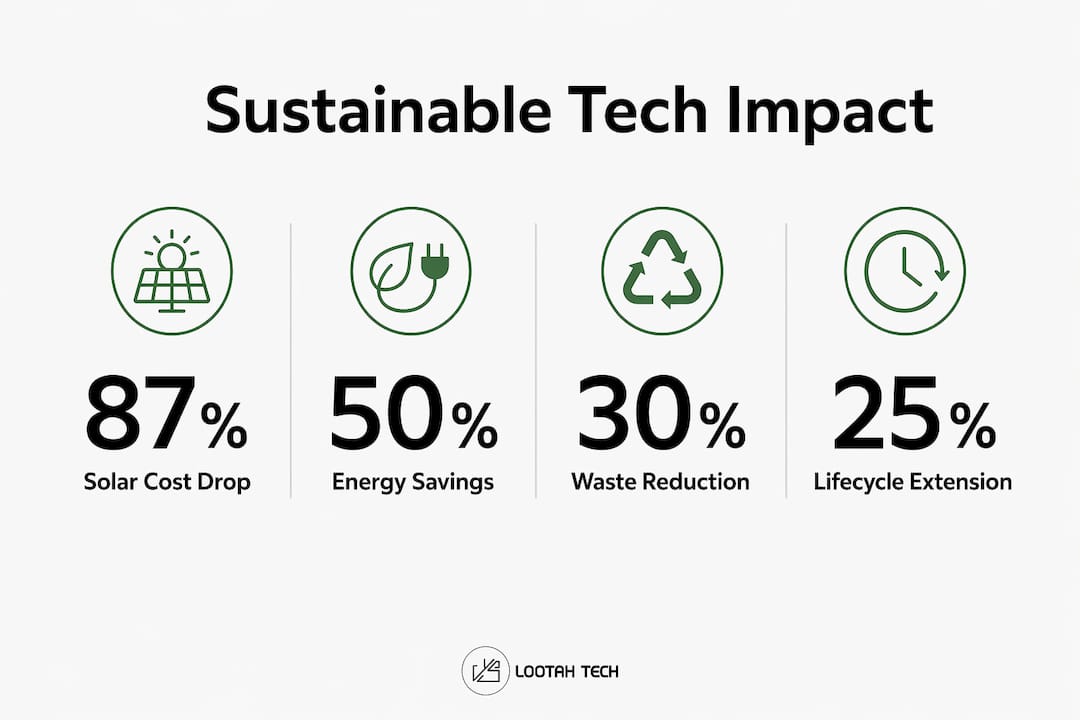
The most significant cost shifts in energy history have happened in the last 15 years. Solar PV costs fell 87%, onshore wind 55%, and battery storage 93% between 2010 and 2024. Those numbers make renewable energy the default economic choice for new capacity, not just the ethical one.
Renewable energy and storage
Solar, wind, and battery storage now compete directly with fossil fuels on price. For businesses building new facilities or renegotiating energy contracts, the math strongly favors renewables. Battery storage solves the intermittency problem that once made solar and wind impractical for 24/7 operations.
Green IT and data center efficiency
Energy-efficient data centers use techniques like liquid cooling, workload consolidation, and dynamic power scaling to cut electricity consumption. Device lifecycle management and endpoint monitoring extend hardware lifespan, reduce e-waste, and lower support costs. Enterprise Mobility Management (EMM) platforms give IT teams visibility into device health across entire fleets, enabling proactive maintenance instead of reactive replacement.
Circular production and waste reduction
Circular production systems design products for disassembly, repair, and reuse rather than disposal. This approach reduces raw material demand and cuts manufacturing waste. For technology companies, it means designing software and hardware with end-of-life plans built in from day one.
The social benefits of green technology are equally concrete:
- Cleaner air from low-emission transport and heating reduces healthcare costs for employees and communities.
- Reduced water consumption from efficient cooling systems protects local water supplies in water-stressed regions like the UAE.
- Lower energy bills from efficiency gains free up capital for workforce investment and product development.
What are the real challenges in sustainable technology adoption?
Digitalization is not inherently sustainable. This is the most common misconception business leaders carry into sustainability planning, and it leads to poor decisions.
- Data centers consume enormous resources. AI data centers are highly water and energy intensive. E-waste reached 62 billion kilograms in 2022, and demand for rare earth metals used in electronics continues to rise. Moving workloads to the cloud does not automatically reduce environmental impact.
- Lower costs can increase consumption. When technology becomes cheaper, organizations tend to use more of it. This economic paradox means efficiency gains at the device level can be offset by a larger number of devices deployed. Sustainable digitalization requires recognizing this pattern and building usage limits into procurement policy.
- One-time solutions do not work. Sustainable technology is an ongoing optimization process, not a fixed state. Organizations that deploy green hardware once and consider the job done will see their sustainability metrics drift over time as usage patterns change.
- Supply chain risks are real. Rare earth metal extraction carries significant environmental and social costs. A product marketed as green at the point of use may carry a heavy upstream footprint.
Pro Tip: Before signing a cloud or AI contract, ask the vendor for their Power Usage Effectiveness (PUE) score and water usage data. A PUE above 1.5 signals significant inefficiency. This single question filters out vendors whose infrastructure contradicts your sustainability goals.
The path forward is not to avoid digital transformation. It is to build environmental and social impact assessments into every technology decision from the start. Yslootahtech recommends treating sustainability criteria the same way you treat security requirements: non-negotiable from day one.
How do you implement sustainable technology effectively?
Effective implementation starts with measurement. You cannot manage what you do not track. The following framework gives business decision-makers a practical starting point.
- Audit your current footprint. Map energy consumption, device counts, and disposal practices across all IT assets. This baseline reveals where the largest gains are available and prevents investment in low-impact areas.
- Build sustainability into your digital transformation roadmap. A digital transformation roadmap that ignores environmental impact will create technical debt in the form of energy costs and compliance gaps. Integrate green criteria at the architecture stage, not as an afterthought.
- Deploy endpoint monitoring. EMM tools give IT teams real-time data on device health, battery degradation, and usage patterns. This data supports proactive maintenance decisions that extend hardware life and reduce unnecessary replacements.
- Align cloud strategy with efficiency goals. Cloud computing trends in 2026 include carbon-aware workload scheduling, where compute jobs run during periods of low-carbon electricity supply. This approach cuts emissions without reducing performance.
- Assess social impact alongside environmental metrics. True sustainable technology must consider social outcomes explicitly. Workforce displacement from automation, data privacy, and digital access are sustainability issues as much as carbon emissions.
- Commit to continuous optimization. Cloud and AI system design that prevents resource-intensive scaling delivers long-term sustainability advantages. Build review cycles into your technology governance calendar, not just your annual sustainability report.
The business value of digital sustainability compounds when organizations treat it as an operating discipline rather than a reporting exercise. Companies that embed these practices into procurement, architecture, and vendor selection build a structural cost advantage over time.
Key Takeaways
Sustainable technology delivers measurable economic, environmental, and social returns when treated as an ongoing operational discipline rather than a one-time initiative.
| Point | Details |
|---|---|
| Economic returns are substantial | Climate action investments can yield returns exceeding 50x the initial capital deployed. |
| Renewable energy is now cost-competitive | Solar, wind, and battery storage costs have fallen dramatically since 2010, making green energy the default economic choice. |
| Digitalization carries hidden costs | AI data centers and e-waste represent real sustainability risks that require active management. |
| Lifecycle management reduces waste | Endpoint monitoring and device lifecycle programs extend hardware life and cut both costs and e-waste. |
| Sustainability requires continuous effort | Green technology is an ongoing optimization process, not a one-time deployment decision. |
The competitive edge most businesses are still missing
The organizations I see winning on sustainability are not the ones with the biggest green budgets. They are the ones that stopped treating sustainability as a separate workstream and folded it into every technology decision they make.
The shift I find most telling is this: companies that once asked "can we afford to go green?" are now asking "can we afford not to?" That inversion happened because the data caught up with the ambition. When battery storage costs fall 93% in 14 years, the economics stop being a debate.
What concerns me is the gap between awareness and execution. Many business leaders understand the importance of sustainable technology in principle but still treat it as a compliance checkbox. They deploy one energy-efficient server room, publish a sustainability report, and move on. Meanwhile, their AI workloads are running in data centers with poor PUE scores, their device fleets have no lifecycle management, and their cloud contracts have no carbon clauses.
The uncomfortable truth is that digital transformation without sustainability criteria is not transformation at all. It is just faster consumption. The businesses that will be most competitive in the next decade are the ones building environmental and social impact assessment into their architecture reviews today, not their annual reports.
Yslootahtech works with organizations across the UAE and beyond to make that integration practical, not theoretical. The technology exists. The economics support it. The remaining variable is decision-making.
— YS
Yslootahtech's approach to sustainable digital solutions
Yslootahtech helps organizations translate sustainability goals into working technology. The team brings together expertise in AI and machine learning to build systems that optimize resource use from the ground up, and in UX/UI design to create digital products that reduce friction, extend user engagement, and minimize unnecessary compute cycles.
Whether you are building a sustainability roadmap for the first time or rearchitecting an existing platform to meet new environmental standards, Yslootahtech provides the technical depth and industry experience to move from strategy to delivery. Contact the team to discuss how sustainable technology principles can be built directly into your next digital project.
FAQ
What is sustainable technology?
Sustainable technology refers to innovations designed to reduce environmental harm, conserve resources, and support long-term economic and social stability. It covers renewable energy, green IT practices, circular production systems, and socially responsible digital design.
Why invest in sustainable tech for business?
Sustainable technology investments generate measurable returns through energy savings, extended hardware lifecycles, and regulatory compliance. Research shows climate action investments can yield returns exceeding 50x the initial capital.
Is digitalization automatically sustainable?
Digitalization is not inherently sustainable. AI data centers are highly water and energy intensive, and e-waste reached 62 billion kilograms in 2022. Organizations must actively manage the environmental impact of their digital infrastructure.
How does sustainable technology help reduce costs?
Sustainable IT reduces costs through lower energy consumption, longer device lifespans, and reduced waste disposal expenses. Total cost of ownership over three or more years typically favors green technology over conventional alternatives.
What is the first step to implementing green technology?
The first step is auditing your current energy consumption, device inventory, and disposal practices. This baseline identifies where the largest efficiency gains are available and prevents misallocated investment.