Stop Binder AI Governance: Map NIST, ISO, EU Into 5 Practical Controls

An AI governance framework is the set of policies, processes, and controls that determine how an organization builds, deploys, and monitors artificial intelligence. Its core job is to catch risk before it becomes a compliance failure or a public incident. Enterprises that treat this as optional now face a widening gap with the NIST AI RMF, ISO/IEC 42001, and the EU AI Act, which are quickly becoming the baseline that auditors and regulators expect.
TL;DR:
- Organizations should prioritize building a model registry and risk assessment processes before formalizing policies to gain accurate visibility of existing unmanaged AI systems.
- AI governance frameworks should be aligned with multiple standards, such as NIST AI RMF, ISO/IEC 42001, and the EU AI Act, to cover policy, documentation, and legal requirements effectively.
- Implementing risk-tiering for models allows for proportionate scrutiny, focusing high-risk models on validation and oversight, while low-impact tools require less rigorous controls.
- Continuous monitoring of model performance, data drift, and bias is critical post-deployment, supported by tools like observability platforms, explainability tools, and automated policy engines.
- Enterprises tend to fail in governance when they treat it as a one-time policy task rather than an ongoing system involving inventories, ownership, and regular monitoring.
Table of Contents
- What Is an AI Governance Framework, and When Do You Need One?
- Core Components Every Framework Needs
- Which Frameworks Should You Align With?
- How to Roll Out AI Governance Without Stalling the Business
- Who Owns AI Governance Inside the Organization?
- Governing the AI Lifecycle by Risk Tier
- What Should You Monitor, and With What Tools?
- How Yslootahtech Puts Governance Into Practice
- What Leaders Consistently Get Wrong About This
- Turn Governance Policy Into Working Infrastructure
- Where to Go for the Primary Standards
- Sources
What Is an AI Governance Framework, and When Do You Need One?
Governance in AI is not a single document sitting in a compliance folder. It's a working system: policies that define acceptable use, processes that route decisions to the right people, and technical controls that enforce those decisions inside the software itself. The scope runs across the entire AI lifecycle, from the moment a data scientist proposes a model to the day it gets retired.
Three forces are pushing this from "nice to have" to mandatory. Regulatory appetite is rising fast, with recent regulations imposing documentation and risk-assessment duties on high-risk systems. Risk exposure grows every time a model touches a hiring decision, a credit score, or a medical triage queue. And scale changes the math entirely. A company running three pilot models can manage governance through email threads and spreadsheets. A company running thirty production models across five business units cannot.
A working AI policy framework typically covers:
- Acceptable use policy: which use cases are approved, restricted, or banned outright
- Data governance: sourcing, labeling, retention, and consent for training and inference data
- Model risk classification: how a system gets sorted into a risk tier before it ships
- Third-party AI oversight: rules for vendor models and embedded AI in purchased software
- Incident response: what happens when a model fails, drifts, or produces a harmful output
Enterprises with mature software portfolios usually discover their governance gap while scaling, not while piloting. That timing matters more than most leaders expect. Ideas on managing that transition are covered in enterprise AI trends for 2026.
Core Components Every Framework Needs
Every credible AI risk management program rests on five principles: accountability, transparency, fairness, safety, and privacy. These aren't slogans. Each one maps to a specific operational control, and skipping one usually shows up later as an audit finding or a public incident.
Accountability means a named person owns each model, not a committee. Transparency means decisions are explainable to the people affected by them, not just to internal engineers. Fairness means bias testing happens before deployment, not after a complaint. Safety covers technical guardrails against misuse or failure. Privacy governs what data trains the model and who can access outputs.
On the operational side, five components turn those principles into practice:
- Risk assessment: a structured review scoring impact, complexity, and reliance before a model moves forward
- Model registry and documentation: a central record of every model's purpose, training data, owner, and version history
- Access controls: identity and permission rules limiting who can query, modify, or retrain a model
- Validation and testing: pre-deployment checks for accuracy, bias, and robustness against edge cases
- Human oversight: defined checkpoints where a person can override or halt an automated decision
Each component attaches to a different point in the delivery lifecycle. Risk assessment happens at intake. Documentation builds continuously. Access controls and human oversight get enforced at deployment and stay active through the model's working life.
Pro Tip: Build the model registry before you build the policy document. A registry with real data forces you to confront how many AI systems are already running unmanaged, which makes the policy negotiation with business units far more concrete.
Which Frameworks Should You Align With?
No single standard covers everything, so most enterprises end up mapping two or three frameworks onto one internal control set rather than picking a single winner.
The NIST AI RMF organizes activity into four functions: GOVERN, MAP, MEASURE, and MANAGE. GOVERN sets the culture and policy foundation. MAP identifies context and risk for a specific use case. MEASURE tests the system against defined metrics. MANAGE handles ongoing risk response. NIST designed the framework to be voluntary and use-case agnostic, which makes it a strong foundational framework regardless of industry.
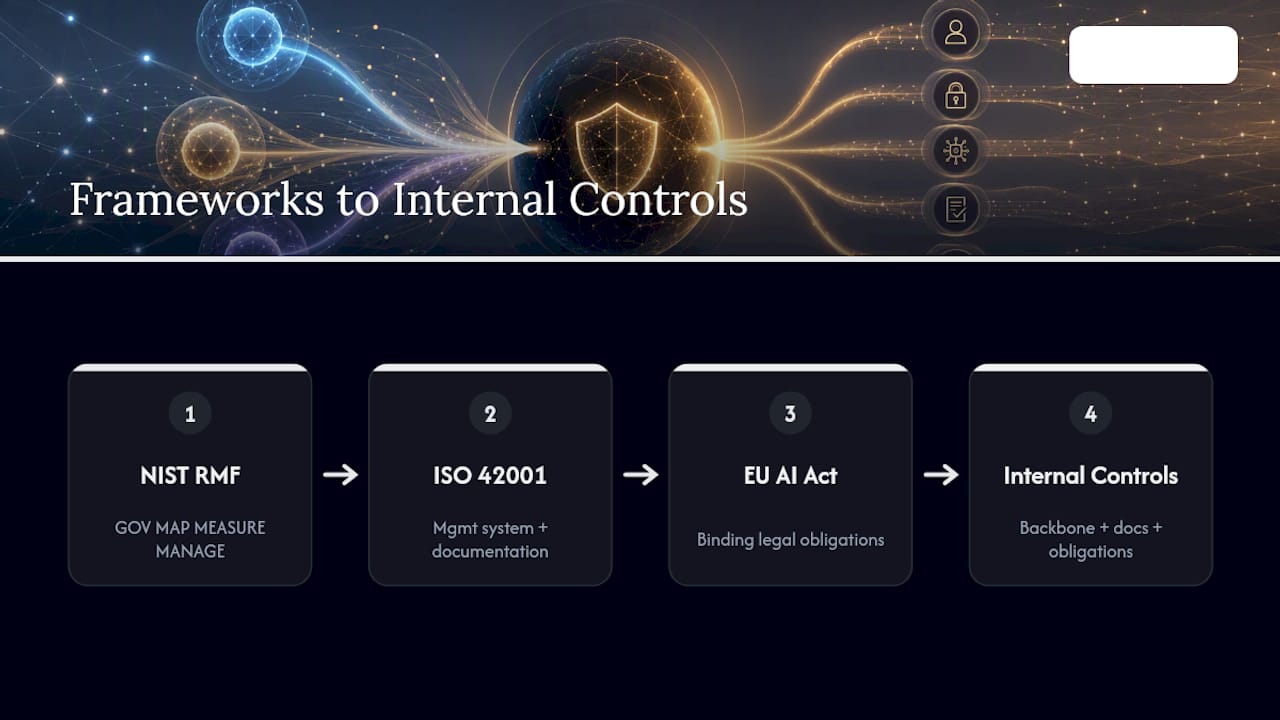
ISO/IEC 42001 takes a management-system approach, similar in spirit to ISO 27001 for information security. It asks organizations to build repeatable processes around AI risk, stakeholder engagement, and continual improvement, and it supports formal certification, which matters if clients or regulators expect third-party proof.
The EU AI Act imposes binding obligations on high-risk AI systems, including conformity assessments, technical documentation, and human oversight requirements. Unlike NIST, it's law, not guidance, and it carries real penalties for noncompliance in scoped use cases.
For financial institutions, the MAS MindForge handbook offers sector-specific guidance: map AI oversight directly into the existing operating model, apply materiality tiering, and fold AI risk into enterprise risk management rather than building a parallel structure. Teams tracking global rule changes across jurisdictions often lean on the MIT AI Risk repository, which indexes laws and policies as they emerge.
The practical move is a hybrid: use NIST's four functions as your process backbone, borrow ISO 42001's documentation discipline for audit readiness, and layer EU AI Act obligations on top for any system that touches the European market.
How to Roll Out AI Governance Without Stalling the Business
Governance programs fail most often when they try to launch everywhere at once. A phased rollout keeps momentum without overwhelming teams that are still learning what "risk tier" even means.
- Assess and inventory. Catalog every AI system in production or pilot, including embedded AI inside purchased software. Most enterprises are surprised by how many shadow AI tools show up here.
- Design risk tiers and proportionate policy. Not every model needs the same scrutiny. A tier reserved for hiring, lending, or medical use cases justifies independent validation and peer review; a low-impact internal tool doesn't need the same weight.
- Stand up governance bodies and technical integrations. Establish the model registry, connect identity and access management, and wire up monitoring before you scale enforcement.
- Pilot, measure, and expand. Run the new controls against a handful of real models, track how long approvals take, and fix bottlenecks before rolling out enterprise-wide.
Automation helps here, but it shouldn't replace judgment entirely. Policy-as-code, where pre-deployment checks run automatically against defined rules, can catch missing documentation or unapproved data sources before a human ever reviews the request. High-risk models still need a person in the loop. The balance that works in practice combines a central registry, automated gate checks for routine cases, and scheduled independent review for anything touching regulated decisions.
Pro Tip: Time your first pilot to a model that's already causing friction internally, like a hiring screen or a customer-facing chatbot. Governance that solves an existing headache gets adopted faster than governance introduced as a compliance exercise nobody asked for.
Integration work like this often overlaps with broader technology rollouts. A practical walkthrough of that overlap is covered in the AI integration guide for business leaders.
Who Owns AI Governance Inside the Organization?
Governance fails when everyone assumes someone else owns it. Senior management and the board hold ultimate accountability for AI risk exposure, but they shouldn't be running day-to-day reviews. That job belongs to operational owners with clear, narrow mandates.
A working operating model usually includes:
- AI governance officer or lead: owns the policy framework and reports risk posture upward
- Model owner: a named individual accountable for each specific system's performance and compliance
- Compliance and legal: verify alignment with the EU AI Act, sector rules, and internal policy
- Security: enforces access controls and reviews systems for adversarial risk
The Model Review Board sits at the center of this structure. It should meet on a fixed cadence, review new and materially changed models against risk-tier criteria, and hold authority to block deployment. Training and documentation ownership needs to sit with a specific role too, not float between departments, or it quietly stops happening within two quarters.
Governing the AI Lifecycle by Risk Tier
Risk-based tiering lets organizations put heavy scrutiny where it matters and light-touch controls everywhere else, rather than applying one rigid process to every system regardless of stakes.
- Design stage: define intended use, data sources, and risk tier before any code gets written.
- Development stage: apply testing and validation proportionate to tier. High-tier models need independent review; low-tier models can rely on peer review.
- Deployment stage: run a pre-deployment checklist covering documentation, bias testing results, and sign-off from the model owner.
- Monitoring stage: track performance and drift continuously, with alert thresholds set tighter for high-tier systems.
- Retirement or retraining stage: treat any material retraining as a new deployment requiring the same review it got the first time.
A model that drifts from "low risk" to "high risk" because its use case expanded (a chatbot that started handling customer complaints and now handles refund decisions, for example) needs to move up a tier immediately, not at the next scheduled review.
What Should You Monitor, and With What Tools?
Governance doesn't end at deployment. NIST's own guidance stresses that documentation alone is insufficient. Continuous monitoring, not a one-time sign-off, is what actually catches problems before they become incidents.
Track four categories: model performance against baseline accuracy, drift in input data or output distribution, bias metrics across protected groups, and incident counts tied to AI decisions. Set alert thresholds tighter for high-risk tiers and review them at every Model Review Board meeting.
Four tool categories support this in practice:
- Model registries for inventory and version tracking
- Observability platforms for real-time drift and performance monitoring
- Explainability tools for generating decision rationale on demand
- Policy engines for automated pre-deployment gate checks
Sensitivity testing and periodic protocol updates matter as much as the initial validation, since a model that passed review a year ago can quietly degrade as real-world data shifts underneath it. A closer look at platform capabilities that support this kind of monitoring is available in the enterprise AI platforms decision guide.
How Yslootahtech Puts Governance Into Practice
We work with enterprise clients to turn governance frameworks from documents into working systems: risk assessments scoped to real use cases, policy templates mapped to established standards, identity and access management integration, and monitoring hooks wired into existing infrastructure.
That work typically touches:
- Governance readiness assessments against NIST AI RMF and ISO 42001 structures
- Model registry and documentation setup tied to existing development pipelines
- IAM and access control integration for AI systems handling sensitive data
- Monitoring and alerting configuration for drift and performance thresholds
The AI and machine learning services team approaches governance as infrastructure, not paperwork. That distinction shapes every recommendation in this piece.
What Leaders Consistently Get Wrong About This
The biggest mistake I see is treating governance as a document to finish rather than a system to run. Policy PDFs don't stop biased hiring models or unsupervised chatbots. Three priorities matter more than a polished policy binder: a real model inventory, a named owner for every system, and a monitoring cadence that survives past the launch week.
The second mistake is waiting for the "perfect" framework before starting. NIST, ISO, and the EU AI Act will keep evolving. Pick a workable hybrid now, pilot it on one model that's already causing friction, and adjust as you scale. Perfection is the enemy of a working system here.
— YS
Turn Governance Policy Into Working Infrastructure
Most enterprises already know what an AI governance framework should contain. The harder problem is wiring it into actual systems: registries that talk to deployment pipelines, access controls that enforce policy automatically, monitoring that flags drift before a regulator does. We build that connective layer for organizations that don't want governance sitting in a binder while production models run unchecked.

Our application development services integrate governance controls directly into the software you're already building, from model registries to automated policy checks at deployment. For teams weighing broader rollout strategy first, the partner analysis on enterprise AI roadmaps and ROI is a useful companion read. If your AI systems need governance that actually runs in production rather than living in a policy document, reach out to Yslootahtech to scope an assessment.
Where to Go for the Primary Standards
For the original text behind each framework discussed here: the NIST AI RMF and its companion playbook, the full NIST AI RMF 1.0 PDF, the MAS MindForge handbook, the Council of Europe framework convention, and the MIT AI risk map.
Sources
- Artificial Intelligence Risk Management Framework (AI RMF 1.0) — NIST
- AI Risk Management Framework | NIST
- MindForge AI Risk Management: Executive Handbook — MAS
- Mapping the AI Governance Landscape — MIT AI Risk
- The Framework Convention on Artificial Intelligence — Council of Europe