Stop Pilot Purgatory: 12–24 Month AI Adoption Roadmap for Leaders

The right AI adoption roadmap runs on three horizons, not one big-bang rollout: prove value with a handful of pilots, scale what works, then differentiate against competitors. The whole sequence typically spans over a year or two, and every initiative moves through a launch, continue, or drop gate before it gets more budget or headcount.
TL;DR:
- Most organizations should focus on establishing data pipelines, governance, and business alignment early in the first three months to avoid scale stalls.
- Prioritize pilots with high business value, feasible deployment, and readily available quality data, avoiding ambitious but unmanageable initiatives.
- Implement clear decision gates with specific success metrics and owners to prevent projects from continuing without proven value or adoption.
- Select the appropriate roadmap variant based on organizational maturity: one to two years for foundational setups, with fast-tracking only for highly mature teams with strong sponsorship.
- Conduct a comprehensive AI readiness assessment before any pilot, ensuring data quality and governance are solid to improve chances of successful scaling.
Table of Contents
- What Does a Complete AI Adoption Roadmap Look Like?
- Which Foundational Capabilities Need To Be Scheduled Early?
- How Do You Assess AI Readiness Before Committing?
- How Should You Prioritize Which AI Use Cases To Pursue?
- What Are Launch, Continue, and Drop Gates?
- What Does a Realistic 12 to 24 Month Timeline Look Like?
- How Do You Measure AI Adoption Success?
- Where Do Most AI Adoption Roadmaps Actually Fail?
- How YS Lootah Tech Structures Roadmaps and Proofs
- Why Most AI Roadmaps Fail Before They Even Start
- Ready to Build Your Roadmap? Here's the Practical Next Step
- Sources
What Does a Complete AI Adoption Roadmap Look Like?
Most AI implementation roadmaps collapse into three horizons. H1 is about proving value: a few contained pilots that generate real evidence within a few months. H2 scales whatever worked, hardening the platform and rolling successful pilots out to more teams. H3 is where you differentiate, building proprietary capabilities competitors can't copy off a shelf.
The sequencing rule that trips up most leaders: shared foundations, like data infrastructure and governance policy, have to land in H1, not H2. A three-horizon roadmap with gates and early foundations avoids the second-phase stall that kills momentum once the first pilots wrap up.
A sample sequencing template for executive review usually looks like this:
- Months 1 to 3 (H1): readiness assessment, foundation setup, two to three pilots launched
- Months 4 to 9 (H2): scale the pilots that passed their gate, formalize MLOps and monitoring
- Months 10 to 24 (H3): differentiated, proprietary use cases layered on a mature platform
Capacity is the constraint nobody plans for. Running six pilots at once with the same data team that's also fielding daily fire drills isn't sequencing, it's chaos with a timeline attached.
Which Foundational Capabilities Need To Be Scheduled Early?
Skipping foundations to chase a flashy pilot is the single most common reason AI roadmaps stall at scale. Five components need a line item in H1, not a footnote in H3:
- Business alignment. Every initiative ties to a measurable business objective, not a technology objective; this practical approach is detailed in Align's brand strategy & execution. "Reduce claims processing time by 20%" beats "deploy a chatbot."
- Data pipelines and ownership. Someone owns data quality for each pipeline, and there's a way to observe when a feed breaks before a model quietly starts making bad predictions.
- Platform and engineering choices. Deployment patterns, MLOps tooling, and version control decisions made once, early, instead of re-litigated for every new pilot.
- Governance and review boards. A lightweight risk review that checks new use cases against privacy, bias, and compliance concerns before launch, not after a complaint.
- People and roles. Named owners and champions for each initiative, with resourcing that doesn't assume everyone has 20% free capacity lying around.
Aligning these five drivers with actual business goals is what the SEI's AI adoption maturity model treats as the difference between scattered experiments and scalable value. Gartner puts it more bluntly: AI success runs roughly 30% technology and 70% the organizational and governance work behind it.
How Do You Assess AI Readiness Before Committing?
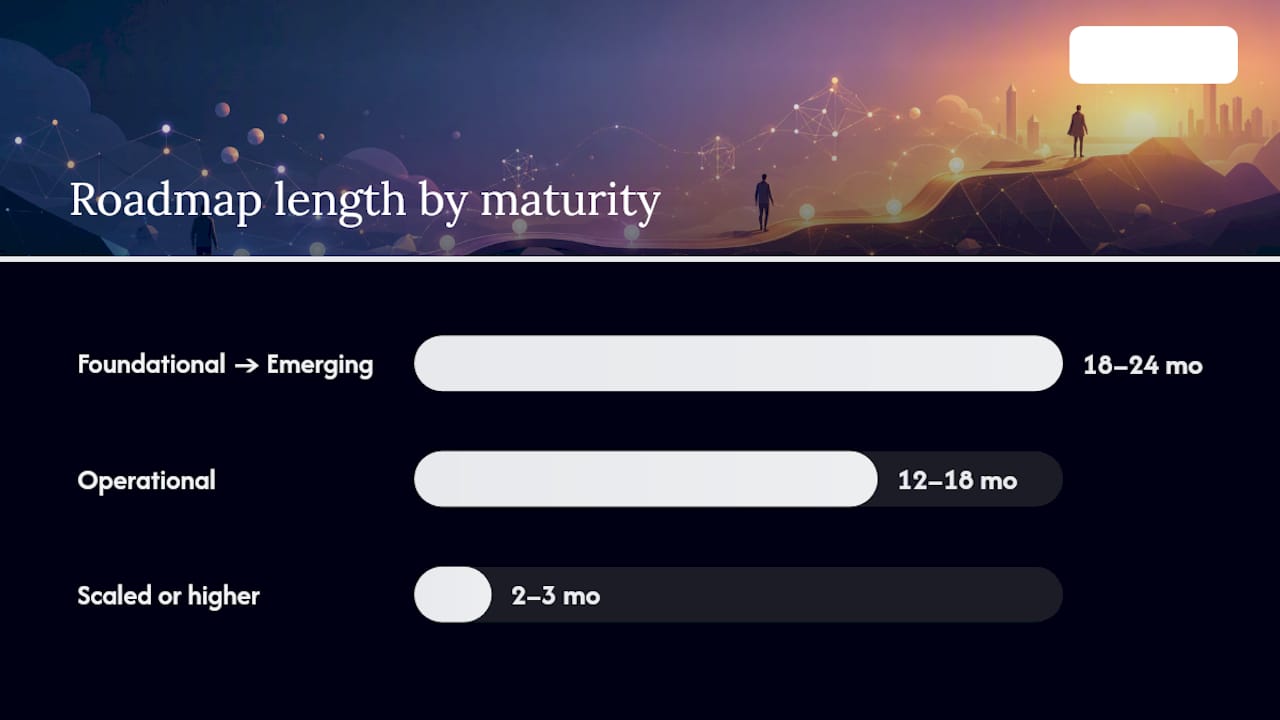
An honest AI readiness assessment scores five pillars: strategy clarity, data quality, governance maturity, engineering capability, and organizational culture. Gartner's maturity model frames this as a five-stage scale, moving from Foundational through Emerging, Operational, Scaled, and finally Transformational.
Your score on that scale should dictate which roadmap variant you run:
- Foundational to Emerging: an extended, 18 to 24 month roadmap with heavy investment in data and governance before any scaling attempt.
- Operational: the standard 12 to 18 month path, with H1 pilots launching within the first quarter.
- Scaled or higher: a fast-track variant, compressing H1 and moving into H2 scaling within two to three months.
Structured instruments like the MITRE AI Maturity Model give organizations concrete dimensions to score rather than a gut-feel guess. The output of a proper assessment should be three deliverables: a readiness report, a prioritized use case portfolio, and a 90 day action plan that names owners.
How Should You Prioritize Which AI Use Cases To Pursue?
Score every candidate use case on three axes: business value, feasibility, and data readiness. A pilot that scores high on value but low on data readiness is a trap, it looks exciting in a slide deck and stalls the moment the data team tries to build a training set.
- Business value: does this move a KPI leadership already tracks, or does it just look impressive in a demo?
- Feasibility: can the current platform and team actually build and deploy this within a quarter?
- Data readiness: does clean, accessible, labeled data already exist, or does someone need to build it from scratch?
Pick pilots that are self-contained and measurable over ones that sound ambitious but sprawl across five departments. The scoring doubles as your gate criteria later, so a use case that barely clears the bar in month one gives you an objective reason to drop it rather than a political fight.
What Are Launch, Continue, and Drop Gates?
A decision gate turns your roadmap from a fixed bet into a living document that responds to evidence. Every gate needs a named owner, a metric threshold, and a scheduled review date, not a vague "we'll revisit this."
- Launch gate: the pilot has a defined success metric, an executive sponsor, and access to the data it needs before day one.
- Continue gate: adoption and value metrics meet a preset threshold, commonly somewhere around 60 to 70% utilization among the target user group and a clear line to ROI realization, before funding extends into H2.
- Drop gate: if adoption stalls below threshold for two consecutive review cycles, the initiative gets killed or reworked, not quietly kept alive on autopilot.
A steering committee should review gates on a monthly or quarterly cadence, with the business sponsor, the technical lead, and a governance representative all in the room.
Pro Tip: Write the drop criteria before you launch the pilot, not after it starts underperforming. Deciding what failure looks like in advance removes the emotional attachment that keeps dead projects on life support.
What Does a Realistic 12 to 24 Month Timeline Look Like?
A standard roadmap runs 12 to 18 months. An extended variant, better suited to organizations still building basic data infrastructure, runs closer to 24 months. A fast-track variant, compressing education, data prep, and pilot development in parallel, is possible but demands a strong executive mandate and a narrow, well-defined scope.
| Roadmap variant | Duration | Best fit |
|---|---|---|
| Fast-track | several months | High maturity, single focused use case, strong executive sponsorship |
| Standard | about a year to a year and a half | Moderate maturity, multiple pilots, typical enterprise governance |
| Extended | longer than a year and a half | Lower maturity, foundational data and governance work still needed |
Most teams overestimate how many initiatives they can run in parallel. Only a few concurrent pilots per horizon, backed by a dedicated platform team, is realistic. Six pilots sharing one overworked data engineer is a recipe for missed gates across the board.
How Do You Measure AI Adoption Success?
Every initiative needs a business KPI it's actually trying to move, not just a model accuracy score sitting in a data scientist's notebook. Adoption percentage often matters more than raw model performance for realizing ROI, since a brilliant model nobody uses generates no value.
- Business KPIs: cost saved, hours reduced, revenue lifted, tied directly to the use case's original objective
- Adoption metrics: percentage of the target user group actively using the tool weekly, not just during onboarding week
- Technical health metrics: latency, accuracy drift, and data quality checks, reviewed on a set monitoring cadence rather than only when something breaks
A useful value-tracking formula: realized value equals (baseline metric minus current metric) multiplied by adoption rate.
Where Do Most AI Adoption Roadmaps Actually Fail?
Pilot purgatory is the most common failure mode: a use case proves technically feasible, gets a round of applause in a steering meeting, and then never scales because nobody set an adoption threshold that triggers the next phase.
- Require adoption and value metrics, not just technical success, before any pilot moves to scale
- Schedule data and governance foundations in H1, since skipping them almost guarantees a stall once you try to scale in H2
- Assign an explicit owner and an executive sponsor to every initiative, because ownerless projects drift until someone quietly kills them
How YS Lootah Tech Structures Roadmaps and Proofs
Some technology companies run client engagements through a sequence of readiness assessment first, then a prioritized use case portfolio, a 90 day action plan, contained pilots, and finally scaling into full production.
That sequence mirrors what structured assessment instruments recommend, producing concrete deliverables rather than a strategy deck that gathers dust. A typical engagement hands leadership a readiness report scored against maturity pillars, a ranked portfolio of candidate use cases, and an architecture direction that names the platform and governance choices needed before any pilot goes live. None of this replaces the client's own decision making, it gives leaders the evidence to make gate decisions with confidence instead of guesswork dressed up as strategy.
Why Most AI Roadmaps Fail Before They Even Start
The conventional advice on AI adoption obsesses over tool selection, which model, which vendor, which platform, when the evidence points somewhere else entirely. Organizations that treat AI as 70% organizational work and 30% technology are the ones that actually scale past the pilot stage. That ratio should reshape how leaders spend their first quarter.
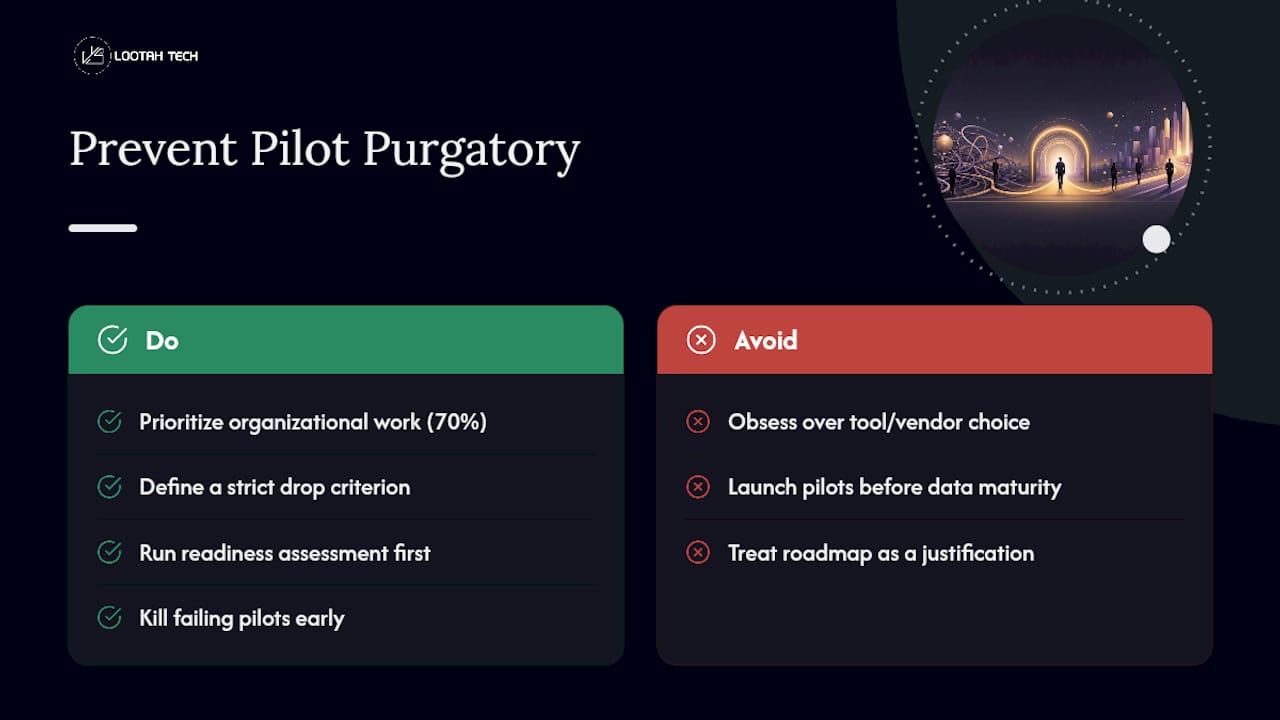
Here's what gets underestimated: the drop gate. Most roadmaps are written to justify continued investment, not to kill bad bets. A roadmap without a real, respected drop criterion isn't a roadmap, it's a wish list with a timeline attached. The organizations that scale AI fastest are usually the ones that kill the most pilots early, freeing capacity for the two or three that actually show adoption traction.
If there's one thing to prioritize first, it's the readiness assessment, not the use case list. Know your data quality and governance maturity before you fall in love with a pilot idea, because a brilliant use case built on broken data infrastructure fails for reasons that have nothing to do with the model.
— YS
Ready to Build Your Roadmap? Here's the Practical Next Step
Some technology providers can take your roadmap from readiness assessment straight through pilot development and production scaling, under one contract instead of three separate vendor handoffs. Where many organizations lose months stitching together a strategy consultant, a data team, and an app developer, Yslootahtech's application development group carries the same engagement from assessment to deployed pilot.
That matters most in H1, when a stalled handoff between planning and building is exactly what kills momentum before you ever reach a scale decision. Yslootahtech's AI and machine learning services cover the platform and governance foundations this roadmap treats as non-negotiable, not just the model. If your organization is ready to move past strategy slides, request an AI readiness assessment and get a scored starting point instead of a guess.
Sources
- SEI — AI adoption maturity model
- Haink — How to build an AI adoption roadmap
- MITRE — AI maturity model and assessment tool