Why long-term tech support is essential for business

TL;DR:
- Long-term tech support is a proactive, strategic program that maintains security, compliance, and resilience over extended periods. It reduces security risks by ensuring timely patches and prevents costly emergency upgrades, enabling planned modernization. When used as a foundation for stability, LTS creates capacity for innovation and operational transformation within organizations.
Most critical business failures don't begin with a dramatic system crash or a headline-grabbing breach. They begin with a patch that was never applied, a compliance gap nobody noticed, or a software component that quietly moved out of support. Leaders who treat tech support as a reactive service are already behind. The organizations that pull ahead are those that recognize long-term tech support (LTS) for what it truly is: a proactive, strategic program that shields operations, removes hidden risk, and creates the breathing room needed for deliberate, controlled innovation.
Table of Contents
- What is long-term tech support and why does it matter?
- How long-term support reduces security risks and upgrade friction
- Risk-aware patching, SLAs, and operational reliability
- LTS as a bridge: Planning for the future, not postponing it
- The uncomfortable truth most leaders miss about long-term tech support
- Empower your business with reliable long-term tech support
- Frequently asked questions
Key Takeaways
| Point | Details |
|---|---|
| Proactive risk reduction | Long-term tech support actively addresses vulnerabilities and compliance challenges before they disrupt business. |
| Operational stability | LTS ensures predictable, uninterrupted operations by minimizing forced upgrades and downtime. |
| Planned modernization | Mature support policies use LTS as a bridge, supporting well-governed, low-risk technology migrations. |
| Efficiency gains with SLAs | Combining SLAs and automation in LTS programs cuts resolution time and improves team productivity. |
| Support as an enabler | Strategic long-term support empowers innovation and growth—not just IT defense. |
What is long-term tech support and why does it matter?
Long-term tech support is not the same as calling the helpdesk when your email stops working. At its core, LTS refers to a structured, ongoing commitment to keeping your systems secure, compliant, and resilient across a defined, extended period, often ranging from three to ten years depending on the platform or vendor relationship.
The range of activities within a mature LTS program is significantly broader than most leaders realize. Consider what it actually includes:
- Security and vulnerability assessments conducted on a scheduled basis, not just in response to incidents
- Risk mitigation case management that tracks and resolves emerging threats before they become incidents
- Vendor lifecycle oversight, meaning your team knows exactly when each component moves toward end-of-support and plans accordingly
- Compliance alignment, ensuring your systems continue to satisfy regulatory requirements as those requirements evolve
- Escalation management, so that when a critical issue surfaces, the response path is already established and tested
As mature support policies include security vulnerability assessments, risk mitigation case management, and lifecycle oversight tied to resilience and compliance, LTS is fundamentally different from the reactive "break/fix" model that still dominates thinking in many mid-market organizations.
"Long-term support is not about waiting for failure. It is about systematically preventing the conditions that create failure in the first place."
The contrast with break/fix support is stark. Break/fix is transactional: something stops working, someone fixes it, and the relationship ends until the next incident. LTS, by contrast, is relational and forward-looking. It connects directly to the understanding of custom software benefits and the full custom software lifecycle, ensuring that business investment in technology delivers sustained value over time.
For IT leaders working with outside partners, IT consulting services can help define the exact scope and SLA structure of an LTS program that matches your organization's risk appetite and growth trajectory.
Now that the importance of ongoing support is clear, let's see how long-term support actively reduces security exposure and supports risk management.
How long-term support reduces security risks and upgrade friction
Security is where LTS delivers its most tangible return. The logic is straightforward but frequently ignored in budget conversations: systems that fall outside active support windows stop receiving security patches. When a vulnerability is discovered in an unpatched component, attackers exploit it. There is no grace period.
Critical patches must be delivered promptly to reduce security exposure, and that delivery only happens when the system is actively under a support agreement. The moment your software or infrastructure component exits the standard maintenance window, you are no longer receiving those fixes.
The benefits of managed security are amplified dramatically when paired with a long-term support structure, because the coverage is continuous rather than episodic. This combination is especially important for organizations running enterprise applications, cloud environments, or fintech platforms where even brief exposure windows can translate directly into financial and reputational damage.
Consider what happens without LTS. A company running an enterprise resource planning (ERP) system on a version approaching end-of-support faces a choice: rush an upgrade or accept growing vulnerability. Rushed upgrades interrupt operations, create unplanned budget overruns, and frequently introduce new instability into environments that were otherwise functioning well.
Key risks when support ends prematurely:
- Unpatched vulnerabilities with no vendor resolution path
- Compliance violations tied to outdated security standards
- Integration failures as connected platforms evolve beyond the unsupported component
- Forced emergency migrations that cost three to five times more than planned transitions
- Loss of vendor escalation rights, meaning incidents have no formal resolution channel
The enterprise Linux support issue illustrates this perfectly. Short support windows create artificial urgency that forces organizations into disruptive upgrade cycles. Extending support coverage through LTS arrangements breaks this pattern and provides the planning stability that enterprise environments genuinely require.
| Factor | LTS approach | Non-LTS approach |
|---|---|---|
| Security patching | Continuous, risk-aware, scheduled | Ends at standard window expiration |
| Upgrade timing | Planned and governed | Reactive and often rushed |
| Budget predictability | High, multi-year visibility | Low, subject to emergency costs |
| Compliance risk | Actively managed | Grows as components age out |
| Operational disruption | Minimal through staged transitions | High during forced migrations |
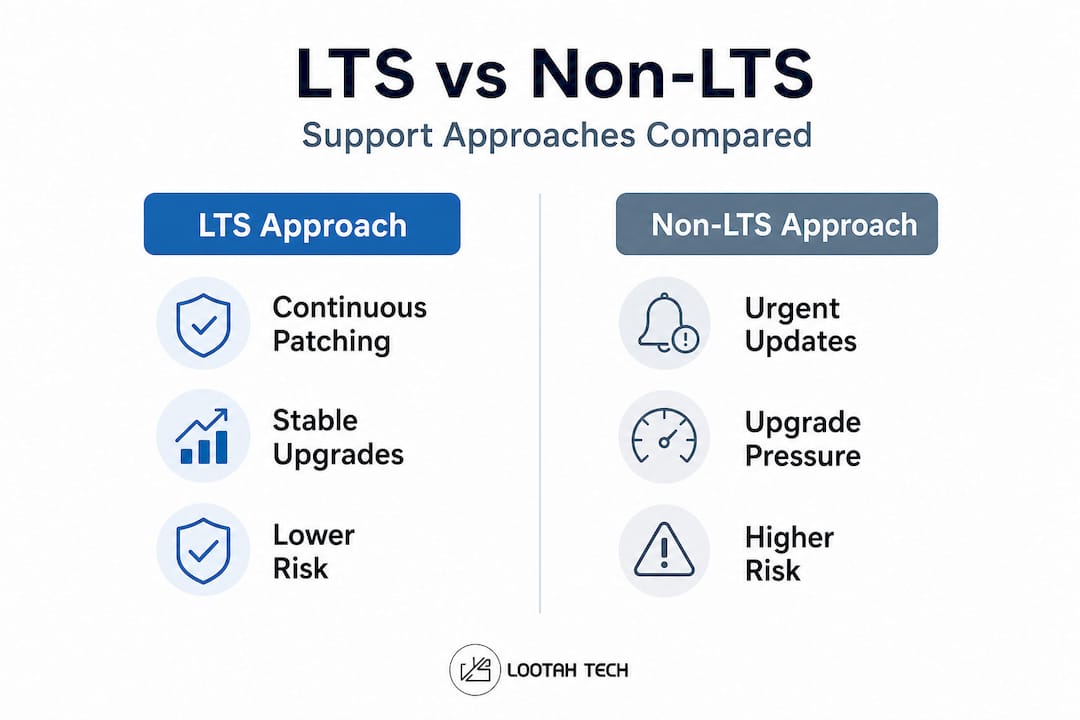
Pro Tip: Never treat LTS as "extra time" to ignore modernization. Use it as planned breathing room to map your next architecture carefully, assess dependencies, and migrate in stages rather than in crisis mode.
Careful application deployment planning is far easier when your existing environment is under active support, because your team is not simultaneously fighting security fires while trying to design the next generation of your platform. The enterprise app case studies that demonstrate the strongest ROI consistently involve organizations that maintained support continuity during transition periods.
From risk reduction, let's dig deeper into how strategic, risk-aware patching and support SLAs truly lift operational performance.
Risk-aware patching, SLAs, and operational reliability
One of the most practical advantages of a well-designed LTS program is something called risk-aware patching, sometimes also described as selective backporting. Rather than applying every available update and accepting the regression risk that comes with it, a mature LTS program backports only selected fixes to address critical security and reliability issues without introducing unnecessary instability.
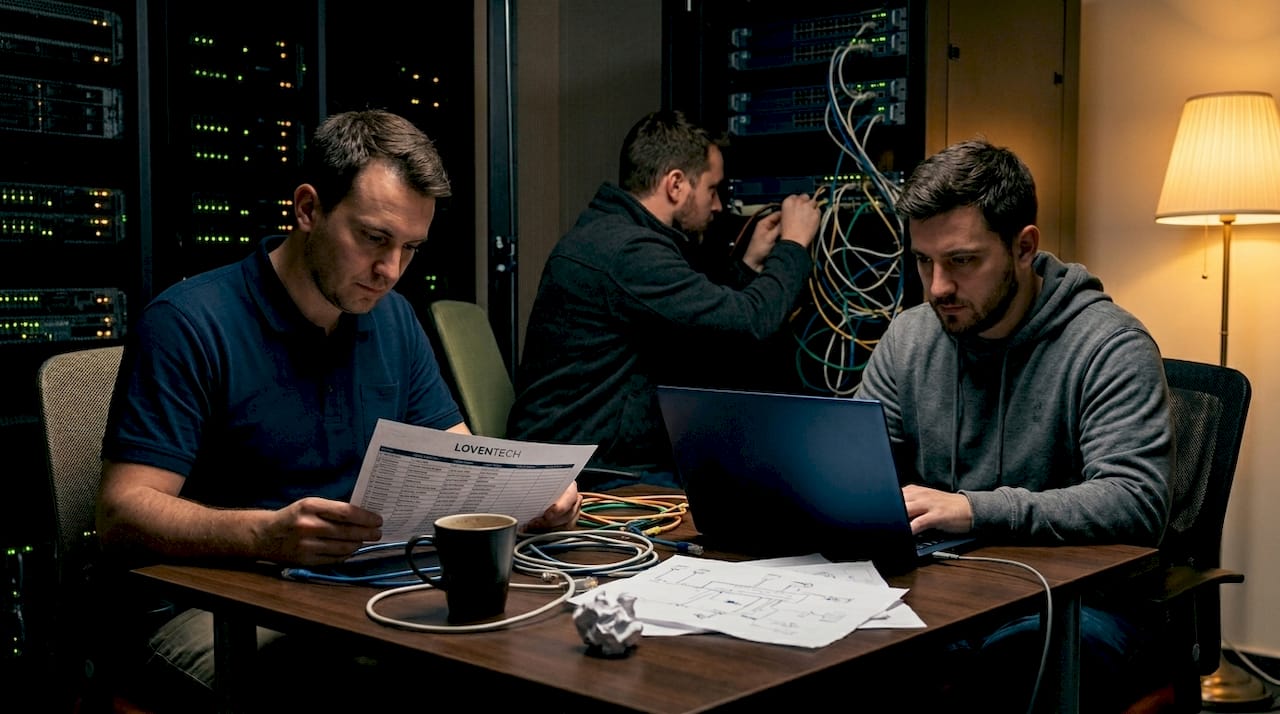
This approach matters enormously for enterprise systems where stability is as important as currency. A financial institution running a core transaction platform cannot accept regressions introduced by feature-driven updates. Risk-aware patching means they receive protection from active threats without the turbulence of a full version upgrade.
The operational efficiency gains from this approach are measurable and significant. Research from a widely cited SolarWinds report found that automation within ITSM practices saves approximately 3 hours per ticket, while self-service portals save 2 hours per ticket, and structured knowledge bases can reduce resolution time by up to 6 hours per ticket. These numbers compound rapidly across an enterprise.
Impact of ITSM and automation on ticket resolution:
| Practice | Time saved per ticket | Operational impact |
|---|---|---|
| Process automation | ~3 hours | Faster incident closure, fewer escalations |
| Self-service portal | ~2 hours | Reduced tier-1 volume, staff freed for complex work |
| Knowledge base integration | Up to 6 hours | Consistent resolution quality, lower repeat incidents |
| SLA-governed workflows | Variable | Measurable accountability, predictable outcomes |
The LTS patch management process works in numbered stages:
- Identify incoming security advisories and vulnerability disclosures across all supported components
- Assess the severity and exploitability of each vulnerability relative to your specific environment
- Prioritize patches based on risk level, not just release sequence
- Test selected patches in a non-production environment before deployment
- Deploy during a controlled maintenance window with rollback procedures in place
- Document the patching action and update your compliance records accordingly
Pro Tip: Pair every SLA with robust internal documentation. When staff changes occur or an incident surfaces, documented processes mean the team doesn't start from scratch. SLAs define the what and when; documentation ensures the how is never lost.
The IT support services guide covers this process in practical depth, while enterprise security frameworks and cybersecurity best practices provide the broader context for building a support structure that integrates with your overall security posture. The managed cybersecurity checklist is also a valuable tool for evaluating whether your current arrangements measure up.
Now, let's address a frequent misconception: does LTS mean you can avoid modernization forever? The real answer is more nuanced.
LTS as a bridge: Planning for the future, not postponing it
Here is where many organizations get into trouble. They deploy an LTS arrangement, feel the immediate relief of reduced upgrade pressure, and gradually allow it to become a reason to avoid the harder conversations about modernization. This is a misuse of the tool.
LTS is intended as a bridge while you plan a major move on a safer, more predictable timeline. The operative phrase is "while you plan." LTS creates a protected window of stability. What you do with that window determines whether it becomes an asset or a liability.
As LTS governance research makes clear, focusing only on extending time and support can create long-term risk if organizations delay modernization or lack a clear plan for what happens after LTS ends. Mature programs therefore pair LTS with a defined upgrade and migration roadmap.
"LTS is a bridge, not a destination."
Best practices for pairing LTS with innovation planning:
- Set a fixed review date at the start of every LTS arrangement to evaluate modernization progress
- Assign explicit ownership for migration planning so it does not default to "everyone's problem and therefore no one's"
- Use the stability period to run controlled pilots of new platforms rather than waiting until the last moment
- Build your migration roadmap before your LTS window opens, not as it approaches its close
- Evaluate emerging technologies like AI and cloud-native architectures during the LTS period so decisions are informed, not rushed
- Communicate the LTS end date to all relevant stakeholders and budget owners well in advance, treating it as a hard deadline, not a flexible horizon
The goal of a well-run LTS program is not to freeze your technology at a point in time. It is to give your organization the strategic clarity and operational stability needed to modernize IT infrastructure on your terms, not on the vendor's timeline or under the pressure of an active breach.
Having resolved how to use long-term support responsibly, let's synthesize a more strategic point of view.
The uncomfortable truth most leaders miss about long-term tech support
Most conversations about LTS center on defense. Protecting systems. Avoiding breaches. Reducing disruption. These are all legitimate benefits, but they represent only half the value equation, and focusing only on them leaves significant strategic opportunity untapped.
The leaders who extract the most value from long-term support programs are not the ones who use LTS as a shield. They are the ones who use it as a runway. When your core systems are stable, patched, and under governance, your engineering teams are freed from firefighting. That freedom is not just a cost reduction. It is an innovation budget.
Think about what becomes possible when your team is not constantly managing an emergency. Pilots of new AI capabilities can run in parallel to the production environment without risk to operations. Architectural decisions can be made thoughtfully, with proper evaluation of options, rather than under the pressure of an expiring support contract. Teams can invest in documentation, automation, and process improvement rather than triage.
The organizational shift required is one of perspective. LTS should appear in your strategic planning documents not under "risk management" but under "innovation enablers." When you look at examples of operational transformation in high-performing enterprises, the pattern is consistent: stability creates capacity for change.
Pro Tip: Audit your LTS strategy annually. Ask not only whether it is protecting you from risk, but whether it is actively creating space for your next wave of capability development. If it is not doing both, the strategy needs to evolve.
The organizations that fall behind are not necessarily those with bad technology. They are organizations that treat their support arrangements as a back-office expense item rather than a forward-looking investment. Reframing LTS as an active enabler of business transformation, rather than a safety net, is the shift that separates technology leaders from technology followers.
Empower your business with reliable long-term tech support
Building a technology environment that is both secure today and ready for tomorrow requires more than good intentions. It requires the right partner with deep expertise across the full spectrum of enterprise technology needs.
YS Lootah Tech brings together custom support strategies across application development services, website development solutions, and AI and machine learning expertise to help organizations in Dubai and across the region build digital environments that last. Whether you are managing a complex enterprise application, planning a cloud migration, or integrating AI-driven capabilities into your operations, our teams design support structures that pair long-term operational reliability with forward-focused innovation. Reach out to discuss how a tailored LTS strategy can protect your business and accelerate your next transformation milestone.
Frequently asked questions
What is the main advantage of long-term tech support?
Long-term tech support ensures ongoing security and stability by providing proactive patching, risk management, and lifecycle guidance beyond basic troubleshooting. As mature support policies demonstrate, LTS encompasses vulnerability assessments and compliance oversight that reactive helpdesk models simply cannot provide.
How does LTS reduce the risk of security breaches?
LTS keeps your systems updated with critical patches, reducing exposure to vulnerabilities that hackers exploit when support lapses. Critical patches delivered on time are the primary mechanism by which LTS reduces material security risk.
Do long-term support programs slow down modernization?
No. When implemented properly, LTS gives organizations time to plan upgrades safely rather than indefinitely postponing essential innovation. LTS is intended as a bridge to a planned migration, not a reason to avoid one.
What happens if a system goes out of support before migration?
You lose access to security updates and risk compliance gaps, exposing your organization to avoidable threats. Short support windows increase risk precisely because they force organizations into unplanned transitions without adequate preparation time.
How do SLAs and automation improve long-term support results?
SLAs and automation cut ticket resolution times substantially and reduce operational risk, allowing your teams to focus on growth and innovation. ITSM practices tied to SLAs and process automation deliver measurably better reliability outcomes across enterprise environments.