What Is Data-Driven Transformation for Business Leaders

TL;DR:
- Data-driven transformation centers on embedding data and analytics into all business decisions to enhance performance. It requires strategic leadership, strong governance, integrated infrastructure, and a culture that values evidence-based choices. Successful organizations treat data as a core asset and foster continuous improvement through feedback and leadership commitment.
Data-driven transformation is the practice of embedding data and analytics at the heart of every business decision to improve performance and competitive advantage. The industry term for this practice is digital data transformation, and it sits at the intersection of technology, leadership, and organizational culture. 91% of Fortune 500 executives identify data and AI as business-critical priorities, yet only 24% see their organizations as truly data-driven. That gap is not a technology problem. It is a strategy and leadership problem, and closing it requires a deliberate, integrated approach.
What is data-driven transformation, and what are its core pillars?
Data-driven transformation is defined as the systematic process of using data as a core corporate asset to change how decisions are made, how operations run, and how value is created. It is not a single project or a software purchase. It is an end-to-end shift in how an organization thinks and acts.

Successful transformations treat governance, architecture, real-time analytics, and AI readiness as interconnected foundations, not separate workstreams. Building them in isolation creates data silos, redundant infrastructure, and misaligned priorities. The table below defines each pillar, its primary benefit, and its most common challenge.
| Pillar | Definition | Primary benefit | Common challenge |
|---|---|---|---|
| Data governance | Policies and standards that define data ownership, quality, and access | Trusted, reliable data assets | Organizational resistance to accountability |
| Data architecture | Infrastructure including data lakes, warehouses, and lakehouses | Unified, accessible data storage | Legacy system integration |
| Real-time analytics | Processing and analyzing data as it is generated | Faster, more responsive decisions | Infrastructure cost and complexity |
| AI readiness | Capabilities to deploy and maintain AI models in production | Automation and predictive intelligence | Only 18% of organizations have sufficient infrastructure to support multiple AI systems |
Organizations with mature data governance have 58% higher confidence in AI model outputs than those without formal governance. That statistic reveals a direct link between governance quality and the reliability of every AI-powered decision downstream.
Pro Tip: Start governance before infrastructure. Defining data ownership and quality standards first prevents the most expensive problem in data transformation: a data swamp that nobody trusts.
How do business leaders drive data-driven transformation successfully?
Data transformation is the CEO's business, not the IT department's. Companies that treat data as a corporate asset with executive ownership consistently outperform those that delegate data responsibility to IT alone. When data stays in IT, it gets optimized for systems. When it sits with the CEO, it gets optimized for business outcomes.
Effective executive leadership in data transformation requires five specific actions:
- Own the data agenda publicly. The CEO must communicate that data is a corporate asset, not a technical function. This signals priority to every department.
- Set measurable stretch goals. Tie data initiatives to specific business outcomes: margin improvement, revenue growth, or risk reduction. Vague goals produce vague results.
- Establish data product management. Treat data sets as products with owners, quality standards, and users. This shifts the culture from data collection to data delivery.
- Create executive governance. A Chief Data Officer or equivalent role with board-level visibility keeps the transformation accountable and funded.
- Allocate resources to the enterprise data platform. Infrastructure investment must be linked to specific business KPIs, not to general IT modernization budgets.
Firm size shapes how these actions play out in practice. Smaller organizations benefit most from lean, integrated data-to-decision systems that connect raw data directly to frontline choices. Larger enterprises rely on accumulated knowledge and scale to build competitive moats from their data assets.
Pro Tip: Link every data platform investment to a named business decision. If you cannot identify the specific decision the data will improve, the investment is premature.
What cultural and organizational changes enable a data-driven mindset?
A data-driven mindset, commonly abbreviated as DDM, is defined as the set of beliefs and behaviors that lead individuals to seek out data before making decisions. Behavioral research shows that analytics knowledge directly shapes positive DDM and improves individual decision quality. Culture, not technology, is the most common reason transformations stall.
Organizational inertia is the primary obstacle. Teams that have made decisions by intuition for years do not abandon that habit because a new dashboard appears. Overcoming inertia requires deliberate interventions at the team level, not just executive mandates. Data literacy programs, where employees learn to read, question, and act on data, are the most direct way to shift behavior at scale.
Democratizing data access accelerates this shift. When analysts are the only people who can query data, decisions slow down and bottlenecks form. When business leaders can access clean, governed data directly, they make faster and better-informed choices. The goal is not to turn every employee into a data scientist. The goal is to make data the default input for every significant decision.
Strategies that build a data-driven culture include:
- Data literacy training tailored to each role, from frontline staff to senior directors
- Visible wins shared across the organization to show how data improved a real outcome
- Psychological safety around questioning data or admitting uncertainty in analysis
- Incentive alignment that rewards evidence-based decisions, not just confident ones
- Cross-functional data teams that include business owners alongside technical staff
Pro Tip: Celebrate the first time a team changes a decision because of data, even if the outcome is uncertain. That moment, made public, does more for culture than any training program.
What practical steps and technology enablers support implementation?
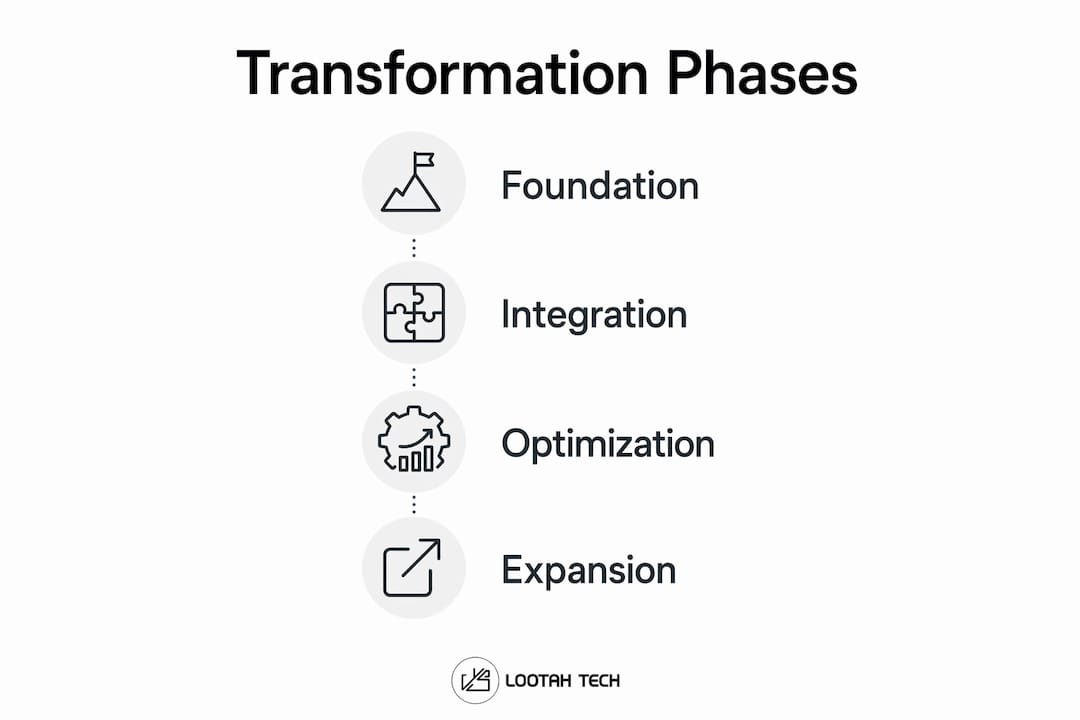
A decision-centric data strategy prioritizes building infrastructure that supports specific, repetitive business decisions rather than collecting data indiscriminately. That principle shapes the entire implementation roadmap. The three phases below reflect how leading organizations sequence their work.
| Phase | Focus | Key activities | Expected outcome |
|---|---|---|---|
| Phase 1: Foundation | Governance and architecture | Data cataloging, ownership assignment, lake or warehouse setup | Trusted, accessible data with no swamp risk |
| Phase 2: Analytics platform | Reporting and insight generation | BI tooling, self-service dashboards, KPI frameworks | Faster decisions with visible evidence |
| Phase 3: AI scaling | Automation and prediction | Model deployment, feedback loop integration, real-time pipelines | Compounding advantage from AI-driven operations |
Data cataloging is the most underrated step in Phase 1. Without a catalog, data lakes become data swamps: vast stores of files that nobody can find, trust, or use. A catalog assigns ownership, documents lineage, and makes data discoverable across the organization.
AI-powered agents now enable continuous, automated data cleaning and monitoring, replacing traditional manual governance approaches. This shift means organizations can maintain data quality at scale without proportionally growing their data engineering teams.
The feedback loop in Phase 3 is where most organizations leave competitive advantage on the table. Capturing model errors and feeding them back into AI systems is the mechanism that makes AI improve over time. Without it, models degrade as the real world changes. With it, the system compounds in accuracy and value. For business leaders exploring AI integration strategies, this feedback architecture is the single most important technical decision to get right.
Pro Tip: Treat your data catalog as a living document with named owners. Assign a quarterly review cycle to every critical data asset, just as you would a financial report.
What benefits and business outcomes does data-driven transformation deliver?
Nearly 50% of U.S. executives report measurable improvements in profitability or performance from digital transformation efforts that use data and analytics. That figure comes from a KPMG 2025 report and reflects organizations that have moved beyond data collection into active, decision-linked analytics. The gap between data-aware and truly data-driven organizations shows up directly in financial results.
The benefits extend well beyond profit margins. Business leaders who commit to data analytics in business consistently report improvements across four areas:
- Decision speed: Real-time dashboards cut the time from question to answer from days to minutes.
- Customer satisfaction: Behavioral data enables personalized experiences that increase retention and lifetime value.
- Operational efficiency: Process analytics identify waste, bottlenecks, and redundancy that manual reviews miss.
- Risk reduction: Predictive models flag anomalies and compliance risks before they become costly problems.
The distinction between data-aware and truly data-driven organizations matters. Data-aware companies collect and report data. Truly data-driven companies build decisions around data, hold leaders accountable to data-backed outcomes, and continuously improve their models. The benefits of digital optimization compound over time for the latter group and stagnate for the former.
Key Takeaways
Data-driven transformation succeeds when executive ownership, integrated infrastructure, and a culture of evidence-based decisions are built together, not in sequence.
| Point | Details |
|---|---|
| Executive ownership is non-negotiable | CEOs who treat data as a corporate asset outperform those who delegate it to IT. |
| Governance precedes architecture | Organizations with mature governance have 58% higher confidence in AI outputs. |
| Culture drives adoption | A data-driven mindset, built through literacy and incentives, determines whether tools get used. |
| Phased implementation reduces risk | Building foundation, analytics, and AI in sequence prevents costly data swamps and misaligned platforms. |
| Feedback loops compound AI value | Capturing model errors and retraining AI systems is the mechanism that creates lasting competitive advantage. |
Why most data transformations fail before they start
The uncomfortable truth I have seen repeatedly is that most organizations begin their data transformation by buying technology. They procure a cloud data warehouse, hire a few data engineers, and call it a strategy. Six months later, they have a well-funded data swamp and a frustrated leadership team wondering why decisions have not improved.
The organizations that succeed start with a different question. They ask: "What specific decision do we need to make better, and what data would change how we make it?" That question forces clarity on governance, ownership, and architecture before a single line of infrastructure code is written. It also makes the business case obvious to every stakeholder, not just the data team.
The cultural shift is harder than the technology, and it takes longer. I have watched technically excellent data platforms sit unused because the business leaders who needed them did not trust the numbers or did not know how to read them. Investing in data literacy at the leadership level, not just among analysts, is the highest-return activity in any transformation program.
Cross-functional collaboration is the other factor that separates successful transformations from expensive experiments. When finance, operations, and technology teams share data ownership and accountability, the transformation gains momentum. When data stays siloed by department, it stays siloed in impact. The tech strategies for business leaders that work in 2026 all share one trait: they treat data as an organizational capability, not a departmental tool.
— YS
How Yslootahtech helps business leaders build data-driven organizations
Yslootahtech works with business leaders across industries to design and implement the data foundations, analytics platforms, and AI-ready architectures that make data-driven transformation real, not theoretical.
From data governance frameworks to custom analytics platforms and AI integration, Yslootahtech brings end-to-end expertise to every engagement. The team works directly with executive sponsors to align data investments with specific business decisions and measurable KPIs. Whether you are in the foundation phase or scaling AI across the enterprise, Yslootahtech provides the technical depth and strategic clarity to move faster and with greater confidence. Visit Yslootahtech's digital solutions to start the conversation.
FAQ
What is data-driven transformation in simple terms?
Data-driven transformation is the process of making data the primary input for business decisions and operations, rather than intuition or experience alone. It requires governance, infrastructure, analytics, and a culture that values evidence over assumption.
Why do most data-driven transformations fail?
Most transformations fail because organizations invest in technology before establishing governance, executive ownership, and data literacy. Without those foundations, even well-funded data platforms produce results that leaders do not trust or use.
How long does data-driven transformation take?
The timeline varies by organization size and starting point, but most enterprises complete the foundation phase in 6–12 months, with analytics and AI scaling extending the program over 2–3 years.
What role does the CEO play in data transformation?
The CEO must own the data agenda publicly, set measurable business goals tied to data outcomes, and fund the enterprise data platform as a strategic asset. Delegating this responsibility to IT alone limits the transformation to infrastructure and misses enterprise-wide value.
What is the difference between data-aware and data-driven organizations?
Data-aware organizations collect and report data. Data-driven organizations build decisions around data, hold leaders accountable to data-backed outcomes, and continuously improve their models to compound performance gains over time.