The Role of Cloud in Digital Agility: 2026 Guide

TL;DR:
- Cloud enables organizations to deploy features faster by removing infrastructure bottlenecks and supporting on-demand scalability. Successful cloud strategies require modernization pathways, governance, and workforce skills to realize agility gains, especially in hybrid cloud environments. Treating cloud as an ongoing capability rather than a one-time project unlocks continuous operational speed and cost efficiency.
Digital agility is defined as an organization's ability to rapidly sense market changes and deploy new capabilities in response, and cloud computing is its primary technical enabler. The role of cloud in digital agility goes far beyond storage or cost reduction. Cloud gives IT teams on-demand compute, elastic capacity, and the architectural freedom to ship features fast. The AWS 2025 Business Value Report confirms that highly modernized organizations deploy 48% more features weekly than partially modernized peers. That single metric captures what cloud-driven agility actually looks like in practice. Business leaders who treat cloud as a utility bill miss the point entirely.
What is the role of cloud in digital agility?
Cloud computing enables digital agility by removing the infrastructure bottlenecks that slow down product teams. Traditional on-premises environments require weeks of procurement, provisioning, and configuration before a developer can test a new idea. Cloud eliminates that wait. Resources spin up in minutes, and teams can experiment, fail, and iterate without capital expenditure cycles.

The cloud computing benefits that matter most for agility are three: elastic scalability, rapid provisioning, and pay-per-use economics. Elastic scalability lets a retail platform absorb a 10x traffic spike during a product launch without pre-buying servers. Rapid provisioning means a DevOps team can stand up a full test environment in under an hour. Pay-per-use economics remove the financial risk of experimentation, which is the cultural fuel agility runs on.
Research published in the Journal of Business and Industrial Marketing confirms that cloud adoption drives organizational ambidexterity, the ability to run existing operations efficiently while simultaneously exploring new business models. That dual capability is exactly what business leaders mean when they say they want to be "agile." Cloud does not just speed up IT. It changes what the business can attempt.
What modernization pathways actually drive cloud agility?
Cloud migration alone does not produce agility. The AWS 2025 report identifies six cloud modernization pathways that collectively deliver measurable agility gains: containerization, cloud-native application design, managed services adoption, DevOps automation, Infrastructure as Code (IaC), and data platform modernization. Organizations that adopt all six see multiplicative benefits across 26 key performance indicators, not incremental ones.
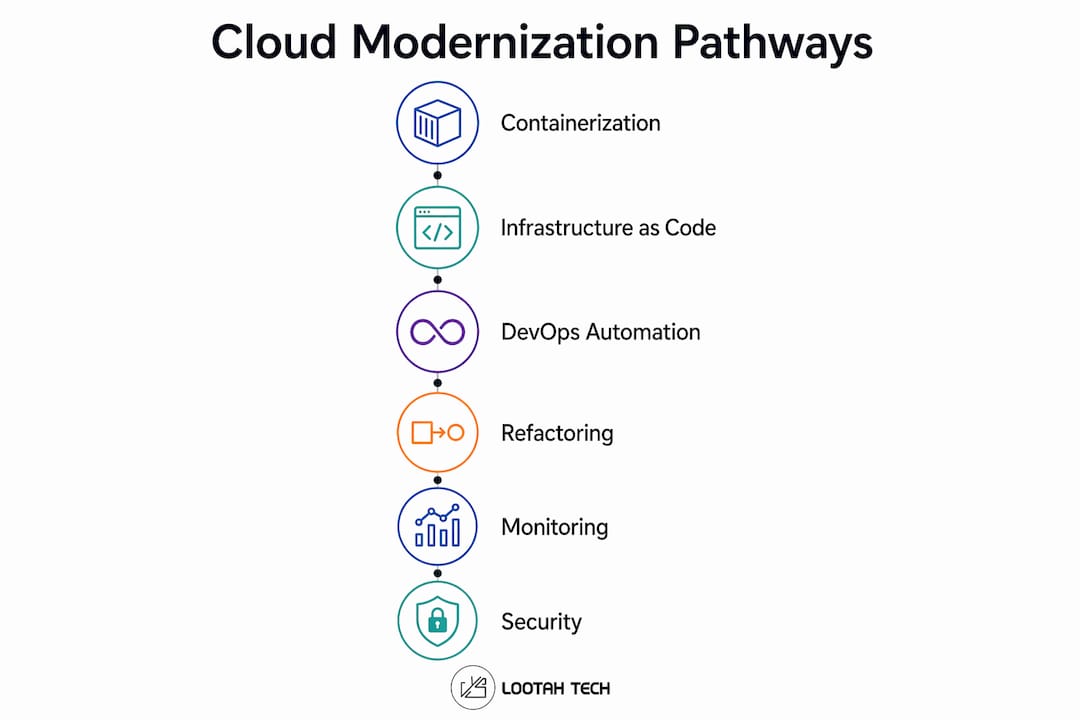
The numbers behind DevOps automation alone are striking. Modern DevOps practices multiply feature deployments by 367% and increase databases managed per administrator by 233%. Yet only 57% of enterprises have fully adopted modern DevOps, which means the majority of organizations are leaving the largest agility gains on the table.
Here is what each pathway contributes in practice:
- Containerization packages applications with their dependencies, so teams deploy consistently across any environment without configuration drift.
- Cloud-native design uses microservices so individual components can be updated, scaled, or replaced without touching the entire application.
- Managed services offload database administration, security patching, and infrastructure monitoring to the cloud provider, freeing engineers for product work.
- DevOps automation replaces manual release processes with continuous integration and continuous delivery (CI/CD) pipelines.
- Infrastructure as Code treats server configurations as version-controlled code, making environments reproducible and auditable.
- Data platform modernization moves analytics workloads to cloud-native warehouses, reducing the lag between data generation and business decision.
Pro Tip: Start with containerization and IaC before tackling DevOps automation. These two pathways create the stable foundation that makes CI/CD pipelines reliable rather than fragile.
Organizations that lift and shift legacy virtual machines to cloud without refactoring consistently report higher costs and worse performance than those that redesign for cloud-native architectures. Migration is a starting line, not a finish line.
How does cloud strategy differ from cloud adoption?
Cloud strategy is defined as the deliberate alignment of cloud capabilities with business goals, governance controls, and financial accountability. Cloud adoption is simply the act of moving workloads to a cloud provider. The difference matters because adoption without strategy produces sprawl, security gaps, and budget overruns that actually reduce agility.
The Microsoft Cloud Adoption Framework states that successful cloud strategies begin with clear business motivations and include governance guardrails from day one. Without those guardrails, teams spin up resources freely, costs compound invisibly, and security posture degrades. That is the opposite of agility.
Three governance pillars separate a real enterprise cloud strategy from a migration project:
- FinOps integration: Cross-team financial governance that tracks cloud spend in real time. Embedding FinOps from the start prevents "cloud bill shock" caused by idle and overprovisioned resources.
- Security guardrails: Automated policy enforcement that blocks non-compliant resource configurations before they reach production.
- Architecture governance: Standards for which services teams may use, how data is classified, and how workloads connect across environments.
Pro Tip: Assign a cloud financial owner, not just a cloud architect, to every major workload. Cost accountability at the team level reduces waste faster than any centralized audit process.
Understanding cloud governance principles helps IT leaders build the controls that protect agility rather than restrict it. Governance done well is an accelerator, not a brake.
Why does workforce readiness determine cloud agility outcomes?
Cloud infrastructure creates the conditions for agility. People and processes determine whether those conditions are used. Upskilling teams on cloud-native practices like DevOps and Infrastructure as Code is the critical step that converts cloud investment into operational speed.
The risk is specific. A team running manual deployment scripts on cloud servers achieves no more agility than it did on-premises. The servers are faster, but the process bottleneck remains. Legacy operational habits negate the architectural advantages that cloud provides.
The skills gap shows up in three areas most often:
- DevOps culture: Teams that separate development and operations into silos cannot use CI/CD pipelines effectively, regardless of tooling.
- IaC proficiency: Engineers who provision infrastructure manually cannot reproduce environments reliably or at scale.
- Cloud cost literacy: Developers who do not understand cloud pricing models overprovision resources by default, driving up costs and reducing the financial headroom for experimentation.
Practical upskilling programs combine formal certification paths, such as AWS Certified Developer or Microsoft Azure Fundamentals, with hands-on project work. Certification without application does not change behavior. The organizations that close the skills gap fastest pair training with immediate project responsibility, not a waiting period.
Pro Tip: Run a two-week "cloud sprint" where a cross-functional team deploys a real internal tool using IaC and a CI/CD pipeline. The hands-on pressure accelerates learning faster than any classroom module.
What role do hybrid and multi-cloud deployments play?
Hybrid cloud is the dominant enterprise architecture in 2026. Over 90% of enterprises are projected to adopt hybrid cloud models that balance compliance requirements, latency constraints, and performance needs. That near-universal adoption reflects a practical reality: most large organizations cannot move everything to public cloud, and they should not try.
Hybrid cloud enables workload portability. A financial services firm can run customer-facing applications on public cloud for elastic scaling while keeping regulated transaction data on-premises to satisfy data residency requirements. A manufacturer can process sensor data at the edge for low-latency control while sending aggregated analytics to a cloud data warehouse. Each workload runs in its optimal environment.
The hybrid cloud guide for IT leaders shows that the key to making hybrid work is consistent governance across environments. Without unified identity management, network policies, and monitoring, hybrid becomes two separate silos rather than one flexible platform.
| Deployment model | Best for | Agility trade-off |
|---|---|---|
| Public cloud only | Greenfield apps, startups | Maximum speed, limited compliance control |
| Private cloud only | Regulated data, air-gapped systems | High control, low elasticity |
| Hybrid cloud | Enterprises with mixed workloads | Balanced agility and compliance |
| Multi-cloud | Avoiding vendor lock-in | Flexibility at the cost of operational complexity |
Hybrid cloud strategies balance scalability with compliance and performance to meet diverse enterprise requirements. The agility gain comes not from choosing one cloud but from placing each workload where it performs best and governing all of them consistently. For IT leaders exploring enterprise cloud adoption, hybrid architecture is the starting point for most realistic transformation plans.
Key Takeaways
Cloud delivers digital agility only when modernization pathways, governance strategy, workforce skills, and hybrid architecture work together as a system.
| Point | Details |
|---|---|
| Modernization beats migration | Adopting all six cloud modernization pathways yields 48% more weekly feature deployments than simple lift-and-shift migration. |
| Strategy requires governance | Cloud strategy must include FinOps, security guardrails, and architecture standards from day one to prevent sprawl and cost overruns. |
| People limit or unlock agility | DevOps culture and IaC proficiency determine whether cloud infrastructure produces real speed gains or just higher bills. |
| Hybrid cloud is the enterprise standard | Over 90% of enterprises use hybrid cloud to balance compliance, latency, and scalability across mixed workloads. |
| DevOps automation is the largest multiplier | Fully adopted DevOps multiplies feature deployments by 367%, yet only 57% of enterprises have reached full adoption. |
What I've learned about cloud agility after years of implementation work
The most common mistake I see is treating cloud migration as the destination. A team moves 200 workloads to a public cloud provider, declares the project complete, and wonders six months later why deployment speed has not improved and costs have doubled. The infrastructure changed. The operating model did not.
The second mistake is sequencing technology before culture. Organizations buy container orchestration platforms and CI/CD tooling before their teams understand why those tools exist. The tools sit underused, and leadership concludes that cloud is overhyped. The real problem is that governance, financial accountability, and skills development were never part of the plan.
What actually works is an iterative approach. Pick one application, modernize it fully using containers, IaC, and automated pipelines, measure the agility and cost outcomes, and then use those results to build internal momentum for the next wave. That evidence-based progression is far more durable than a big-bang transformation program.
The organizations I respect most treat cloud agility as an ongoing capability, not a project. They run FinOps reviews monthly, update their governance policies quarterly, and invest in skills continuously. Cloud technology evolves fast. The teams that stay agile are the ones that treat learning as part of operations, not a one-time event.
— YS
How Yslootahtech helps you build cloud-ready digital platforms
Yslootahtech works with business leaders and IT teams across industries to design and build digital platforms that are built for cloud-native performance from the ground up.
The team at Yslootahtech delivers custom application development using microservices and container-based architectures, so your products can scale and deploy at the speed your market demands. For organizations that need a strong digital front end, the website development services are built to integrate with cloud infrastructure and modern API ecosystems. Yslootahtech also brings AI and machine learning capabilities into cloud platforms, adding intelligent automation to the agility equation. If your team is ready to move beyond migration and into real modernization, Yslootahtech is the partner built for that work.
FAQ
What is digital agility in cloud computing?
Digital agility is an organization's ability to rapidly deploy new capabilities and respond to market changes using cloud infrastructure. Cloud enables this by providing on-demand compute, elastic scaling, and flexible architectures that remove traditional IT bottlenecks.
How does cloud modernization improve agility?
Cloud modernization through containers, DevOps automation, and Infrastructure as Code reduces environment management time and accelerates feature delivery. Highly modernized organizations deploy 48% more features weekly than those that rely on basic cloud migration alone.
What is an enterprise cloud strategy?
An enterprise cloud strategy is a plan that aligns cloud capabilities with business goals, governance controls, financial accountability, and security requirements. Without this alignment, organizations risk uncontrolled resource sprawl, security gaps, and cost overruns that reduce rather than improve agility.
Why is hybrid cloud important for enterprise agility?
Hybrid cloud lets enterprises place each workload in its optimal environment, balancing public cloud scalability with on-premises compliance and latency control. Over 90% of enterprises are projected to use hybrid cloud models by 2026 for exactly this reason.
How does workforce readiness affect cloud agility?
Teams without DevOps skills and cloud-native practices cannot use cloud infrastructure to its full potential. Legacy manual processes negate agility gains even when the underlying cloud architecture is well designed, making upskilling a prerequisite for real operational speed.