The Role of Robotics in Business: A 2026 Leader's Guide

TL;DR:
- Robotics in business uses AI-driven systems to perform tasks that traditionally required human workers. Implementing robotics with workforce collaboration and realistic planning yields higher returns and smoother transitions. AI-enabled robots significantly reduce costs and expand automation into dynamic, high-variation environments.
Robotics in business is defined as the deployment of automated, AI-driven physical systems to perform tasks that previously required human labor, from assembly and palletizing to logistics and quality inspection. The role of robotics in business has shifted from a manufacturing novelty to a core operational strategy, with 78% of deployments meeting or exceeding their ROI targets across 200+ manufacturing sites. Business leaders who treat robotics as a tactical cost-cut miss the larger opportunity. The real competitive edge comes from integrating physical automation with workforce strategy and digital infrastructure.
How does robotics improve efficiency and reduce costs?
Robotics technology in commerce delivers measurable efficiency gains by removing humans from repetitive, hazardous, and time-sensitive tasks. The median payback period for a single-shift robotics deployment is 18 months, dropping to 11 months for two-shift operations. That gap is significant. Running a robot across two shifts nearly halves your time to breakeven without adding capital cost.
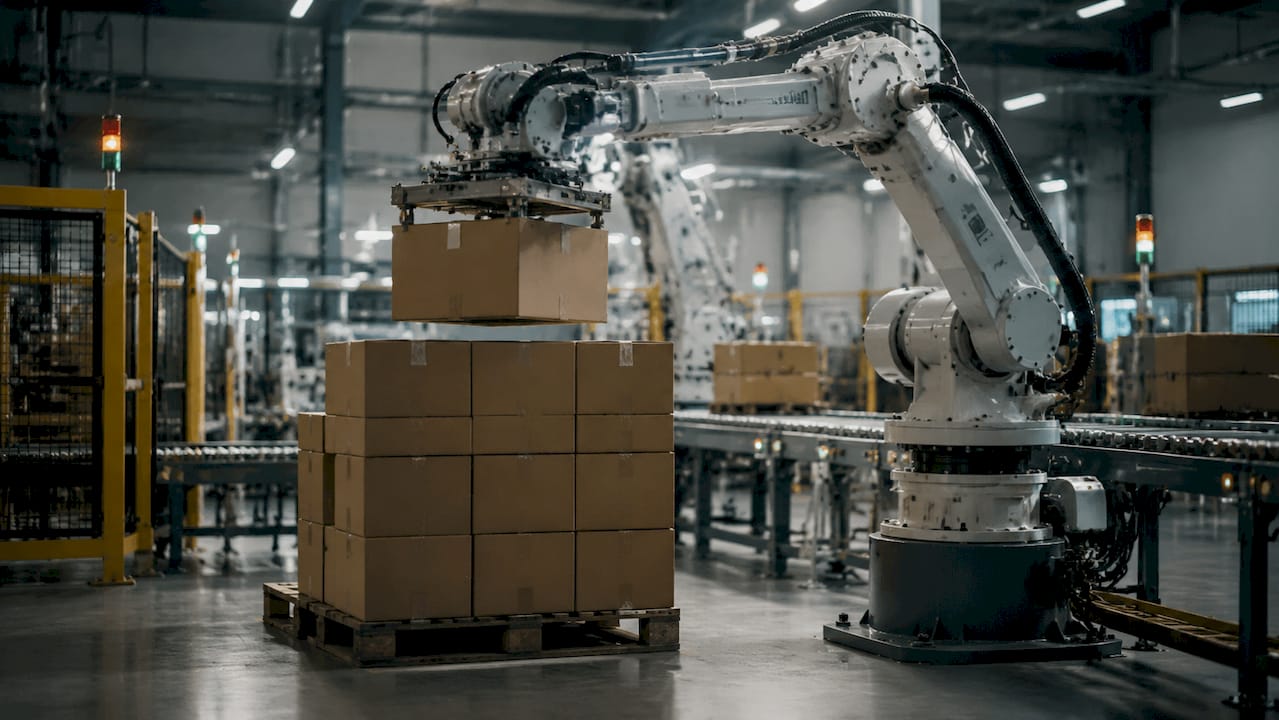
The cost reduction potential goes further when AI enters the picture. AI-guided robotics systems in assembly lines have reduced automation costs by up to 90% in some applications. That figure reflects smarter path planning, reduced rework, and fewer errors per cycle, not just labor substitution.
Applications like machine tending and palletizing consistently show the fastest ROI because they involve high-volume, low-variation tasks. The table below compares typical payback timelines by application type and shift structure.
| Application | Single shift payback | Two-shift payback |
|---|---|---|
| Palletizing | 12–15 months | 7–9 months |
| Machine tending | 14–18 months | 9–11 months |
| Assembly (AI-guided) | 10–14 months | 6–8 months |
| Quality inspection | 16–20 months | 10–13 months |
Pro Tip: Run your robot on two shifts wherever possible. The capital cost stays flat, but your utilization doubles and your payback period shrinks by roughly one third.
What is the impact of robotics on workforce dynamics?
The most common fear about automation in business processes is job elimination. The evidence points in a different direction. A 2026 Binghamton University School of Management study found that companies using a complementary human-robot model generate higher business value and stronger employee commitment than those pursuing pure replacement strategies. The distinction matters because employee commitment directly affects output quality, retention, and adaptability.
The workforce impact is not uniform across pay grades. A February 2026 study across 52 economies found that industrial robot adoption boosts total factor productivity and real wages primarily for top and bottom wage earners. Middle-wage roles face the most disruption. Business leaders must plan workforce transitions with that asymmetry in mind, not assume automation benefits flow evenly.
Strategic workforce involvement changes outcomes. When employees participate in designing robot-augmented workflows, resilience and acceptance rates improve significantly. This is not a soft HR consideration. It is a deployment risk factor.
Key principles for managing workforce dynamics during robotics integration:
- Identify which roles change, not just which roles disappear. Most automation shifts task composition rather than eliminating positions entirely.
- Involve frontline workers in workflow design. Employees who help design new processes are more likely to support them and flag practical problems early.
- Create visible upskilling pathways. Workers need to see a future role, not just a retraining program. Linking to workforce transition strategies builds that confidence.
- Communicate the complementary model explicitly. Leaders who frame robotics as a partner to human talent, not a replacement, see faster adoption and fewer productivity dips during transition.
Pro Tip: Run a collaborative design workshop before finalizing any robot cell layout. Operators who work the line daily will identify bottlenecks and safety concerns that engineers miss from a distance.
What are the best practices for robotics integration?
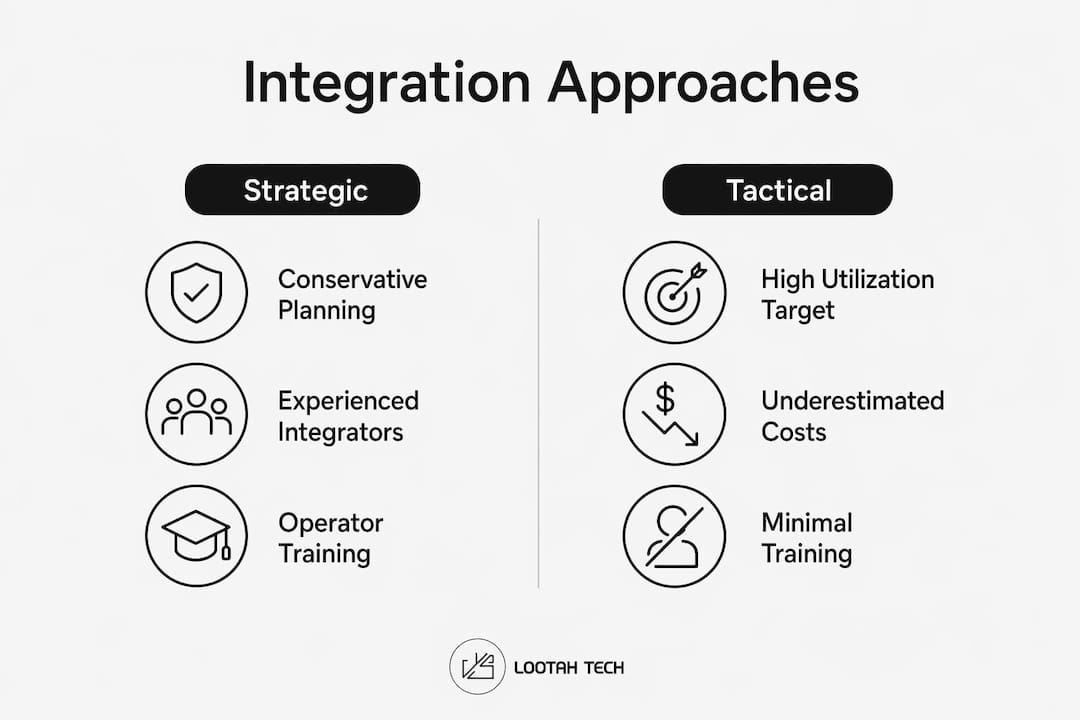
Successful robotics integration is a strategic leadership challenge, not just a technical deployment. The data on failed projects makes that clear. Among the 22% of deployments that missed ROI targets, overestimated utilization accounts for 35% of failures and underestimated integration costs account for 28%. Both failures stem from planning assumptions, not hardware performance.
The fix is conservative modeling. Plan for 70% utilization, not 90%. Budget for integration rework. Factor in operator training time. Projects that use realistic assumptions consistently outperform those built on optimistic projections.
Integrator selection is the single highest-leverage decision in a robotics project. Experienced integrators accelerate ROI by 35% and reduce costly rework. Their premium fees recover within six months through higher utilization and fewer errors. Choosing an integrator based on price alone is the most common and most expensive mistake in robotics deployments.
The table below contrasts strategic and tactical integration approaches across key outcome dimensions.
| Dimension | Tactical approach | Strategic approach |
|---|---|---|
| Planning horizon | Project-level | Business-wide |
| Workforce involvement | Post-deployment training | Co-design from day one |
| Integrator selection | Lowest bid | Track record and specialization |
| Utilization assumptions | Optimistic (85–95%) | Conservative (65–75%) |
| ROI tracking | Annual review | Monthly KPI monitoring |
A pre-deployment checklist for business leaders:
- Audit current task volumes and variation levels before selecting robot type.
- Define ROI targets with conservative utilization assumptions built in.
- Select an integrator with documented experience in your specific application.
- Involve operations staff and frontline workers in cell design.
- Build a 90-day post-deployment review into the project plan.
- Align robotics deployment with broader tech integration strategies to avoid siloed automation.
What does the future of robotics in business look like?
The future of robotics in business is defined by flexibility. Traditional industrial robots excel at high-volume, low-variation tasks. The next generation of AI-enabled systems is expanding into dynamic environments that require real-time adaptation, such as mixed-SKU fulfillment centers, variable-batch manufacturing, and autonomous logistics.
Several trends are reshaping the opportunity set for business leaders right now:
- Hyperautomation combines robotic process automation (RPA) with physical robots and AI decision-making to automate entire workflows end to end, not just individual tasks.
- Autonomous logistics uses mobile robots and AI routing to manage warehouse movement without fixed conveyor infrastructure, cutting setup costs and increasing layout flexibility.
- Sustainability through efficiency is an underappreciated benefit. Well-designed robotic systems consume less energy per unit output than equivalent manual processes, supporting ESG commitments alongside cost goals.
- AI-driven quality control moves inspection from sampling to 100% coverage using computer vision, catching defects that human inspectors miss at speed.
- Human-robot collaboration platforms are evolving to include real-time coaching interfaces, where robots guide human workers through complex assembly steps rather than replacing them entirely.
Business leaders who treat robotics as a fixed-cost infrastructure investment will fall behind those who treat it as an adaptive capability. The role of AI in business automation is accelerating this shift, making the software layer around physical robots as important as the hardware itself.
Key Takeaways
Robotics integration delivers the strongest ROI when leaders combine conservative financial planning, experienced integrators, and genuine workforce collaboration from the start.
| Point | Details |
|---|---|
| ROI depends on shift structure | Two-shift operations cut payback periods from 18 months to 11 months with no added capital cost. |
| AI cuts automation costs sharply | AI-guided assembly systems have reduced automation costs by up to 90% in documented deployments. |
| Collaboration beats replacement | Binghamton University research shows complementary human-robot models outperform substitution strategies on value and commitment. |
| Planning errors drive most failures | Overestimated utilization and underestimated integration costs cause 63% of missed ROI targets. |
| Integrator quality accelerates returns | Experienced integrators recover their premium within six months through higher utilization and fewer reworks. |
Robotics strategy: what the numbers don't tell you
I've worked with business leaders across manufacturing, logistics, and services who approached robotics the same way they approached a software license purchase. They evaluated specs, compared prices, and signed a contract. Most of them hit their first-year targets. Almost none of them hit their three-year targets.
The reason is almost always the same. They automated the task but ignored the system around it. A palletizing robot running at 65% utilization because the upstream line feeds it inconsistently is not a robotics problem. It's a workflow design problem that the robot exposed.
The leaders who get sustained value from robotics share one habit. They treat the deployment as a reason to redesign the surrounding process, not just replace a human in a fixed role. That mindset shift changes everything, from how they involve employees to how they measure success.
Realistic ROI expectations matter too. The robotics services conversation should start with conservative utilization numbers and a clear picture of integration costs, not with the best-case payback period on a vendor slide. Leaders who build their business case on 90% utilization are setting themselves up for disappointment.
The most durable competitive advantage from robotics comes from the combination of physical automation and human judgment. Neither alone is enough. The companies that figure that out early will be very difficult to catch.
— YS
How Yslootahtech supports your automation goals
Robotics integration does not stop at the factory floor. The digital systems that manage, monitor, and connect robotic workflows are just as critical as the hardware itself.
Yslootahtech builds the software layer that makes physical automation work at scale. From custom application development that connects robotic systems to your existing operations, to website development and UX/UI design that gives operators and managers clear visibility into automated workflows, Yslootahtech delivers end-to-end digital solutions built for industries where efficiency and reliability are non-negotiable. If your business is planning a robotics or automation deployment and needs the digital infrastructure to support it, Yslootahtech is the partner to call.
FAQ
What is the typical ROI timeline for robotics in business?
The median payback period is 18 months for single-shift operations and 11 months for two-shift operations, based on analysis of 200+ manufacturing deployments. Running robots across multiple shifts is the fastest way to accelerate returns without additional capital investment.
Do robots replace workers or work alongside them?
A 2026 Binghamton University study found that companies using a complementary human-robot model generate more business value and stronger employee commitment than those pursuing replacement strategies. Robotics works best as an amplifier of human capability, not a substitute for it.
What causes robotics projects to miss their ROI targets?
Overestimated utilization rates account for 35% of missed targets, and underestimated integration costs account for 28%, according to analysis of deployments that failed to meet ROI goals. Conservative planning assumptions and experienced integrators are the two most reliable ways to avoid both problems.
How is AI changing the role of robotics in business?
AI-guided systems are expanding robotics beyond fixed, repetitive tasks into high-variation environments like mixed-SKU fulfillment and adaptive assembly. AI-guided assembly systems have already reduced automation costs by up to 90% in documented applications, and that capability is spreading across industries.
How should business leaders prepare their workforce for robotics adoption?
Involve frontline employees in designing robot-augmented workflows before deployment begins. Research shows that workforce participation in design improves resilience and acceptance rates, while HR automation tools can support the upskilling and transition planning that follows.