The Real Purpose of Mobile Apps for Business and Growth

TL;DR:
- Mobile apps extend beyond websites by utilizing device hardware and offline capabilities, acting as essential operational tools. They enhance daily life through personalized, speedy functions like banking, health tracking, and communication, with onboarding quality crucial for user retention. For businesses, apps boost productivity, cut costs, and strengthen customer engagement, especially when built on quality standards and integrated AI features.
Most people assume mobile apps exist to keep users entertained or give smaller websites a mobile presence. That framing misses almost everything that matters. The true purpose of mobile apps spans far beyond consumer convenience. Apps are purpose-built tools that run natively on your device, access hardware features no browser can touch, and serve as operational infrastructure for businesses of every size. Whether you are an individual looking for smarter daily tools or a company evaluating digital investments, understanding what mobile applications actually do, and why, changes how you build them, choose them, and get value from them.
Key takeaways
| Point | Details |
|---|---|
| Apps go beyond websites | Mobile apps access device hardware like GPS, camera, and push notifications that browsers cannot reliably replicate. |
| Offline access matters | Apps with offline capabilities maintain productivity when connectivity drops, a critical advantage for enterprise use. |
| Business ROI is measurable | Enterprise apps save up to 240 hours per year per employee and cut operational costs by up to 15%. |
| First impressions drive retention | Early onboarding quality determines whether users stay or abandon an app, more than any later feature update. |
| AI is now a core feature | AI-powered personalization and automated support are transforming apps from static tools into adaptive systems. |
The purpose of mobile apps: what they are actually built to do
A mobile app is a software application designed to run directly on smartphones and tablets, optimized for the operating system, screen size, and touch input of the device. That is the textbook definition. But the practical significance goes much deeper.

Unlike a mobile website, an app lives on your device. It loads faster, works with the hardware, and can function without a constant internet connection. Apps optimized for touch deliver intuitive experiences that mobile websites simply cannot match. Think about the difference between opening a banking app versus navigating a bank's website on your phone. The app remembers your preferences, loads in under two seconds, uses biometric login, and sends you a push alert when a payment clears. None of that requires you to open a browser.
The core functions of mobile apps break down into three categories:
- Device integration. Apps access GPS for location services, cameras for scanning and imaging, accelerometers for motion detection, and local storage for offline data. This hardware access is what makes apps genuinely powerful.
- Specialized functionality. Each app is built for a specific purpose, whether that is project management, health tracking, payment processing, or field service management. That focus creates better experiences than generic web tools.
- Persistent connectivity. Push notifications let apps communicate with users even when the app is closed. No website does this natively.
Pro Tip: If you are evaluating whether your business needs an app or a mobile-optimized website, ask one question: Does your use case require device hardware, offline access, or real-time alerts? If yes to any of these, an app is the right investment.
Mobile apps evolved from early productivity tools into hundreds of categories including navigation, health, finance, communication, and enterprise operations. That evolution reflects how broadly the roles of mobile apps have expanded since the first smartphones arrived.
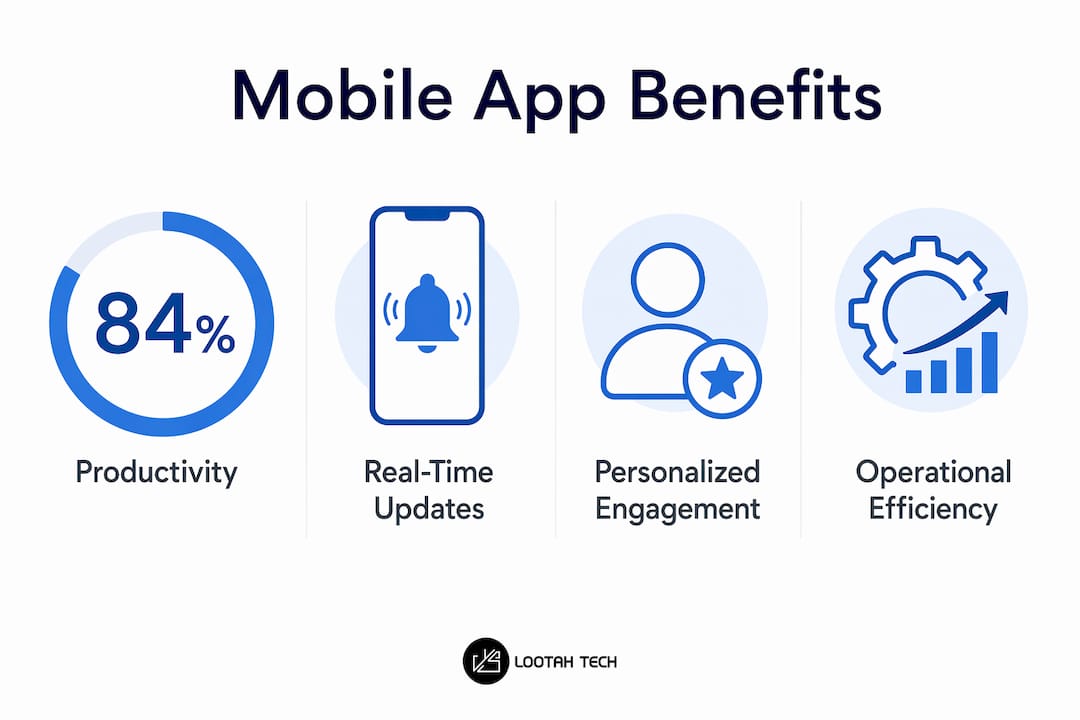
How apps improve daily life for individuals
For individual users, the mobile app benefits that matter most are convenience, personalization, and speed. Apps compress tasks that used to take significant effort into a few taps.
Consider the practical use cases most people rely on daily:
- Banking and finance. You check balances, transfer funds, and deposit checks from your couch. The app connects to your bank's systems in real time and uses your phone's camera instead of requiring a trip to a branch.
- Health and fitness. Apps track steps, sleep, heart rate, and nutrition, often pulling data directly from wearables. Over time, they surface patterns and make suggestions you would never spot manually.
- Communication and social connection. Messaging apps deliver texts, voice messages, and video calls through a single interface, compressing what used to require multiple tools into one.
- Shopping and delivery. Retail apps remember your preferences, show you relevant products, and track your order from warehouse to doorstep using integrated GPS.
What separates good apps from forgettable ones at the individual level is personalization. AI-powered apps use predictive analytics to adapt content, timing, and recommendations to your specific behavior. This is not a luxury feature anymore. It is what keeps users engaged beyond the first week.
Early user onboarding is where most apps win or lose their users. If the first few minutes feel confusing or slow, most users will not return regardless of how good the app becomes later. The Day 1 retention window is where apps either earn their place on your device or get deleted.
Pro Tip: As a user, judge any app you download by its first three minutes. If the onboarding does not show you clear value immediately, that friction rarely improves. The best apps earn your trust before you finish signing up.
For developers and product teams at Yslootahtech, the lesson here is that retention starts at setup, not at the feature roadmap. You can read more about engaging users from day one in practical development terms.
Why mobile apps matter for business operations
The advantages of mobile apps for business are measurable and significant. Apps are not just marketing tools. They are operational assets.
Here is what the data shows:
| Metric | Impact |
|---|---|
| Employee productivity | 84% of organizations deploying enterprise apps report significant productivity gains |
| Time saved | Apps save employees up to 240 hours per year |
| Cost reduction | Operational costs drop by up to 15% with enterprise app deployment |
| Communication speed | 46% of companies report faster internal communication after adopting mobile apps |
| Frontline worker efficiency | Manual tasks reduced by 40% for frontline workers using dedicated apps |
These numbers come from real enterprise deployments across industries. The pattern is consistent: when workers have the right tools on their devices, output increases and errors drop.
Beyond workforce productivity, the advantages of mobile apps for business extend to customer relationships. Loyalty programs, push notifications for offers, in-app customer service, and order tracking all deepen the connection between a brand and its customers in ways that email or websites cannot replicate.
Consider what a well-built enterprise mobile app does for a logistics company. Drivers receive route updates in real time, customers track deliveries live, and warehouse staff confirm shipments with a barcode scan. The entire operation runs through one connected system on mobile devices. That is not a marketing tool. That is infrastructure.
Businesses that still think of apps primarily as consumer-facing features are leaving significant operational gains untouched. Many organizations also use essential productivity apps to improve team efficiency across departments, stacking gains further.
What makes a mobile app actually effective
Understanding the importance of mobile applications also means understanding why so many fail. Building an app is not enough. Building a good app requires meeting quality standards that most teams underestimate.
Android's core app quality guidelines emphasize four non-negotiable standards:
- Performance. The app must start fast and respond immediately to input. Users abandon apps that take more than three seconds to load.
- Stability. Crashes and unresponsive screens are unacceptable. A single crash during a critical task destroys user trust.
- Responsiveness. Every tap, swipe, and scroll should feel instantaneous. Lag creates frustration even when the core function works correctly.
- Resource efficiency. Apps that drain batteries or run unnecessary background processes get deleted. Users notice when their phone gets warm or their battery drops faster than usual.
"An app that performs brilliantly in a demo but drains battery in real use will lose users faster than a poorly designed app that at least stays out of the way."
Adaptive design matters too. Your app will run on hundreds of different screen sizes and device configurations. Apps that only look right on the latest flagship phones are not apps. They are prototypes. Thoughtful design accounts for older hardware, varied screen densities, and different accessibility needs from the start.
How AI is redefining what apps can do
The most significant shift in why mobile apps matter right now is the integration of artificial intelligence. AI is no longer an advanced feature reserved for tech giants. It is becoming the baseline expectation for competitive apps.
AI-powered mobile apps improve engagement through several mechanisms:
- Personalized recommendations. Apps learn your preferences and surface content, products, or actions before you search for them. Streaming apps, e-commerce platforms, and news aggregators all use this to increase time spent and conversion rates.
- Predictive analytics. Enterprise apps can flag potential equipment failures, predict inventory shortfalls, or identify customer churn risk before problems become costly.
- Automated support. AI chatbots provide 24/7 service and handle common queries instantly, cutting support costs while improving response times.
- Natural language interfaces. Voice commands and conversational search make apps more accessible and reduce the learning curve for new users.
The business case for AI in apps is straightforward. Better personalization means higher retention. Automated support means lower operational costs. Predictive tools mean fewer expensive surprises. The future of mobile app development is already pointing toward AI as the differentiating layer between average apps and genuinely useful ones.
My take on what most businesses get wrong about apps
I have seen a pattern repeat itself across dozens of conversations with businesses evaluating mobile investments. They ask, "Should we build an app?" when the better question is, "What specific problem do we need an app to solve?"
Apps built as digital brochures, essentially websites dressed up in a native wrapper, almost always fail to justify their development cost. The organizations that get real returns treat their apps as operational tools first and marketing channels second. They track time-to-task, error rates, and support ticket volume, not just downloads and sessions.
What I have also learned is that the productivity gains from enterprise apps rarely happen automatically. The deployment matters as much as the software. Training, change management, and iterative improvement based on actual usage data determine whether an app changes how people work or just adds another icon to their home screen.
The AI opportunity is real, but it requires honest planning. Adding an AI feature because a competitor has one is a waste. Investing in AI that solves a specific friction point in your user journey, whether that is reducing support load, personalizing product discovery, or automating a manual workflow, delivers returns you can measure. That is the distinction I would encourage every business to hold onto as the market gets noisier.
— YS
Build smarter apps with Yslootahtech's AI capabilities
If this article clarified what your mobile app strategy should actually accomplish, the next step is figuring out how to build it with the right technology underneath.
Yslootahtech's AI and machine learning services are built specifically to add intelligent, adaptive capabilities to mobile applications. From predictive analytics and personalization engines to automated support workflows, the team brings proven expertise in turning app ideas into high-performing digital products. Whether you are building a customer-facing app or an internal enterprise tool, Yslootahtech works with you from strategy through deployment to deliver solutions that perform under real-world conditions. Explore the IAExperience project to see what AI-powered mobile development looks like in practice, then reach out to start the conversation about your build.
FAQ
What is the main purpose of mobile apps?
Mobile apps are designed to deliver specialized functionality directly on a user's device, leveraging hardware features like GPS, cameras, and push notifications that websites cannot access. They serve purposes ranging from personal productivity and entertainment to enterprise workflow automation and customer engagement.
Why do businesses need mobile apps?
Mobile apps give businesses tools to improve internal operations, communicate faster, and deepen customer relationships. Enterprise deployments show productivity gains significant enough to recover development costs within months, particularly for frontline workers and field teams.
How do mobile apps improve user engagement?
Apps improve engagement through personalized experiences, fast load times, and persistent features like push notifications that keep users connected between sessions. Early onboarding quality is the single most critical factor in converting downloads into active, returning users.
What role does AI play in mobile apps today?
AI enables mobile apps to personalize content, automate customer support through chatbots, and predict user behavior to improve retention. These capabilities are increasingly standard expectations rather than premium features in competitive app markets.
How is a mobile app different from a mobile website?
A mobile app runs natively on your device and can access hardware, store data locally, and send push notifications without a browser. A mobile website requires a connection and cannot interact with device hardware in the same way, making apps better suited for complex, frequent-use scenarios.