Secure SDLC: A Practical Guide for Engineering Teams

A secure SDLC (Secure Software Development Lifecycle) is a structured approach that embeds security activities into every phase of software development, from requirements through maintenance, using frameworks like NIST SSDF (SP 800-218), OWASP, and Microsoft SDL as authoritative references. Three things you can do this week to get started:
- Shift left with automated scans. Add a lightweight SAST tool (Semgrep, CodeQL, or Checkmarx) to your pull request workflow so developers see findings before code merges.
- Assign security ownership. Nominate at least one security champion per team. Without a named owner, security tasks drift to "someone else's problem."
- Add one gating control. Block merges on secrets detected in code. It takes under an hour to configure and eliminates one of the most common, most costly vulnerability classes.
Fixing a vulnerability in design costs significantly less than fixing it after release, and the gap widens further when regulatory fines or breach response costs enter the picture. Every phase you push security left, you reduce both remediation cost and the technical debt that accumulates when insecure code ships and has to be patched later.
Key Takeaways
A Secure SDLC embeds security into every development phase, and teams that start with three controls (automated scans, assigned ownership, and one gating policy) build momentum faster than teams that try to implement everything at once.
| Point | Details |
|---|---|
| Start with three controls | Add SAST to PRs, assign security champions, and block on detected secrets to get immediate coverage. |
| Use all three frameworks | NIST SSDF for program compliance, OWASP SAMM/ASVS for maturity and verification, Microsoft SDL for developer-facing guidance. |
| Blend static and dynamic testing | SAST runs at PR level; DAST and IAST run in CI and nightly; SCA runs continuously on every build. |
| Track MTTR and scan coverage | Mean time to remediate by severity and percentage of PRs with passing scans are the two metrics that matter most. |
| Yslootahtech | Offers Secure SDLC assessments, CI/CD pipeline hardening, and security champions training for U.S. engineering teams. |
Table of Contents
- What a secure SDLC actually covers (and what it doesn't)
- How secure SDLC and DevSecOps relate to each other
- Security activities mapped to each SDLC phase
- Core practices every team needs to adopt
- How static and dynamic testing work together
- Which frameworks should your team actually use?
- Embedding security controls into your CI/CD pipeline
- Organizational adoption: roles, KPIs, and making the ROI case
- Common pitfalls that derail Secure SDLC programs
- Your 30/60/90-day playbook to start or scale Secure SDLC
- Yslootahtech can help you build this from the ground up
- Sources
What a secure SDLC actually covers (and what it doesn't)
The secure software development lifecycle is not a parallel security track that runs alongside your normal process. It is your normal process, with security activities woven into each phase. The shift-left principle is the core idea: the earlier a vulnerability is found, the cheaper and faster it is to fix.
What it is not: a final penetration test before release, a checkbox audit, or a separate team's responsibility. Treating security as a gate at the end of the pipeline is one of the most reliable ways to ship vulnerable software on schedule.
Secure SDLC applies regardless of methodology. Agile, Scrum, SAFe, waterfall, and hybrid models all accommodate it. The activities look different in a two-week sprint versus a quarterly release train, but the underlying controls, threat modeling, secure coding standards, automated scanning, and gating policies, are the same. The framework is also platform-agnostic: it applies equally to cloud-native microservices, mobile apps, on-premises enterprise software, and embedded systems.
The distinction from traditional SDLC is straightforward. A traditional SDLC treats security as a late-stage quality check. A secure SDLC treats it as a design requirement, a coding standard, a test criterion, and an operational concern simultaneously. DevSecOps, covered next, is the CI/CD-native expression of the same idea.
How secure SDLC and DevSecOps relate to each other
Teams often use these terms interchangeably, but they describe different layers of the same commitment.
Secure SDLC is the what: a phase-based model that defines which security activities belong at requirements, design, implementation, verification, deployment, and maintenance. It is methodology-agnostic and describes outcomes and artifacts.
DevSecOps is the how: the operational practice of executing those activities inside automated CI/CD pipelines, with shared ownership across development, security, and operations. DevSecOps is Secure SDLC made executable in a continuous delivery context.
Key contrasts:
- Intent. Secure SDLC defines security requirements and acceptance criteria per phase. DevSecOps automates their enforcement in pipelines.
- Focus. Secure SDLC is lifecycle-wide (including governance, training, and design reviews). DevSecOps is pipeline-centric (build, test, deploy, monitor).
- Typical owners. Secure SDLC activities are owned by product, engineering, and security teams jointly. DevSecOps controls are owned by platform/SRE teams with security input.
A concrete example: your Secure SDLC policy requires that all third-party dependencies are scanned for known CVEs before a release. In a DevSecOps pipeline, that requirement becomes an SCA step in the CI job that fails the build when a critical CVE is detected in a direct dependency. The policy lives in the Secure SDLC; the enforcement lives in the pipeline.
To make stage-based Secure SDLC tasks executable in CI/CD, map each phase artifact to a pipeline event. A threat model sign-off maps to a PR label or a required review. A SAST scan pass maps to a CI job status check. A secrets scan maps to a pre-commit hook and a PR gate. The goal is zero manual handoffs for controls that can be automated.
Security activities mapped to each SDLC phase
OWASP recommends embedding security into each development phase rather than creating a separate security lifecycle. The table below maps the six standard phases to their core security activities and primary owners.
| Phase | Core security activities | Primary owner |
|---|---|---|
| Requirements | Security requirements elicitation, abuse case definition, compliance mapping | Product manager + security engineer |
| Design | Threat modeling, secure architecture review, data flow diagrams | Lead engineer + security engineer |
| Implementation | Secure coding standards, peer review with security checklist, pre-commit hooks | Developer + security champion |
| Verification | SAST, DAST, IAST, SCA, dependency review, fuzz testing | QA engineer + security engineer |
| Deployment | Artifact signing, secrets validation, infrastructure-as-code scanning, release gate review | SRE/DevOps + security engineer |
| Maintenance | Vulnerability monitoring, CVE triage, patch management, incident response readiness | SRE/ops + security team |
A few things worth noting about this mapping. First, the design phase is where threat modeling earns its keep. Running a structured threat model session (STRIDE or LINDDUN) before a single line of code is written produces a defensible record of what was considered and why certain controls were chosen. Microsoft's threat modeling guidance recommends scoping threat models to specific features or data flows rather than trying to model an entire system at once, which keeps sessions under two hours and produces actionable output.
Second, the verification phase is not a single scan. It is a layered set of tests with different coverage profiles, covered in detail in the testing strategy section below.
Third, maintenance is the phase most teams underinvest in. A vulnerability discovered in a dependency six months after release is still your responsibility. Continuous SCA monitoring, not a one-time scan at release, is what catches it.
Core practices every team needs to adopt
Threat modeling as a design discipline
Threat modeling is not a one-time exercise. Run it at the start of any feature that touches authentication, authorization, data storage, or external integrations. The output should be a short document: assets at risk, threats identified (using STRIDE or a similar framework), mitigations chosen, and residual risks accepted. That document becomes the acceptance criterion for the design phase.
Keep sessions focused. A two-hour workshop on a specific user story or API endpoint produces more usable output than a full-day session on the entire application. Microsoft's SDL materials show that threat modeling, secure design reviews, and developer ownership scale better than a centralized gate model, precisely because focused sessions fit inside sprint planning cycles.
Secure coding standards and peer review
Pick a standard and enforce it consistently. OWASP's Top 10 Proactive Controls is a practical starting point for most teams. For more granular verification requirements, the OWASP Application Security Verification Standard (ASVS) provides three verification levels mapped to risk profiles. Add a short security checklist to your PR template covering the five highest-risk items for your stack (input validation, output encoding, authentication checks, error handling, and logging). Reviewers who know exactly what to look for catch more issues in less time.
Dependency management and SCA
Software Composition Analysis (SCA) should run on every CI build, not just at release. Tools like Snyk, Dependabot, or OWASP Dependency-Check scan your dependency tree against known CVE databases and flag vulnerable packages. Set a policy: critical CVEs in direct dependencies block the build; high CVEs in transitive dependencies create a ticket with a defined SLA. Without that policy, SCA findings pile up and become noise.
Supply chain risk extends beyond open-source libraries. Verify the integrity of build tools, container base images, and third-party SDKs. Artifact signing (Sigstore, for example) and a software bill of materials (SBOM) give you a verifiable record of what shipped.
Secrets and configuration management
Secrets in source code are a perennial problem. Pre-commit hooks using tools like git-secrets or TruffleHog catch credentials before they reach the repository. For secrets that are already in your history, tools like gitleaks can scan the full commit log. At the infrastructure level, use a managed secrets store (HashiCorp Vault, AWS Secrets Manager, or Azure Key Vault) and apply least-privilege access: each service gets only the secrets it needs, rotated on a defined schedule.

Configuration management follows the same principle. Environment-specific configuration should never be hardcoded. Infrastructure-as-code templates (Terraform, CloudFormation) should be scanned with tools like Checkov or tfsec before deployment.
How static and dynamic testing work together
Static and dynamic testing are not competing approaches. They cover different vulnerability classes and run at different points in the pipeline. Using only one leaves gaps that the other would catch.
-
SAST (Static Application Security Testing) analyzes source code or compiled artifacts without executing them. It finds injection flaws, insecure API usage, hardcoded credentials, and logic errors early in the cycle. SAST is fast enough to run on every PR. The tradeoff is false positives: a well-tuned SAST policy is more useful than a default one that flags hundreds of low-confidence findings per build.
-
DAST (Dynamic Application Security Testing) sends requests to a running application and observes responses. It finds issues that only appear at runtime: authentication bypasses, session management flaws, server misconfigurations, and injection vulnerabilities that SAST missed because they depend on runtime data flow. DAST requires a deployed environment, so it typically runs in CI against a staging environment or on a nightly schedule.
-
IAST (Interactive Application Security Testing) instruments the application during functional testing to trace data flows and flag vulnerabilities with runtime context. It produces fewer false positives than SAST and finds issues DAST misses because it has visibility into internal code paths. IAST fits naturally into integration test runs.
-
SCA sits alongside all three. It does not test your code; it audits your dependencies. Run it on every build and treat it as a continuous monitoring function, not a point-in-time check.
NIST's SSDF guidance explains that static and dynamic testing complement each other and recommends integrating both as part of a blended testing strategy to catch issues earlier and reduce remediation cost. The practical schedule that follows from that recommendation:
- PR level: lightweight SAST (fast rules only), secrets scan, dependency license check. Target: under 2 minutes.
- CI level: full SAST ruleset, SCA with CVE blocking policy, IAST during integration tests. Target: under 15 minutes.
- Nightly / pre-release: DAST against staging, fuzz testing, full dependency audit, container image scan.
For triage, prioritize by exploitability and exposure, not severity score alone. A critical finding in a library that is never called in a reachable code path is lower priority than a high finding in an authentication endpoint. Tools like Snyk and Semgrep support reachability analysis to help make that call. Tune your SAST rules aggressively in the first 30 days: suppress findings your team has reviewed and accepted, and set a PR-level threshold (block only on high-confidence, high-severity findings) to keep developer trust intact.
Pro Tip: Start with a "warn-only" policy for new SAST rules for the first two weeks. Developers who see warnings without immediate build failures are more likely to engage with findings than developers who hit a surprise block on their first PR.
Which frameworks should your team actually use?
Three frameworks dominate the space, and they are complementary rather than competing. The right answer for most teams is to use all three at different levels of abstraction.
| Framework | Best for | First document to read |
|---|---|---|
| NIST SSDF (SP 800-218 Rev. 1) | Federal contractors, supply chain compliance, executive-level program planning | SP 800-218 Rev. 1 practice list |
| OWASP SAMM | Maturity-based roadmapping, gap assessment, program governance | SAMM model overview at owaspsamm.org |
| OWASP ASVS | Developer verification checklists, acceptance criteria per feature | ASVS Level 1 checklist |
| Microsoft SDL | Cross-methodology developer guidance, threat modeling, secure design reviews | SDL Practices page |
NIST SSDF is the right starting point if your organization sells software to the U.S. federal government or operates in a regulated sector. SP 800-218 Rev. 1 provides a core set of high-level practices to integrate into existing SDLCs to reduce vulnerabilities and address root causes. It is not prescriptive about tools; it describes outcomes and lets teams choose their implementation.
OWASP SAMM gives you a maturity model with four business functions (governance, design, implementation, verification) and three maturity levels each. It is the right tool for a gap assessment: score your current state, identify the highest-value improvements, and build a roadmap. The OWASP SAMM model provides practical activities and maturity levels for program planning.
OWASP ASVS is the developer's daily companion. Its three verification levels (L1 for low-risk apps, L2 for most business applications, L3 for high-value targets) map directly to test cases and acceptance criteria. Use it to write security requirements that QA can actually verify.
Microsoft SDL is the most accessible starting point for teams new to structured secure development. Its practices are adaptable across methodologies and platforms, and the threat modeling guidance is among the most practical available.
For teams building on web platforms, aligning your Secure SDLC controls with platform-specific security tooling matters. Resources like security plugins for Drupal can help map platform-level controls to your broader program requirements.
For enterprise security framework context that complements these standards, Yslootahtech's guide on enterprise security frameworks covers how to align program planning with organizational risk posture.
Embedding security controls into your CI/CD pipeline
The pipeline is where Secure SDLC policy becomes real. A policy that lives in a document but has no enforcement in the pipeline is a policy that gets skipped under deadline pressure.
-
PR phase controls. Run secrets detection (TruffleHog, git-secrets), lightweight SAST (Semgrep with a curated ruleset), and dependency license checks. These must complete in under 2 minutes. A slow PR check gets disabled by developers within a week.
-
CI phase controls. Run full SAST, SCA with a CVE blocking policy (critical in direct dependencies = build failure), IAST during integration tests, and container image scanning if you ship containers. Advisory findings (medium severity, transitive dependencies) create tickets automatically but do not block the build.
-
Release phase controls. Hard gate on any high-severity SCA finding, any detected secret, and any DAST finding rated critical. Artifact signing and SBOM generation happen here. No release without a signed artifact.
-
Progressive exposure. For high-risk changes, use feature flags and canary deployments rather than full rollouts. This limits blast radius if a vulnerability slips through and gives your monitoring stack time to detect anomalous behavior before it affects all users.
-
Pipeline security itself. Microsoft's Azure Well-Architected guidance makes a point that teams often miss: the security of your CI/CD infrastructure is part of your Secure SDLC. Compromised build agents, leaked pipeline credentials, or misconfigured artifact stores can bypass every scan you run. Harden CI runners (ephemeral agents, no persistent secrets), restrict repository access with least-privilege policies, and audit pipeline configuration files as you would application code.
-
Credential management in pipelines. Never store secrets as plain-text environment variables in pipeline configuration. Use your platform's native secrets management (GitHub Actions secrets, GitLab CI/CD variables with masking, or an external vault integration). Rotate pipeline credentials on a defined schedule.
For cloud-native deployments, cloud security best practices cover the infrastructure-level controls that complement pipeline security.
Organizational adoption: roles, KPIs, and making the ROI case
Who owns what
Security does not scale when it lives in one team. The model that works distributes ownership while keeping a security team in an enabling role.
- Product managers own security requirements and acceptance criteria. They decide what level of ASVS verification applies to a feature.
- Developers own secure coding and first-line triage of SAST/SCA findings in their PRs.
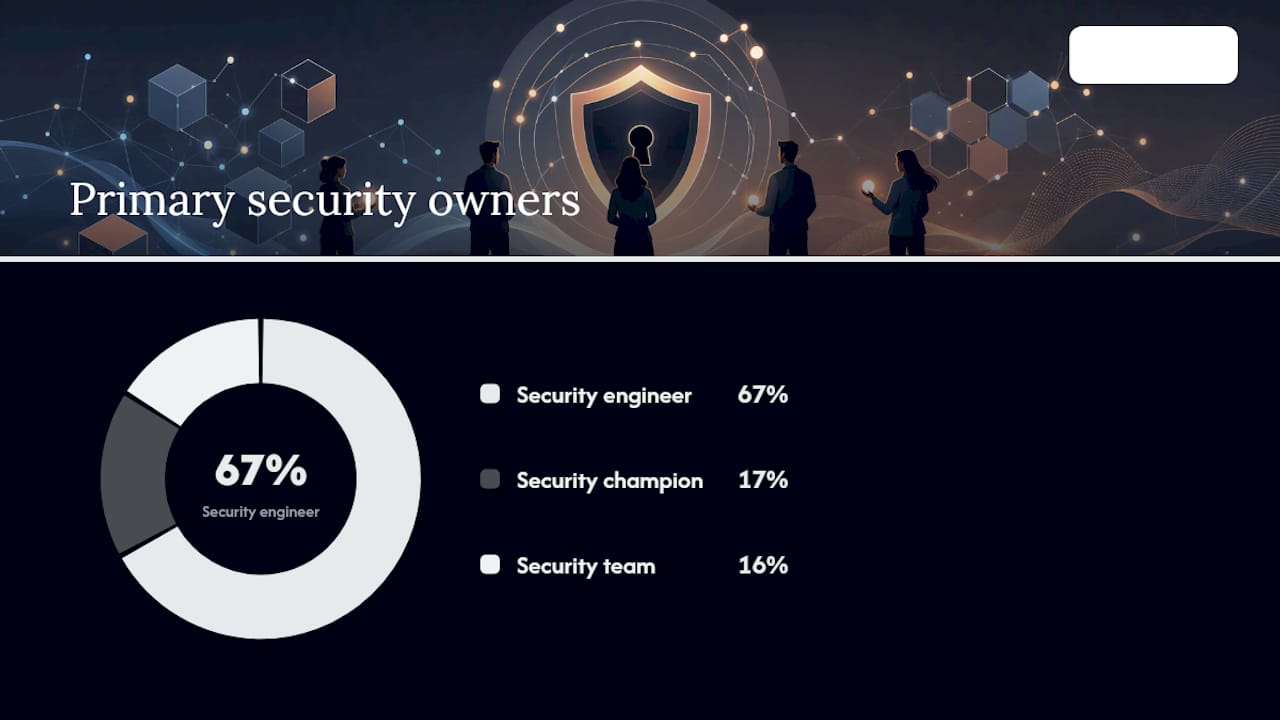
- Security champions are embedded developers or engineers with additional security training who act as the first point of contact for their team. They run threat modeling sessions, review security findings, and escalate when needed.
- Security engineers own the program: tooling selection, policy definition, training, and escalation for complex findings.
- SRE/ops own pipeline security, artifact integrity, and runtime monitoring.
KPIs worth tracking
Measure both technical coverage and human adoption signals. Raw finding counts tell you almost nothing useful.
- Mean time to remediate (MTTR) by severity. Critical: target under 24 hours. High: under 7 days. This is the single most important operational metric.
- Percentage of PRs with SAST scans passing. Tracks adoption. If it drops, something in the tooling or policy is creating friction.
- Open SCA CVE backlog (critical + high). Tracks debt accumulation. A growing backlog means your SLA is not being met.
- Percentage of features with completed threat models. Tracks design-phase adoption.
- Time-to-fix trend. Are developers getting faster at resolving findings? If not, they may need better tooling or training.
The ROI case
The cost argument for Secure SDLC is straightforward. Vulnerabilities caught at the design or coding phase cost a fraction of what they cost to fix post-release, and a fraction again of what a breach costs. For teams carrying significant technical debt from years of deferred security work, a Secure SDLC program also provides a structured path to technical debt remediation: each sprint, new code meets the security standard, and legacy code refactoring is prioritized by risk score rather than guesswork.
For executive-level framing of this ROI argument, Yslootahtech's executive cybersecurity workflow guide covers how to present security investment in terms leadership responds to.
Common pitfalls that derail Secure SDLC programs
Security as a final gate
The most common failure mode. A single security review at the end of the release cycle creates a bottleneck, delays releases, and trains developers to view security as an obstacle. Microsoft's SDL guidance and the Azure Well-Architected framework both emphasize that shifting ownership to product teams with automated guardrails scales better than a centralized gate model. Fix: move security checks to the PR and CI phases and reserve the release gate for final hard-stop criteria only.
Skipping developer environment security
Teams invest in pipeline scanning but leave developer workstations, local secrets files, and repository access policies unsecured. A compromised developer machine or a leaked personal access token bypasses every pipeline control you have. Fix: enforce disk encryption, require MFA on all repository access, and run secrets scanning on local commits with pre-commit hooks.
Noisy SAST rules destroying developer trust
A SAST tool configured with default rules on a large codebase will generate hundreds of findings on the first run, most of them false positives or low-priority issues. Developers who see 400 findings on their first PR will disable the tool or ignore it entirely. Fix: start with a curated, high-confidence ruleset (Semgrep's security-audit rules or a vendor-provided starter pack), suppress known false positives with documented justifications, and set PR-level thresholds to block only on high-confidence, high-severity findings. Add rules incrementally as the team builds trust in the tool.
Overcentralized security approvals
Requiring a security team sign-off on every PR or every deployment creates a queue that slows delivery and builds resentment. Fix: automate the routine checks and reserve human security review for high-risk changes (new authentication flows, cryptographic implementations, external API integrations). Define "high-risk change" explicitly in your policy so developers know when to request a review.
Treating legacy code as out of scope
Legacy code refactoring is uncomfortable, but leaving it unscanned means your attack surface is larger than your metrics suggest. Fix: run SCA and SAST on legacy modules in advisory mode first. Prioritize remediation by exposure: code that handles authentication, payment processing, or sensitive data gets addressed first, regardless of age.
Your 30/60/90-day playbook to start or scale Secure SDLC
Days 1–30: Quick wins and baseline
-
Run baseline scans on all active repositories. Owner: security engineer. Acceptance criterion: scan results documented, critical findings triaged. Risk if skipped: you are flying blind on your current exposure.
-
Nominate security champions. Owner: engineering manager. Acceptance criterion: at least one champion per team identified and briefed. Risk if skipped: security tasks have no owner and drift.
-
Add secrets scanning to all PRs. Owner: platform/DevOps engineer. Acceptance criterion: zero secrets committed to main branch after day 30. Risk if skipped: credential exposure remains a live risk.
-
Add lightweight SAST to PR workflow. Owner: security champion + platform engineer. Acceptance criterion: SAST runs on 100% of PRs; block only on high-confidence, high-severity findings. Risk if skipped: developers never see findings in their natural workflow.
-
Document your current SDLC phases and map one security activity to each. Owner: security engineer + product manager. Acceptance criterion: a one-page phase map exists and is shared with all teams. Risk if skipped: adoption has no shared reference point.
Days 31–60: Integration and depth
-
Integrate SCA into CI with a CVE blocking policy. Owner: platform engineer + security engineer. Acceptance criterion: CI fails on critical CVEs in direct dependencies; high CVEs create auto-tickets. Risk if skipped: vulnerable dependencies ship undetected.
-
Automate secret scanning on the full commit history. Owner: security engineer. Acceptance criterion: full repo history scanned; any found secrets rotated immediately. Risk if skipped: historical leaks remain undetected.
-
Run a threat modeling workshop on one live project. Owner: security champion + lead engineer. Acceptance criterion: threat model document produced, reviewed, and stored in the project repo. Risk if skipped: design-phase security remains theoretical.
-
Configure DAST against a staging environment. Owner: QA engineer + security engineer. Acceptance criterion: DAST runs on nightly schedule; findings reviewed weekly. Risk if skipped: runtime vulnerabilities go undetected until production.
-
Establish a vulnerability SLA. Owner: security engineer + engineering manager. Acceptance criterion: written policy defining remediation timelines by severity, communicated to all teams. Risk if skipped: MTTR has no target and findings age indefinitely.
Days 61–90: Gates, metrics, and resilience
-
Define and enforce release gates for high-severity findings. Owner: security engineer + platform engineer. Acceptance criterion: no release with open critical or high findings without documented exception. Risk if skipped: the program has no teeth at the point that matters most.
-
Measure and report KPIs for the first time. Owner: security engineer. Acceptance criterion: MTTR, PR scan coverage, and open CVE backlog reported to leadership. Risk if skipped: you cannot demonstrate progress or justify continued investment.
-
Run a tabletop incident response exercise. Owner: security engineer + SRE. Acceptance criterion: exercise completed, gaps documented, and at least one runbook updated. Risk if skipped: your team has never practiced responding to a real incident.
-
Review and tune SAST rules based on 60 days of data. Owner: security champion + security engineer. Acceptance criterion: false positive rate reduced; developer satisfaction with tooling documented. Risk if skipped: noisy tools erode adoption over time.
For a complementary checklist oriented toward leadership, Yslootahtech's enterprise cybersecurity checklist guide covers the governance layer that sits above the technical playbook.
Why integration beats perfection every time
The teams that succeed with Secure SDLC are not the ones with the most sophisticated tooling. They are the ones that made security feel like a natural part of the development workflow rather than an external imposition. A threat model that fits inside sprint planning, a SAST tool that gives useful feedback in under two minutes, a security champion who sits in the same Slack channel as the engineering team: these are the things that actually move the needle. The frameworks, NIST SSDF, OWASP SAMM, Microsoft SDL, give you the vocabulary and the structure. The hard work is the cultural integration, and that starts with reducing friction at every touchpoint.
If your organization is at the point of formalizing this work, the custom software development workflow guide from Yslootahtech covers how to integrate security requirements into existing development processes without overhauling what already works.
Yslootahtech can help you build this from the ground up
Most engineering teams know what a Secure SDLC should look like. The gap is execution: finding the time, the expertise, and the right sequence of changes to make it stick without derailing delivery.
Yslootahtech works with U.S.-based engineering organizations to close that gap through structured engagements: a baseline security assessment that maps your current SDLC against NIST SSDF and OWASP SAMM, a hands-on Secure SDLC implementation that embeds controls into your existing pipelines, CI/CD pipeline hardening with gating policies and artifact signing, and a security champions training program that builds internal capability rather than dependency.

Clients who go through the assessment and implementation typically see faster vulnerability triage, fewer post-release security incidents, and a measurable reduction in the CVE backlog within the first 90 days. Engagements are available on a project or ongoing retainer basis, depending on your team's needs.
To discuss a Secure SDLC assessment or a pipeline hardening engagement, contact Yslootahtech or explore the UX/UI and secure design services that support the design-phase activities covered in this guide.
Sources
The following resources back the guidance in this article and are worth bookmarking for deeper study.
NIST SP 800-218 Rev. 1 (SSDF Version 1.2) is the definitive U.S. government reference for secure software development practices; read it if you sell software to federal agencies or need a compliance-aligned program framework. NIST SP 800-218 (SSDF final) is the stable release version with the full practice catalog and implementation examples. OWASP Developer Guide: Secure Development and Integration explains how to embed security into each phase without creating a separate security lifecycle; it is the most practical starting point for developer teams. OWASP SAMM provides the maturity model for program planning and gap assessment; use it to score your current state and build a roadmap. Microsoft SDL Practices covers threat modeling, secure design reviews, and cross-methodology applicability; the threat modeling page alone is worth an afternoon. Microsoft threat modeling guidance gives a step-by-step process for running focused, sprint-compatible threat modeling sessions. Snyk's Secure SDLC guide offers a practitioner-oriented walkthrough of phase-based activities and a tiered testing schedule that maps directly to CI/CD pipelines. The Security Knowledge Framework provides additional context on IAST, SCA, and blended testing strategies for teams building out their verification layer.
- SP 800-218 Rev. 1, Secure Software Development Framework (SSDF) Version 1.2: Recommendations for Mitigating the Risk of Software Vulnerabilities | CSRC
- Secure development and integration - OWASP Developer Guide