Multi Cloud Strategy: A Practical Guide for UAE IT Leaders

A multi cloud strategy means running workloads across two or more public cloud providers, each chosen for what it does best, rather than consolidating everything on a single platform.
Three things to lock in before adding a second provider:
- Primary provider first. Reach operational maturity on one cloud before distributing workloads. Complexity compounds fast when governance is immature.
- Secondary clouds for specific jobs. Use a second provider only where it delivers a clear, measurable advantage — a specialized AI/ML service, a data residency requirement, or a disaster recovery region your primary doesn't cover in the UAE.
- Mandate governance before you scale. Tagging standards, cost allocation, identity federation, and a Cloud Center of Excellence (CCoE) must exist before you add providers, not after.
Gartner notes that organizations choose multicloud for differentiated capabilities and regional needs, but success depends on balancing business value against operational complexity. That balance is exactly what this guide is built around.
Key Takeaways
| Point | Details |
|---|---|
| 80/20 rule is the right default | Use one primary provider for most workloads; add secondary providers only for specific, justified use cases. |
| Cost premium is real | Multicloud carries a 30–50% total cost premium over single-cloud once staffing, governance, and diluted discounts are counted. |
| Governance must come first | Tagging standards, account hierarchy, identity federation, and a CCoE must be in place before scaling to a second provider. |
| UAE compliance shapes architecture | Data residency rules (PDPL, CBUAE, DIFC) determine which data can sit on which provider's UAE region — map this before deployment. |
| Yslootahtech delivers the roadmap | Yslootahtech offers fixed-scope multicloud readiness assessments and end-to-end implementation for UAE enterprises. |
Table of Contents
- What does a multi cloud strategy actually mean today?
- Multicloud vs hybrid cloud: how do you choose which you need?
- What are the real benefits of a multicloud approach?
- What are the biggest multicloud challenges, and how do you mitigate them?
- How does multicloud actually work? Reference architectures explained
- Which tools should you adopt first to enable multicloud?
- Governance, FinOps, security, and UAE compliance: what you need before you scale
- How to implement multicloud: a phased roadmap
- What teams and skills does multicloud actually require?
- Practical multicloud use cases: when does it actually make sense?
- How Yslootahtech implements multicloud for UAE enterprises
- The case for cloud-smart over cloud-everywhere
- Yslootahtech's multicloud services for UAE enterprises
- Sources
What does a multi cloud strategy actually mean today?
Multicloud is not the same as running multiple accounts or multiple regions on one provider. It means deliberately placing workloads across two or more distinct public cloud platforms — Microsoft Azure, Google Cloud, Amazon Web Services (AWS), or others — because each platform offers something the others don't, or because regulatory requirements demand it.
The practical scope is narrower than most vendor marketing suggests. A genuine multicloud deployment involves:
- Workload-level placement decisions. Each application or service is assigned to a provider based on a specific technical or business rationale, not convenience.
- Cross-cloud integration. Services on different providers communicate through APIs, private interconnects, or a service mesh — not just the public internet.
- Unified operations. A single control plane (or at least a unified observability layer) spans all providers so teams aren't managing four separate dashboards.
A concrete example: a UAE financial services firm might run its core banking application on Azure (for local data center presence and compliance tooling), use AWS for its data analytics pipeline (where Redshift and SageMaker offer mature capabilities), and rely on Google Cloud's Vertex AI for a specific machine learning model in production. Each placement has a reason. The firm is not duplicating the entire stack across three clouds — that would be expensive and operationally unsustainable.
The distinction between multicloud and multi-region matters. Running your application in Azure UAE North and Azure East US is multi-region, not multicloud. DigitalOcean frames the choice clearly: single-cloud favors simplicity and cost predictability; multicloud favors flexibility and best-of-breed services but increases operational complexity. Both are legitimate strategies — the right one depends on your organization's maturity and specific business requirements.
Multicloud vs hybrid cloud: how do you choose which you need?
These two terms get conflated constantly, and the confusion leads to poor architecture decisions. They describe different things.
Hybrid cloud connects on-premises infrastructure (your own data center or private cloud) with one or more public clouds. The defining characteristic is the on-premises component. A UAE bank running its core ledger on-premises while using Azure for customer-facing applications is running a hybrid cloud. For a deeper look at the hybrid model and its local implications, this guide to hybrid cloud for IT leaders covers the architecture and workload placement decisions in detail.
Multicloud is purely public-cloud-to-public-cloud. No on-premises component is required. A company running workloads on both AWS and Google Cloud, with no private data center, is running multicloud.
The two are not mutually exclusive. Many UAE enterprises run hybrid multicloud: on-premises systems, a primary public cloud, and one or two secondary public clouds for specific workloads.
| Dimension | Hybrid cloud | Multicloud |
|---|---|---|
| Where workloads run | On-premises + public cloud | Two or more public clouds |
| Primary driver | Data sovereignty, legacy integration, latency to on-prem systems | Best-of-breed services, resilience, vendor leverage |
| Typical complexity | Moderate (network connectivity, VPN/ExpressRoute) | High (cross-cloud identity, networking, observability) |
| Main use cases | Regulated data on-prem, burst to cloud, gradual migration | Specialized AI/ML, multi-region DR, M&A integration |
| Cost profile | Capex (on-prem) + opex (cloud) | Opex-only, but with a documented 30–50% premium |
When to choose each:
- Choose hybrid cloud when you have regulatory requirements that mandate on-premises data storage, significant legacy infrastructure that can't be migrated quickly, or latency-sensitive workloads that need proximity to on-premises systems.
- Choose multicloud when a specific workload genuinely performs better or costs less on a different public cloud, when you need geographic redundancy across providers, or when a secondary provider offers a capability your primary doesn't.
- Stay single-cloud when your team is still building cloud maturity, when your workload portfolio is largely contiguous (tightly coupled services that should run together), or when the operational overhead of a second provider would outweigh any benefit.
Three rules of thumb for workload packaging:
- Keep contiguous workloads together. Services that share data constantly should run on the same provider to avoid egress fees and latency penalties.
- Respect data gravity. Large datasets are expensive to move. Place compute near the data, not the other way around.
- Don't split a workload for the sake of splitting. A workload that runs well on your primary cloud has no business on a secondary cloud unless there's a specific, measurable reason.
What are the real benefits of a multicloud approach?
The benefits are real, but they're not universal. Each one delivers measurable value only under specific conditions — and knowing those conditions is what separates a well-justified multicloud investment from an expensive experiment.
Best-of-breed service access is the most commonly cited benefit, and the most legitimate. AWS leads in data warehousing and serverless compute. Google Cloud's Vertex AI and BigQuery are genuinely differentiated for ML and analytics workloads. Azure's compliance certifications and Active Directory integration make it the natural home for Microsoft-heavy enterprises. No single provider leads across every service category, and for organizations with diverse workload types, that gap is real money.
Reduced vendor dependence matters most when a provider raises prices, changes terms, or experiences a regional outage. Having a secondary provider with at least some workloads already running there means you have negotiating leverage and a fallback — not just a theoretical exit plan. The leverage is only real if the secondary provider is genuinely operational, not just a paper architecture.
Regional and data residency options are particularly relevant in the UAE. Both AWS (UAE region, launched in 2022) and Microsoft Azure (UAE North, UAE Central) have local regions. Google Cloud has a presence through interconnect partners. For workloads subject to UAE data residency requirements — financial data, health records, government-adjacent services — the ability to place data in a specific provider's UAE region, or to split between providers based on data classification, is a genuine compliance tool. Cloud computing benefits for UAE businesses provides more detail on the local business case.
Resilience and performance optimization through multicloud is achievable but requires deliberate architecture. An active-active deployment across two providers can survive a full provider outage — but it costs significantly more to build and operate than a single-provider high-availability setup.
| Benefit | When it delivers measurable ROI | Example signal |
|---|---|---|
| Best-of-breed services | Workload has a clear performance or cost gap between providers | Analytics team benchmarks BigQuery significantly faster than alternative |
| Vendor leverage | Contract renewal approaching, significant spend concentration | Single-provider spend exceeds AED 1M/year |
| Data residency | Regulatory audit requires data location proof | UAE Central Bank or DIFC compliance requirement |
| Resilience | Business continuity requires RTO under 1 hour | E-commerce platform with SLA penalties for downtime |
| Performance optimization | Latency-sensitive workloads serving multiple geographies | Global app needing sub-50ms response in EU and GCC simultaneously |
What are the biggest multicloud challenges, and how do you mitigate them?
The honest answer: multicloud is harder and more expensive than most organizations expect going in. Practitioner analysis puts the total cost premium at 30–50% over an equivalent single-cloud deployment, once staffing, governance overhead, and diluted volume discounts are counted. Platform staffing typically runs 1.5–2 times higher, and training a small team across multiple providers can add AED 110,000–180,000 (approximately $30,000–$50,000) in direct costs before any infrastructure is deployed.
The main pain points, and what to do about each:
- Cost sprawl. Fragmented spend across providers means you lose volume discounts on both. Egress fees — charged when data leaves a provider's network — add up fast in a multicloud setup where services on different clouds communicate constantly. Mitigation: apply the 80/20 rule, concentrate committed-use reservations on your primary provider, and budget egress explicitly before architecture decisions are made.
- Operational complexity. Each provider has its own IAM model, networking constructs, CLI, and monitoring stack. Teams that are expert on one platform are often novices on another. Mitigation: adopt infrastructure as code (IaC) with a provider-agnostic layer (Terraform works across AWS, Azure, and Google Cloud), and use a unified observability platform rather than native tools alone.
- Security policy drift. Security policies configured on one provider don't automatically replicate to another. Misconfigurations are the leading cause of cloud security incidents, and the risk multiplies with each additional provider. Mitigation: centralize identity with a federated identity provider (Azure AD/Entra ID or Okta work across providers), enforce zero-trust network access, and run a cloud security posture management (CSPM) tool that spans all providers.
- Staffing and skills gaps. Finding engineers who are genuinely proficient on two or three cloud platforms is harder than finding single-cloud specialists, and they command a premium. Mitigation: build deep expertise on your primary provider first; use managed services or a specialist partner for secondary-provider workloads until internal skills develop.
- Governance gaps. Without a unified tagging standard and account structure, cost allocation becomes guesswork and compliance audits become painful. Mitigation: establish tagging policy, account hierarchy, and ownership rules before onboarding a second provider — not after.
Numbered mitigation priorities for teams starting out:
- Adopt the 80/20 distribution: one primary provider for most workloads, secondary providers only for specific, justified use cases.
- Implement IaC from day one. Manual configuration across multiple providers is unsustainable.
- Stand up a FinOps practice before scaling. Visibility into spend across providers is not automatic.
- Federate identity. A single identity provider across all clouds reduces attack surface and simplifies access reviews.
- Run a CSPM tool that covers all active providers from the start.
Pro Tip: Before onboarding a second cloud provider, run a full inventory of your existing cloud assets on the primary provider. Rackspace's multicloud management framework identifies discovery as the critical first step — most governance failures and outages trace back to assets that weren't inventoried before the environment grew. If you can't see everything you have, you can't govern it.
How does multicloud actually work? Reference architectures explained
Four deployment patterns cover most enterprise multicloud scenarios. Each has a different cost and complexity profile.
Active-active across providers. Both providers serve live traffic simultaneously. A global load balancer (such as AWS Global Accelerator or Azure Front Door, or a provider-agnostic option like Cloudflare) routes requests to the nearest healthy endpoint. This pattern delivers the highest resilience and can optimize latency by geography, but it requires the application to be stateless or to replicate state across providers in near-real time. It's the most expensive pattern to build and operate.
Active-passive failover. One provider handles all production traffic; the second runs a warm standby that can be promoted if the primary fails. Recovery time depends on how "warm" the standby is — a cold standby might take hours; a hot standby can fail over in minutes. This pattern is significantly cheaper than active-active and suits most disaster recovery requirements.
Segmented workload model. The most common pattern in practice. A primary cloud handles the majority of workloads; one or two secondary clouds host specific services where they have a clear advantage. The segmented model is what the 80/20 rule describes. Integration between segments happens through APIs or private interconnects, not through tight coupling.
Data-only multicloud. Some organizations keep all compute on a primary provider but store certain datasets on a secondary provider for compliance or cost reasons. Object storage on a secondary provider can serve as a cost-effective archive or a regulatory-compliant data copy.
Essential components for any multicloud architecture:
- Identity federation. A single identity provider (IdP) that issues credentials recognized across all clouds. Without this, access management becomes a patchwork of separate IAM systems.
- Service mesh. Tools like Istio or Linkerd manage service-to-service communication, traffic routing, and mutual TLS across cloud boundaries.
- Cross-cloud networking. Private interconnects (AWS Direct Connect, Azure ExpressRoute, Google Cloud Interconnect) rather than public internet for inter-cloud traffic. In the UAE, Equinix and du's data center facilities offer colocation and interconnect options that connect to multiple providers.
- Unified observability. A single platform (Datadog, Grafana, or similar) that ingests metrics, logs, and traces from all providers. Native monitoring tools from each provider don't talk to each other by default.
Design team note: a reference architecture diagram for this article should show a primary cloud (AWS or Azure UAE region) connected via private interconnect to a secondary cloud (Google Cloud or the other major provider), with a federated IdP sitting outside both, a unified observability layer at the top, and workload segments labeled by type (core apps, analytics, DR standby).
Which tools should you adopt first to enable multicloud?
The tool categories below are listed in the order most teams should adopt them. Getting the first two right before adding the others prevents the most common failure modes.
Phase 1 (adopt before adding a second provider):
- Infrastructure as Code (IaC). Terraform is the de facto standard for multicloud IaC because it supports AWS, Azure, and Google Cloud with a consistent workflow. Pulumi is an alternative for teams that prefer general-purpose programming languages. Without IaC, configuration drift across providers is inevitable.
- Unified IAM and identity federation. Azure Active Directory (now Microsoft Entra ID), Okta, or AWS IAM Identity Center can federate identity across providers. Pick one and enforce it before any secondary-provider workloads go live.
Phase 2 (adopt as the second provider is onboarded):
- Container orchestration. Kubernetes is the primary portability layer between clouds. Running workloads in containers managed by Kubernetes means the application layer is largely provider-agnostic. Fleet management tools (Google Anthos, Azure Arc, or AWS EKS Anywhere) extend a single Kubernetes control plane across providers and on-premises environments.
- Multicloud networking and interconnect. Private interconnects between providers, plus a software-defined networking layer (Aviatrix or Alkira are vendor-agnostic options) that abstracts provider-specific networking constructs.
- Centralized observability. Datadog, Grafana Cloud, or Dynatrace ingest data from all providers. Native tools (CloudWatch, Azure Monitor, Google Cloud Operations) remain useful for provider-specific diagnostics but shouldn't be the primary observability layer in a multicloud environment.
Phase 3 (adopt as spend scales):
- FinOps tooling. CloudHealth (now Broadcom), Apptio Cloudability, or open-source options like OpenCost provide unified cost visibility across providers. Without this, cost allocation across business units becomes a manual, error-prone process.
- Cloud Security Posture Management (CSPM). Wiz, Orca Security, or Microsoft Defender for Cloud (which covers non-Azure clouds) continuously scan for misconfigurations across all active providers.
UAE-specific availability notes: AWS has a dedicated UAE region (ap-south-1 equivalent in the Middle East). Azure UAE North (Dubai) and UAE Central (Abu Dhabi) are both generally available. Google Cloud does not currently operate a dedicated UAE region but is accessible through its Middle East network presence and through interconnect partners at UAE data centers. For latency-sensitive workloads, AWS and Azure are the natural primary choices for UAE-based deployments. For cloud security considerations specific to UAE businesses, the security controls and compliance requirements are worth reviewing alongside your provider selection.
Governance, FinOps, security, and UAE compliance: what you need before you scale
Governance is not a phase-two activity. Every team that has tried to retrofit governance onto a running multicloud environment has paid for it in audit findings, cost overruns, and security incidents. Build the framework before you scale.
Governance checklist:
- Define an account/subscription hierarchy that separates environments (production, staging, development) and business units across all providers.
- Establish a mandatory tagging standard: owner, cost center, environment, application, and data classification at minimum.
- Assign a named owner for every cloud account. Unowned accounts are where shadow IT and cost surprises live.
- Stand up a Cloud Center of Excellence (CCoE) with representation from platform engineering, security, finance, and application teams. AWS enterprise guidance is explicit: one CCoE with provider-specialized skills, not separate teams per provider.
FinOps checklist:
- Implement cost visibility dashboards before any workload goes live on a secondary provider.
- Allocate costs to business units from day one using tags, not retroactively.
- Concentrate committed-use reservations (Reserved Instances on AWS, Reserved VM Instances on Azure, Committed Use Discounts on Google Cloud) on your primary provider where spend is highest.
- Budget egress fees explicitly. Cross-provider data transfer is not free, and in a multicloud setup it can become a significant line item.
- Use your multicloud footprint as negotiating leverage at contract renewal — but only if you have real, operational workloads on the secondary provider, not just a pilot.
Security controls:
- Federate identity across all providers through a single IdP. Every human and machine identity should authenticate through one system.
- Enforce zero-trust network access: no implicit trust based on network location, verify every request.
- Run a CSPM tool that covers all active providers continuously, not just at audit time.
- Apply consistent data classification and encryption standards across providers. A file that's encrypted at rest on Azure should be encrypted at rest on AWS too, with the same key management discipline.
- For cloud security best practices that apply across provider environments, the controls framework is worth reviewing as a baseline.
UAE-specific regulatory considerations:
| Regulatory area | What to check | Action required |
|---|---|---|
| Data residency | UAE Personal Data Protection Law (PDPL) and sector-specific rules (CBUAE, DIFC, ADGM, MOHAP) | Confirm data classification and map each data type to a compliant provider region |
| Cross-border data transfer | PDPL restrictions on transferring personal data outside the UAE | Include data transfer clauses in provider contracts; use UAE-region storage for regulated data |
| Financial services | CBUAE cloud outsourcing guidelines | Notify CBUAE before migrating regulated workloads; maintain exit plans |
| Healthcare | MOHAP and DHA data regulations | Health records must remain in UAE-approved infrastructure |
| Contract exit terms | Provider lock-in and egress cost at contract end | Negotiate exit assistance, data portability guarantees, and egress cost caps into initial contracts |
Cross-cloud data handling also intersects with consent management. When personal data flows between providers — particularly for analytics or marketing workloads — consent records and data processing agreements need to reflect the actual data path, not just the primary provider's terms.
How to implement multicloud: a phased roadmap
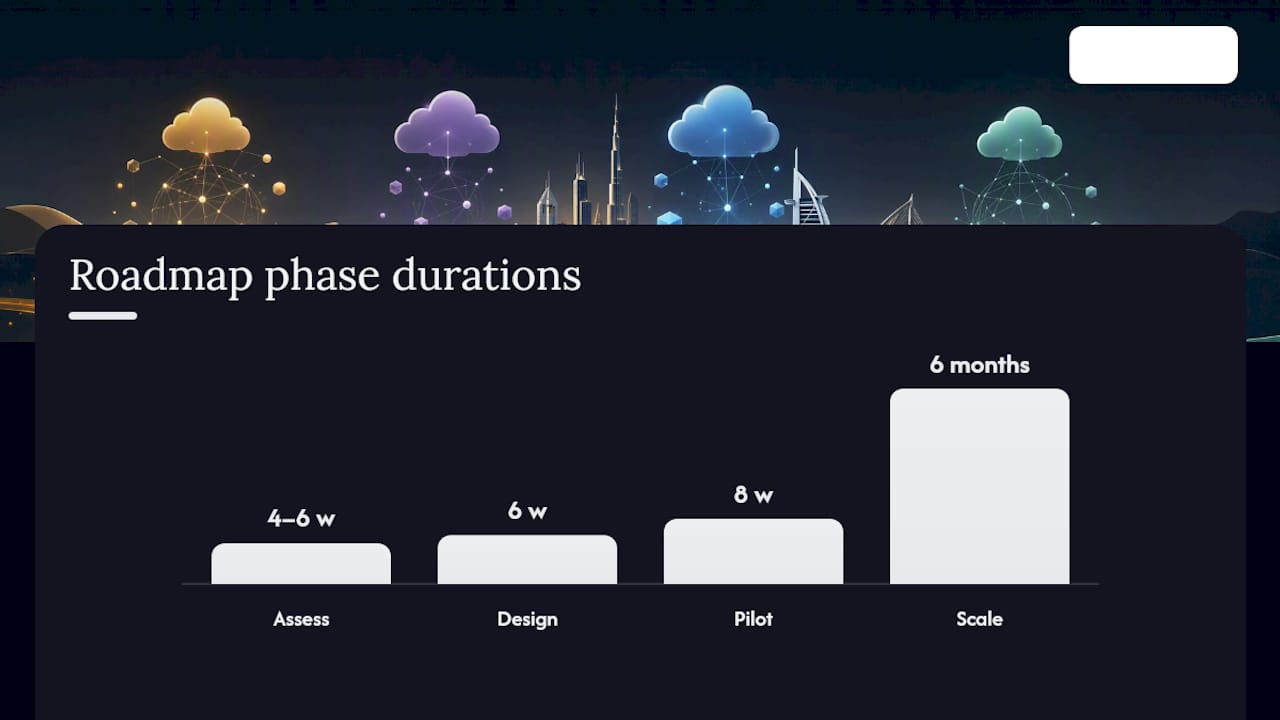
The roadmap below assumes an organization starting from a single-cloud or hybrid baseline. Teams already running multicloud informally (often the result of acquisitions or shadow IT) should run the assessment phase first to establish a current-state inventory before anything else.
Phase 1: Assess (weeks 1–6)
- Inventory all existing cloud assets across every provider currently in use, including shadow IT accounts.
- Classify workloads by data sensitivity, performance requirements, and provider dependency.
- Identify the specific use cases that justify a second provider (a genuine capability gap, a compliance requirement, or a resilience need).
- Assess current team skills against the roles matrix in the next section.
- Produce a current-state cost baseline per provider.
Phase 2: Design (weeks 7–14)
- Select the primary provider and confirm the 80/20 workload distribution.
- Design the account/subscription hierarchy, tagging standard, and CCoE structure.
- Choose IaC tooling and identity federation approach.
- Design the cross-cloud networking architecture (private interconnects, service mesh).
- Define the governance, security, and FinOps frameworks before any workload moves.
Phase 3: Pilot (weeks 15–26)
- Migrate one non-critical workload to the secondary provider using the IaC and governance framework designed in phase 2.
- Validate cross-cloud networking, identity federation, and observability in a real environment.
- Run a cost analysis against the pre-pilot baseline to confirm the business case.
- Identify and resolve operational gaps before scaling.
Phase 4: Scale (months 7–18)
- Migrate additional workloads to the secondary provider based on the justified use-case list from phase 1.
- Expand FinOps tooling and CSPM coverage as the environment grows.
- Build provider-specific skills within the CCoE through training and, where needed, specialist partners.
Phase 5: Optimize (ongoing)
- Review workload placement quarterly against cost and performance data.
- Renegotiate committed-use agreements as spend patterns stabilize.
- Retire workloads from secondary providers if the original justification no longer holds.
| Phase | Typical duration | Key acceptance criteria |
|---|---|---|
| Assess | 4–6 weeks | Full asset inventory, workload classification complete, cost baseline established |
| Design | 6 weeks | Architecture approved, governance framework documented, IaC tooling selected |
| Pilot | 8 weeks | One workload live on secondary provider, observability and identity federation validated |
| Scale | 6 months | Justified workloads migrated, FinOps and CSPM operational across all providers |
| Optimize | Ongoing | Quarterly cost and placement reviews, committed-use agreements in place |
Main cost drivers and how to control them:
- Staffing. The largest cost driver. Control it by concentrating expertise on the primary provider and using managed services or partners for secondary-provider workloads initially.
- Private interconnects. Direct Connect (AWS), ExpressRoute (Azure), and Cloud Interconnect (Google) carry monthly port fees plus data transfer charges. Size them for actual traffic, not theoretical peaks.
- Egress fees. Budget these explicitly. Data leaving a provider's network is charged per GB. In a multicloud setup where services communicate across providers, egress can become a significant monthly line item.
- Management tooling. FinOps platforms, CSPM tools, and unified observability add cost. Factor them into the business case from the start.
- Migration effort. Application refactoring to make workloads portable (containerization, removing provider-specific API dependencies) is often underestimated. For a detailed view of migration steps and project considerations, this cloud migration guide for IT leaders covers the process in depth.
What teams and skills does multicloud actually require?
Under-resourcing the platform layer is the most common reason multicloud programs stall after the pilot phase. The operating model needs to be designed before the environment scales, not after the first production incident.
Roles matrix:
| Role | Primary responsibility | Hire vs partner |
|---|---|---|
| CCoE lead | Governance, standards, provider relationships | Hire (internal authority needed) |
| Platform engineer | IaC, Kubernetes, CI/CD pipelines | Hire or partner |
| Cloud architect | Solution design, workload placement decisions | Hire (at least one per primary provider) |
| FinOps analyst | Cost visibility, allocation, optimization | Hire or managed service |
| Security operations | CSPM, identity, incident response | Hire or managed service |
| Network engineer | Cross-cloud networking, interconnects | Hire or partner |
| Site reliability engineer (SRE) | Observability, reliability, incident management | Hire |
| Application owner | Workload-level decisions, provider requirements | Internal (business unit) |
Skills and training priorities:
- IaC proficiency (Terraform or Pulumi) for all platform engineers.
- Kubernetes administration and fleet management for container-centric workloads.
- Cloud networking fundamentals across at least two providers (VPC design, private interconnects, DNS).
- Cross-cloud security: federated identity, CSPM tool operation, zero-trust principles.
- FinOps practices: tagging, cost allocation, reserved instance management, egress optimization.
AWS enterprise guidance recommends organizing a single CCoE with provider-specialized skills rather than separate teams per provider. That structure prevents duplication and keeps governance consistent.
When to hire vs when to partner:
Hire for roles that require internal authority (CCoE lead, cloud architects) and for roles where institutional knowledge compounds over time (SREs, platform engineers). Engage managed services or specialist partners for FinOps, CSPM, and secondary-provider operations until internal skills develop. In the UAE market, several systems integrators and managed service providers offer cloud-specialized teams that can fill gaps during the scaling phase without the lead time of full-time hiring.
Practical multicloud use cases: when does it actually make sense?
These four scenarios represent the clearest business cases for multicloud in a UAE enterprise context. Each includes the signal that justified the investment.
-
Global application with regional compliance requirements. A UAE-headquartered retailer with operations in Europe runs its core e-commerce platform on Azure UAE North for local data residency, while serving European customers from AWS EU regions to comply with GDPR data locality requirements. Business signal: regulatory audit identified cross-border data transfer risk that a single-provider, single-region setup couldn't resolve.
-
Analytics and ML on a best-of-breed provider. A financial services firm runs its transaction processing on Azure (for Active Directory integration and CBUAE compliance tooling) but routes its fraud detection and customer analytics workloads to Google Cloud's BigQuery and Vertex AI, where the data science team benchmarked materially better performance. Business signal: the analytics team's benchmark showed a clear performance gap that justified the operational overhead of a second provider.
-
Disaster recovery with active-passive failover. A government-adjacent entity in Abu Dhabi runs production workloads on AWS UAE region and maintains a warm standby on Azure UAE North. A full AWS regional outage would promote the Azure standby within a defined recovery time objective. Business signal: a business continuity audit required a recovery time objective that a single-provider multi-AZ setup couldn't guarantee.
-
M&A integration. A UAE conglomerate acquires a subsidiary already running on Google Cloud. Rather than immediately migrating the subsidiary's workloads to the parent's Azure environment (a costly, risky project), the integration team connects the two environments through private interconnect and manages them as a segmented multicloud until a migration plan is ready. Business signal: the cost and risk of immediate migration exceeded the cost of temporary multicloud operations.
How Yslootahtech implements multicloud for UAE enterprises
Yslootahtech has worked with UAE-based organizations across financial services, retail, and government-adjacent sectors to design and implement multicloud environments that meet local regulatory requirements without the operational overhead that typically derails these programs.
In practice, engagements follow a pattern: most clients arrive with informal multicloud already in place — different teams using different providers, no unified governance, and cost visibility that amounts to three separate invoices. The first deliverable is always a current-state inventory and cost baseline, because you can't govern what you haven't mapped.
Anonymized client patterns from recent engagements:
- A Dubai-based financial services client needed to separate regulated customer data (on Azure UAE North, meeting CBUAE requirements) from its analytics workloads (on AWS, where the data engineering team had existing expertise). Yslootahtech designed the account hierarchy, tagging standard, and private interconnect architecture, then stood up a unified observability layer across both providers. The client's compliance team passed its next regulatory review without findings related to cloud infrastructure.
- A regional retail group running an e-commerce platform on AWS wanted to add Google Cloud's AI services for personalization without migrating the core platform. Yslootahtech implemented a containerized API layer on Kubernetes that allowed the Google Cloud ML models to serve recommendations to the AWS-hosted storefront, with egress costs budgeted and monitored from day one.
Engagement models Yslootahtech offers:
- Multicloud readiness assessment. A fixed-scope engagement (typically four to six weeks) that produces a current-state inventory, workload classification, cost baseline, and a prioritized roadmap.
- Pilot design and delivery. End-to-end delivery of a first secondary-provider workload, including IaC, identity federation, and observability setup.
- Full migration and managed operations. Ongoing management of multicloud environments, including FinOps, CSPM, and governance operations.
- Regulatory and compliance advisory. Specific guidance on UAE data residency, CBUAE cloud outsourcing guidelines, and DIFC/ADGM requirements as they apply to cloud architecture decisions.
Yslootahtech's approach to multicloud in the UAE starts with one question: what specific business outcome justifies the operational cost of a second provider? When clients can answer that question with a number — a compliance requirement, a performance benchmark, a recovery time objective — the architecture follows naturally. When they can't, the recommendation is to build maturity on the primary provider first. That discipline, applied consistently, is what separates multicloud programs that deliver value from ones that generate complexity and cost without a clear return.
The case for cloud-smart over cloud-everywhere
The conventional wisdom in enterprise IT circles is that multicloud is the mature, sophisticated choice — and single-cloud is what organizations do before they know better. That framing is wrong, and it costs organizations real money.
Multicloud is a tool, not a destination. The 80/20 approach recommended by AWS Prescriptive Guidance — one primary provider for most workloads, secondary providers only for specific, high-value cases — is not a compromise position.
The organizations that get the most value from multicloud are the ones that treat it as a deliberate, workload-by-workload decision rather than a blanket architecture mandate. They know exactly why each workload is on each provider, they measure the outcome, and they're willing to consolidate back to the primary provider if the justification disappears.
Yslootahtech's multicloud services for UAE enterprises
For UAE enterprises ready to move beyond informal multicloud and build a governed, cost-controlled environment, Yslootahtech offers end-to-end support across the full implementation lifecycle.
The starting point for most clients is a multicloud readiness assessment: a fixed-scope engagement that maps your current cloud footprint, classifies workloads, establishes a cost baseline, and produces a prioritized roadmap with realistic timelines and cost estimates. From there, Yslootahtech can deliver:
- Pilot design and delivery for a first secondary-provider workload, including IaC, identity federation, and observability.
- Full multicloud migration and managed operations, with FinOps and CSPM built in from the start.
- UAE regulatory advisory covering CBUAE, DIFC, ADGM, and MOHAP requirements as they apply to your cloud architecture.
- AI and ML workload integration on best-of-breed providers, with the cross-cloud architecture to support it.
The assessment is fixed-scope, time-boxed, and designed to give you a decision-ready roadmap — not a sales document. Contact Yslootahtech to schedule a multicloud readiness assessment for your organization.
Sources
- Why organizations choose a multicloud strategy (Gartner)
- Multi-Cloud vs Single-Cloud: Risk and Cost Analysis for CTOs (CTO Accelerator)
- How to Manage Multi-Cloud: A Practical Framework, Tools, and Best Practices (Rackspace Spot)
- Multi-Cloud vs Single-Cloud: Choosing the Right Strategy (DigitalOcean)
- Proven Practices for Succeeding with a Multicloud Strategy (AWS blog)
- Proven practices for developing a multicloud strategy (AWS Prescriptive Guidance PDF)