Role of Digital Consultation in Business Growth 2026

TL;DR:
- Digital consultation replaces costly, location-dependent interactions with flexible, technology-driven services that enhance operational efficiency. It offers significant cost savings, improved reach, and better resource management across industries, with interface quality and tailored models being critical success factors. Leaders should adopt hybrid approaches, focus on user experience, and build escalation paths to maximize long-term value and satisfaction.
The role of digital consultation is to replace costly, location-bound interactions with flexible, technology-driven engagements that cut operational expenses and expand strategic reach. For business leaders, this shift is not theoretical. Telemedicine visits average $96 compared to $509 for in-person visits, a gap that translates directly to budget decisions at the executive level. The same cost logic applies across industries, from legal advisory to financial services to enterprise IT. Understanding how digital consultation works, and where it delivers the most value, is now a core competency for any leader serious about operational efficiency.
How does digital consultation drive cost savings?
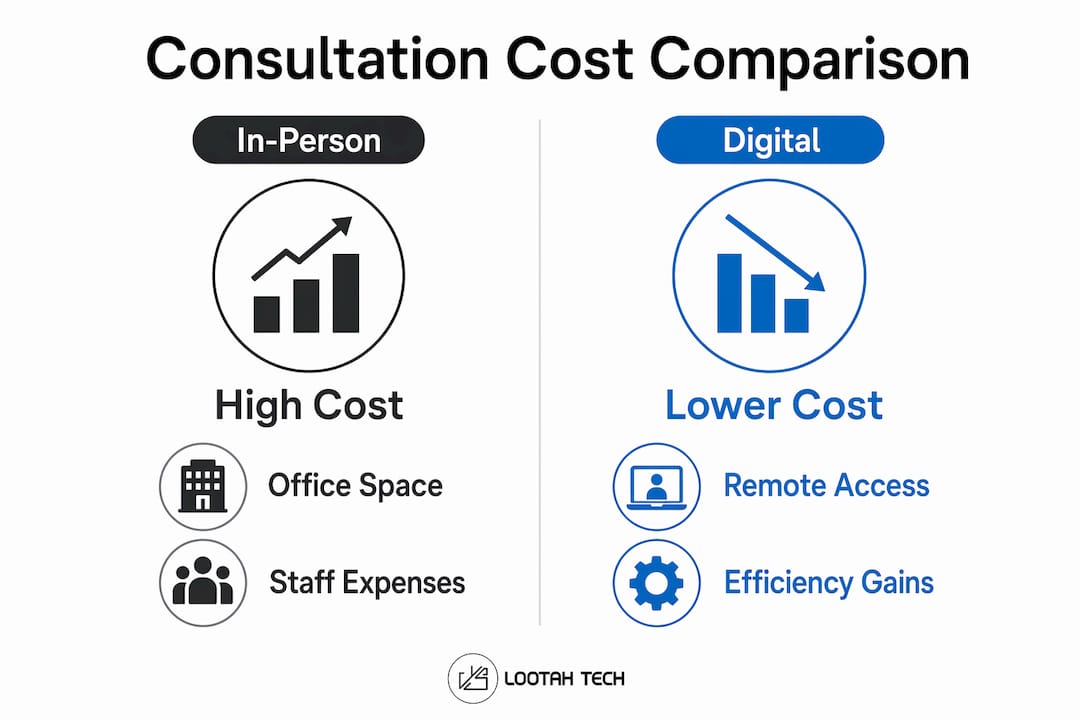
Digital consultation is the practice of delivering expert advice, clinical care, or professional services through digital channels including video, messaging platforms, and AI-assisted interfaces. The financial case is direct. Average episode savings exceed $413 per visit when comparing digital to in-person formats. That figure compounds quickly across thousands of client or patient interactions annually.
Beyond per-interaction savings, virtual consultations reduce the need for physical office space, reception staff, and in-person scheduling infrastructure. Organizations that shift even 40% of routine consultations to digital channels report measurable reductions in overhead. The efficiency gain is not just financial. Telemedicine reduces follow-up visits compared to in-person care, which means fewer resource cycles per resolved case.
The table below compares in-person and digital consultation across the dimensions that matter most to operations leaders.
| Dimension | In-Person Consultation | Digital Consultation |
|---|---|---|
| Average cost per visit | $509 | $96 |
| Follow-up visit rate | Higher | Lower |
| Geographic reach | Local | Global |
| Infrastructure required | Office, staff, scheduling | Platform, internet, device |
| Turnaround time | Days to weeks | Hours to days |
Pro Tip: Before calculating ROI on a digital consultation rollout, map your current follow-up visit rate. Reducing that number is often where the largest efficiency gains hide.
What factors drive satisfaction in digital consultations?
A mean patient satisfaction score of 7.15 out of 10 for digital consultations tells two stories at once. First, digital consultation is broadly accepted. Second, significant room for improvement remains, particularly in service reliability and empathy. Business leaders implementing digital consultation platforms need to understand exactly which variables move that score.
Research based on 7,374 patient consultation records confirms that the number of consultation rounds and the frequency of interaction significantly affect satisfaction. More exchanges, done well, produce better outcomes than a single fast response. Speed alone does not drive satisfaction. Interaction patterns and media synchronization have greater influence than response time, which means platforms built around rapid but shallow replies are leaving satisfaction points on the table.
The quality of the digital interface itself is the single strongest predictor of satisfaction. Interface tangibility carries the highest effect (β=0.25) but also records the lowest satisfaction scores (mean=6.78). This is the most underinvested area in most digital consultation deployments. Leaders who fix the interface first will see the fastest satisfaction gains.
Key success factors and common pitfalls for digital consultation implementations:
- Interaction depth: Multiple structured exchanges outperform single-response formats for complex queries.
- Platform stability: Downtime and lag directly erode trust and satisfaction scores.
- Emotional support signals: Empathetic language and acknowledgment of user concerns matter even in text-based formats.
- Synchronous vs. asynchronous fit: Video and phone calls suit urgent or sensitive issues; messaging suits routine follow-ups.
- Digital literacy support: Video consultations require training to overcome user barriers, especially for less tech-familiar populations.
Common pitfalls include deploying platforms without user testing, skipping onboarding support for first-time users, and treating all consultation types as interchangeable regardless of complexity.
Pro Tip: Run a quarterly interface audit using real user session recordings. Most satisfaction gaps trace back to navigation friction that developers stopped noticing months ago.
Digital-only vs. hybrid vs. in-person: which model wins?
No single consultation model fits every business need. Hybrid models outperform purely digital or purely in-person approaches for client-centered outcomes. The key word is "adaptive." Rigid digital-first policies that force every interaction through a single channel produce worse results than flexible systems that match the consultation mode to the actual need.
The NHS England evaluation of digital-first primary care found that flexible hybrid models outperform rigid policies across client satisfaction and clinical appropriateness metrics. For business leaders, this translates to a clear design principle: build your consultation infrastructure to escalate. A client who starts with a chatbot should be able to reach a live video advisor within minutes when the issue demands it.
The comparison below gives leaders a practical framework for choosing the right model by use case.
| Model | Best Use Case | Key Advantage | Key Limitation |
|---|---|---|---|
| Digital-only | Routine queries, high-volume support | Lowest cost, highest scalability | Insufficient for complex or sensitive issues |
| Hybrid | Mixed complexity, ongoing relationships | Flexibility, client choice, better outcomes | Requires more platform investment |
| In-person only | High-stakes, relationship-critical decisions | Highest trust and nuance | Highest cost, limited reach |
Effective digital consultation strategies combine technology selection with clinical or business appropriateness rather than defaulting to digital for every interaction. Leaders who treat the hybrid model as the default, not the exception, build consultation systems that scale without sacrificing quality. For deeper context on how digital health solutions are reshaping service delivery, the digital health transformation space offers instructive parallels for any industry.
What are the best digital consultation strategies for growth?
Digital consultation becomes a growth driver when it connects directly to your organization's operational goals, not just your IT roadmap. The importance of digital consultation at the strategic level lies in its ability to scale client engagement without proportionally scaling headcount. That is a structural advantage no physical model can replicate.

Digital literacy gaps in vulnerable populations pose real equity challenges that leaders must address in their rollout plans. Ignoring this creates two-tier service quality and exposes organizations to reputational and regulatory risk. A well-designed digital consultation strategy accounts for the full user spectrum, not just the most tech-comfortable segment.
Here is a numbered framework for business leaders building or upgrading their digital consultation approach:
- Audit current consultation touchpoints. Map every client or stakeholder interaction and classify it by complexity, frequency, and sensitivity.
- Select platforms by interaction type. Use synchronous tools like Zoom, Microsoft Teams, or purpose-built telehealth platforms for high-stakes conversations. Use asynchronous messaging for routine queries.
- Invest in interface quality first. Given that interface tangibility drives satisfaction most, allocate UX budget before feature budget.
- Train both sides of the interaction. Staff training and client onboarding are equally critical. Overcoming user barriers requires active support, not just a help page.
- Build escalation paths into every digital workflow. Every digital consultation channel should have a clear route to a higher-touch format when needed.
- Measure interaction depth, not just volume. Track consultation rounds per resolved issue, not just tickets closed. Depth predicts satisfaction better than speed.
Organizations in the UAE and broader Middle East can find sector-specific guidance on implementing digital health solutions that address local access and skills barriers. The role of AI in digital transformation is also reshaping how consultation platforms handle triage, routing, and follow-up at scale. AI-powered tools like customer service AI platforms can resolve tier-1 consultation requests around the clock, freeing human advisors for complex cases.
Key takeaways
Digital consultation delivers its greatest value when organizations combine cost-efficient digital channels with flexible escalation to in-person or synchronous formats, grounded in strong interface design.
| Point | Details |
|---|---|
| Cost advantage is measurable | Digital consultations save over $413 per episode compared to in-person visits. |
| Interface quality drives satisfaction | Tangibility has the strongest effect on satisfaction but scores lowest in current platforms. |
| Hybrid models outperform rigid policies | Matching consultation mode to need produces better outcomes than digital-first mandates. |
| Interaction depth beats speed | More structured exchanges per case improve satisfaction more than faster single responses. |
| Equity must be built in | Digital literacy gaps require targeted onboarding and escalation paths for all user segments. |
What i've learned after watching hundreds of digital consultation rollouts
Most organizations approach digital consultation as a cost-cutting project. That framing is understandable, and the savings are real. But the leaders who extract the most long-term value treat it as a client relationship architecture decision, not a line-item reduction.
The pattern I see repeatedly: a company deploys a capable platform, achieves the projected cost savings in the first year, then watches satisfaction scores plateau or decline by year two. The culprit is almost always interface neglect. The platform was built for the launch, not for the user who returns six months later with a more complex question. Fixing this requires treating the interface as a living product, not a completed project.
The equity dimension also gets underestimated. Digital literacy gaps are not a fringe concern. They affect a meaningful share of most client bases, and organizations that ignore this create a two-tier consultation experience. The clients who need the most support end up with the least accessible channel. That is a strategic and ethical problem simultaneously.
The most resilient digital consultation programs I have observed share one trait: they were designed to fail gracefully. Every digital touchpoint has a human escalation path. Every automated response has a review cycle. The technology serves the relationship, not the other way around.
— YS
How Yslootahtech helps you build better digital consultation platforms
The evidence is clear: interface quality and platform design determine whether your digital consultation investment pays off or stalls at mediocre satisfaction scores. Yslootahtech builds the digital infrastructure that makes consultation experiences work at scale.
Yslootahtech's UX/UI design services are built specifically for organizations that need consultation platforms their users will actually trust and return to. From custom software development to mobile-first consultation tools, Yslootahtech delivers end-to-end solutions that address the interface gaps research consistently identifies as the weakest link. Their website development capabilities support the full consultation workflow, from first contact to case resolution. If your current platform is underperforming on satisfaction or scalability, Yslootahtech is the partner to close that gap.
FAQ
What is digital consultation in a business context?
Digital consultation is the delivery of professional advice or client services through digital channels such as video calls, messaging platforms, or AI-assisted tools. It applies across industries including healthcare, legal, financial services, and enterprise IT.
How much can digital consultation save per interaction?
Telemedicine visits cost $96 on average compared to $509 for in-person visits, saving over $413 per episode. Similar cost structures apply in other professional service sectors using digital delivery models.
What is the biggest factor in digital consultation satisfaction?
Interface quality, specifically the tangibility and ease of navigation of the platform, has the strongest effect on satisfaction (β=0.25) but also records the lowest average scores. Improving the interface is the highest-return investment for most organizations.
Is a hybrid or digital-only model better for business?
Hybrid models outperform digital-only approaches by matching the consultation format to the complexity and sensitivity of each interaction. Digital-only works for routine, high-volume queries but falls short for complex or relationship-critical engagements.
How do you measure digital consultation effectiveness?
Track consultation rounds per resolved case, satisfaction scores, follow-up visit rates, and escalation frequency. Volume metrics like tickets closed miss the interaction depth that research links directly to satisfaction outcomes.