Lead Generation Process for Tech Companies in 2026

TL;DR:
- Effective tech lead generation requires coordinating multiple tactics into a structured, repeatable system that targets defined demand states.
- Building this system takes 6-8 weeks, with proper ICP definition, pipeline auditing, and tailored tooling as key steps.
- Fast channels like LinkedIn content and outbound outreach quickly generate pipeline, while longer-term strategies build trust and authority over time.
The lead generation process for tech companies is defined as a repeatable system that converts a well-researched ideal customer profile (ICP) into qualified sales conversations through coordinated outreach, compelling offers, and systematic follow-up. Most tech firms treat lead generation as a set of disconnected tactics. That approach fails. Coordinating three or more tactics produces 200% more sales pipeline than single-channel approaches. That gap explains why some companies fill their calendars with demos while others stall at the same revenue for quarters. Yslootahtech works with tech companies that need this kind of integrated system, combining precise targeting, offer design, and multi-channel follow-up into one operating model.
What does the lead generation process for tech companies require first?
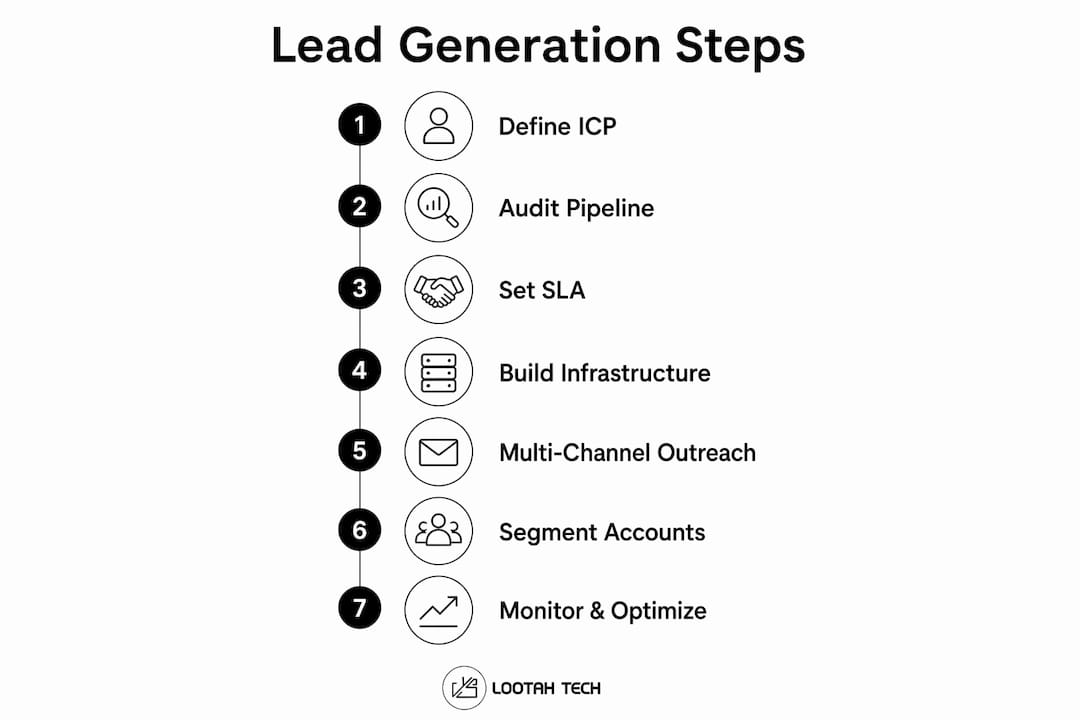
Before running a single outreach sequence, you need three things in place: a defined ICP, a clean pipeline audit, and the right tooling. Skip any one of these and your execution will produce noise, not pipeline.
Defining your ICP goes deeper than job titles. The buying committee for most B2B tech products includes three to six people across IT, finance, and operations. Job titles alone are unreliable for identifying who actually feels the pain your product solves. Map the specific team-level problems first, then work backward to the roles that own those problems.
Auditing your existing pipeline reveals where leads stall. Most tech companies discover that 60–80% of their pipeline sits in one or two stages with no movement. That stagnation points to a handoff problem, a messaging problem, or a routing problem. Fix the bottleneck before adding more volume.
Tooling requirements for a functional lead generation system include:
- A marketing automation platform such as HubSpot or Marketo for sequence management and lead scoring
- A CRM with defined pipeline stages and SLA rules for lead handoffs between marketing and sales
- A content inventory covering at least one case study, one whitepaper, and one demo or free trial offer
- Intent data tools to identify accounts showing active buying signals
- A B2B digital strategy framework that maps each tactic to a specific demand state
Pro Tip: Set a written SLA between marketing and sales before launching any campaign. Define what a "qualified lead" means, how fast sales must follow up, and what feedback they owe marketing on lead quality. Without this agreement, even great campaigns produce zero revenue.
Building a reliable pipeline engine takes 6–8 weeks for auditing, setup, and multi-channel infrastructure. That timeline is not a delay. It is the minimum investment to avoid wasting budget on a broken system.
How do you build a coordinated multi-channel outreach sequence?
A multi-channel outreach sequence is not a spray of messages across every platform. It is a structured series of touches designed to move a specific account from awareness to conversation.
The most effective sequences follow a clear structure:
- Day 1: Send a personalized cold email referencing a specific pain point relevant to the prospect's industry and role. Include one proof point, such as a case study result or a relevant stat.
- Day 3: Connect on LinkedIn with a short note that references the email without repeating it. The goal is recognition, not a pitch.
- Day 5: Send a LinkedIn message with a short, useful insight. A one-paragraph observation about a trend in their space works well.
- Day 8: Follow up by email with a different angle. If the first email focused on cost, this one focuses on risk or speed.
- Days 10–14: Alternate between LinkedIn engagement (commenting on their posts, sharing relevant content) and one final email offering a direct call or a specific resource.
- Day 21: Send a breakup email. Keep it short. Ask if the timing is wrong, not if they are interested.
A strong outbound sequence includes 8–12 touches over 14–21 days, with email carrying the offer and proof, and LinkedIn carrying recognition and light context. That division of labor matters. Email is where you make the ask. LinkedIn is where you build familiarity.
Segment your accounts by demand state, not by lead score. An account actively researching your category needs a different message than one that has never heard of you. Treating demand generation as a unified operating system based on demand states produces more accurate routing and better conversion rates than traditional lead scoring models.

Pro Tip: Seed your Account-Based Marketing (ABM) efforts with intent data before writing a single message. If you know an account has been searching for "data migration tools" or "cloud security compliance," your first email can reference that context directly. That specificity lifts reply rates far above generic outreach.
What are the most effective B2B lead generation strategies for tech companies?
The fastest channels for early-stage tech companies are LinkedIn educational content and multi-channel cold outbound. Seed-stage companies should prioritize these two channels first to build pipeline momentum within 14–30 days. Only after proving ROI on these should you layer in slower, compounding channels.
Here is how the channel stack builds over time:
- Weeks 1–4 (fast channels): LinkedIn posts that teach, not sell. Cold outbound sequences targeting 50–100 accounts per week. These produce meetings within days when executed well.
- Months 2–3 (medium channels): CEO or founder newsletter to a curated list. Educational email courses for prospects who are not yet ready to buy. These build trust and keep you top of mind.
- Months 4–6 (slow channels): SEO content targeting high-intent search queries. PR placements in trade publications. These compound over time but produce no pipeline in the first 90 days.
- Ongoing: Partnerships and integrations as lead engines. A well-placed integration with a platform your buyers already use can generate qualified inbound leads at near-zero cost per lead.
Cost per lead varies significantly by channel. Newsletter sponsorships cost $30–$120 per lead, cold outbound runs $80–$250, and Google Ads reach $150–$400 per lead in B2B tech. Those numbers shift the budget conversation from "which channel is best" to "which channel fits our current stage and margin."
For developer-focused tech products, community channels such as Hacker News, Discord servers, and Product Hunt require a different approach entirely. Community-first growth demands a strict give-before-you-get discipline: answer ten questions for every one product mention. Violate that ratio and the community will ignore or actively reject your presence.
For teams building out their automation tools stack, integrating marketing automation with CRM and intent data platforms is what separates companies that generate consistent pipeline from those that rely on luck. Microsoft 365 environments, for example, offer productivity integrations that connect communication, calendar, and CRM data into a single workflow, reducing manual handoffs between marketing and sales.
How do you measure and fix a broken lead generation process?
Measuring lead generation correctly means tracking quality alongside volume. Volume metrics tell you how much activity you produced. Quality metrics tell you whether that activity will become revenue.
The four metrics that matter most are:
- Net-new contacts added per week to your target account list
- Qualification rate: the percentage of leads that meet your ICP criteria after the first sales conversation
- Conversion to meeting: the percentage of outreach sequences that produce a booked call
- Pipeline contribution: the dollar value of opportunities sourced by marketing versus inbound versus outbound
Build a lead quality feedback loop with your sales team. A simple A–D rating system works well. Sales rates each lead after the first call: A means strong ICP fit and active pain, D means wrong company or no budget. Marketing reviews those ratings weekly and adjusts targeting, messaging, or channel mix accordingly.
Pipeline shortfalls are rarely a channel problem. They almost always trace back to outdated playbooks that no longer reflect how modern B2B tech buyers actually research and buy. The fix is not more volume. It is better alignment between your system and your buyer's actual journey.
The most common mistakes tech companies make in lead generation are spreading resources across too many channels before proving ROI on any single one, relying on job title filters instead of intent signals, and failing to update their ICP as the market shifts. Each mistake is fixable with a structured audit cycle every 90 days.
Pro Tip: Run a routing audit every quarter. Check whether leads are reaching the right sales rep within the SLA window, whether follow-up sequences are triggering correctly, and whether your demand state segments still reflect actual buyer behavior. A broken routing rule can silently kill a campaign that would otherwise perform.
Key Takeaways
A coordinated, multi-channel lead generation system built on accurate ICP definition, demand state segmentation, and continuous quality feedback produces far more pipeline than any single tactic or channel alone.
| Point | Details |
|---|---|
| Define ICP beyond job titles | Map team-level pain points first, then identify the roles that own those problems. |
| Allow 6–8 weeks for setup | Auditing, tooling, and infrastructure configuration take time before outreach begins. |
| Stack three or more tactics | Coordinating three or more channels produces 200% more pipeline than single-channel approaches. |
| Prioritize fast channels first | LinkedIn content and cold outbound generate meetings within 14–30 days for early-stage companies. |
| Measure quality, not just volume | Use an A–D lead rating system with sales to refine targeting and messaging every week. |
What I've learned about lead generation that most playbooks get wrong
The biggest mistake I see tech companies make is treating lead generation as a channel problem when it is almost always a systems problem. Teams add a new channel, run it for six weeks, declare it dead, and move on. The channel was never the issue. The ICP was too broad, the messaging was generic, or the sales handoff was broken.
The shift that actually moves the needle is treating your entire demand generation effort as one operating system, not a collection of experiments. That means every channel has a defined role, every account has a demand state, and every piece of feedback from sales feeds back into targeting and messaging. When that loop runs cleanly, pipeline becomes predictable.
I also think the industry underestimates how much buyer behavior has changed. Cold email open rates have collapsed, and LinkedIn InMails convert under 1%. The companies winning pipeline today are not sending more messages. They are sending fewer, better messages to accounts they know are actively looking. Intent data is not optional anymore. It is the difference between interrupting someone and arriving at the right moment.
The last thing I would say is this: resist the urge to scale before you have proven the system works at a small scale. Fifty well-researched accounts outperform five hundred generic ones every time. Build the machine right first. Then scale it.
— YS
How Yslootahtech helps tech companies build lead generation infrastructure
Tech companies often have the strategy right but lack the technical infrastructure to execute it. A poorly built landing page kills conversion before a single lead enters the funnel. A slow or confusing product demo page loses buyers who were ready to talk.
Yslootahtech builds the digital infrastructure that makes lead generation work: high-converting websites designed to capture and qualify inbound leads, UX/UI design that reduces friction at every step of the buyer journey, and AI and machine learning services that power smarter lead scoring, intent detection, and personalization at scale. If your current digital presence is not converting the traffic and outreach you are already generating, that is the first problem worth solving.
FAQ
What is the lead generation process for tech companies?
The lead generation process for tech companies is a repeatable system that moves accounts from initial awareness to qualified sales conversations using coordinated outreach, targeted content, and structured follow-up across multiple channels.
How long does it take to build a B2B lead generation system?
Building a reliable B2B lead generation system takes 6–8 weeks to complete the pipeline audit, configure marketing automation, and launch multi-channel outreach infrastructure.
How many tactics should a tech company use for lead generation?
Tech companies should coordinate at least three tactics simultaneously. Using three or more coordinated tactics produces 200% more pipeline than relying on a single channel.
What are the fastest lead generation channels for startups?
LinkedIn educational content and multi-channel cold outbound are the fastest channels for early-stage companies, capable of generating pipeline within 14–30 days when executed with a defined ICP and personalized messaging.
Why is my lead generation pipeline not growing despite high activity?
Pipeline stagnation usually traces back to outdated playbooks, overly broad ICP definitions, or broken sales handoff processes rather than insufficient outreach volume. A 90-day audit of targeting, routing, and messaging typically identifies the root cause.