End-to-End Solutions Explained for Business Leaders

TL;DR:
- An end-to-end solution manages an entire process within a single system, eliminating manual handoffs and fragmented tools. Such solutions improve productivity by three to four times and deliver better collaboration, customer experience, and long-term competitiveness. Implementing E2E systems requires careful process redesign, leadership alignment, and phased deployment to ensure success.
An end-to-end solution is defined as a fully integrated system that manages every step of a process, from initial trigger to final delivery, under a single unified management structure. Unlike patched-together software stacks, a true end-to-end system eliminates fragmented third-party integrations and manual handoffs between departments. BCG research shows that organizations prioritizing end-to-end reinvention achieve 3 to 4 times greater productivity and cost efficiency impact than those making incremental improvements. That gap is not a rounding error. It is the difference between a business that reacts and one that runs. For business leaders and IT decision-makers, understanding what is end-to-end solution means understanding how to build operations that do not break at the seams.
What is an end-to-end solution and how does it work?
An end-to-end solution, often called an E2E solution, manages an entire process from the moment a business event occurs to the moment the final outcome is delivered. The system handles every step in between without requiring human intervention to pass data from one tool to another. Think of it as a single track that a train runs on from departure to arrival, rather than a series of separate rail segments managed by different operators.
In practice, E2E systems replace the fragmented approach where one tool handles customer intake, another manages inventory, a third processes payments, and a fourth generates reports. Each handoff between those tools creates a gap where data gets lost, delayed, or corrupted. An E2E architecture closes those gaps by keeping all data and logic inside one connected workflow.
Typical processes managed end-to-end include:
- Order processing: From the moment a customer places an order through payment, fulfillment, shipping, and post-sale support
- Supply chain management: Covering procurement, manufacturing, logistics, and delivery as one continuous flow
- IT service management: From a user submitting a ticket through diagnosis, resolution, and closure with no manual routing
- Customer onboarding: From the first form submission through identity verification, account setup, and first-use confirmation
Technology accelerates these workflows, but it is not the fix by itself. Re-engineering entire workflows rather than automating isolated tasks is what produces real gains. A business that automates a broken process just breaks faster.
Pro Tip: Do not confuse "integrated" software with a true E2E solution. A set of tools connected by APIs still requires manual oversight when those connections fail. A genuine E2E system has no external middleware holding it together.
What are the benefits of end-to-end solutions?
The case for adopting a full-process approach is grounded in measurable outcomes, not theory. Here are the five most significant benefits business leaders and IT decision-makers see in practice:
-
Higher productivity and lower costs. Organizations that commit to end-to-end reinvention rather than point-by-point fixes achieve 3 to 4 times the impact on productivity and cost efficiency. That multiplier comes from eliminating redundant steps across the entire process, not just within one department.
-
Elimination of analog costs. E2E solutions replace analog costs such as manual emails, phone follow-ups, and data reconciliation with automated data flow between departments. These hidden costs are rarely tracked in budgets, which makes them easy to underestimate and hard to justify eliminating without a full-process view.
-
Better cross-department collaboration. When all teams operate from the same data in real time, coordination improves without additional meetings or status reports. End-to-end value stream analysis identifies bottlenecks and enables cross-functional collaboration that isolated step optimizations simply cannot achieve.
-
Stronger customer experience. A customer interacting with a business that runs on an E2E system gets faster responses, accurate information, and consistent service across every touchpoint. Gaps between systems are invisible to the business but very visible to the customer.
-
Long-term competitive advantage. Businesses that build E2E capability create a structural advantage that is difficult for competitors to replicate quickly. The enterprise applications efficiency gains from full-process integration compound over time as the system learns and adapts.
"Adopting an E2E reinvention strategy is a transformation of workflows, not just a software upgrade, typically achieving substantially higher impact than incremental improvements." — BCG
How do end-to-end solutions differ from fragmented systems?
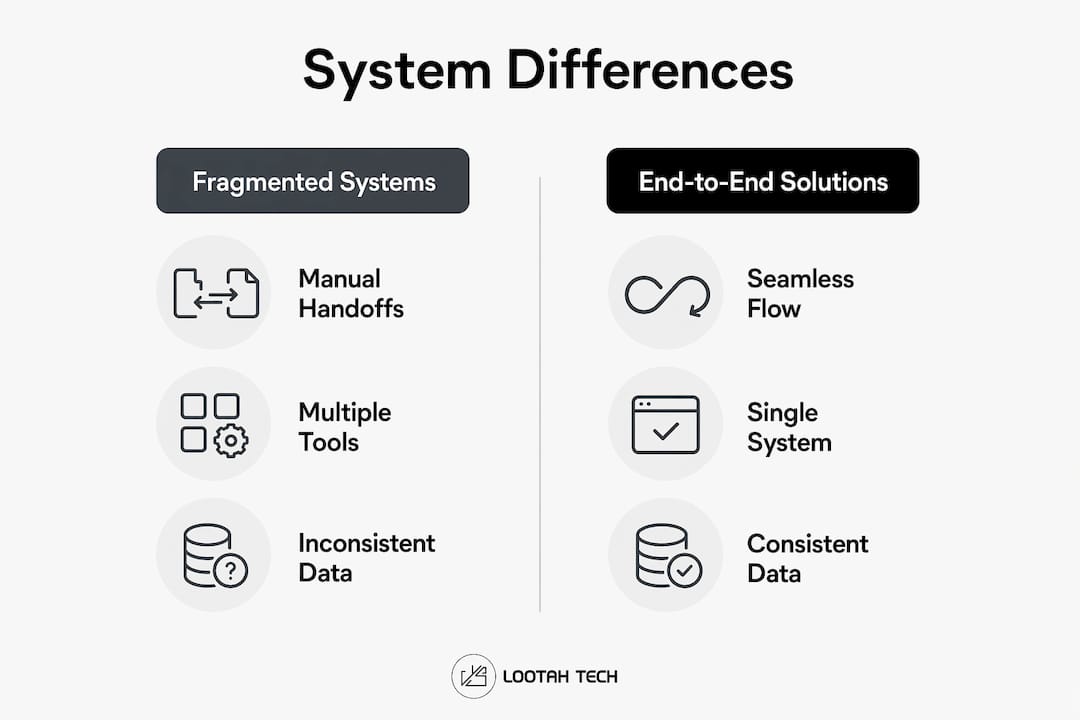
The distinction between a true E2E solution and a collection of integrated tools is one of the most misunderstood points in enterprise technology. Many organizations believe they have an E2E system because their tools share data through APIs. They do not.

True E2E solutions require vertical integration and seamless flow without manual handoffs or external middleware. That means the logic, data, and workflow all live within one architecture. When a step fails, the system handles it internally. There is no human in the middle re-entering data or forwarding an email to trigger the next step.
The table below shows the key differences between fragmented systems and true E2E solutions:
| Characteristic | Fragmented systems | End-to-end solutions |
|---|---|---|
| Data flow | Manual transfers between tools | Automated, real-time across all steps |
| Handoffs | Human-managed between departments | System-managed with no manual steps |
| Middleware dependency | High (APIs, connectors, custom scripts) | None or minimal |
| Failure points | Multiple, often invisible | Centralized and traceable |
| Visibility | Partial, per-tool dashboards | Full-process view in one place |
| Cost of errors | High (rework, delays, data loss) | Low (caught and corrected automatically) |
A common misconception is that adding more integrations makes a system more end-to-end. The opposite is often true. More integrations mean more failure points, more maintenance, and more places where data can diverge. Simplifying the architecture is the goal, not expanding it.
What are real-world examples of end-to-end solutions?
Seeing how E2E solutions operate across industries makes the concept concrete. The pattern is consistent: one system owns the entire process, and no step requires a human to manually move data forward.
-
Supply chain management: End-to-end supply chains integrate procurement, manufacturing, delivery, and after-sales into a single visibility layer. A retailer using this model can see a supplier delay in real time and automatically reroute orders before a customer notices a problem.
-
E-commerce operations: An end-to-end business solution covers customer interaction, order processing, inventory, shipping, and after-sales service as one connected ecosystem. The customer places an order and every downstream action happens without a single manual trigger.
-
Financial services: A fintech platform built on E2E principles handles loan applications from submission through credit scoring, approval, disbursement, and repayment tracking in one system. No department waits for another to send a file.
-
IT service management: An enterprise IT team using an E2E platform routes every support ticket from submission through triage, assignment, resolution, and user confirmation automatically. Response times drop and nothing falls through the cracks.
-
Digital health: A patient management platform that connects appointment booking, clinical records, billing, and follow-up care gives providers a complete picture without switching between systems. For a look at how enterprise apps transform operations in practice, the pattern holds across every sector.
The common thread is that the system owns the outcome, not just a step within it.
How to implement an end-to-end solution in your organization
Adopting an E2E approach requires more than selecting a platform. Effective adoption depends on cultural readiness, budget alignment, and strategic long-term goals. Organizations that skip this groundwork typically end up with an expensive tool that nobody uses correctly.
A practical implementation path looks like this:
-
Assess your current process map. Document every step in the process you want to transform. Identify where data is manually transferred, where delays occur, and where errors are most common. This baseline is your starting point.
-
Define the full scope before selecting technology. Decide what "start" and "finish" mean for your process. A solution that covers 80% of the workflow still leaves 20% fragmented, which is where most failures happen.
-
Align leadership and budget early. E2E transformation is an organizational decision, not an IT project. Finance, operations, and leadership must agree on the scope and timeline before any technology is selected.
-
Plan for phased deployment. Start with one process, prove the model, then expand. Trying to transform every workflow at once creates change fatigue and increases the risk of failure.
-
Train for the new workflow, not just the new tool. Staff need to understand why the process changed, not just how to use the software. Without that context, workarounds appear and the old fragmented behavior returns.
Pro Tip: Before signing any contract, ask the vendor to walk you through a failure scenario. How does the system handle a step that breaks? If the answer involves a manual workaround or a third-party connector, you are not looking at a true E2E solution.
Key Takeaways
End-to-end solutions deliver their greatest value when they replace entire fragmented workflows rather than adding another layer of integration on top of existing tools.
| Point | Details |
|---|---|
| Definition is specific | An E2E solution covers every step from initial trigger to final delivery under one system. |
| Productivity multiplier is real | BCG research shows E2E reinvention delivers 3 to 4 times the impact of incremental fixes. |
| Integration is not the same as E2E | True E2E systems have no manual handoffs or external middleware holding steps together. |
| Implementation needs culture first | Budget, leadership alignment, and cultural readiness matter as much as the technology chosen. |
| Industry applications are broad | Supply chain, fintech, IT service management, and digital health all benefit from full-process coverage. |
Why I think most organizations are solving the wrong problem
After working with organizations across multiple industries, the pattern I see most often is this: a business identifies a painful bottleneck, buys a tool to fix it, and then discovers three months later that the bottleneck has simply moved one step downstream. The tool solved the symptom. The process is still broken.
The uncomfortable truth about E2E solutions is that they require you to stop thinking about technology first. The question is not "which platform should we buy?" The question is "what does this process need to look like from start to finish, and what would have to be true for no human to need to intervene?" That second question is much harder to answer, and most organizations never ask it.
I have also seen businesses mistake vendor consolidation for E2E transformation. Reducing from eight tools to three is not the same as building a process that runs without gaps. The number of tools is not the metric. The number of manual handoffs is.
The organizations that get this right treat technology as the last decision, not the first. They map the ideal workflow, identify the gaps, and then find a system that fits the workflow. That sequence matters more than any feature list. For teams looking to automate business workflows effectively, the process design has to come before the platform selection.
— YS
How Yslootahtech builds end-to-end digital solutions
Yslootahtech works with business leaders and IT decision-makers who need more than a collection of tools. The team designs and builds custom applications that cover entire business processes, from the first customer interaction through every operational step to final delivery. Each solution is built around the specific workflow of the client, not adapted from a generic template.
Yslootahtech brings expertise in AI, cloud computing, cybersecurity, and enterprise application development to every project. The result is a system that your teams actually use because it fits how your business operates. If your current tech stack has gaps, manual steps, or data that does not flow between departments, that is the starting point for a conversation with Yslootahtech.
FAQ
What is an end-to-end solution in simple terms?
An end-to-end solution is a single system that manages every step of a business process from start to finish, with no manual handoffs or external tools required between steps.
How do end-to-end solutions differ from integrated software?
Integrated software connects separate tools through APIs, while a true E2E solution runs the entire workflow within one architecture, eliminating the failure points that integrations create.
What are the main benefits of end-to-end solutions?
The primary benefits include higher productivity, lower operational costs, better cross-department data flow, and stronger customer experience. BCG research shows E2E reinvention delivers 3 to 4 times the impact of incremental improvements.
What industries use end-to-end solutions most effectively?
Supply chain management, financial services, IT service management, e-commerce, and digital health are the sectors where E2E solutions produce the clearest and most measurable results.
How long does it take to implement an end-to-end solution?
Implementation timelines vary by organizational complexity and process scope. A phased approach, starting with one core process, typically produces faster results and lower risk than a full-organization rollout.