Digital Health Platform Guide for Healthcare Leaders

TL;DR:
- A digital health platform integrates clinical workflows, patient data, and care tools into a unified, interoperable ecosystem. Successful implementation requires stakeholder engagement, continuous monitoring, and designing for privacy and equity while focusing on clinical needs. Evaluating platforms with a structured framework ensures effective adoption and scalable, compliant technology solutions.
A digital health platform is a technology ecosystem that integrates clinical workflows, patient data, and care delivery tools into a single, coordinated infrastructure. Systems like Epic and Cerner represent the foundational layer of this ecosystem, connecting electronic health records (EHRs) to scheduling, billing, and clinical decision support. The American Medical Association (AMA) has formalized evaluation standards for AI tools embedded in these platforms, signaling that the field has matured beyond experimentation. For healthcare professionals and decision-makers, this digital health platform guide covers what to build, how to choose, and how to deploy with confidence in 2026.
What core components make up a digital health platform?
A modern digital health platform is not a single application. It is a modular stack of interconnected technologies designed to serve clinicians, administrators, and patients simultaneously.

The foundation is interoperability. Standards like FHIR and HL7 enable data to flow between systems without manual translation. That matters because a cardiologist using Epic needs to pull lab results from a separate hospital system running Cerner without friction. Semantic web architectures built on these standards support scalable, interoperable ecosystems rather than siloed applications.
Key building blocks to evaluate
- EHR integration layer: Connects clinical records to downstream tools via FHIR APIs
- AI and machine learning modules: Support clinical decision-making, not replace it, per AMA guidance
- Cloud infrastructure: Azure Functions and AWS Lambda power agile, modular deployments that scale with patient volume
- Patient engagement tools: Portals, mobile apps, and remote monitoring dashboards
- Security and compliance layer: Role-based access control, audit logging, and HIPAA-aligned data handling
Pro Tip: Build your platform on a microservices architecture from day one. Replacing a single module, such as your scheduling engine, is far cheaper than rebuilding a monolithic system when your needs change.
| Component | Function | Example Technologies |
|---|---|---|
| Interoperability layer | Connects disparate systems | FHIR, HL7, REST APIs |
| Clinical AI modules | Decision support and risk scoring | AMA-evaluated AI frameworks |
| Cloud infrastructure | Scalable hosting and compute | AWS Lambda, Azure Functions |
| Patient engagement | Communication and self-service | Mobile apps, patient portals |
| Security and compliance | Data protection and audit trails | HIPAA controls, role-based access |
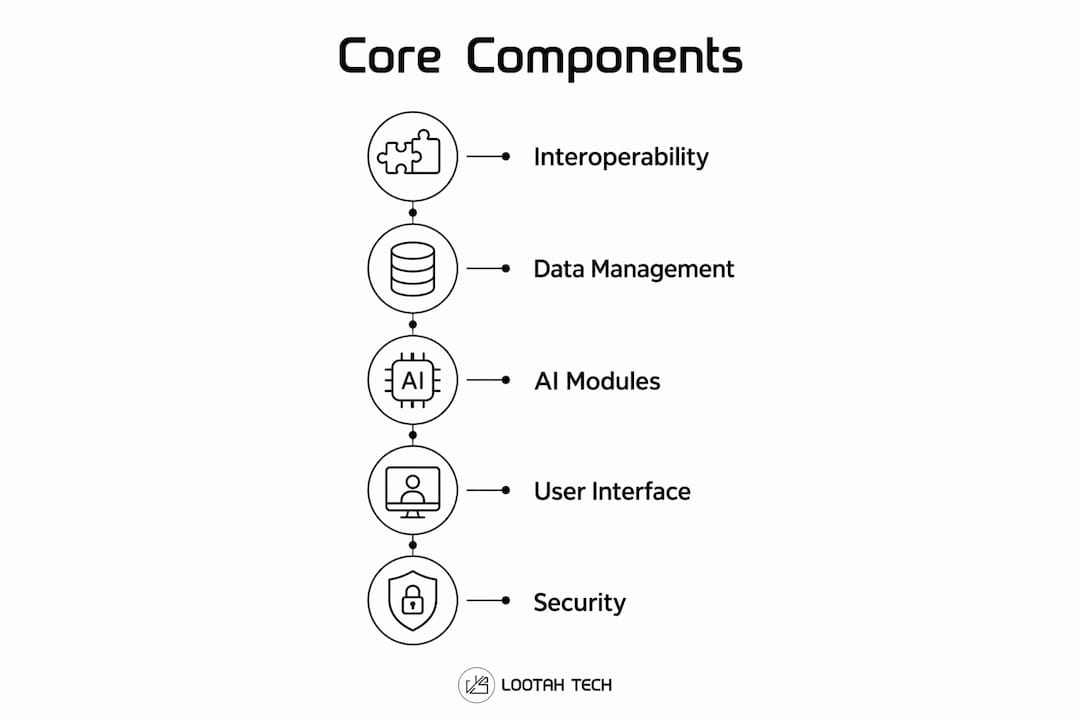
The role of AI in healthcare transformation is expanding fast. However, AI tools embedded in platforms must be evaluated against clinical use cases, not just technical benchmarks. The AMA's framework makes this distinction explicit.
How to evaluate and select the right digital health platform
Selecting a platform without a structured framework produces expensive mismatches between technology and clinical reality. The AMA's 2026 AI Evaluation Guide provides five domains that apply directly to platform selection, not just AI tools.
The five-domain evaluation framework
- Clinical use case: Does the platform address a specific, validated clinical problem? Generic platforms that claim to do everything often do nothing well.
- Training data relevance: For AI components, was the model trained on data that reflects your patient population? A tool trained on data from one demographic may underperform in a different clinical setting.
- Risks and mitigation: What failure modes exist, and how does the vendor address them? Ask for documented incident response procedures.
- Effectiveness and performance: What outcome data does the vendor provide? Peer-reviewed evidence carries more weight than internal case studies.
- Workflow integration: Does the platform fit into existing clinical workflows, or does it require clinicians to change how they work? Poor workflow integration is the leading cause of low adoption rates.
Beyond the AMA framework, apply these additional filters during vendor comparison:
| Evaluation Criterion | Questions to Ask Vendors |
|---|---|
| Scalability | Can the platform handle a 3x increase in patient volume without re-architecture? |
| HIPAA compliance | Is compliance built into the product or dependent on your configuration? |
| Interoperability | Does it support FHIR R4 natively, or only through third-party connectors? |
| Support model | Is 24/7 clinical support included, or is it a paid add-on? |
| Total cost of ownership | What are the implementation, training, and ongoing licensing costs? |
Healthcare leaders often underestimate the cost of switching platforms mid-deployment. Lock-in risk is real. Prioritize vendors who publish open API documentation and support data portability from day one.
What are best practices for implementing digital health platforms?
Implementation is where most digital health initiatives fail. The technology is rarely the problem. Stakeholder alignment, data migration, and change management determine whether a platform delivers value or collects dust.
Stakeholder engagement and training
Clinicians must be involved before procurement, not after. Physicians who help select a platform are significantly more likely to adopt it. Identify clinical champions in each department, such as a lead hospitalist or a chief nursing officer, who can translate technical capabilities into workflow benefits for their peers.
Training cannot be a one-time event. Build a continuous learning program that includes refresher modules, peer coaching, and a dedicated support channel for the first 90 days post-launch.
Data migration and interoperability challenges
Moving patient data from legacy systems to a new platform is technically complex and clinically risky. Incomplete or corrupted migration can affect care decisions. Work with your vendor to define a data validation protocol before go-live. Test with a representative sample of records across all patient demographics and care settings.
IoT-connected devices like wearables and remote monitoring sensors add another layer of data complexity. These devices generate continuous streams of unstructured data that must map cleanly to your platform's data model.
Pro Tip: Run a parallel operation period of at least 30 days where both the old and new systems are active. This gives clinical staff a safety net and surfaces integration gaps before full cutover.
Monitoring and iterative improvement
Deployment is not the finish line. Establish a governance committee that reviews platform performance metrics monthly. Track adoption rates by department, error rates in clinical decision support, and patient satisfaction scores. Use this data to prioritize iterative updates rather than waiting for annual release cycles.
The CMS Health Technology Ecosystem framework reinforces this point. CMS promotes collaboration and shared infrastructure across stakeholders, not one-time compliance checkboxes. Treat your platform as a living system that evolves with clinical needs.
How can organizations address data privacy and ethics in digital health?
Privacy and ethics are not compliance tasks. They are design requirements. Ethical and regulatory compliance must be integrated from the earliest design stage through every deployment decision.
HIPAA sets the legal floor, but it does not address equity. A platform that collects and analyzes data from a predominantly white, urban patient population may produce biased clinical recommendations when deployed in a rural or minority-serving hospital. Addressing equity and technical constraints is not optional for effective adoption. It is a prerequisite for patient safety.
"Ethics, equity, and privacy remain persistent barriers despite technological advances and must be proactively addressed at every stage of digital health platform development." — Frontiers in Public Health, 2025
Practical privacy safeguards include privacy-by-design architecture, audit logging for every data access event, and role-based access controls that limit data visibility to clinical need. For organizations operating across borders, the FDA and CMS both publish guidance on software as a medical device (SaMD) that applies to AI-powered platform components.
Building patient trust requires transparency. Publish a plain-language data use policy. Give patients meaningful control over how their data is shared. Organizations that treat data privacy as a patient right rather than a legal obligation consistently report higher engagement rates in digital health programs.
The API architecture connecting your platform to third-party tools also carries privacy risk. Every API endpoint is a potential exposure point. Require vendors to provide security audit reports for all integration layers, not just the core platform.
Key takeaways
Selecting and deploying a digital health platform requires a structured approach to evaluation, integration, and ongoing governance to deliver measurable clinical and operational results.
| Point | Details |
|---|---|
| Use a structured evaluation framework | Apply the AMA's five domains to assess every platform component, including AI tools. |
| Prioritize interoperability from day one | Build on FHIR and HL7 standards to prevent costly data silos as your platform scales. |
| Involve clinicians before procurement | Clinical champions drive adoption and surface workflow gaps that technical teams miss. |
| Treat compliance as a design requirement | Integrate HIPAA controls, audit logging, and equity considerations into the platform architecture. |
| Plan for continuous improvement | Establish a governance committee to review performance metrics and drive iterative updates post-launch. |
What I've learned building digital health platforms that actually get used
After working on digital health projects across multiple markets, the pattern I see most often is this: organizations invest heavily in selecting the right technology and then underinvest in everything that determines whether clinicians actually use it.
The AMA's AI evaluation framework is genuinely useful, but most teams treat it as a procurement checklist rather than an ongoing governance tool. AI supplements clinical decision-making and requires continuous performance monitoring. That means your evaluation work does not end at go-live. It starts there.
The shift toward interoperable ecosystems is real, but it is slower than the vendor community suggests. I have seen organizations spend 18 months on an integration project that a vendor promised would take 90 days. The gap is almost always in legacy data quality, not in the new platform's capabilities. Honest scoping of your existing data infrastructure before you sign a contract saves more time than any implementation accelerator.
The most underrated factor in platform success is the digital strategy that sits above the technology. A platform without a clear clinical strategy is just expensive infrastructure. Define the patient outcomes you want to improve before you evaluate a single vendor. That clarity will make every subsequent decision faster and cheaper.
— YS
Build your digital health platform with Yslootahtech
Yslootahtech brings end-to-end expertise to digital health platform development, from custom application development built on FHIR-ready architectures to UX/UI design that drives clinician adoption from day one. The team has delivered digital health products across healthcare and enterprise markets, combining AI integration, cloud infrastructure, and compliance-ready security into cohesive platforms. If you are evaluating vendors or planning your next deployment, Yslootahtech offers strategic consultation to align technology decisions with your clinical and operational goals. Explore our website development services to see how we build platforms that perform at scale.
FAQ
What is a digital health platform?
A digital health platform is an integrated technology ecosystem that connects EHR systems, AI tools, patient engagement applications, and clinical workflows into a unified infrastructure. Platforms like Epic and Cerner represent the foundational layer, with modular components added to address specific clinical use cases.
How do I choose the right digital health platform for my organization?
Apply the AMA's five-domain evaluation framework covering clinical use case, training data relevance, risk mitigation, performance evidence, and workflow integration. Pair this with a vendor comparison focused on HIPAA compliance, FHIR support, scalability, and total cost of ownership.
What is FHIR and why does it matter for health platforms?
FHIR (Fast Healthcare Interoperability Resources) is a data standard that allows different health systems to exchange patient information without manual translation. Platforms built on FHIR avoid data silos and support scalable, interoperable ecosystems across care settings.
How does AI fit into a digital health platform?
AI modules in digital health platforms support clinical decision-making by surfacing risk scores, flagging anomalies, and automating administrative tasks. Per AMA guidance, AI supplements physician judgment and requires ongoing performance monitoring to remain safe and effective.
What are the biggest risks in digital health platform implementation?
The three most common risks are poor stakeholder alignment before launch, incomplete data migration from legacy systems, and insufficient attention to equity and privacy in platform design. Addressing all three before go-live significantly improves adoption rates and patient safety outcomes.