Building Scalable Fintech Solutions for Startups

TL;DR:
- Building scalable fintech solutions requires early architectural decisions that align with regulatory domains and use API-first modular designs. Implementing the Saga pattern for distributed transactions and streaming events through Apache Kafka ensures system reliability, compliance, and high throughput, supporting growth without reimplementation. Starting with a modular monolith and embedding AI automation enables startups to scale efficiently while maintaining regulatory adherence and operational resilience.
Building scalable fintech solutions is defined as designing financial technology platforms that grow in capacity, compliance, and reliability without requiring a full rebuild at each stage of growth. For startups and SMEs in finance, this is not a luxury. Platforms built on API-first modular architectures already process over 500 million transactions and move $90 billion across international markets. That scale is achievable, but only when the right architectural decisions are made early. This article covers the architecture, tools, execution steps, and pitfalls that determine whether your fintech platform grows or breaks under pressure.
What are the architectural best practices for building scalable fintech solutions?
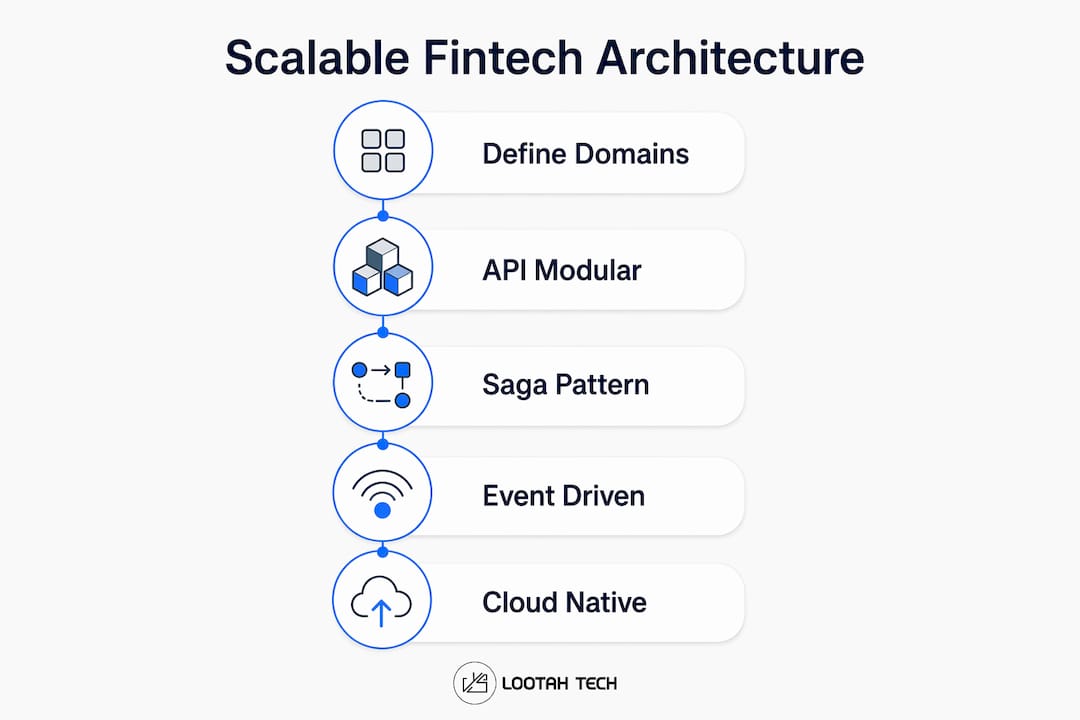
Fintech solution architecture starts with one principle: every service boundary must map to a regulatory or business domain. Payment processing, identity verification, and ledger management each carry distinct compliance obligations. Mixing them into a single service creates a compliance risk and a scaling bottleneck at the same time.

API-first modular design
An API-first approach treats every capability as a contract exposed through a well-defined interface. This means third-party vendors, internal services, and future product lines all connect through APIs rather than direct code dependencies. Designing for swappability via APIs isolates vendor relationships and makes platform changes far less costly. When a payment processor changes its pricing or a compliance vendor updates its API, you replace one module, not the entire system.
Managing distributed transactions with the Saga pattern
Two-phase commit is the default choice for many developers handling distributed transactions. It is the wrong choice for fintech at scale. The Saga pattern decomposes a distributed financial transaction into a sequence of local transactions, each with a compensating step that reverses the action if a later step fails. This eliminates cross-service locks that degrade performance under high throughput. A payment that fails at the settlement step triggers a compensating transaction that reverses the authorization, without locking the entire system.
Event-driven communication and data integrity
Apache Kafka is the standard backbone for financial event streaming because it provides durability, exactly-once semantics, and strict ordering guarantees. These properties matter for auditability and disaster recovery. Schema versioning and idempotency keys on every event prevent duplicate processing when services retry after a failure.
Data storage strategy follows the same logic. Write-ahead logs and immutable audit records give you a complete, tamper-proof history of every financial event. Regulators expect this. Your operations team will rely on it during incident response.
- Use domain-driven service boundaries aligned to regulatory domains
- Apply the Saga pattern instead of two-phase commit for distributed transactions
- Stream events through Apache Kafka with schema versioning and idempotency
- Store immutable audit logs for every financial event
- Implement circuit breakers, bulkheads, and idempotent retry logic from day one
Pro Tip: Design your service boundaries before writing a single line of code. Changing them later costs ten times more than getting them right at the start.
Which tools and platforms best support scalable fintech development?
Cloud-native, composable platforms give fintech startups the fastest path to scale. Modern fintech platforms like Mambu provide AI-ready, API-centric cores that support over 500 million daily API calls across 65+ countries. That kind of infrastructure would take years to build from scratch. The smarter move is to build your differentiated logic on top of proven, modular infrastructure.
Modular monolith vs. microservices at the startup stage
The microservices debate is real, but the answer for most startups is clear. Starting with a modular monolith enforces domain boundaries and simplifies observability before the operational complexity of microservices becomes necessary. A modular monolith supports ACID transactions natively and reduces the infrastructure overhead that kills small engineering teams. You transition to microservices when a specific domain needs independent scaling, not before.
| Approach | Best for | Key advantage | Main trade-off |
|---|---|---|---|
| Modular monolith | Early-stage startups | Simpler ops, ACID transactions | Harder to scale individual domains |
| Microservices | Growth-stage platforms | Independent scaling per domain | High operational complexity |
| Composable SaaS | Rapid product launches | Pre-built compliance and APIs | Less control over core logic |
AI-powered automation in fintech infrastructure
Embedding AI capabilities from the ground up improves automation of treasury, reconciliation, and fraud detection at scale. AI reduces manual intervention in processes that would otherwise require large operations teams. For a startup, this means you can handle transaction volumes that would normally require hiring before you have the revenue to support it. Pair AI modules with sandbox environments and developer-friendly APIs so your team can test automation logic without touching production data.
The right technology stack for scaling enterprise applications in fintech combines a cloud-native core, event-driven messaging, and AI-powered automation layers. Each layer handles a distinct concern, which keeps the system testable and replaceable as your needs change.
How do you execute the development process for scalable fintech solutions?
A structured development process prevents the architectural mistakes that become expensive at scale. The steps below apply to startups and SMEs building their first fintech platform or rebuilding one that has hit its limits.
- Define scope by regulatory and business domain. Map every feature to a compliance obligation before writing architecture documents. PCI-DSS, AML, and KYC requirements each impose data handling rules that shape service boundaries.
- Build modular APIs with clear service contracts. Document every API before implementation. Treat the API contract as the source of truth, not the code.
- Implement event-driven communication. Set up Apache Kafka or an equivalent event streaming platform early. Define schema versioning standards before your first event goes into production.
- Build observability from the start. Fintech observability requires immutable audit logs and business event tracing that links user actions to financial outcomes. Standard latency and error rate metrics are not enough. You need a three-layer monitoring approach that covers infrastructure, application, and business event layers.
- Deploy resilience patterns before launch. Circuit breakers and bulkheads belong in your first production release, not in a post-incident remediation sprint.
- Test for scalability and compliance before go-live. Run load tests that simulate peak transaction volumes. Run compliance audits against your audit log structure before regulators ask for them.
Pro Tip: Treat your audit log as a product, not a side effect. Design it to answer the questions a regulator or fraud investigator would ask, not just the questions your developers think of today.
The fintech solution implementation workflow for most startups takes longer than expected at the design phase and shorter than expected at the build phase, when the architecture is sound. Front-load the design investment.
What common pitfalls occur when scaling fintech platforms?
Most fintech scaling failures trace back to decisions made in the first three months of development. The problems surface at month eighteen, when fixing them requires a partial rebuild.
- Tight service coupling creates a situation where changing one service breaks three others. This is the most common cause of expensive rework at scale. Improper service boundaries and tight coupling cause platform failures that require full architectural overhauls.
- Two-phase commit in high-throughput systems degrades availability under load. Every distributed lock is a potential bottleneck. Replace it with the Saga pattern before your transaction volume makes the problem visible.
- Reconciliation drift happens when event processing is not idempotent. A retry sends a duplicate event. The duplicate updates a ledger entry. The ledger no longer matches the source of truth. This is a compliance problem, not just a data problem.
- Missing idempotency on retries causes duplicate charges. Resilience patterns like circuit breakers and idempotent retry logic prevent cascading failures and duplicate financial transactions. Every retry must carry an idempotency key that the receiving service checks before processing.
- Compliance gaps in audit trails appear when developers treat logging as optional. Regulators treat it as mandatory. Build your audit trail to the standard you expect to be audited against.
"Scaling is not just feature growth. It hinges on sound early architecture. Many startups fail by neglecting domain boundaries and service isolation. The cost of fixing these mistakes grows exponentially with every transaction processed on a flawed foundation."
For a deeper look at how these pitfalls appear in real fintech deployments, the fintech solutions examples from 2026 show how architectural decisions play out across different business models. Reviewing them before you finalize your own architecture is time well spent.
Key takeaways
Sound early architecture is the single most important factor in building scalable fintech solutions. Teams that define domain boundaries, adopt the Saga pattern, and build observability from day one avoid the expensive rebuilds that stall growth-stage platforms.
| Point | Details |
|---|---|
| Define domain boundaries first | Map every service to a regulatory domain before writing any code. |
| Replace two-phase commit | Use the Saga pattern to handle distributed transactions without cross-service locks. |
| Stream events with idempotency | Apache Kafka with idempotency keys prevents duplicate processing and supports auditability. |
| Start with a modular monolith | Enforce domain boundaries early and transition to microservices only when a domain needs independent scaling. |
| Build observability as a product | Immutable audit logs and three-layer monitoring are compliance requirements, not optional features. |
Why I think most fintech startups get architecture backwards
After working across fintech projects at Yslootahtech, the pattern I see most often is this: teams spend the first month on features and the next year fixing the foundation those features broke. The instinct to ship fast is understandable. The cost of acting on it without a sound architecture is not.
Domain-driven design aligned with regulatory requirements is not an academic exercise. It is the difference between a platform that passes its first compliance audit and one that fails it at the worst possible moment. The role of AI in fintech adds another layer to this. AI modules that automate reconciliation and fraud detection only work reliably when the event data feeding them is clean, ordered, and idempotent. A flawed event architecture produces flawed AI outputs.
The teams that get this right share one habit: they treat architecture as a business decision, not a technical one. They ask what a regulator will need to see, what a customer will experience under load, and what an engineer will need to debug at 2 AM. Those questions produce better architecture than any framework comparison.
— YS
Yslootahtech's fintech development services
Yslootahtech works with startups and SMEs building fintech platforms that need to scale without compromising compliance or customer experience.

The team at Yslootahtech specializes in custom application development for fintech, covering API-first architecture design, modular platform builds, and UX/UI design that keeps end users at the center of every product decision. For teams that need automation at scale, Yslootahtech's AI and machine learning services integrate directly into fintech infrastructure to handle reconciliation, fraud detection, and treasury automation. If your platform is hitting its architectural limits or you are starting from scratch, Yslootahtech brings the technical depth and fintech domain knowledge to get it right the first time.
FAQ
What does building scalable fintech solutions mean?
Building scalable fintech solutions means designing financial platforms that handle growing transaction volumes, user loads, and regulatory demands without requiring a full rebuild. It relies on modular, API-first architecture and resilience patterns applied from the start.
Why is the Saga pattern better than two-phase commit in fintech?
The Saga pattern replaces cross-service locks with compensating transactions, which keeps systems available under high throughput. Two-phase commit degrades performance at scale because every distributed lock is a potential bottleneck.
When should a fintech startup move from a modular monolith to microservices?
A startup should transition to microservices when a specific domain requires independent scaling and the engineering team has the operational capacity to manage distributed infrastructure. Starting with a modular monolith reduces overhead and supports ACID transactions natively.
How does Apache Kafka support fintech compliance?
Apache Kafka provides durability, exactly-once semantics, and strict event ordering, which are the properties that make financial event streams auditable and recoverable. These guarantees support both regulatory compliance and disaster recovery requirements.
What causes reconciliation drift in fintech systems?
Reconciliation drift occurs when event processing lacks idempotency, allowing retries to create duplicate ledger entries. Assigning idempotency keys to every event and checking them before processing prevents duplicate updates and keeps ledgers accurate.