B2B digital strategy: Frameworks for growth in 2026

TL;DR:
- Most B2B marketers lack confidence in measuring digital results despite frequent AI tool use.
- Modern strategy emphasizes targeted signals, buyer intent, and human connection over volume.
- Effective B2B digital success relies on clear measurement, technology, and authentic creator-led outreach.
Most B2B marketing managers assume their digital strategy is working because their team is busy. Campaigns are running, content is publishing, and AI tools are firing on all cylinders. But 95% of B2B marketers use AI tools weekly while only 40% feel confident their efforts drive measurable results. That gap is not a technology problem. It is a strategy problem. This guide cuts through the noise to give you a clear definition of B2B digital strategy, the frameworks top-performing organizations are using right now, and the measurement practices that actually connect your digital activity to revenue.
Table of Contents
- Defining B2B digital strategy: Core principles and components
- Navigating today's B2B landscape: Key challenges and trends
- Modern B2B frameworks: Signal-based strategies, hybrid approaches, and creator-led growth
- Measuring impact and iterating: How to drive ROI in B2B digital strategy
- A fresh perspective: The overlooked power of signals and human connection
- Take your B2B digital strategy further with expert support
- Frequently asked questions
Key Takeaways
| Point | Details |
|---|---|
| Strategy foundation | B2B digital strategy integrates technology, data, and content to drive growth and outpace traditional methods. |
| Signal-based success | Leveraging identity and intent data enables more precise engagement with today’s complex buying teams. |
| Iterative measurement | Confident ROI requires ongoing tracking, feedback loops, and adaptation as technology evolves. |
| Brand and creator moat | Unique, creator-driven content and authentic brand presence offer sustainable competitive advantage. |
| Expert support | Partnering with specialists maximizes the effectiveness and adaptability of strategic digital initiatives. |
Defining B2B digital strategy: Core principles and components
A B2B (business-to-business) digital strategy is a structured plan that uses digital channels, data, and technology to attract, engage, and convert other businesses as customers. It is not just running paid ads or launching a new website. It is the deliberate orchestration of every digital touchpoint across a long and complex buying journey.
Traditional approaches treated digital as a broadcast medium. You pushed messages out and hoped the right buyer would respond. That model is essentially obsolete. In 2026, digital-first strategies outperform traditional broad-based approaches by enabling more precise engagement with the right accounts at the right moment. Broad nets catch a lot of noise. Targeted engagement catches revenue.
So what does a modern B2B digital strategy actually include? Here are the core components every marketing manager and executive should have on their radar:
- Identity resolution: Knowing exactly who is visiting your digital properties, even before they fill out a form
- Intent signals: Behavioral data that reveals which accounts are actively researching solutions like yours
- Hybrid channel mix: Combining inbound content with outbound activation, not treating them as separate programs
- Content orchestration: Sequencing the right content for the right stakeholder at each stage of their buying journey
- Closed-loop measurement: Connecting digital activity directly to pipeline and revenue, not just traffic and clicks
Understanding digital strategy fundamentals is the starting point, but the real edge comes from how you connect these components into a system that learns and improves over time.
"Digital-first strategies outperform traditional broad-based approaches, enabling more precise engagement rather than casting wide nets that capture mostly noise."
One of the most common misconceptions is that digital strategy is primarily a marketing department concern. In reality, it touches sales, product, customer success, and IT. Staying current with 2026 technology trends is essential because the tools shaping buyer behavior are evolving faster than most annual planning cycles can accommodate.
Navigating today's B2B landscape: Key challenges and trends
The B2B buying environment has fundamentally shifted, and the data is striking. Longer sales cycles are now the top challenge for 73% of B2B organizations, up 13% year over year. The average buying network involves 13 stakeholders. And 71% of B2B buyers complete significant portions of their decision-making with zero direct sales interaction.

That last figure deserves a moment. Nearly three quarters of your potential customers are forming opinions, shortlisting vendors, and sometimes making final decisions before your sales team ever speaks to them. These are what strategists call "dark buyers," and they are reshaping how digital strategy must be designed.
Here is a summary of the current B2B landscape:
| Challenge | Opportunity |
|---|---|
| Longer, more complex sales cycles | More touchpoints to build trust and authority |
| 13 stakeholders per buying group | Content tailored to each role drives influence |
| 71% dark buyers with no sales contact | Intent signals and digital content become critical |
| Low ROI confidence despite AI adoption | Structured measurement frameworks create an edge |
| Fragmented channel behavior | Unified data platforms reveal the full buyer journey |
The rise of AI in B2B marketing adds another layer of complexity. Tools are powerful, but without a clear measurement framework, you cannot tell what is actually working. AI and sales predictions from leading analysts confirm that AI adoption is accelerating, yet most teams still struggle to connect AI-driven activities to tangible pipeline outcomes.
Understanding 2026 B2B success factors helps you prioritize where to invest. For example, infrastructure decisions like cloud computing trends directly affect your ability to unify data across channels, which is foundational to any modern B2B strategy.
The organizations winning right now are not necessarily spending more. They are spending smarter, guided by real-time signals rather than quarterly assumptions.
Modern B2B frameworks: Signal-based strategies, hybrid approaches, and creator-led growth
Top-performing B2B organizations have moved away from volume-based outreach and toward signal-based systems. Signal-based strategies use identity resolution and intent scoring to identify which accounts are in-market right now, then activate coordinated outreach at exactly the right moment.
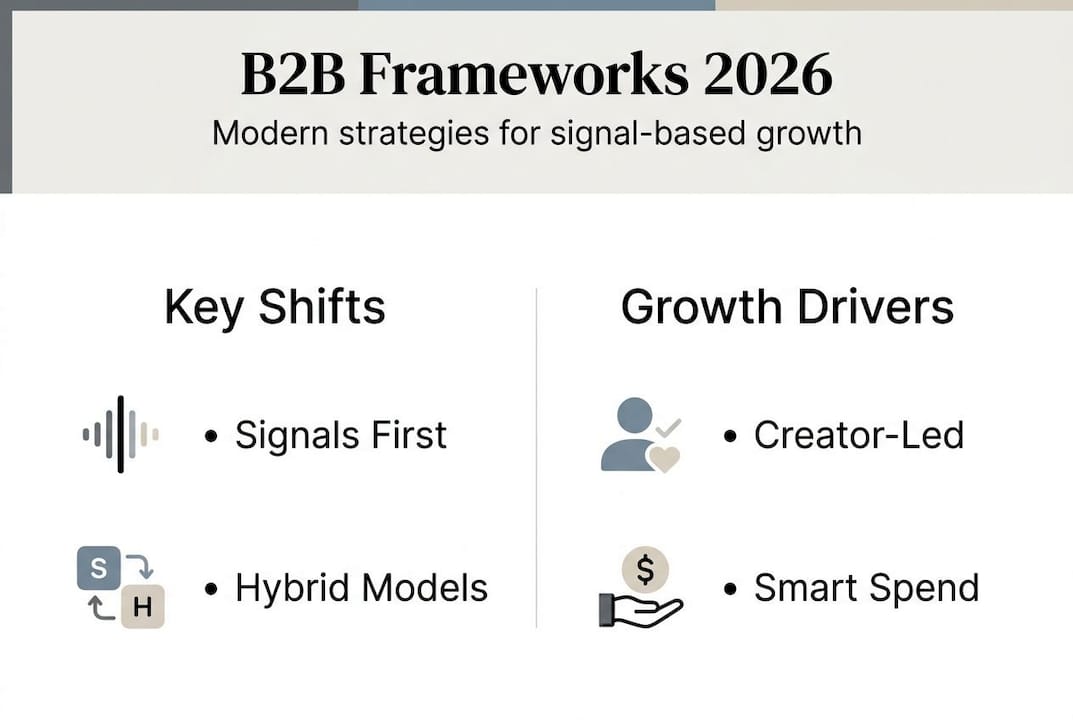
Here is how signal-based strategy compares to the traditional volume approach:
| Dimension | Signal-based strategy | Volume-based outreach |
|---|---|---|
| Targeting | In-market accounts with intent data | Broad lists with demographic filters |
| Outreach timing | Triggered by buyer behavior | Scheduled in batch sequences |
| Personalization | Role and stage specific | Generic or lightly personalized |
| Efficiency | High, fewer wasted contacts | Low, high noise-to-signal ratio |
| Scalability | Scales with data quality | Scales with headcount |
If you want to shift to an intent-based outbound model, here is a practical sequence to follow:
- Build your ideal customer profile (ICP) with firmographic and behavioral attributes, not just company size and industry
- Layer intent data from third-party sources to identify accounts showing active research behavior
- Resolve identity on your own website to connect anonymous visits to known accounts
- Trigger coordinated outreach across email, LinkedIn, and targeted ads when intent scores cross a threshold
- Measure engagement by account, not just individual leads, to reflect how B2B buying actually works
The second major shift is creator-led and employee advocacy growth. When your executives, subject matter experts, and even frontline employees share genuine perspectives on platforms like LinkedIn, they build trust that no paid campaign can replicate. Hybrid digital strategies combine this organic credibility with structured outbound activation for compounding results.
Pro Tip: Treat your brand's creator content and employee voices as defensible competitive moats, not optional extras. A competitor can copy your ad spend overnight. They cannot copy the trust your team has built with your audience over months.
Exploring digital solutions for growth and studying proven digital marketing strategies will help you identify which hybrid elements fit your specific market and sales motion.
Measuring impact and iterating: How to drive ROI in B2B digital strategy
Here is an uncomfortable truth: only 40% of B2B marketers are confident in their ability to measure digital ROI, even as AI adoption hits near-universal levels. The problem is rarely a lack of data. It is a lack of the right measurement architecture.
Start with clear, outcome-oriented KPIs (key performance indicators). Not vanity metrics like page views or email open rates, but indicators that tie directly to pipeline and revenue. Think pipeline influenced by digital touchpoints, cost per qualified opportunity, and account engagement scores.
Here are best practices for building a closed-loop measurement system:
- Map every digital channel to a stage in your buying journey, so you know what each touchpoint is supposed to do
- Use multi-touch attribution to understand which combinations of content and channels drive the most pipeline
- Track account-level engagement, not just lead-level activity, to reflect how B2B buying decisions actually happen
- Run regular pipeline reviews that include marketing data, so sales and marketing align on what is working
- Set a 90-day iteration cadence to test, measure, and adjust rather than waiting for annual reviews
AI tools can accelerate every one of these steps, but only if you have a clean data foundation and a clear definition of what success looks like before you turn them on. Reviewing innovative tech strategies can help you identify which AI capabilities are genuinely ready to improve your measurement stack versus which ones are still more hype than substance.
Pro Tip: Treat your digital strategy as a living experiment, not a fixed campaign. The organizations that improve fastest are the ones that build learning loops into their process from day one, not as an afterthought.
A fresh perspective: The overlooked power of signals and human connection
Most B2B advice in 2026 still defaults to the same playbook: more content, more automation, more outbound volume. We think that is exactly backward. The organizations we see winning are doing less but doing it with far more precision and authenticity.
Cold outbound at scale, non-branded search as a primary acquisition channel, and generic nurture sequences are all losing effectiveness at a measurable rate. What cuts through is human-driven signal orchestration combined with genuine creator voices. When a real expert shares a real opinion, buyers pay attention in a way they simply do not for polished brand content.
The shift to signal stacks and creator-led growth as competitive moats is not a trend. It is a structural change in how B2B trust is built. The mainstream advice misses this because it is harder to package into a simple framework. But the competitive edge is real and it is durable.
Less volume, more signal. Less automation for its own sake, more authentic human connection at scale. That is where the actual leverage is in 2026.
Take your B2B digital strategy further with expert support
Building a signal-based, hybrid B2B digital strategy requires more than a good plan. It requires the right technology infrastructure, the right data architecture, and partners who understand how these systems connect.
At YS Lootah Tech, we work with B2B organizations across industries to design and build the digital foundations that make modern strategy possible. From website development services that convert dark buyers into known accounts, to AI and machine learning solutions that power intent scoring and personalization at scale, our team brings the technical depth and strategic perspective your growth requires. If you are ready to move from busy to effective, we are ready to help you get there.
Frequently asked questions
What makes B2B digital strategy different from B2C?
B2B digital strategy focuses on managing complex, multi-stakeholder buying cycles involving an average of 13 decision-makers, while B2C typically targets individual buyers with shorter, more emotional purchase journeys.
How can I measure ROI from my B2B digital strategy?
Set clear KPIs tied to pipeline and revenue, then use closed-loop reporting to connect digital activities to actual deals. Only 40% of B2B marketers currently feel confident doing this, so a structured measurement framework is a genuine competitive advantage.
What are 'dark buyers' and how do they impact strategy?
"Dark buyers" are prospects who complete most of their decision-making without any direct sales interaction, which 71% of B2B buyers now do, making intent signals and always-on digital content essential for reaching them.
Is cold outbound still effective in B2B marketing?
Cold outbound reply rates have dropped to as low as 1 to 5%, making it far less effective as a standalone tactic. Modern B2B strategies favor hybrid and intent-based approaches that activate outreach only when buyer signals justify it.