Top technology trends: What business leaders need for 2026

Global technology spending is set to grow 7.8% in 2026 to reach $5.6 trillion, yet most business leaders still struggle to separate genuinely transformative trends from well-marketed noise. The sheer volume of predictions from Gartner, IEEE, Forrester, and IDC can feel paralyzing rather than clarifying. This guide cuts through that confusion. We break down the trends that actually move the needle for strategic planning, explain where AI and security investments are heading, and give you a practical framework for building a technology roadmap that holds up under real-world pressure.
Table of Contents
- Setting the stage: Why 2026 is a critical pivot year
- Decoding the top technology trends of 2026
- Strategic AI infrastructure and software evolution
- Security advances and risk: Navigating the digital threatscape
- From trend to action: Building an adaptive roadmap
- Partnering for technology success in 2026
- Frequently asked questions
Key Takeaways
| Point | Details |
|---|---|
| 2026 marks a spending leap | Record IT investment means businesses must narrow focus to high-impact trends. |
| AI is strategic, but nuanced | AI-native and agentic systems drive results, but hype and rollout challenges persist. |
| Security posture is critical | Quantum security, preemptive cyber tools, and digital provenance are top executive priorities. |
| Adaptivity outperforms rigid plans | Success will come from flexible, ROI-driven roadmaps, not chasing every trend. |
| Specialized expertise accelerates value | Partnering for UX, app, and website innovation speeds up execution of strategic trends. |
Setting the stage: Why 2026 is a critical pivot year
With the surge in tech investment, let's examine why 2026 stands apart from prior years. This is not just another incremental upgrade cycle. The convergence of AI maturity, post-pandemic infrastructure debt, and geopolitical pressure on supply chains has created a genuine inflection point for enterprise technology strategy.
IDC forecasts global ICT spending will hit $4 trillion in 2026, up 10% year over year. Software accounts for more than 33% of that figure, and hardware is expanding by 15%, driven largely by AI platform infrastructure in sectors like aerospace and defense. These are not marginal shifts. They signal a structural reorientation of how organizations build and operate.
"The organizations that treat 2026 as a planning year rather than an execution year will find themselves two to three years behind competitors who moved decisively."
For IT leaders, the practical implication is clear: prioritize by impact, not by buzz. A trend that dominates conference keynotes may be years away from delivering enterprise-grade ROI. Reviewing digital strategy efficiency tips and aligning them with your current capability gaps is a smarter starting point than chasing headlines.
| Technology category | Projected 2026 spend | YoY growth | Adoption stage |
|---|---|---|---|
| AI platforms and software | $1.3T+ | +33% | Rapid scaling |
| Hardware and compute | $900B+ | +15% | Expanding |
| Cybersecurity solutions | $280B+ | +12% | Mainstream |
| Cloud infrastructure | $700B+ | +18% | Mature/accelerating |
| Enterprise applications | $500B+ | +10% | Steady growth |
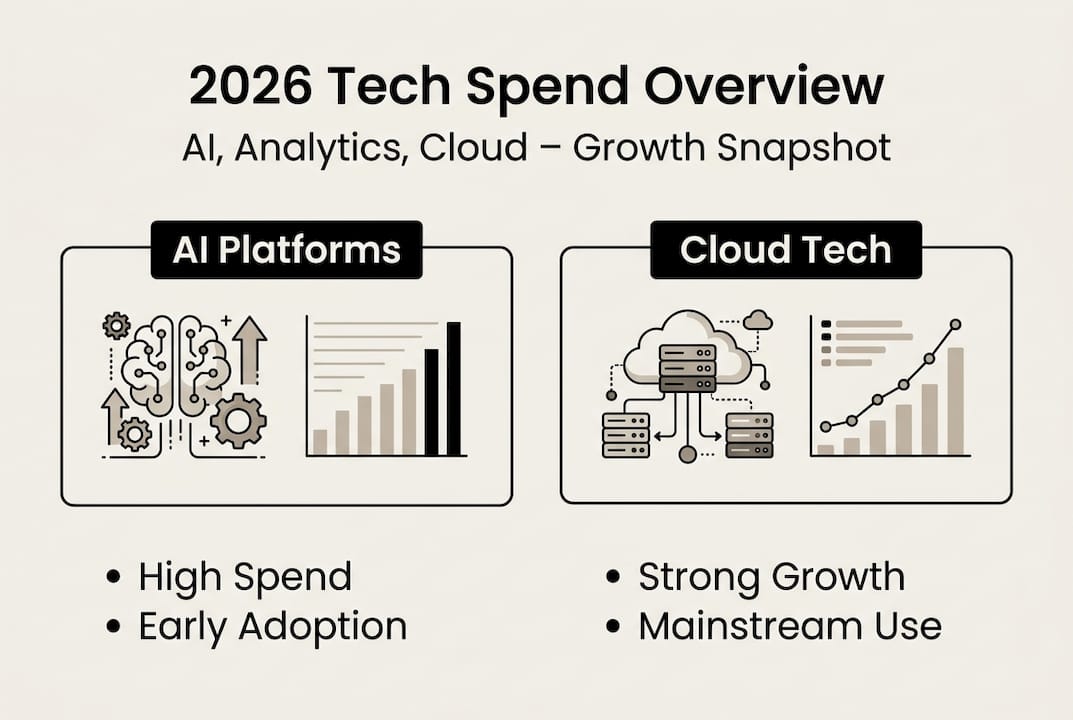
Understanding data analytics in 2026 alongside these spending categories helps you map where your organization sits relative to the broader market.
Decoding the top technology trends of 2026
With the context of 2026's significance established, let's break down the headline technology trends shaping business competitiveness. Gartner's Top 10 Strategic Technology Trends for 2026 include AI-Native Development Platforms, AI Supercomputing Platforms, Confidential Computing, Multiagent Systems, Domain-Specific Language Models, Physical AI, Preemptive Cybersecurity, Digital Provenance, AI Security Platforms, and Geopatriation. That is a wide spectrum, and not every trend deserves equal budget attention.
IEEE's 2026 predictions cover 26 AI-influenced technologies, with AI agents becoming standard in business operations, AI-driven power grids, adaptive bio-AI interfaces, and embodied physical AI moving from research labs into operational environments. The breadth of these predictions reflects genuine momentum, not speculation.
| Trend | Category | Business readiness |
|---|---|---|
| AI-native development platforms | Core | High |
| Multiagent systems | Emerging | Medium |
| Preemptive cybersecurity | Core | High |
| Physical/embodied AI | Emerging | Low to medium |
| Geopatriation | Emerging | Medium |
| Domain-specific language models | Core | High |
| Digital provenance | Emerging | Low |
| Quantum security | Emerging | Low |
Top 5 needle-movers for strategic ROI in 2026:
- Domain-specific AI models: Trained on industry data, these deliver faster, more accurate outputs than general-purpose models and reduce hallucination risk in regulated sectors.
- Multiagent systems: Networks of AI agents that coordinate tasks autonomously, reducing manual workflow bottlenecks across finance, logistics, and customer service.
- Preemptive cybersecurity: Shifts defense from reactive patching to predictive threat neutralization, cutting breach response costs significantly.
- AI-native development platforms: Accelerate software delivery cycles by embedding AI into the build process itself, not just as a feature.
- Confidential computing: Enables secure data processing in untrusted environments, critical for cross-border data collaboration and regulated industries.
Exploring tech strategies for 2026 alongside cloud computing trends gives you a clearer picture of how these trends interact with your existing infrastructure. For organizations building or modernizing internal tools, enterprise app development in 2026 is a natural entry point for applying several of these trends simultaneously.
Strategic AI infrastructure and software evolution
With top trends mapped, let's zoom into AI and see what business leaders can realistically adopt in 2026. The honest answer is: less than the hype suggests, but more than the skeptics admit.

Only 11% of AI agents are currently in production despite 38% of organizations piloting them, according to Deloitte data cited by Forrester. Forrester also warns of a meaningful AI hype correction, with 40% of agentic AI projects expected to fail and enterprise spend being deferred as a result. This is not a reason to pause AI investment. It is a reason to invest smarter.
Embodied and physical AI is expanding into specialized business roles beyond manufacturing, including logistics coordination, healthcare diagnostics support, and retail inventory management. The organizations winning with AI in 2026 are not the ones with the biggest models. They are the ones with the clearest use cases and the most disciplined rollout processes.
How to evaluate AI initiatives for ROI and resilience:
- Define a specific, measurable business problem before selecting any AI tool or platform.
- Run a time-boxed pilot with clear success metrics, not an open-ended proof of concept.
- Assess data readiness. AI performance is only as good as the data it trains and operates on.
- Map the human workflow changes required. Technology adoption fails most often at the people layer, not the technical layer.
- Build in a review gate at 90 days to decide whether to scale, pivot, or stop.
Pro Tip: Build AI teams for iterative learning rather than all-in bets. A small, cross-functional team that ships and learns in 60-day cycles will outperform a large project team chasing a 12-month launch date.
Our AI and machine learning services are designed around exactly this kind of disciplined, iterative approach. You can also see how AI is reshaping digital healthcare as a sector-specific example of responsible AI deployment.
Security advances and risk: Navigating the digital threatscape
AI fuels opportunity, but it also introduces new risks. Here is where technology security is headed in 2026.
Gartner identifies preemptive cybersecurity, AI security platforms, digital provenance, quantum security, and geopatriation as the defining security priorities for C-suites this year. Cyber-enabled fraud has now surpassed ransomware as the primary threat vector, a shift that demands a fundamentally different defensive posture. Meanwhile, quantum security will exceed 5% of IT security budgets in 2026, according to Forrester, signaling that post-quantum cryptography is moving from theoretical to operational.
"Cyber-enabled fraud is not just a security problem. It is a trust problem. Organizations that cannot verify the provenance of their data and communications will face compounding reputational and regulatory risk."
Action steps to harden IT infrastructure against 2026 threats:
- Audit your current threat detection stack for AI-native capabilities. Legacy signature-based tools are increasingly ineffective against adaptive attacks.
- Implement digital provenance controls for all externally shared content and communications to counter deepfake-enabled fraud.
- Begin a post-quantum cryptography readiness assessment, even if full migration is 18 to 24 months away.
- Review your geopatriation exposure. If your data crosses jurisdictions with conflicting sovereignty laws, you need a clear data residency strategy now.
- Invest in AI security platforms that monitor model behavior, not just perimeter threats.
Reviewing data security fundamentals for businesses and the future of cloud computing security will help you build a layered defense that matches the sophistication of 2026's threat environment. A solid digital strategy for 2026 must treat security as a design principle, not an afterthought.
From trend to action: Building an adaptive roadmap
To close, here is how you can convert your technology awareness into actionable leadership and measurable results. Awareness without execution is just expensive reading.
Forrester's spending analysis highlights four business imperatives for 2026: prioritizing ROI-proven AI, rebuilding organizations for AI-native operations, managing inference economics, and addressing developer shortages that are already slowing adoption timelines. These are not abstract concerns. They are the operational constraints that will determine which organizations actually benefit from the trends described in this guide.
Steps to operationalize emerging tech without organizational bottlenecks:
- Map your current technology portfolio against the trend categories above. Identify gaps and redundancies before adding new tools.
- Assign a named owner to each strategic technology initiative. Diffuse ownership is the single biggest predictor of failed adoption.
- Create a quarterly technology review cadence that includes both IT and business unit leaders. Trends shift fast. Your roadmap should too.
- Prioritize vendor partnerships that offer modular, interoperable solutions over monolithic platforms that create lock-in.
- Build a skills inventory. Know exactly where your team has capability gaps and plan hiring or upskilling 6 months ahead of need.
Pro Tip: Balance moonshot innovation with incremental digital gains. For every high-risk, high-reward initiative on your roadmap, pair it with two to three lower-risk improvements that deliver measurable value within a single quarter. This keeps momentum and stakeholder confidence high while longer bets mature.
Your 2026 strategy efficiency tips and innovative tech strategies resources are practical starting points for turning this framework into a living roadmap your teams can actually execute against.
Partnering for technology success in 2026
If you are ready to turn these trends into competitive advantage, specialized guidance and digital innovation support can make the difference between a roadmap that sits in a slide deck and one that ships real results. The gap between knowing the trends and executing on them is where most organizations lose ground.
At YS Lootah Tech, we work with business leaders across industries to design, build, and secure digital solutions that are built for where the market is going, not where it has been. Whether you need UX/UI design experts to modernize customer-facing experiences, application development support to bring AI-native tools to life, or website development solutions that reflect your 2026 brand positioning, our teams are structured for exactly the kind of iterative, outcome-focused delivery this moment demands. Let's build something that lasts.
Frequently asked questions
Which technology trend offers the fastest ROI for mid-sized businesses in 2026?
AI-native development and automation software typically deliver the quickest measurable ROI for mid-sized firms, as software and AI platforms are the fastest-growing and most immediately deployable category in 2026.
How should companies evaluate hype versus reality in 2026's AI trends?
Prioritize pilots with clear KPIs and focus on domain-specific AI rather than general-purpose tools. Forrester warns that 40% of agentic AI projects will fail, making disciplined evaluation essential before scaling.
What is the biggest cybersecurity threat businesses must address in 2026?
Cyber-enabled fraud has surpassed ransomware as the primary security risk. Gartner identifies digital provenance and AI security platforms as the core defenses organizations need to deploy now.
How will developer shortages affect technology adoption in 2026?
Hiring time for technology talent is expected to double, slowing project delivery and new technology adoption. Organizations should plan upskilling programs at least six months ahead of any major technology initiative.
Does investing in physical or embodied AI matter for non-manufacturing industries?
Yes. IEEE confirms that embodied AI, including intelligent digital assistants and autonomous process automation, will impact customer experience and back-office productivity across virtually every sector, not just manufacturing.