How to Enhance Customer Experience Online in 2026

TL;DR:
- Enhancing online customer experience involves personalized, proactive, and connected digital interactions to boost satisfaction and loyalty.
- Success depends on a strong digital infrastructure, effective data integration, and cross-team collaboration focusing on AI-driven personalization and user-centric UX practices.
Enhancing customer experience online is defined as delivering personalized, proactive, and connected digital interactions that increase satisfaction and drive long-term loyalty. Digital-first service strategies reduce cost-to-serve by 20–40% while lifting customer satisfaction scores from 55% to 80% within 18 months. That gap between 55% and 80% represents real revenue. Businesses that close it do so through three core pillars: AI-powered personalization, journey mapping, and trust-building across every digital channel.
How to enhance customer experience online: the foundation
Before any tactic works, you need the right digital infrastructure in place. Digital-first customer service meets customers on their preferred channels and provides 24/7 self-service, reducing customer effort and improving satisfaction. Customers now expect digital access as a baseline, not a bonus.
Three technology categories form the core of any effective digital customer experience (CX) program:
| Technology category | Primary purpose |
|---|---|
| AI chatbots and virtual agents | Handle routine queries, collect feedback, and escalate to live agents |
| Digital analytics platforms | Track behavior, identify friction points, and measure satisfaction scores |
| Customer journey mapping tools | Visualize the full path from awareness to purchase and post-sale support |
Each category serves a distinct function, but the real power comes from connecting them. A unified customer data layer lets your analytics platform feed your chatbot, which informs your journey maps. Without data integration, each tool operates in isolation and produces incomplete insights.
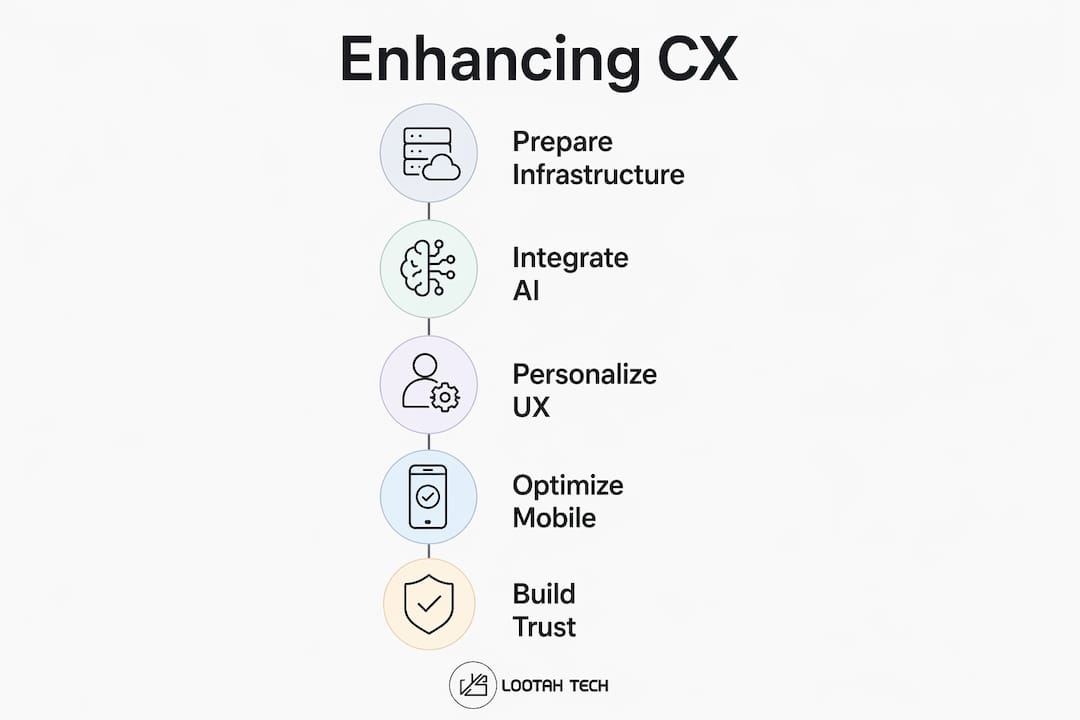
Cross-functional collaboration is equally non-negotiable. Marketing, IT, and customer support teams must share data and decision-making. Breaking silos between design, development, and content teams is what separates organizations that improve fast from those that stall. Assign a CX owner who sits across all three functions and holds authority over the roadmap.
How can AI and personalization boost digital customer satisfaction?
Personalization is the single biggest lever for improving online user experience at scale. When done well, it makes every customer feel like the product was built for them. When done poorly, it feels intrusive. The difference lies in how you collect and act on data.

Conversational AI feedback tools change the quality of customer insight you receive. AI-driven feedback interviews increase customer response rates from 8–15% to 20–35% while providing richer qualitative context to identify friction points. Higher response rates mean your data reflects actual customer sentiment, not just the opinions of your most vocal 10%.
AI chatbots that remember conversation context reduce customer effort significantly. Customers hate repeating themselves. A chatbot that carries context from one session to the next, and passes that full context to a live agent when needed, removes one of the most common sources of digital frustration. The human-in-the-loop model keeps AI handling routine queries while humans manage complex ones, with no information lost in the handoff.
Personalization techniques that drive loyalty include:
- Dynamic content blocks that change based on browsing history, purchase behavior, or geographic location
- Tailored product recommendations powered by collaborative filtering algorithms
- Triggered email sequences that respond to specific customer actions, not just time intervals
- Personalized onboarding flows that adapt to the user's stated goals during sign-up
Each technique works best when tied to a clear metric. Track completion rates, click-through rates, and repeat purchase frequency to know which personalization efforts actually move the needle.
Pro Tip: Start with one personalization use case, measure it for 30 days, and then expand. Deploying five personalization tactics at once makes it impossible to know which one drove results.
What UX best practices create intuitive online experiences?
User experience (UX) quality determines whether customers stay or leave. Most digital teams focus on page load speed, but the metric that matters most in 2026 is different. Interaction to Next Paint (INP) measures how quickly a site visually responds to a user's click or tap, with under 300ms being the threshold for a responsive feel. A site can load fast and still feel sluggish if INP is poor.
Microcopy: the underrated UX fix
Microcopy changes often deliver bigger UX improvements than full visual redesigns. Changing "Submit" to "Get My Quote" reduces cognitive load and friction at almost zero cost. The principle is simple: specific verb-driven labels tell customers exactly what happens next, which removes hesitation. Apply this logic to every button, error message, and form field label on your site.
Mobile-first design and accessibility
Mobile-first responsive design is not optional. The majority of digital interactions now happen on mobile devices, and a layout that breaks on a phone loses customers before they ever see your offer. Pair mobile optimization with clear navigation: limit top-level menu items to five or fewer, and use progressive disclosure to reveal complexity only when customers request it.
Accessibility compliance protects both your customers and your business. WCAG 2.2 compliance is now a legal requirement in many regions, and failing to meet it creates liability alongside a poor experience for customers with disabilities. The European Accessibility Act reinforces this standard across EU markets. Treat accessibility as a quality standard, not a checkbox.
| UX improvement | Primary benefit |
|---|---|
| INP optimization (under 300ms) | Site feels responsive; reduces abandonment |
| Verb-driven microcopy | Reduces hesitation and form abandonment |
| Mobile-first layout | Captures majority of digital traffic |
| WCAG 2.2 compliance | Reduces legal risk and serves all customers |
| Simplified navigation | Lowers cognitive load and speeds task completion |
Pro Tip: Run a five-second test with real users. Show them your homepage for five seconds, then ask what the site does. If they can't answer clearly, your navigation and microcopy need work before anything else.
How do you build trust and loyalty through connected online experiences?
Trust is the currency of digital commerce. Customers who trust your brand spend more, return more often, and refer others. Building that trust requires consistency across every channel and transparency about how you use customer data.
Transparent data usage policies are a direct driver of customer confidence. When customers understand what data you collect, why you collect it, and how it benefits them, they are more willing to share information. That information, in turn, powers better personalization. The cycle only works when the initial trust is established through clear, plain-language privacy communication, not buried legal text.
Unified experiences across digital and physical channels define the modern customer journey. Brands must create destination-worthy owned digital experiences that are rich, intuitive, and personalized to prevent AI shopping agents from diverting customers to competitors. This means your website, app, social media presence, and in-store experience must all tell the same story with the same tone and the same data.
Strategies for building lasting online customer loyalty include:
- Consistent brand voice across email, social media, live chat, and self-service portals
- Real-time analytics to identify when a customer is at risk of churning and trigger a relevant intervention
- Conversation continuity between AI agents and live support, so customers never repeat their issue
- Proactive outreach based on behavioral signals, such as a customer who viewed a product three times but did not purchase
- Loyalty program integration that rewards digital engagement, not just purchases
Social media marketing correlates with 80% customer satisfaction and 70% retention in e-commerce, outperforming email marketing, which scores 75% satisfaction and 60% retention. Social channels create two-way conversations that email cannot replicate. Use them to respond publicly, acknowledge issues quickly, and celebrate customer milestones.
The emerging concept of the "agentic" customer experience adds another layer. Customers now interact with brands through AI environments, voice assistants, and third-party platforms, not just your owned channels. For strategies for online customer loyalty to work in this environment, your brand experience must be consistent wherever a customer encounters you, whether that is on your website, inside a social feed, or through an AI shopping assistant.
Pro Tip: Map your customer journey across every touchpoint, including third-party platforms where your brand appears. Gaps in that map are where loyalty breaks down.
Key Takeaways
Improving digital customer satisfaction requires integrating AI-powered personalization, UX performance standards, and transparent trust-building practices across every channel your customers use.
| Point | Details |
|---|---|
| AI-powered feedback drives insight | Conversational AI lifts response rates to 20–35%, giving you richer data to act on. |
| INP under 300ms is the new speed standard | Optimizing interaction responsiveness reduces abandonment more than page load speed alone. |
| Microcopy beats redesigns for quick wins | Changing button labels from vague to specific reduces friction at near-zero cost. |
| Trust requires transparent data practices | Plain-language privacy communication increases willingness to share data and enables better personalization. |
| Unified multichannel presence protects loyalty | Consistent experiences across owned and third-party channels prevent AI agents from diverting customers. |
What I've learned from watching AI-driven CX succeed and fail
Working across digital transformation projects, the pattern I see most often is this: companies invest in AI tools before they fix their data. They deploy a chatbot on top of fragmented customer records and wonder why it gives inconsistent answers. The technology is not the problem. The foundation is.
The organizations that see real gains from AI in customer experience share one trait: they treat data unification as a prerequisite, not an afterthought. They build a single customer view before they build the chatbot. That sequencing matters more than the tools they choose.
The AI integration guide for business leaders I recommend most often emphasizes iteration over perfection. Start with one channel, measure it honestly, and expand from there. The companies that try to transform everything at once almost always stall at the implementation stage.
The future belongs to agentic AI, where automated systems take actions on behalf of customers across multiple platforms. That shift will reward brands that have already built consistent, data-rich digital experiences. It will punish brands that have not. The window to build that foundation is now, not after the next platform shift arrives.
— YS
How Yslootahtech helps you build better digital customer experiences
Yslootahtech works with businesses across industries to implement AI-powered CX solutions that are grounded in real customer data and built for scale. The team at Yslootahtech brings together custom software development, UI/UX design, and advanced AI capabilities to close the gap between what customers expect and what your digital channels currently deliver.
If you are ready to move from reactive customer service to proactive, personalized engagement, Yslootahtech's AI and machine learning services cover everything from conversational AI deployment to predictive analytics integration. You can also explore digital strategy insights tailored for UAE business leaders looking to build efficiency and customer loyalty simultaneously. Contact the Yslootahtech team to discuss your specific CX goals.
FAQ
What does "enhancing customer experience online" actually mean?
Enhancing customer experience online means delivering personalized, proactive, and connected digital interactions across every channel a customer uses. The goal is to reduce friction, increase satisfaction, and build loyalty through consistent, data-driven engagement.
How much can AI improve customer satisfaction scores?
Digital-first AI-agent models have lifted customer satisfaction scores from 55% to 80% within 18 months while reducing cost-to-serve by 20–40%. The key is integrating AI with a human-in-the-loop model so complex issues escalate smoothly.
What is INP and why does it matter for UX?
Interaction to Next Paint (INP) measures how quickly a site visually responds to a user's click or tap. A score under 300ms is the threshold for a site that feels responsive, making it a critical metric for reducing abandonment.
How does microcopy improve online customer experience?
Microcopy changes, such as replacing "Submit" with "Get My Quote," reduce cognitive load and hesitation at almost zero cost. Specific, verb-driven labels tell customers exactly what happens next, which lowers form abandonment and improves conversion.
What is the most effective channel for e-commerce customer retention?
Social media marketing correlates with 70% customer retention in e-commerce, outperforming email marketing at 60% retention. Social channels enable two-way conversations that build stronger relationships than broadcast-style email alone.