Fintech Solution Implementation Workflow: A Project Leader's Guide

TL;DR:
- Fintech deployment success depends on managing technical, regulatory, and partner tracks simultaneously from the project's start. Workflow automation and embedding compliance into CI/CD pipelines improve operational resilience and ensure audit readiness. Treating regulatory approval timelines as part of the development plan prevents delays and facilitates continuous governance.
A fintech solution implementation workflow is the coordinated management of three parallel tracks: technical delivery, regulatory compliance, and partner alignment. Most project failures in financial technology deployment trace back to treating these tracks as sequential rather than simultaneous. Yslootahtech has worked across fintech deployments where the engineering team finished on time but the product launched months late because compliance documentation was treated as an afterthought. This guide gives business leaders and project managers a concrete framework for running all three tracks in parallel, embedding compliance into CI/CD pipelines, and using workflow automation to build operational durability from day one.
What are the core parallel tracks in fintech solution implementation workflows?
The critical path in regulated fintech is dominated by regulatory engagement, legal documentation, and partner alignment rather than engineering work. That single fact reshapes how you should structure your entire project plan. If your Gantt chart treats compliance as a phase that follows development, you have already built in a delay.
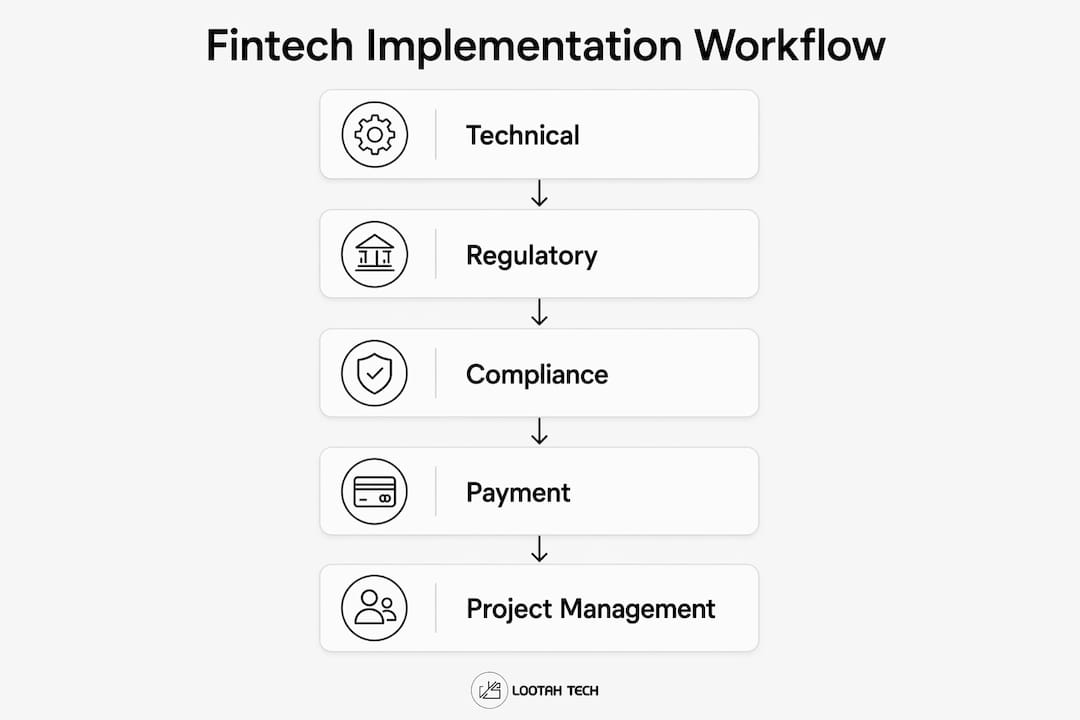
A well-structured financial technology workflow runs three tracks from the first sprint:
- Technical delivery track: Software build, Agile sprint planning, CI/CD pipeline configuration, and environment management. This is the track most project managers know well.
- Regulatory and legal track: Compliance documentation produced as sprint deliverables, jurisdiction approval cycles mapped against delivery milestones, and regulatory hold states modeled as workflow phases rather than interruptions.
- Partner and business track: Bilateral agreements, third-party onboarding, API integration agreements, and commercial alignment with payment networks or identity providers.
Multi-country deployments make this especially clear. A digital identity project spanning the UAE, Saudi Arabia, and Egypt may have identical engineering requirements in each market. The delivery timeline in each country is set by the local regulatory body, not the development team. Overlaying jurisdiction approval cycles over delivery milestones is the practice that prevents cascading delays.
Pro Tip: Map every regulatory approval deadline to a specific sprint before the project kicks off. Treat each approval as a deliverable with an owner, a due date, and a dependency chain, exactly as you would treat a software feature.
How can workflow automation improve fintech implementation?
Workflow automation is not just a developer convenience. It is the mechanism that makes long-running fintech processes operationally durable. Payment operations, identity verifications, and compliance checks can span minutes, hours, or days. A process that crashes midway and restarts from zero creates reconciliation problems, customer complaints, and audit gaps.

The right approach treats each payment operation as a stateful process with explicit idempotency and compensation for failures. Idempotency means the same operation can run twice without creating a duplicate transaction. Compensation means the system knows how to reverse a partial action if a downstream step fails. Workflow engines like Temporal are built specifically for this pattern.
FinHarbor's Money Flow module demonstrates what this looks like in practice. The module uses a workflow engine that resumes operation after restarts and manages retries automatically. The result is a significant reduction in time to go live and shorter change cycle times. Payment orchestration engines also shift developer attention from failure handling to business logic, which accelerates iteration.
Key benefits of workflow automation in fintech integration processes include:
- Audit trails: Every state transition is logged with a timestamp, making compliance reviews straightforward.
- Operational resilience: The system recovers from infrastructure failures without manual intervention.
- Developer efficiency: Teams write business rules, not retry loops.
- Faster change cycles: Updating a workflow step does not require rebuilding the entire process.
"In long-running payment workflows, explicitly modeling hold and resume states with compensating actions prevents operational incidents and reduces reconciliation efforts." — FinHarbor Money Flow documentation
What are best practices for embedding compliance into fintech development workflows?
Compliance testing belongs inside the CI/CD pipeline, not at the end of a release cycle. The standard mistake is to treat compliance as a checklist reviewed before go-live. That approach produces two problems: it creates a bottleneck at the worst possible moment, and it generates findings that require rework after the code is already integrated.
Embedding compliance testing into CI/CD pipeline gates blocks non-compliant changes before they reach production. A regulatory test suite running in a production-representative environment on a weekly or bi-weekly cadence catches drift early. This turns compliance from a release risk into a continuous governance loop.
Follow these steps to build compliance into your fintech software deployment process:
- Define your regulatory test suite. Identify the specific controls your product must satisfy, such as AML transaction monitoring rules, KYC data handling requirements, or PCI DSS encryption standards. Write automated tests for each control.
- Integrate tests as pipeline gates. Configure your CI/CD pipeline so that a compliance test failure blocks the merge to the main branch. No exceptions for "we'll fix it later."
- Maintain a production-representative test environment. Run your compliance suite against an environment that mirrors production data structures and configurations. Tests against a simplified sandbox produce false confidence.
- Schedule regulatory test runs. Run the full compliance suite on a fixed cadence, weekly at minimum. This catches issues introduced by dependency updates or configuration changes, not just code changes.
- Update compliance libraries with regulatory changes. Assign a compliance engineer or legal liaison to monitor regulatory updates and translate them into test cases within two weeks of publication.
Pro Tip: Track compliance test pass rates as a sprint metric alongside feature velocity. A drop in compliance pass rate is an early warning signal, not a post-release surprise. Teams that measure this weekly catch problems when they are cheap to fix.
How to implement secure SDLC practices aligned with ISO 27001 in fintech projects?
ISO 27001 alignment in a fintech SDLC is not a documentation exercise. It is an evidence collection discipline built into every pipeline run. Auditors do not want to read policy documents. They want to see indexed records proving that controls were applied to specific changes.
Continuous pipeline evidence collection turns audits into simple queries. Each production change generates a record containing the commit hash, reviewer identity, timestamp, pipeline run ID, target environment, and outcome, all mapped to a control ID. When an auditor asks for evidence that change management controls were applied to a specific deployment, you run a query rather than reconstruct a narrative.
The table below compares the traditional approach to ISO 27001 evidence management with the pipeline-integrated approach:
| Approach | Evidence collection | Audit readiness | Risk level |
|---|---|---|---|
| Traditional (manual) | Collected retrospectively before audits | Low. Gaps are common and reconstruction is slow. | High |
| Pipeline-integrated | Captured automatically per pipeline run | High. Evidence is indexed and queryable at any time. | Low |
The practical challenge is that most teams do not configure evidence collection until they are preparing for their first audit. By that point, months of change history exist without structured records. Capturing change evidence continuously with indexed control IDs from the start of the project eliminates this problem entirely. Pipeline observability platforms such as those built on OpenTelemetry can collect this data without requiring developers to change their workflow.
For fintech teams building on secure SDLC foundations, the principle is simple: treat every pipeline run as an audit event, not just a deployment event.
What project management strategies optimize fintech implementation?
Agile methodologies outperform traditional waterfall approaches in fintech project management because regulatory and market conditions change faster than a fixed plan can accommodate. Agile with tools like Jira provides clarity, transparency, and cross-functional alignment through rapid feedback cycles. The key is adapting Agile to the fintech context rather than applying it unchanged from a software product company.
Specific adaptations that work in fintech implementation:
- Include compliance owners in sprint planning. Legal and compliance team members should attend sprint planning as contributors, not observers. They identify regulatory dependencies before the sprint starts, not after it ends.
- Model regulatory holds as sprint phases. When a jurisdiction review is pending, the sprint does not stop. It shifts focus to another market or another compliance track. Treating regulatory hold states as workflow phases rather than interruptions keeps velocity metrics honest.
- Use Jira or Trello for cross-functional backlog visibility. Every team member, including legal, compliance, and partner management, should see the same backlog. Siloed tracking creates misaligned expectations.
- Run weekly risk reviews. Fintech projects carry regulatory, technical, and commercial risks simultaneously. A weekly 30-minute risk review with all track owners surfaces blockers before they become delays.
- Track sprint velocity including compliance deliverables. Continuous sprint velocity accounting that includes compliance documentation allows dynamic scope adjustments and prevents cascading timeline risks.
For a deeper look at custom software workflow optimization, the same principles of parallel track management apply across industries, not just fintech.
Key takeaways
A successful fintech solution implementation workflow requires running technical delivery, regulatory compliance, and partner alignment as simultaneous tracks from the first day of the project.
| Point | Details |
|---|---|
| Run three tracks in parallel | Manage technical delivery, regulatory compliance, and partner alignment simultaneously from project kickoff. |
| Treat compliance as a sprint deliverable | Include compliance documentation in sprint velocity metrics to prevent cascading timeline delays. |
| Automate workflow orchestration | Use stateful workflow engines like Temporal to handle retries, failures, and audit trails automatically. |
| Embed compliance in CI/CD | Run regulatory test suites as pipeline gates on a weekly cadence to block non-compliant changes before production. |
| Collect ISO 27001 evidence continuously | Index control-mapped evidence per pipeline run so audits become queries, not reconstruction exercises. |
What I have learned from fintech implementations that most guides skip
The most expensive mistake I see project leaders make is treating the regulatory track as something that starts after the product is built. The engineering team delivers on time, and then the project sits in a regulatory review queue for four months. That delay was predictable from day one. The approval timeline was always on the calendar. Nobody mapped it to the delivery plan.
The second lesson is about sprint velocity. When you exclude compliance documentation from your velocity calculation, your sprint reports look healthy right up until the moment they collapse. Including compliance deliverables in velocity tracking forces an honest conversation about capacity. It also gives leadership a real signal when the compliance workload is crowding out feature development.
Workflow orchestration engines changed how I think about payment process design. The instinct is to build retry logic into application code. The better approach is to use a purpose-built engine that handles retries, timeouts, and compensations at the infrastructure level. Teams that do this spend their time on business rules. Teams that do not spend their time debugging race conditions.
The audit readiness practices that matter most are the ones you set up before you need them. Configuring pipeline evidence collection on day one costs almost nothing. Reconstructing six months of change history the week before an ISO 27001 audit costs a great deal.
— YS
How Yslootahtech supports fintech workflow implementation
Yslootahtech builds fintech solutions for organizations that cannot afford implementation delays or compliance gaps. The AI and machine learning services from Yslootahtech are designed to accelerate compliance testing, automate decision processes within payment workflows, and improve the operational efficiency of financial technology deployments. Whether you are managing a multi-country rollout or embedding compliance into an existing CI/CD pipeline, Yslootahtech provides the technical depth and regulatory awareness that fintech projects require. The team works as a long-term delivery partner, not a one-time vendor, which means the workflow practices built during implementation continue to serve your organization after go-live.
FAQ
What is a fintech solution implementation workflow?
A fintech solution implementation workflow is the coordinated management of technical delivery, regulatory compliance, and partner alignment tracks running simultaneously throughout a fintech deployment project.
Why does compliance slow down fintech projects?
Compliance slows projects when it is treated as a post-development phase rather than a parallel track. Regulatory approval cycles often set the critical path, not engineering timelines.
What is a stateful workflow engine in fintech?
A stateful workflow engine manages long-running processes by tracking the state of each operation, handling retries and failures automatically, and resuming after system restarts without data loss or duplicate transactions.
How does CI/CD support fintech compliance?
Integrating compliance tests into CI/CD as pipeline gates blocks non-compliant code before it reaches production, creating a continuously auditable governance loop rather than a fragile pre-release checklist.
What does ISO 27001 require from fintech CI/CD pipelines?
ISO 27001 requires evidence that security controls were applied to each production change. Indexed evidence records captured per pipeline run, including commit, reviewer, timestamp, and control ID, satisfy this requirement without manual reconstruction.