Custom App Development Steps: A 2026 Business Guide

TL;DR:
- Following a structured, security-integrated development process ensures custom applications meet business needs and stay secure throughout their lifecycle. Each project phase builds on the previous one, emphasizing discovery, design, development, testing, and post-launch optimization. Choosing the appropriate methodology and utilizing automation tools support efficient delivery, ongoing security, and long-term app performance.
Custom app development steps define a structured software delivery process that takes a business idea from raw concept to a deployed, maintained application. Unlike off-the-shelf software, custom applications are built around your specific workflows, users, and operational goals. Following a defined process matters because misaligned requirements at the start cause the majority of IT project budget overruns. This guide covers every phase of the app development lifecycle, compares Agile and Waterfall methodologies, details the tools that support each stage, and explains how to embed security from day one using frameworks like NIST SSDF 1.2 and DevSecOps.
What are the essential phases in custom app development?
The custom app development steps follow a logical sequence. Each phase builds on the last, and skipping one creates compounding problems downstream.
- Discovery and requirement gathering. Your team interviews stakeholders, maps existing workflows, and defines the problem the app must solve. This phase produces a requirements document that every subsequent decision references.
- Planning and system architecture. Architects choose the technology stack, define data models, and set integration points. UX/UI designers create wireframes that translate requirements into screen flows before a single line of code is written.
- Prototyping and MVP build. A clickable prototype or minimum viable product goes in front of real users early. Prototyping catches design issues before they become expensive code changes, and user involvement at this stage directly increases product adoption.
- Development. Developers build features incrementally. Up to 90% of modern app code can come from open source libraries, which accelerates delivery and reduces cost without sacrificing quality when dependencies are managed properly.
- Testing. Quality assurance covers functional correctness, performance under load, and security vulnerabilities. Defects found post-deployment cost significantly more to fix than those caught during testing. Automated test suites run with every code commit to catch regressions early.
- Deployment and launch. The app moves through staging to production. Continuous deployment practices release smaller, frequent updates rather than one large release, reducing downtime and user disruption.
- Post-launch optimization and maintenance. Monitoring tools track performance, crash reports, and user behavior. Feedback loops feed the next development cycle.
The mobile app development process follows the same sequence, though mobile projects add platform-specific considerations for iOS and Android performance, battery usage, and app store compliance.
How do Agile and Waterfall compare for custom app projects?

Choosing the right methodology shapes every other decision in your app development project phases. The two dominant models are Waterfall and Agile, and they suit different project conditions.
| Factor | Waterfall | Agile |
|---|---|---|
| Structure | Linear, phase-by-phase | Iterative sprints (1-4 weeks) |
| Requirements | Fixed upfront | Evolving throughout |
| Stakeholder involvement | Heavy at start, light during build | Continuous throughout |
| Risk management | Risks surface late | Risks surface early per sprint |
| Best for | Regulated, fixed-scope projects | Products with changing user needs |
| Delivery | Single release at end | Incremental releases |
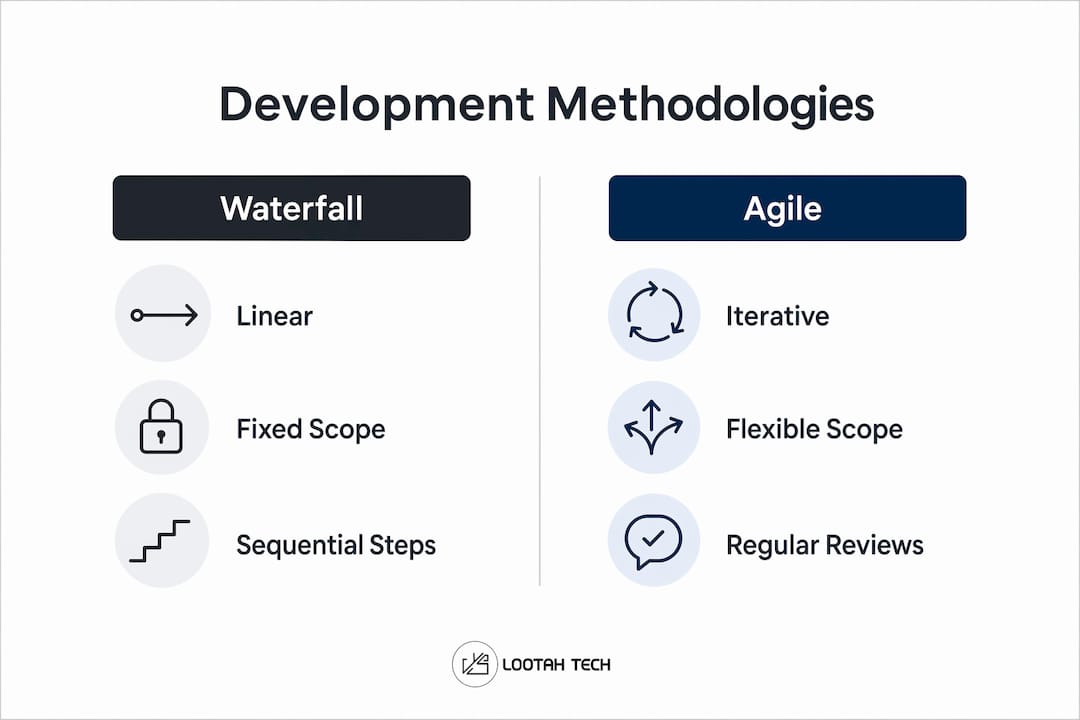
Waterfall fits projects with fixed requirements, such as compliance-driven government systems where scope cannot shift mid-build. Agile fits most commercial custom app projects because business needs evolve and user feedback should shape the product. A fintech startup building a payment app benefits from Agile's sprint reviews. A hospital replacing a legacy records system with strict regulatory requirements may prefer Waterfall's predictability.
Many teams use a hybrid: a Waterfall-style discovery and architecture phase followed by Agile sprints for development. This gives you a stable foundation without locking you into a rigid delivery plan.
Pro Tip: If your stakeholders cannot commit to regular sprint reviews, Agile will underperform. Assess your organization's availability before choosing a methodology, not after.
What tools and best practices support each development step?
The right tools reduce manual effort, enforce quality, and keep your team aligned across the app development lifecycle.
Design and prototyping
Figma and Adobe XD are the standard choices for wireframing and interactive prototypes. Both support real-time collaboration, so designers and product managers review the same file simultaneously. InVision adds user testing layers on top of static designs.
Development platforms and technology stacks
Front-end frameworks React, Vue.js, and Angular handle web interfaces. React Native and Flutter cover cross-platform mobile development from a single codebase. For back-end services, Node.js, Django, and Spring Boot each suit different performance and team skill profiles. PostgreSQL and MongoDB cover relational and document database needs respectively.
Security and compliance frameworks
NIST SP 800-218 recommends integrating secure development practices into every phase of the software development lifecycle (SDLC) to reduce vulnerabilities. This is not optional for enterprise projects. Tools like Snyk, Checkmarx, and SonarQube perform static analysis and dependency scanning automatically within your pipeline.
Testing and automation
Selenium and Cypress handle end-to-end browser testing. Jest and Mocha cover unit testing for JavaScript applications. JMeter and k6 run load and performance tests before launch.
Project management and collaboration
Jira tracks sprints, backlogs, and bug reports. Confluence stores technical documentation and decision logs. Slack or Microsoft Teams keeps communication centralized. These tools matter because distributed teams without a shared system lose context between sprints.
Pro Tip: Connect Jira directly to your CI/CD pipeline so every code commit references a ticket. This creates an automatic audit trail that saves hours during post-launch incident reviews.
For teams building enterprise-grade solutions, the enterprise app development steps for UAE-based projects in 2026 add procurement, compliance, and localization layers that standard guides omit.
What are the key security steps in custom app development?
Security is the most commonly skipped step in the custom application development guide for small and mid-size projects. Most traditional SDLC models treat security as a final checkpoint rather than a continuous practice. That approach fails.
NIST SSDF 1.2 organizes secure development into four practice groups: Prepare the Organization, Protect the Software, Produce Well-Secured Software, and Respond to Vulnerabilities. Each maps directly to your development phases.
Here is how security integrates across the app development process:
- Discovery phase: Define security requirements alongside functional requirements. Identify data classification levels and regulatory obligations (GDPR, HIPAA, UAE PDPL) before architecture decisions are made.
- Design phase: Conduct threat modeling using frameworks like STRIDE or PASTA. Identify attack surfaces in your architecture before coding begins.
- Development phase: Enforce secure coding standards. Use pre-commit hooks to block secrets from entering version control. Scan dependencies with Snyk or OWASP Dependency-Check on every build.
- Testing phase: Run dynamic application security testing (DAST) with tools like OWASP ZAP alongside functional QA. Penetration testing before launch is non-negotiable for apps handling financial or health data.
- Deployment phase: Use infrastructure-as-code tools like Terraform to enforce consistent, auditable environment configurations. Secrets management platforms like HashiCorp Vault keep credentials out of config files.
"Security is most effective when it is not an afterthought but integrated deeply and continuously across all development phases." — NIST SSDF 1.2
NIST NCCoE's DevSecOps project with 14 technology companies demonstrates how automated pipelines standardize security practices across the full SDLC. The practical result is that security checks run without developer intervention, removing the human bottleneck that causes most compliance gaps. For a deeper look at managing enterprise security frameworks within your SDLC, the linked resource covers risk prioritization in detail.
How to effectively maintain and optimize your custom app post-launch
Launch day is not the finish line. Post-launch maintenance is where most of the app development lifecycle's long-term value is created or destroyed.
- Set up monitoring before launch. Tools like Datadog, New Relic, or AWS CloudWatch track uptime, response times, and error rates in real time. You need baseline metrics from day one so you can detect degradation before users report it.
- Collect and triage user feedback systematically. In-app feedback tools like Hotjar or Intercom capture user behavior and direct input. Route all feedback into a prioritized backlog in Jira. Not every request becomes a feature. Your product manager decides what moves forward based on business impact and development cost.
- Schedule regular security patches. Unpatched dependencies are the leading cause of post-launch breaches. Automate dependency scanning with Dependabot or Renovate so your team receives pull requests for updates rather than discovering vulnerabilities manually.
- Plan feature rollouts with feature flags. Tools like LaunchDarkly let you release new functionality to a subset of users before a full rollout. This limits blast radius if a new feature introduces a regression.
- Review performance quarterly. Database query performance degrades as data volumes grow. Schedule quarterly reviews of slow query logs, API response times, and infrastructure costs. Optimization at this stage is far cheaper than an emergency refactor.
- Budget for maintenance explicitly. A common mistake is treating maintenance as a residual cost. Allocate 15 to 20 percent of the original development budget annually for ongoing upkeep. Apps that receive no maintenance budget become security liabilities within 18 months.
The custom software development guide for 2026 covers how UAE-based businesses are structuring maintenance contracts to align with digital transformation timelines.
Key takeaways
Following a security-integrated, phase-by-phase custom app development process is the most reliable way to deliver on time, within budget, and without post-launch vulnerabilities.
| Point | Details |
|---|---|
| Start with discovery | Align all stakeholders on requirements before any design or code work begins to prevent costly rework. |
| Choose methodology deliberately | Use Agile for evolving requirements and Waterfall for fixed-scope, regulated projects. |
| Embed security in every phase | Apply NIST SSDF 1.2 practices from discovery through deployment, not only at testing. |
| Automate testing and security scans | Tools like Snyk, Cypress, and SonarQube catch defects and vulnerabilities before they reach production. |
| Budget for post-launch maintenance | Allocate 15 to 20 percent of development cost annually to keep the app secure, performant, and current. |
What I've learned building apps for businesses that skip the process
Most project failures I've seen don't happen because of bad developers. They happen because a business owner approved a budget before anyone wrote down what the app actually needed to do. The discovery phase feels slow and expensive when you're eager to build. It is the cheapest work you will ever do.
The second pattern I see repeatedly is treating security as a final gate. Teams rush through development, hand the app to a penetration tester two weeks before launch, and then spend the next month fixing critical findings under deadline pressure. Integrating tools like Snyk and SonarQube into the CI/CD pipeline from sprint one costs almost nothing in setup time and eliminates that scramble entirely.
The third thing most guides won't tell you: your methodology choice matters less than your team's discipline in executing it. I've seen Waterfall projects deliver beautifully when requirements were genuinely stable. I've seen Agile projects collapse because stakeholders skipped sprint reviews. The framework is a container. What you put in it determines the outcome.
If you're a project manager reading this, your most valuable contribution is not picking the right tools. It is creating the conditions where your team can follow the process without constant interruption. Protect the discovery phase. Attend the sprint reviews. Review the security scan reports. The steps to build a custom app are well understood. The discipline to follow them is rarer than it should be.
— YS
Build your custom app with Yslootahtech
Yslootahtech works with business owners and project managers across Dubai and the broader UAE to deliver custom applications that are built to spec, secured from the ground up, and maintained for the long term. The team brings hands-on experience with Agile delivery, NIST SSDF-aligned security practices, and full-stack development across web and mobile platforms. Whether you need a UX/UI design partner to validate your concept before development begins or an end-to-end application development team to take your project from discovery to deployment, Yslootahtech provides the technical depth and industry experience to get it done right. Contact the team for a custom consultation.
FAQ
What are the first steps to build a custom app?
The first steps are discovery and requirement gathering, where you align stakeholders, define the problem, and document functional and security requirements. Skipping this phase is the primary cause of budget overruns in custom app projects.
How long does the custom app development process take?
A typical custom app takes three to nine months from discovery to launch, depending on complexity, team size, and methodology. Agile projects with a defined MVP scope can reach a first release in eight to twelve weeks.
What is NIST SSDF and why does it matter for app development?
NIST SSDF 1.2 is a secure software development framework that defines practices for reducing vulnerabilities across every phase of the SDLC. It matters because most standard development models do not include explicit security guidance, leaving apps exposed.
When should I use Agile versus Waterfall for my project?
Use Agile when your requirements will evolve based on user feedback, and use Waterfall when your scope is fixed and regulatory compliance demands a documented, linear process. Many enterprise projects use a hybrid of both.
How much does post-launch app maintenance cost?
Post-launch maintenance typically costs 15 to 20 percent of the original development budget per year, covering security patches, performance optimization, and feature updates. Apps without a dedicated maintenance budget become security risks within 18 months.