Enterprise AI Benefits: A CEO's Guide to Measurable ROI

The top benefits of AI for enterprises are improved decision-making, higher productivity, better customer experience, cost optimization, faster innovation, and stronger risk detection — each one maps directly to executive KPIs and competitive position. Gartner reports that 79% of corporate strategists already view AI and analytics as critical to their organization's success over the next two years, and Deloitte's State of AI research shows that well-integrated pilots typically deliver measurable KPI changes within 3–9 months.
Here is what that looks like in practice:
- Decision-making: AI surfaces patterns in data that no analyst team can match at scale, cutting decision latency from weeks to hours.
- Productivity and efficiency: Automated workflows free skilled workers from repetitive tasks, compressing cycle times across functions.
- Customer experience: Personalization engines tailor offers, content, and service responses to individual behavior in real time.
- Cost optimization: Predictive models reduce waste in procurement, maintenance, and staffing before costs materialize.
- Innovation: AI accelerates R&D cycles by simulating outcomes and identifying high-probability paths faster than traditional methods.
- Risk detection: Anomaly detection and compliance monitoring catch fraud, drift, and regulatory exposure earlier and more reliably.
- Workforce augmentation: AI handles volume and repetition; people handle judgment and relationship — output per employee rises.
Time-to-value signal: Most enterprise pilots with reasonably mature data and integration infrastructure show measurable KPI movement within 3–9 months, per Deloitte's enterprise AI reporting.
Key Takeaways
Enterprise AI delivers measurable ROI when benefits are tied to specific executive KPIs, pilots are scoped on clean data, and model outputs are integrated into the workflows where decisions actually happen.
| Point | Details |
|---|---|
| Benefits map to KPIs | Each AI benefit (decision-making, productivity, CX, cost, risk) has a direct executive KPI; define it before the pilot starts. |
| Pilots deliver in 3–9 months | Well-integrated pilots with mature data typically show measurable KPI movement within 3–9 months, per Deloitte's research. |
| Readiness drives results | Data quality, integration, and change management determine outcomes more than model sophistication. |
| Governance is non-negotiable | Every production deployment needs a model owner, impact assessment, monitoring plan, and incident response protocol. |
| Yslootahtech as your AI partner | Yslootahtech structures engagements as pilot-first, KPI-confirmed, then scale — covering data engineering, MLOps, and enterprise integration. |
Table of Contents
- What are the core benefits of AI for enterprises, and how do they work in practice?
- Which AI use cases map to your business functions?
- How do you measure AI ROI and set realistic KPI targets?
- What does your organization need in place to capture AI benefits?
- What risks should executives anticipate, and how do you mitigate them?
- How do you pick the right AI pilot for your enterprise?
- Where enterprises actually gain the most value, from our perspective
- Yslootahtech's AI and machine learning services for enterprise leaders
- Sources
What are the core benefits of AI for enterprises, and how do they work in practice?
Google Cloud defines enterprise AI as the combined use of machine learning, natural language processing, data engineering, and system integration to solve complex business problems — not just automation of simple tasks. That definition matters because it sets the right expectation: the benefits come from combining models with process integration, not from deploying a model in isolation.
Smarter decisions, faster
AI's decision-making benefit works through three layers: it aggregates data from sources no human team can monitor simultaneously, it applies statistical models to surface non-obvious patterns, and it delivers recommendations at the moment a decision is being made. The executive KPI this moves most directly is decision cycle time, but it also improves decision quality — reducing the variance between your best and worst calls. Predictive analytics gives firms a competitive edge by surfacing market trends and customer behaviors earlier than competitors relying on lagging indicators.
Productivity gains that show up in margin
Deloitte's State of AI reporting consistently places productivity and efficiency at the top of realized enterprise benefits. The mechanism is straightforward: AI handles high-volume, rule-based work (document processing, data entry, scheduling, tier-1 support) while employees shift to higher-value tasks. The KPIs that move are throughput per FTE, processing time, and error rate. A finance team that automates invoice matching, for example, can redirect analysts toward exception handling and strategic modeling rather than data reconciliation.
Customer experience and personalization
Personalization is where AI's commercial impact is most direct. Recommendation engines, dynamic pricing, and AI-driven customer service tools use behavioral data to tailor every interaction. Esade's analysis identifies personalization and customer experience as a primary commercial benefit of enterprise AI, and the KPIs are concrete: conversion rate, average order value, churn rate, and Net Promoter Score. For more on deploying these tactics, the customer experience enhancement guide from Yslootahtech covers practical implementation steps.
Cost optimization before costs happen
Predictive maintenance in manufacturing is the clearest example. Instead of scheduling maintenance on a fixed calendar, AI models analyze sensor data to flag equipment likely to fail within a specific window. The result: fewer unplanned outages, lower parts costs, and longer asset life. The same logic applies to demand forecasting in retail (reducing overstock and stockouts) and workforce scheduling in logistics (matching labor supply to predicted demand). The KPI is OPEX savings, and the mechanism is shifting from reactive to predictive spending.
Innovation and R&D acceleration
AI compresses the hypothesis-to-result cycle in product development. Drug discovery pipelines use ML to screen molecular candidates orders of magnitude faster than wet-lab methods alone. Software teams use AI-assisted code generation to reduce time-to-feature. The executive KPI here is time-to-market, and the secondary benefit is the ability to run more experiments in parallel — which increases the probability of finding a winning product or process.
Risk detection and compliance
Fraud detection in financial services is the canonical use case. ML models trained on transaction patterns flag anomalies in milliseconds, far faster than rule-based systems and with fewer false positives. The same architecture applies to AML compliance monitoring, cybersecurity threat detection, and supply chain risk scoring. KPIs include fraud loss rate, mean time to detect, and compliance incident frequency.
Pro Tip: When attributing a productivity or cost benefit to AI specifically, isolate the AI variable by running a controlled comparison — same process, same period, with and without the model in the decision loop. Without that isolation, you are measuring process change, not AI impact.
According to HBS Online's synthesis of enterprise AI adoption, roughly 73% of U.S. companies have adopted AI in some form — meaning the competitive question is no longer whether to adopt but how fast to scale from isolated pilots to enterprise-wide programs.
Which AI use cases map to your business functions?
The fastest path to a high-confidence pilot is matching a use case to a function where you already have clean data and a clear KPI. Here is a quick lookup by function:
Sales and marketing
- Propensity-to-buy scoring: ML models rank leads by conversion likelihood, letting sales teams prioritize outreach. KPI: pipeline conversion rate.
- Dynamic content personalization: AI tailors email, ad, and web content to individual behavior. KPI: click-through rate, revenue per visitor. AI-driven insights increasingly inform go-to-market decisions at the campaign planning stage, not just execution.
Supply chain and operations
- Demand forecasting: models trained on historical sales, seasonality, and external signals reduce forecast error. KPI: inventory carrying cost, stockout rate.
- Predictive maintenance: sensor-fed models flag equipment degradation before failure. KPI: mean time between failures, unplanned downtime.
Customer service
- AI-assisted agents: NLP models suggest responses and surface relevant knowledge base articles in real time. KPI: average handle time, first-contact resolution.
- Automated tier-1 support: chatbots resolve common queries without human involvement. KPI: cost per contact, CSAT.
Risk and compliance
- Fraud detection: anomaly detection on transaction streams flags suspicious activity. KPI: fraud loss rate, false positive rate.
- Regulatory monitoring: NLP models scan contracts and communications for compliance exposure. KPI: compliance incident rate.
R&D and product development
- Simulation and modeling: AI accelerates scenario testing in product design. KPI: time-to-prototype, development cost per feature.
- Competitive intelligence: NLP tools monitor market signals and patent filings. KPI: time to identify emerging threats.
For real-world AI application examples across industries, Yslootahtech's case-study content covers healthcare, fintech, and industrial deployments with outcome data.
How do you measure AI ROI and set realistic KPI targets?
Measurement is where most enterprise AI programs lose credibility. Executives approve a pilot, the team reports model accuracy, and no one connects that accuracy to a business outcome. The fix is defining KPIs before the pilot starts, not after.
Core KPI categories
| KPI Category | Example Metric | Measurement Cadence |
|---|---|---|
| Revenue lift | Conversion rate, average order value | Monthly |
| Cost reduction | OPEX savings, cost per transaction | Quarterly |
| Time saved | Processing time, decision cycle time | Weekly/Monthly |
| Quality improvement | Error rate, defect rate, false positive rate | Weekly |
| Risk reduction | Fraud loss rate, compliance incidents | Monthly/Quarterly |
A simple ROI calculation
A straightforward approach: estimate the annual value of the KPI improvement, subtract the total cost of the AI program (data prep, model development, infrastructure, talent, and change management), and divide by total cost.
Illustrative example: A demand forecasting model reduces inventory carrying costs by $2.4M annually. Total program cost (year one) is $800K. This is a simplified illustration; actual results depend on data maturity, integration quality, and organizational adoption.
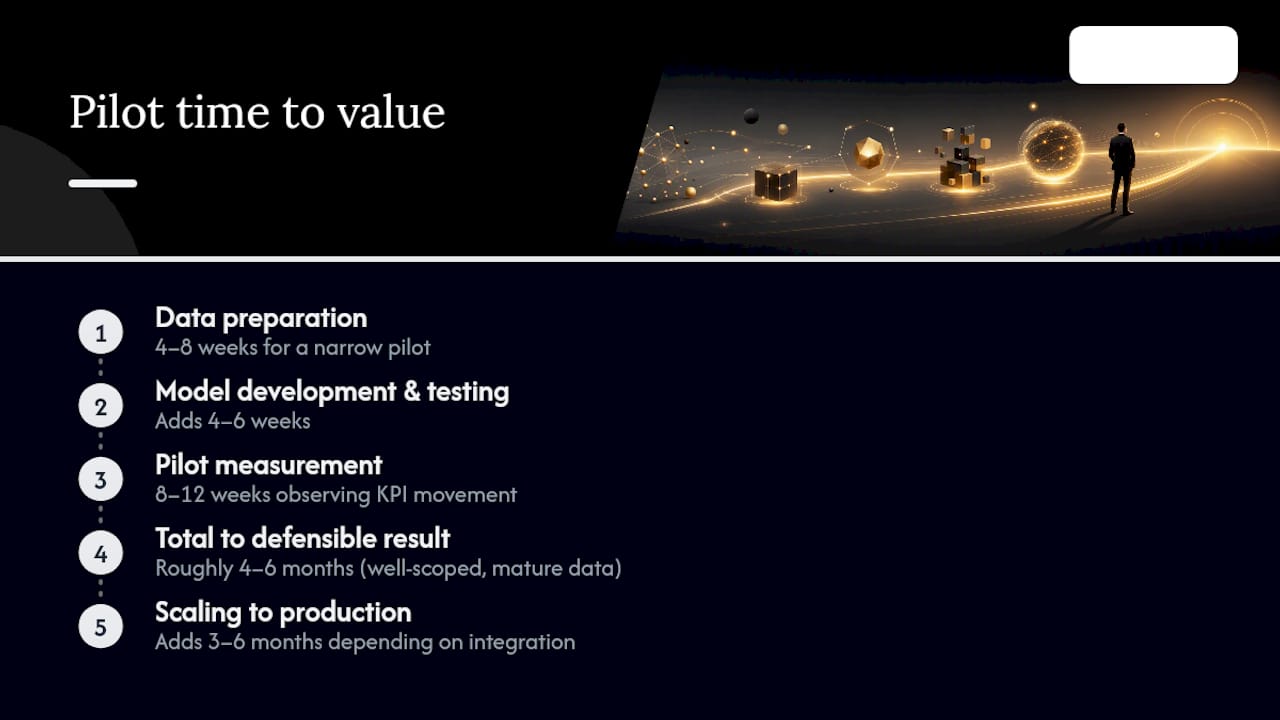
Realistic timeline: Data preparation typically takes 4–8 weeks for a narrow pilot. Model development and testing adds another 4–6 weeks. The pilot measurement period — where you actually observe KPI movement — runs 8–12 weeks. Total time from kickoff to a defensible KPI result: roughly 4–6 months for a well-scoped pilot with mature data. Scaling to production adds another 3–6 months depending on integration complexity.
Stat callout: Deloitte's enterprise AI research shows that pilots with operational integration in place tend to deliver measurable value within a months-long window, reinforcing that data and integration readiness, not model sophistication, are the primary drivers of time-to-value.
What does your organization need in place to capture AI benefits?
The gap between a promising pilot and enterprise-scale value is almost always an organizational readiness gap, not a technology gap. Here is what needs to be in place before you commit significant budget:
Data quality and access
- Identify the specific datasets the pilot requires and audit them for completeness, accuracy, and freshness.
- Establish data pipelines that can deliver clean, labeled data to the model on the cadence the use case requires.
Cloud and compute infrastructure
- Most enterprise AI workloads require scalable compute. Assess whether your current cloud environment can support training and inference at the volume the pilot demands.
Integration and APIs
- A model that cannot write its output back into the systems where decisions are made delivers no business value. Map the integration points before development starts.
MLOps and deployment pipeline
- Plan for model monitoring, retraining, and versioning from day one. Models degrade as data distributions shift; without a deployment pipeline, a working pilot becomes a liability in production.
Governance and compliance
- Assign a model owner, define an impact assessment process, and document the monitoring plan. For regulated industries, confirm regulatory posture before deployment.
Change management and reskilling
- The people who use AI outputs need to trust them and know how to act on them. Budget for training, communication, and a feedback loop that lets frontline users flag model errors.
Pro Tip: Start with the highest-value dataset you already have in good shape, not the most ambitious use case. A narrow pilot on clean data delivers a credible KPI result faster than a broad pilot on messy data — and it builds the organizational confidence to scale.
On staffing, a minimum viable pilot team typically includes a data engineer, an ML engineer, a product manager who owns the business KPI, and a business-side owner who can drive adoption. For organizations without that capability in-house, a structured engagement with an external partner covers the gap without the overhead of permanent hires. The AI integration guide for business leaders from Yslootahtech walks through the pilot-to-production scaling steps in detail.
What risks should executives anticipate, and how do you mitigate them?
Model bias and fairness
AI models trained on historical data can encode and amplify existing biases. In hiring, lending, or customer segmentation, this creates legal exposure and reputational risk. Mitigation: run bias audits before deployment, define fairness metrics alongside accuracy metrics, and test model outputs across demographic subgroups.
Data privacy and regulatory compliance
Enterprise AI often requires large volumes of personal data. GDPR, CCPA, and sector-specific regulations (HIPAA, GLBA) impose strict requirements on data collection, processing, and retention. Mitigation: apply privacy-by-design principles — minimize data collection, anonymize where possible, and document data lineage for every model in production.
Model drift and operational fragility
A model trained on pre-2024 data may perform poorly on 2026 inputs if the underlying patterns have shifted. Without monitoring, you will not know until the KPI degrades. Mitigation: set automated drift alerts, define retraining triggers, and include model performance in operational dashboards.
Security and adversarial risk
AI systems can be targeted through data poisoning, model inversion, or prompt injection. Mitigation: treat AI systems as critical infrastructure, apply the same access controls and penetration testing you apply to production applications, and monitor for anomalous query patterns.

Vendor lock-in
Dependence on a single AI platform or cloud provider creates switching costs and negotiating leverage risk. Mitigation: prefer open standards and modular architectures; document model artifacts and training pipelines in portable formats.
Change fatigue
Rapid AI deployment without adequate change management leads to low adoption, workarounds, and eventually abandoned tools. Mitigation: involve end users in pilot design, communicate the "why" behind each deployment, and measure adoption alongside model performance.
Governance checklist: Every production AI deployment should have a named model owner, a completed impact assessment, a monitoring plan with defined alert thresholds, and an incident response protocol. In regulated industries, add a regulatory review sign-off before go-live. The iSchool Syracuse overview of AI transformation notes that implementation challenges are a consistent theme alongside the benefits — governance is not optional overhead, it is what keeps the benefits from reversing.
How do you pick the right AI pilot for your enterprise?
A 30-minute prioritization session using a simple impact-versus-ease matrix will surface better pilot candidates than a six-month strategy process. Score each candidate use case on four axes:
- Expected ROI: How large is the addressable value if the model performs? (Score 1–5)
- Data readiness: Do you have the data, in the right quality and volume, today? (Score 1–5)
- Integration complexity: How many systems does the output need to connect to? (Score 1–5, where 5 = low complexity)
- Regulatory friction: Does the use case touch regulated data or decisions? (Score 1–5, where 5 = low friction)
Sum the scores. Pilots scoring 16–20 are high-priority candidates. Pilots scoring below 10 need a readiness investment before they belong on the roadmap.
Example scoring for three common pilot types
Predictive maintenance scores highest here because the data (sensor logs) is typically structured and available, the integration point (maintenance scheduling system) is narrow, and regulatory friction is low. Fraud detection scores lower on regulatory friction because of AML and data privacy requirements — not a reason to avoid it, but a reason to budget more time for compliance review.
Pilot checklist before you commit
- Success criteria defined and agreed by the business owner before development starts
- Baseline KPI measured and documented
- Named model owner and business sponsor
- Data pipeline confirmed as production-ready
- Monitoring plan and retraining schedule drafted
- Scaling triggers defined (what KPI result justifies moving to production?)
For a broader strategic view of where AI is heading in 2026, the enterprise AI trends guide from Yslootahtech covers adoption patterns and emerging use cases worth tracking.
Where enterprises actually gain the most value, from our perspective
The organizations that extract the most value from AI are not the ones with the most sophisticated models. They are the ones that pick a narrow problem with a clear KPI, get the data right, and integrate the model output into the actual workflow where decisions happen. Every engagement we work through at Yslootahtech follows that pattern: start with the business question, trace it back to the data, and build the integration before the model. The pilot-to-scale path works when the pilot is honest about what it is testing and when scaling triggers are defined in advance, not retroactively.
The pitfall we see most often is the reverse: an organization deploys a technically impressive model into a workflow that was not redesigned to use it, and adoption stalls. The model sits in a dashboard no one checks, the KPI does not move, and leadership concludes that "AI did not work here." It worked. The integration did not.
Yslootahtech's AI and machine learning services for enterprise leaders
Executives who have read this far know what they need: a partner who can scope a defensible pilot, build the data and integration layer that makes the model useful, and scale what works without rebuilding from scratch.
Yslootahtech's AI and machine learning services cover the full engagement from data engineering and model development through MLOps, monitoring, and enterprise integration. The engagement model is structured: pilot first, with defined success criteria and a fixed scope, then production deployment once the KPI result is confirmed, then scaling across functions or geographies. No open-ended retainers, no scope creep disguised as agile.
- Data engineering: Clean, pipeline-ready data for your highest-value use case, built to production standards from day one.
- Model development and MLOps: Models that are monitored, retrained, and version-controlled — not abandoned after launch.
- Enterprise integration: AI outputs connected to the systems where your teams actually make decisions, via application development and API integration.
- Governance and compliance support: Impact assessments, monitoring plans, and regulatory documentation built into every engagement.
To scope a pilot or discuss where AI fits your current priorities, contact Yslootahtech directly through the AI and machine learning services page.
Sources
The sources below anchor the claims in this article and offer deeper coverage for executives who want to go further.
- Gartner
- 5 Key Benefits of Integrating AI into Your Business - HBS Online
- Key Benefits of AI in 2025: How AI Transforms Industries - iSchool
- Advantages and challenges of AI in companies - Esade