Advantages of Robotics in Business: An ROI-First Guide

Robotics delivers measurable operational gains across speed, quality, cost, safety, and data intelligence, making it one of the highest-leverage investments a U.S. business can make right now. The International Federation of Robotics frames robot adoption as a direct competitiveness tool, particularly for SMEs looking to reshore production and offset labor-cost differentials through precision and reduced waste. Here is what that translates to in practice:
- Speed and throughput: Robots run continuous shifts without fatigue, compressing cycle times and lifting output volume.
- Precision and quality: Fixed-cycle robotic arms eliminate variance, cutting scrap rates and defect-related rework.
- Cost reduction: Lower direct labor, reduced waste, and non-obvious savings like facility energy costs all shrink total cost of ownership.
- Safety: Removing workers from hazardous tasks cuts injury rates and the liability costs that follow.
- Data and analytics: Onboard sensors feed real-time process data into analytics pipelines, enabling predictive maintenance and continuous improvement.
Industry analysis reports that robotics can reduce maintenance costs by 10–40%, increase productivity 3–5%, and cut time-to-market 20–50% in certain manufacturing contexts.
Table of Contents
- What are the core advantages of robotics in business?
- How do you calculate ROI from a robotics deployment?
- What barriers should you expect, and how do you clear them?
- Which industries see the strongest results from robotics?
- How do you launch a robotics project step by step?
- What does a digital-transformation partner bring to a robotics program?
- Key Takeaways
- Why robotics adoption matters right now for U.S. businesses
- Yslootahtech's robotics and automation services
- Useful sources
What are the core advantages of robotics in business?
Speed is the most visible gain. A robot arm running a fixed cycle does not slow down at hour six of a shift, does not call in sick, and does not need a break. That consistency compounds: a line that runs 20 hours instead of 16 produces 25% more volume with the same floor space.
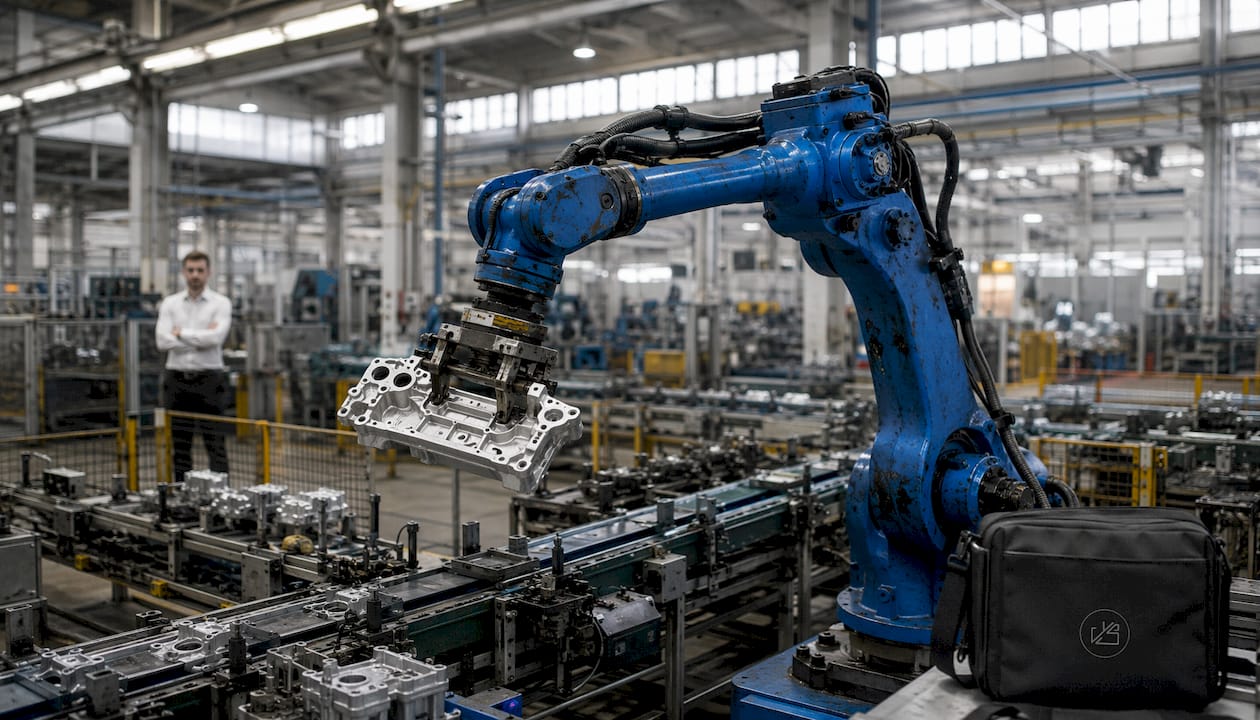
Quality follows directly from consistency. Human fatigue and distraction cause variation; robots eliminate both. Robot adopters consistently report lower scrap rates and higher export competitiveness, because every unit meets spec the first time. In a mid-size U.S. auto-parts plant, for example, switching a welding station to a robotic arm typically drops weld-defect rates from several percent to well below one percent.
Cost impact runs deeper than labor substitution. Automated environments need less lighting and less HVAC because fewer humans are present, producing sustained utility savings that most ROI models miss entirely. Faster throughput also reduces work-in-progress inventory, freeing working capital.
Safety is where robotics often delivers its fastest payback. Forklift-related accidents alone account for nearly 100,000 incidents per year in U.S. warehouses. Autonomous mobile robots (AMRs) handling transport routes remove workers from that risk entirely. Cobots take over repetitive motions that cause repetitive strain injuries and vibration white finger, conditions that generate both workers' compensation claims and long-term productivity drag.
The data integration angle is where robotics connects to the broader Industry 4.0 opportunity. Sensors on robotic systems generate continuous process data: cycle time, torque, temperature, error codes. Routed to an edge processor and then to a cloud analytics stack, that data powers predictive maintenance models that catch equipment failures before they cause downtime, and process-optimization algorithms that tighten yield over time.
Pro Tip: Map every robotic improvement to a tracked KPI from day one. A 12% cycle-time reduction means nothing to a CFO until you express it as an OEE gain and attach a dollar value to the incremental throughput.
How do you calculate ROI from a robotics deployment?
The core KPIs to track are throughput rate, cycle time, Overall Equipment Effectiveness (OEE), defect and scrap rate, mean time to repair (MTTR), and total cost of ownership (TCO) over the full asset lifecycle.
| Impact Area | Reported Range | Source Basis |
|---|---|---|
| Maintenance cost reduction | 10–40% | Industry analysis |
| Productivity uplift | 3–5% | Manufacturing sector data |
| Time-to-market reduction | 20–50% | Manufacturing contexts |
| Operator time freed for higher-value work | 30–50% | Industry automation analysis |
A simple ROI example: assume a U.S. manufacturer pays $28/hour fully loaded for a manual assembly operator running two shifts. A collaborative robot handling the same task costs roughly $8–12/hour on a Robotics as a Service (RaaS) subscription, runs three shifts, and reduces defect-related rework by 40%, as consistently reported in industry studies. The incremental throughput from the third shift alone often covers the subscription cost within the first year, with quality savings accelerating payback further.
Measurement practices that actually work:
- Establish a 60–90 day baseline before deployment so you have clean pre-robot data to compare against.
- Pull data from the robot's own controller logs, not just the ERP, to capture cycle-level granularity.
- Normalize throughput figures for demand seasonality before claiming productivity gains.
- Track TCO quarterly: include software updates, integration maintenance, spare parts, and retraining alongside hardware depreciation.
The largest long-term cost in most automation programs is not the hardware. It is lifecycle support: software updates, integration upkeep, spare parts, and retraining. Build that into your TCO model from the start, not as an afterthought at year three.
What barriers should you expect, and how do you clear them?
Skills gap. Most U.S. manufacturers do not have robotics engineers on staff. Mitigation: structure vendor contracts to include managed maintenance in the first two years, and run parallel reskilling tracks for existing operators. Economists' analysis confirms that automation reshapes jobs rather than eliminating them when retraining is part of the program.
Integration complexity. Connecting robot controllers to legacy MES, ERP, and SCADA systems is where projects stall. Mitigation: choose pilots on isolated production cells with clean data interfaces before tackling plant-wide integration.
Upfront capital. A full robotic cell can require significant capital expenditure with a multi-year payback. RaaS models convert that into a predictable monthly operating expense, enabling pilots without large capital approvals and aligning vendor incentives to uptime outcomes.
Standardization gaps. Proprietary protocols between robot OEMs and plant systems create integration debt. Mitigation: require OPC-UA or MTConnect compatibility in vendor contracts, and insist on open APIs for data export.
Pro Tip: Pick your first pilot on a task that is repetitive, high-volume, and physically isolated. Avoid anything that requires complex vision systems or multi-robot coordination on the first pass. A clean win builds internal confidence and gives you real data for the business case.
Vendor and integration readiness checklist:
- IT/OT network segmentation and cybersecurity zoning confirmed
- Robot controller APIs documented and tested against your MES
- Safety zoning designed to OSHA and ANSI/RIA R15.06 standards
- SLA for uptime and mean time to repair defined in the contract
- Training scope and handover plan agreed before go-live
Which industries see the strongest results from robotics?
Manufacturing. Articulated robot arms dominate welding, painting, and precision assembly. The productivity and quality gains are well-documented: lower scrap, higher exports, and 24/7 uptime. U.S. reshoring initiatives in electronics and automotive have made robotics a core enabler, not a nice-to-have. Regulatory note: OSHA 29 CFR 1910.217 and ANSI/RIA R15.06 govern industrial robot safety in U.S. facilities.
Warehousing and logistics. AMRs and AGVs handle goods-to-person picking, reducing travel time per pick by 50–70% in high-SKU environments. This directly addresses the chronic labor shortage in U.S. distribution centers. Regulatory note: OSHA 1910.178 covers powered industrial truck safety, which applies to AGV deployments.
Healthcare. Surgical assist robots let surgeons perform with greater precision on standard tasks without replacing clinical judgment. Pharmacy dispensing robots cut medication errors. FDA 510(k) clearance is required for most surgical robotic systems used in U.S. clinical settings.
Retail and e-commerce. Robotic sortation and automated storage and retrieval systems (ASRS) compress order fulfillment windows. Energy consumption in some automated fulfillment processes has shown reductions of around 22% in simulation studies, a meaningful sustainability metric for large-footprint operations.
| Industry | Robot Type | Primary Outcome |
|---|---|---|
| Manufacturing | Articulated arm, cobot | Lower defect rate, 24/7 uptime |
| Warehousing | AMR, AGV | Faster pick rates, labor reallocation |
| Healthcare | Surgical assist, dispensing | Precision improvement, error reduction |
| Retail/e-commerce | ASRS, sortation | Faster fulfillment, energy savings |
How do you launch a robotics project step by step?
- Discover (weeks 1–4). Audit your processes for automation fit: high volume, low variability, physical isolation. Define the business problem in KPI terms before touching hardware.
- Pilot (weeks 5–16). Deploy on one cell or one workflow. Instrument everything. Capture baseline vs. post-deployment data on throughput, defect rate, and OEE.
- Evaluate (weeks 17–20). Compare actuals to the ROI model. Ask: did the pilot hit its KPI targets? Are integration points stable? Is the team trained and confident?
- Scale (month 6 onward). Replicate the pilot configuration to adjacent cells or sites. Introduce more complex automation (vision, multi-robot coordination) only after the baseline is proven.
Questions to ask every vendor and integrator:
- What integration APIs do you expose, and which industrial protocols do you support natively?
- Who owns the process data generated by the robot, and how is it exported?
- What is your contractual SLA for uptime and MTTR?
- What does the training and support scope cover, and for how long?
Scale decision checklist: pilot hit throughput KPI targets, defect rate improved measurably, integration with MES/ERP is stable, team can operate and troubleshoot independently, and TCO is tracking within 15% of the model. If all five are true, scale. If not, identify which variable is off and fix it before committing capital.
For a broader view of how automation strategy connects to pilot selection, the decision framework there maps directly to this roadmap.
What does a digital-transformation partner bring to a robotics program?
A robot OEM sells hardware and basic programming. A systems integrator connects that hardware to your plant floor. A software and digital-transformation partner like Yslootahtech handles the layer that determines whether the investment actually pays off: the data architecture, custom application logic, analytics, and lifecycle support that turn a robot into a business asset.
Services that matter most in a robotics program:
- Custom robotics software: Application logic, HMI interfaces, and workflow automation tailored to your process, not a generic template.
- System integration: Connecting robot controllers to MES, ERP, SCADA, and cloud platforms via documented APIs and industrial protocols.
- AI/ML analytics: Predictive maintenance models, yield optimization, and anomaly detection built on the sensor data your robots generate. See how AI-driven optimization connects to robotics data streams.
- Cloud and edge architecture: Data pipelines from robot controller to edge processor to cloud analytics, designed for latency, security, and scalability.
- Lifecycle support: Managed software updates, integration maintenance, and retraining programs that keep the system performing as your processes evolve.
The distinction between robot OEM, integrator, and software partner matters for contract structure. Expect an initial engagement structured around fixed milestones (requirements, integration design, pilot deployment, acceptance testing) followed by a managed services agreement covering ongoing support. That structure protects both parties and keeps vendor incentives aligned to outcomes, not hours billed.
Pro Tip: In your first partner engagement, require a written integration design document before any hardware is ordered. The document forces alignment on data ownership, API contracts, and security zoning early, when changes are cheap.
For Yslootahtech's robotics capabilities and how they map to each phase of a deployment, the services page outlines the full scope.
Key Takeaways
Robotics delivers measurable gains in throughput, quality, safety, and cost when deployed with clear KPIs, a structured pilot, and lifecycle support built into the TCO model from day one.
| Point | Details |
|---|---|
| Start with measurable KPIs | Define throughput, OEE, defect rate, and TCO targets before selecting hardware. |
| Use RaaS to reduce entry barriers | Subscription models convert multi-year CAPEX into a predictable operating expense, enabling pilots without large capital approvals. |
| Lifecycle support dominates long-term cost | Software updates, integration maintenance, and retraining often exceed hardware costs over a five-year horizon. |
| Pilot on isolated, high-volume tasks | Clean wins on simple cells build the business case and internal confidence needed to scale. |
| Yslootahtech covers the software and integration layer | Custom robotics software, AI/ML analytics, and lifecycle support are where ROI is won or lost after hardware is installed. |
Why robotics adoption matters right now for U.S. businesses
The IFR's position is clear: robot-driven productivity contributes to national competitiveness, and SMEs that adopt robotics are better positioned to reshore production and compete on quality rather than wage arbitrage. For U.S. manufacturers watching supply chain fragility play out since 2020, that argument has only gotten stronger.
What most articles understate is the workforce dimension. Automation does not eliminate jobs at the aggregate level when retraining is part of the program. Well-designed pilots free 30–50% of an operator's time from repetitive tasks, creating space for higher-value work and improving retention. The companies that struggle are the ones that deploy hardware without a parallel change-management and reskilling plan.
The other underrated point: robotics is a system integration challenge as much as a hardware purchase. The Industry 4.0 literature is consistent on this. Sensors, data pipelines, workforce training, and standardization are what separate a robot that pays back in 18 months from one that sits underutilized at year three. The hardware is the easy part. The software, integration, and organizational change are where the work actually is.
For U.S. business leaders, the practical implication is straightforward: treat your first robotics project as a digital transformation project that happens to involve a robot, not the other way around. You can explore automation use cases and strategy to see how other businesses have structured that framing.
Yslootahtech's robotics and automation services
Robotics projects succeed or fail at the software and integration layer, and that is exactly where Yslootahtech focuses. For U.S. businesses ready to move from pilot to production, Yslootahtech delivers custom robotics software, system integration connecting robot controllers to your existing MES and ERP, AI/ML analytics built on your robot-generated data, and cloud and edge architecture that keeps everything running securely at scale.
The engagement model is designed for operational leaders who need results, not open-ended consulting: fixed milestones for design and deployment, followed by a managed support agreement that covers software updates, integration maintenance, and retraining as your processes evolve. OPEX-friendly options, including RaaS-aligned contract structures, are available for teams where capital approval is a barrier to getting started.
Ready to define your pilot and build the business case? Visit Yslootahtech's AI and machine learning services page or contact the team directly to scope your first engagement.
Useful sources
- The Impact of Robots on Productivity, Employment and Jobs — IFR position paper on how robots affect SME competitiveness, reshoring, and national productivity; primary source for the competitiveness and workforce claims throughout this article.
- Robots at Work (LSE Research) — Empirical economic analysis of robot adoption outcomes including scrap rates, exports, and productivity; supports the quality and ROI sections.
- Making the Case for Robotics for SMEs (Dassault Systèmes) — Industry analysis summarizing maintenance cost reduction, productivity uplift, and time-to-market ranges; source for the ROI data table and RaaS discussion.
- Effect of Industrial Robots on Quality, Labor Productivity, Exports and Environment (MDPI) — Peer-reviewed study covering global robot installation trends, energy reduction findings, and productivity data; supports the use-cases and body sections.
- Industry 4.0 Robotics Integration Analysis (MDPI Machines) — Expert analysis on integration barriers, standardization requirements, and the system-level conditions for robotics success; supports implementation considerations and the perspective section.
- 7 Ways Businesses Benefit from Robotics and Automation (HowToRobot) — Practitioner-focused analysis of project objectives, labor reallocation, and non-obvious cost savings including facility overhead; supports the body and TCO sections.
- Advantages and Disadvantages of Automation (Britannica) — Balanced overview of workforce transformation economics; supports the implementation barriers and perspective sections on retraining and job reshaping.
- Breaking Down the Impact of Automation in Manufacturing (MIT Science Policy Review) — Peer-reviewed policy analysis covering productivity, quality, consumer pricing, safety tradeoffs, and workforce policy implications; broad supporting reference for the body and perspective sections.