IT Infrastructure Modernization: A Practical Guide for Leaders

TL;DR:
- Modernization of IT infrastructure involves upgrading compute, storage, networking, security, and applications to reduce risk and increase agility. It requires careful planning, including asset inventory and risk assessment, to achieve benefits like faster deployment, lower costs, and stronger security. Effective governance and clear KPIs are essential for success and preventing program stalls.
IT infrastructure modernization is the deliberate replacement or upgrade of an organization's compute, storage, networking, security, and application layers to reduce operating risk and improve business agility. Done right, it cuts the cost of keeping legacy systems alive, shrinks the attack surface, and gives development teams the speed they need to ship faster. The immediate next step for any leader reading this: run a full asset and capability inventory before committing a dollar to any vendor.
Expected outcomes IT and business leaders should plan for:
- Improved agility: Shorter release cycles and faster response to market changes
- Lower operating costs: Reduced maintenance burden and energy spend, especially as energy costs for IT operations have jumped more than 20% in the last two years
- Stronger security posture: Zero-trust architecture and SASE frameworks replace perimeter-only defenses
- Regulatory compliance: Modern platforms make audit trails, data residency controls, and policy enforcement far easier to manage
- Faster time-to-market: CI/CD pipelines and containerized workloads cut deployment lead times from weeks to hours
The shift from ETL to ELT data pipelines, the adoption of infrastructure-as-code, and the move toward zero-trust security are not optional upgrades; they are the baseline for any organization that wants to compete in the next five years.
Table of Contents
- What IT infrastructure modernization actually covers
- Which modernization initiatives should you actually run?
- Benefits of IT infrastructure modernization for business and IT leaders
- Modernization approaches: how to choose the right path
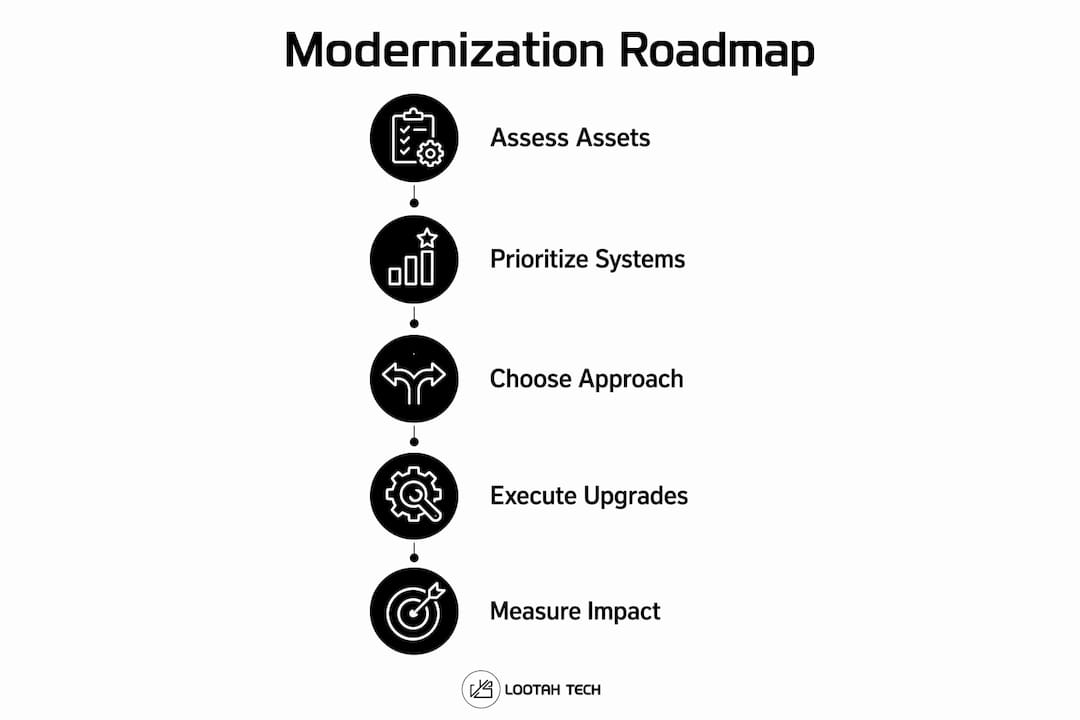
- Roadmap: a step-by-step checklist for your modernization program
- What the research says about timelines, costs, and failure causes
- Risks, trade-offs, and how to mitigate them
- How to measure whether your modernization program is working
- Key Takeaways
- The governance gap nobody talks about enough
- What Yslootahtech's modernization services deliver
- Authoritative sources and further reading
What IT infrastructure modernization actually covers
Most leaders hear "modernization" and picture a cloud migration. The reality is broader. IT infrastructure modernization spans eight distinct domains, and gaps in any one of them create bottlenecks that undercut gains in the others.

| Component | Modernization move | Key trade-off |
|---|---|---|
| Compute | On-prem VMs → containers or serverless | Speed and density vs. operational complexity |
| Storage/Backup | Tape/SAN → object storage + immutable snapshots | Cost reduction vs. egress fees |
| Networking | Flat LAN → software-defined networking (SDN) | Flexibility vs. upfront reconfiguration effort |
| Security architecture | Perimeter firewall → zero-trust / SASE | Stronger posture vs. identity management overhead |
| Applications/Platforms | Monoliths → microservices or managed PaaS | Agility vs. refactoring cost and skill requirements |
| Data pipelines | ETL → ELT with cloud-native transformation | Decoupled ingestion vs. governance complexity |
| DevOps/Automation | Manual deployments → CI/CD and IaC | Faster delivery vs. toolchain standardization effort |
| Observability | Siloed logs → unified APM and distributed tracing | Full visibility vs. data volume and licensing cost |

Replacement cycles matter for budget planning. Workstations typically need replacement every few years; servers generally require replacement after a longer cycle when maintenance costs become excessive. Network equipment follows a similar 5–7 year curve, though software-defined options can extend useful life by abstracting hardware dependencies.
The data pipeline row deserves special attention. Moving from ETL (extract, transform, load) to ELT (extract, load, transform) decouples ingestion from transformation. That separation reduces pipeline failures because raw data lands in the target store first, and transformations run on demand. Cloud-native warehouses like Snowflake, BigQuery, and Databricks are built around this pattern. Organizations still running on-prem ETL jobs with rigid schemas will hit a wall when they try to feed modern analytics or AI workloads.
For automation and DevOps practices, the shift from manual runbooks to infrastructure-as-code tools like Terraform or Pulumi is where most teams see the fastest compounding returns. Provisioning that once took days drops to minutes, and environments become reproducible by definition.
Which modernization initiatives should you actually run?
Common modernization programs include cloud migration, application modernization, network upgrades, automation, and observability improvements. The challenge is knowing which initiative fits your situation. Here is a plain-language breakdown:
-
Lift-and-shift (rehost): Move workloads to cloud infrastructure with no code changes. Right for organizations that need to exit a data center quickly or reduce hardware costs fast. Caveat: you carry technical debt into the cloud, so operating costs often disappoint without a follow-on optimization pass.
-
Replatform: Move to a managed cloud service (e.g., swap a self-managed MySQL instance for Amazon RDS) with minimal code changes. Good when you want managed patching and scaling without a full refactor. Watch for configuration drift between environments.
-
Refactor/re-architect: Decompose monolithic applications into microservices. The right call when a system is a competitive differentiator and its current architecture limits release velocity. Expensive and time-consuming; reserve it for systems where speed-to-market directly drives revenue.
-
Containerization: Package applications in Docker containers and orchestrate with Kubernetes. Fits teams that need environment consistency across dev, staging, and production. The operational overhead of Kubernetes is real; smaller teams often do better with managed container services like AWS ECS or Azure Container Apps.
-
Data-pipeline ELT migration: Replace batch ETL jobs with streaming or ELT patterns on cloud-native platforms. The right move when analytics teams are waiting hours for data that should be available in minutes. Governance and data-quality controls need to move with the pipeline, not after it.
-
Hybrid/hyperconverged infrastructure (HCI): Consolidate compute, storage, and networking into software-defined nodes on-prem or at the edge. Best for high-compliance workloads (healthcare, defense, financial services) that cannot move to public cloud. HCI vendors like Nutanix and VMware vSAN reduce hardware sprawl but still require on-prem operational expertise.
-
SASE and zero-trust: Replace VPN-centric access with identity-aware, policy-driven access controls delivered from the cloud edge. The right choice when remote and hybrid workforces have outgrown traditional perimeter security. Requires a mature identity provider (Okta, Azure AD, Ping) as a prerequisite.
-
Infrastructure-as-code (IaC): Define infrastructure in version-controlled code using Terraform, Pulumi, or AWS CloudFormation. Appropriate for any team running more than a handful of cloud resources. The main caveat: IaC requires discipline around state management and drift detection from day one.
-
CI/CD pipeline modernization: Automate build, test, and deployment pipelines using tools like GitHub Actions, GitLab CI, or Jenkins. The entry point for most DevOps transformations. Teams that skip this step find that every other modernization initiative slows down at the deployment gate.
Benefits of IT infrastructure modernization for business and IT leaders
The business case for infrastructure upgrades is not just about technology. Each benefit maps to a specific stakeholder concern, and framing it that way is what gets budgets approved.
For the CFO: Legacy infrastructure carries a hidden tax. Maintenance contracts, emergency hardware replacements, and energy costs compound year over year. Consolidating workloads onto cloud or HCI platforms reduces the per-workload operating cost, and cloud optimization disciplines like FinOps give finance teams real-time visibility into spend that on-prem environments simply cannot provide.
For the CTO: Agility is the headline benefit. When infrastructure is defined as code and deployments are automated, engineering teams stop waiting on tickets and start shipping. Resilience improves too: modern platforms support active-active architectures and automated failover that cut recovery time objectives (RTOs) from hours to minutes.
For the CISO: The security argument is the most urgent. The 2021 Colonial Pipeline breach and the JBS ransomware attack, which cost JBS $11 million in ransom, both exploited weaknesses in legacy infrastructure and access controls. Zero-trust and SASE architectures reduce the blast radius of any single compromised credential or endpoint.
Statistic to anchor your business case: Energy costs for IT operations have climbed more than 20% in the last two years. For a mid-size data center running aging hardware, that trajectory alone justifies a modernization investment on operating-cost grounds before you factor in security or agility.
Additional benefits worth quantifying in your business case:
- Improved disaster recovery: Modern backup platforms with immutable snapshots and geo-redundant replication cut recovery point objectives (RPOs) to near-zero for critical workloads.
- Better observability: Unified monitoring across cloud and on-prem gives operations teams the signal-to-noise ratio they need to catch problems before users do.
- Developer productivity: Automated pipelines and self-service infrastructure reduce the time developers spend waiting on environment provisioning, which compounds into faster feature delivery over a quarter.
Modernization approaches: how to choose the right path
No single migration pattern fits every organization. The right approach depends on your risk tolerance, budget, timeline, and how much technical debt you are willing to carry forward.
| Approach | Risk level | Cost profile | Speed to value | Best when |
|---|---|---|---|---|
| Lift-and-shift | Low | Low upfront, higher ongoing | Fast (weeks) | Urgent data-center exit, hardware EOL |
| Replatform | Low–Medium | Moderate | Moderate (1–3 months) | Reducing ops burden without full refactor |
| Refactor/re-architect | High | High | Slow (6–18 months) | Competitive differentiator systems |
| Strangler/incremental | Medium | Moderate, spread over time | Moderate, with early wins | Large legacy estates, risk-averse orgs |
| Continuous modernization | Low–Medium | Ongoing OpEx | Continuous | Mature DevOps teams, cloud-native orgs |
The strangler pattern deserves more attention than it usually gets. Rather than replacing a legacy system all at once, you build new capabilities alongside it and route traffic incrementally to the modern version. Running modernized slices in production alongside legacy systems verifies behavior in real conditions and reduces the business risk of a hard cutover. It is slower than a big-bang replacement, but the failure rate is dramatically lower.
Decision guidance: Start with a business capability map. Separate your systems into three buckets: competitive differentiators (refactor or rebuild), commodity functions (replatform or SaaS-replace), and legacy debt (retire or lift-and-shift as a bridge). A cloud migration process built around this distinction avoids the common trap of over-engineering commodity systems and under-investing in the ones that actually drive revenue.
Risk tolerance drives the rest. Organizations with low tolerance for business disruption should default to incremental/strangler approaches with staged cutovers. Teams with strong DevOps maturity and automated rollback can move faster through refactor cycles.
Roadmap: a step-by-step checklist for your modernization program
A modernization program without a governance structure is just a series of expensive experiments. Here is a practical, ordered sequence:
-
Asset and capability inventory: Catalog every server, application, network device, and data store. Document age, support status, licensing cost, and business owner. Flag anything running on unsupported software or past its replacement cycle.
-
Business capability mapping: Map each system to the business capability it supports. Classify as differentiator, commodity, or legacy debt. This step prevents modernizing around platforms instead of business outcomes, a pitfall that creates unnecessary complexity and duplicated solutions.
-
Prioritization matrix: Score each candidate by business value, current operating cost, security/compliance risk, and technical debt. High-risk, high-cost systems with low business value go first. Competitive differentiators with high complexity go into a separate, longer-horizon workstream.
-
Pilot project selection: Pick one bounded, high-value workload for the first wave. A pilot proves the approach, surfaces integration surprises, and gives leadership an early win to show stakeholders. Keep it small enough to complete in 60–90 days.
-
Incremental rollout (wave planning): Group remaining workloads into waves of manageable scope. Each wave should deliver measurable value before the next begins. Avoid the temptation to batch everything into a single large wave to "save time."
-
Operations integration: Involve operations and security teams from wave one, not after go-live. Define runbooks, alerting thresholds, and on-call responsibilities before each workload goes live. Ongoing IT support structures need to be in place before the handoff, not built reactively.
-
Hardware retirement and disposition: For retired hardware, follow a documented process: data sanitization, environmental disposal, and asset value recovery where applicable. Proper disposition includes documentation for compliance audits.
-
Governance cadence: Run weekly delivery team standups, monthly sponsor reviews, and quarterly steering committee sessions. Funding decisions and scope changes belong at the steering level, not the delivery team level.
Prioritization criteria to apply at step 3:
- Business value delivered by the system
- Current operating cost (maintenance, licensing, energy)
- Security and compliance exposure
- Regulatory requirements and audit risk
- Volume of technical debt and integration complexity
Metrics to track during rollout:
- Deployment frequency (how often you ship to production)
- Mean time to recovery (MTTR) after incidents
- Cost per workload (cloud spend per application)
- Change failure rate (percentage of deployments causing incidents)
What the research says about timelines, costs, and failure causes
Set realistic expectations before you brief your board. Here is what the evidence shows.
Typical modernization timelines
| Scope | Typical duration | Key variables |
|---|---|---|
| Scoped upgrade (single system or network segment) | A few days to a couple of weeks | Vendor readiness, data volume, testing requirements |
| Small rollout (5–20 workloads) | 1–3 months | Integration complexity, team capacity |
| Mid-size migration | 6–12 months | Dependency mapping, compliance reviews |
| Enterprise-scale program | 18–36 months | Wave planning, organizational change management |
Managed-service providers complete scoped infrastructure upgrades in as little as a few days to a couple of weeks for well-defined projects. Enterprise programs with hundreds of interdependent workloads routinely run 18–36 months. The gap between those two numbers is almost always explained by dependency complexity, compliance requirements, and organizational readiness, not technical difficulty.
The ELT transition
Modern cloud-native data platforms are built around ELT, not ETL. In an ELT pattern, raw data loads into the target store first, and transformations happen on demand using the compute power of the warehouse itself. This decouples ingestion from transformation, which means a failed transformation does not block data availability. Organizations running on-prem ETL jobs with rigid schemas will find that their data pipelines become the bottleneck for every AI and analytics initiative they try to run.
Why programs stall
"Technology modernization often stalls because decision rights, funding models, and accountability structures do not keep pace with change; leaders mistake activity for progress without clear business value and cost discipline." — Protiviti
The most common failure causes, drawn from research:
- Unclear decision rights: No one knows who can approve scope changes, vendor selections, or budget reallocations. Programs stall at every decision point.
- Funding model mismatch: Modernization funded as a capital project with a fixed end date cannot sustain the incremental, wave-based delivery that actually works.
- Big-bang thinking: Large-scale projects that try to replace legacy systems in a single phase frequently fail. The fix is delivering small, working increments in production alongside legacy systems.
- Cultural resistance: Involving staff early, mapping retraining pathways, and identifying internal champions increases adoption and prevents the loss of institutional knowledge that derails many programs.
Risks, trade-offs, and how to mitigate them
Every modernization program carries risk. The ones that succeed are not the ones that avoid risk; they are the ones that manage it deliberately.
-
Vendor lock-in: Committing deeply to a single cloud provider's proprietary services (managed databases, serverless runtimes, AI APIs) creates exit costs that compound over time. Mitigation: use open standards and containerized workloads where possible; negotiate portability terms in contracts before signing.
-
Business disruption during cutover: Hard cutovers that go wrong take systems offline during business hours. Mitigation: use blue-green deployments or canary releases; schedule cutovers during low-traffic windows; define rollback procedures before go-live, not after.
-
Skill gaps: Teams that built and operated legacy systems often lack cloud-native, DevOps, or security skills. Mitigation: build retraining pathways alongside the technical program. Losing institutional knowledge from long-tenured operators is a real program risk, not a soft concern.
-
Cost overruns: Cloud costs are easy to underestimate, especially egress fees, data transfer charges, and idle resource costs. Mitigation: implement FinOps controls from wave one. Tag every resource by workload and owner, set budget alerts, and review cloud spend monthly.
-
Shadow IT and compliance gaps: Modernization programs sometimes accelerate shadow IT as business units spin up their own cloud accounts to move faster. Mitigation: establish a cloud landing zone with guardrails (AWS Control Tower, Azure Landing Zones) before teams start self-provisioning.
-
Compatibility and integration failures: Legacy systems often have undocumented integrations that only surface during migration. Mitigation: run a dependency-mapping exercise as part of the asset inventory, and test integration points in a staging environment before each wave.
Pro Tip: Set up a FinOps dashboard in the first 30 days of any cloud migration wave. Tagging every resource by workload, team, and environment from the start costs almost nothing and prevents the "where did the budget go?" conversation that kills program momentum six months in.
How to measure whether your modernization program is working
Measurement is what keeps a modernization program funded past the first wave. Without clear KPIs, sponsors lose confidence and budgets get reallocated.
Core KPIs to track:
- Availability: Target uptime per workload (e.g., 99.9% for tier-1 systems); track against baseline before modernization
- MTTR (mean time to recovery): How long it takes to restore service after an incident; modern platforms should cut this significantly versus legacy baselines
- Deployment frequency: How often teams ship to production; a direct proxy for agility
- Change failure rate: Percentage of deployments that cause a production incident; should decrease as automation matures
- Cost per workload: Cloud spend per application per month; compare to pre-migration on-prem cost including maintenance and energy
- Cloud spend efficiency: Ratio of productive compute to total cloud spend; tracked via FinOps tooling (AWS Cost Explorer, Azure Cost Management, Apptio Cloudability)
- Security incident frequency: Number of incidents per quarter; should trend down as zero-trust controls mature
- Time-to-market for features: Lead time from code commit to production; the metric development teams care most about
ROI signals to report to sponsors:
Reduced OPEX shows up in the first 6–12 months as maintenance contracts expire and hardware refresh cycles lengthen. Lower downtime cost is calculable: multiply your hourly revenue impact by the reduction in annual downtime hours. Developer productivity gains are harder to quantify but show up in deployment frequency and lead time metrics within two to three quarters of a successful CI/CD rollout.
Reporting cadence: Weekly metrics for delivery teams (deployment frequency, MTTR, open incidents). Monthly dashboards for program sponsors (cost per workload, wave completion status, risk register). Quarterly steering reviews for funding decisions and scope adjustments.
A modernization program that cannot show measurable improvement in at least two of these KPIs within the first 90 days of a wave going live is a signal to revisit the approach, not to accelerate spending.
Key Takeaways
IT infrastructure modernization succeeds when governance, funding models, and incremental delivery are treated as seriously as the technical work itself.
| Point | Details |
|---|---|
| Assess before you spend | Run a full asset and capability inventory before committing to any vendor or migration pattern. |
| Match approach to risk tolerance | Strangler and incremental patterns reduce failure risk; reserve full refactors for competitive differentiator systems only. |
| Governance drives outcomes | Decision rights and funding models that do not keep pace with change are the leading cause of stalled programs. |
| Measure from day one | Track deployment frequency, MTTR, and cost per workload from the first wave to keep sponsors aligned and budgets intact. |
| Yslootahtech as your next step | Yslootahtech offers assessment, cloud migration, application modernization, and managed support to move programs from inventory to production. |
The governance gap nobody talks about enough
The technical side of modernization is genuinely hard. But in most programs that stall or fail, the technical team is not the problem. The problem is that the organization's decision-making structure was designed for a world where IT changes happened slowly, in big batches, with long lead times. Modernization programs that try to run fast, incremental delivery inside that old structure hit a wall almost immediately.
What actually works is treating governance as a first-class deliverable. That means defining who can approve a vendor change before the first wave starts, not when a conflict arises six months in. It means funding the program in waves tied to demonstrated value, not as a fixed-scope capital project with a single go-live date. And it means involving operations and security from the first pilot, because the teams who will run the modernized environment need to build confidence in it incrementally, not inherit it on a handoff date.
The cultural dimension is equally real. Long-tenured operators carry institutional knowledge that is not in any runbook. Losing that knowledge because a retraining pathway was never built is a program risk that shows up as production incidents, not as a line item in a risk register. The organizations that get this right treat retraining as a parallel workstream, not an afterthought.
One more thing: stop measuring modernization programs by activity. Tickets closed, servers migrated, and sprints completed are not value. The signal is whether deployment frequency is up, MTTR is down, and the cost per workload is moving in the right direction. If those numbers are not improving, the program is generating motion, not outcomes.
What Yslootahtech's modernization services deliver
Yslootahtech gives IT leaders a structured path from inventory to production, without the sprawl of managing a dozen point vendors. The engagement starts with a discovery and assessment phase: mapping your current estate, identifying the highest-cost and highest-risk systems, and building a prioritized wave plan tied to your business capabilities. From there, the team runs a bounded pilot, proves the approach in production, and scales across waves with governance checkpoints built in.
Core services relevant to a modernization program include cloud migration, application modernization, data engineering and ELT pipeline work, FinOps controls, and ongoing managed support through the operations handoff. For organizations building out AI and analytics capabilities on modernized infrastructure, Yslootahtech's AI and machine learning services connect directly to the data pipeline and cloud foundation work. The engagement model is outcome-focused: each wave has defined success metrics before it starts, and funding decisions happen at steering reviews, not in open-ended retainers. To start with a discovery conversation, visit yslootahtech.com.
Authoritative sources and further reading
These sources were used to ground the timeline, governance, and technical pattern guidance in this article. They are worth bookmarking when you are building a business case or preparing a board deck.
-
Protiviti: Technology modernization stalling in the age of AI — The clearest analysis available of why governance and funding model failures, not technical failures, kill modernization programs. Use this when briefing executives on program structure.
-
InformationWeek: The leadership disconnect paralyzing enterprise modernization — Covers the case against big-bang replacement and the evidence for incremental delivery. Useful for risk and approach sections of a business case.
-
Migravion: Legacy system modernization and data integration — Practical guidance on change management, retraining, and integration patterns. Reference this when addressing cultural and organizational risks.
-
GlobalQuest: When to upgrade your IT infrastructure — Covers the operational signals (downtime, energy costs, compatibility failures) that indicate a system is past its useful life. Good supporting material for the asset inventory phase.
-
Omnistech: High-priority IT infrastructure upgrades — Replacement cycle data for workstations (3–5 years) and servers (5–7 years), with ROI framing. Use this to justify hardware refresh timelines in a budget request.
-
TierPoint: IT infrastructure modernization — A solid overview of common modernization initiatives including cloud migration, application modernization, and observability. Useful as a reference list when scoping program workstreams.
-
exIT Technologies: What is IT infrastructure modernization and how to manage it — Covers hardware disposition, data sanitization, and asset recovery. Reference this when planning the retirement phase of any wave.
-
Enstep: Infrastructure upgrade services — Provides realistic timeline benchmarks for scoped upgrade projects. Use this to set expectations with stakeholders before a program kicks off.